Showing posts with label Georgia. Show all posts

Saturday, October 04, 2008

Russia and Georgia: International Law and Norm Considerations

Many insightful analyses have been written on the recent Russia-Georgia war. Some writers looked at what the war means in the context of the "great game." Others examined what might have motivated Georgia to instigate such a seemingly impossible fight with Russia. Another approach was to analyze the United States' influence on the conflict. This particular composition will utilize a few basic applications of international law to briefly analyze the war.

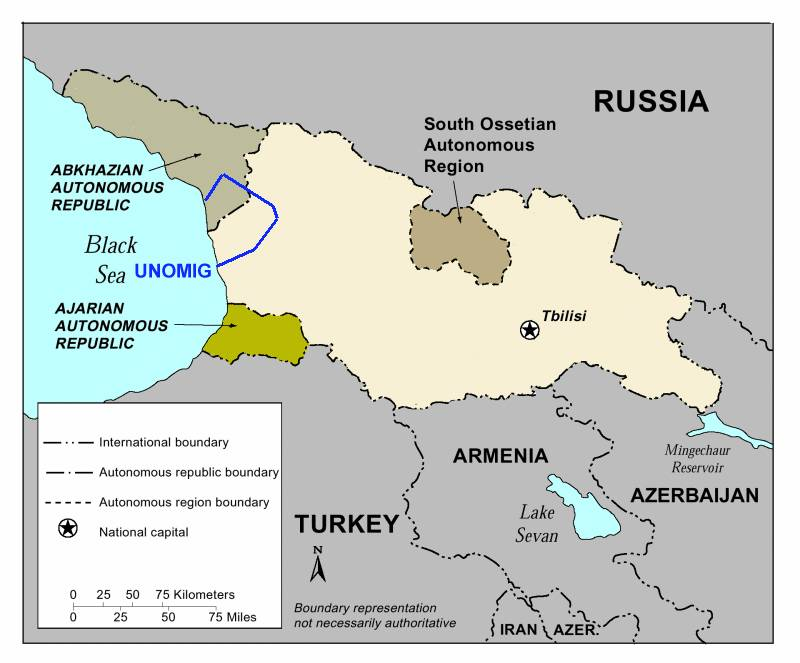
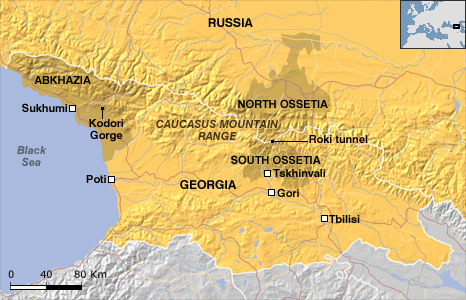
On July 31st, Russian railroad troops finished work repairing a strategic railroad in Georgia's semi-autonomous region of Abkhazia. Its completion would allow Russia to deploy military equipment and reinforcements directly in the region to a position located just outside Georgian artillery's reach. Georgian President Mikheil Saakashvili and his advisors knew that if he was going to ratchet up the pressure on the country's separatist regions to bring them more under Georgian control, he would have to do so soon before Russian reinforcements and equipment had the opportunity to arrive. On the night of August 1st, Georgian soldiers attacked the north end of Tskhinvali, the capital of another semi-autonomous region of Georgia called South Ossetia.1 They exchanged gunfire with Ossetian militia forces and following a two hour firefight, the Georgian Army shelled the area and withdrew. Over the next few days, Georgian forces deployed to the South Ossetian border for a more definitive strike. Georgian and North Atlantic Treaty Organization (NATO) officials both denied any military buildup was occurring.2 On August 6th, another battle occurred in South Ossetia and the Russian barracks were targeted. After a night of gunfire that claimed several lives, the Georgian Army resumed artillery fire at daybreak on August 7th. On the evening of August 7th, after an all-day battle between the Georgian Army and Ossetian fighters, President Saakashvili declared a unilateral ceasefire.3 He publicly announced on television that the Georgian Army had been ordered to cease all hostilities. In addition, President Saakashvili offered South Ossetia unlimited autonomy within Georgia and stated that Russia would be allowed to enforce the agreement.4

However, while talking peace, President Saakashvili prepared for war. Tanks and heavy weapons were moved to the South Ossetia border.5 On the night of August 8th, President Saakashvili violated his own ceasefire as the Georgian Army unilaterally attacked fellow Georgian citizens in Tskhinvali. The attack was coordinated to coincide with the opening ceremony of the 2008 Summer Olympics in Beijing because the eyes of the international press would be focused there, and by the time they were completely aware of the full-scale war in Georgia, Russian tanks were already rolling in and their air strikes were underway. President Saakashvili reinforced this myopic version of events to the public by focusing on the Russian forces that crossed into Georgia during his press conferences and interviews. In addition, China's preoccupation with the Olympic Games prevented them from responding to the crisis by backing Russia either politically and/or militarily. Russia's Prime Minister, Vladimir Putin, and several other high-ranking Russian statesmen were also in Beijing for the opening festivities to meet with other world leaders, including United States President George W. Bush. Their preoccupation allowed Georgia to publicly respond to the crisis first and disseminate their version of events.

Also apparently lost on the western press was the fact that the Georgian Army committed war crimes and crimes against humanity by targeting civilian structures in Tskhinvali. Initially, they targeted schools, hospitals, housing complexes, and the city's university with BM-21, 122mm, and 152mm mortar shells. When the attack was initiated, artillery shells began raining down while the town's residents were sleeping in their homes. Rockets were launched on the town shortly after. Then, Georgian tanks rolled in along with ground forces and encircled the town while the Georgian Air Force took flight. The area quickly fell under siege. Ossetian militias and Russian peacekeepers engaged the Georgians. The Georgian Army also advanced on Abkhazia, which has a mutual defense pact with South Ossetia. Abkhazian militias pushed Georgia out of the Kodori Gorge. By the end of August 8th, Russia responded by commencing airstrikes on Gori and other military targets while sending in thousands of soldiers along with tanks, transport vehicles, and heavy weaponry. Based on the speed and size of the response, it is clear that Russia had pre-planned for this scenario and was militarily ready and able to deploy before August 8th. Georgian officials admitted to dropping Israeli-made M-85 cluster bombs at the Roki Tunnel, where the Russian infantry, tanks, and vehicles crossed into Georgia.6 Russian warships were sent to the Black Sea, where at least one Georgian ship was sunk. The Georgian armed forces, though trained by the United States and Israel, did not really stand a chance against the large-scale Russian deployment and their air superiority. After the Russian Army pushed the Georgian Army out of South Ossetia and moved into Georgia Proper, Ossetian militias looted and burned Georgian homes in Tamarasheni, Kekhvi, Kvemo Achabeti (Nizhnie Achaveti), Zemo Achabeti (Verkhnie Achaveti), and Kurta.7

Georgia defended its attack on South Ossetia by invoking the sacrosanct principle of sovereignty. Indeed, South Ossetia is still a legal part of the sovereign state of Georgia because it has not received diplomatic recognition from other sovereign states or international organizations like the United Nations (UN). Georgian officials stated that it is their right to use force against separatist militias that threaten the sovereignty of the Georgian state, which is defined here as a monopoly of force and legal authority over an internationally-recognized geographic territory.8 Initial armed intervention to legitimately protect the peace of a sovereign nation is an internationally accepted legal norm articulated in Article 51 of the UN Charter. Their other argument is essentially that the Russian Army, by crossing into Georgian territory and attacking Georgian state forces, committed an Act of Aggression as defined by United Nations (UN) General Assembly Resolution 3314 (1974) and also violated Article 2.4 in Chapter 1 of the UN Charter.9 President Saakashvili tried to reinforce these arguments to the international community by repeatedly claiming that Russia's ultimate goal was to overthrow his government, not protect the Ossetians.10 Russia's advance into Georgia Proper, as opposed to simply securing South Ossetia, was used as evidence for his claim. President Saakashvili also accused Russia (without providing evidence) of committing acts of ethnic cleansing, a war crime and crime against humanity.11 Finally, one can argue that Russia's political influence within South Ossetia undermines Georgia's legal authority (a part of sovereignty) over the region.12

Russia had its own justifications and precedent to attempt to explain their intervention. One argument is that they were coming to the aid of Russian citizens who were being unilaterally attacked by the Georgians.13 Most South Ossetians have Russian passports and are afforded all the benefits of a native-born Russian passport holder. As such, South Ossetians are considered de facto Russian citizens by Moscow. In addition, Georgia attacked the Russian soldiers that were legally deployed in South Ossetia as a part of the peacekeeping force set up in the 1992 ceasefire agreement between South Ossetia and Georgia. These soldiers are native Russian citizens and by August 8th, several Russian peacekeepers were killed in the attacks by Georgian forces.14 Russia invoked the inherent right of self-defense to defend these Russian citizens, and Article 51 of the UN Charter allows the use of force for self-defense from an armed attack until the Security Council undertakes measures against the aggression. However, Matthew Bryza, the United States Assistant Secretary of State for European and Eurasian Affairs and a National Security Council (NSC) member, attempted to counter this argument by stating that although Georgia attacked on August 7th, in his view the conflict began much earlier and was originally provoked by South Ossetian militias.15

Russia also infers reference to the "Just War" principle, which sets out ethical guidelines for using force other than for self-defense purposes. This concept, the cornerstone of the "Responsibility to Protect" doctrine, is defined by: Right intention, last resort, proportional means, reasonable prospects for success, right authority, just cause, reasonable withdrawal of forces. As their argument goes, just cause was provided when the Georgian offensive targeted Ossetian civilians, causing large-scale loss of life. Russian officials sought to reinforce this justification by accusing Georgian forces of committing genocide; however no evidence for this accusation has yet to be presented. Their authority (or perception thereof) would be derived from Russia's role as a state authority protecting their citizens from harm. The right intention was the Russians' stated intention of protecting their citizens who were under siege. Russia's superior air power allowed for an almost certain chance of "success" (i.e. defeating the Georgian forces). Russian officials likely believed they had fulfilled the "last resort" measure because several diplomatic initiatives went unheeded. NATO Secretary General Jaap de Hoop Scheffer called for a ceasefire on August 8th that was ignored by both sides.16 An emergency UN Security Council meeting on the night of August 7-8th to create a Russian-sponsored ceasefire resolution ended in failure when the Security Council members could not come to an agreement.17 Additionally, preplanned talks between South Ossetian and Georgian ceasefire negotiators were scheduled to be held on August 8th.18 The Georgian attack on that day ended this initiative. The United States seeks to nullify the "just war" argument by stating that Russia used "disproportionate force."19 China, Kazakhstan, Kyrgyzstan, Tajikistan, and Uzbekistan, all members of the Shanghai Cooperation Organization (SCO), voiced their consent for Russia's "active role" in Georgia as an attempt to counter the United States' statement.20

Perhaps Russia's strongest defense for their actions is the precedent set by NATO in Kosovo. In 1999, NATO violated Serbia's sovereignty in an aerial bombing campaign. Prior to the bombing campaign, the UN Security Council did not pass a resolution mandating a collective intervention under Chapter 7. NATO itself could not attack under Article 5 of the North Atlantic Treaty because Serbia had not attacked a member of NATO, which would have allowed them to invoke the collective security agreement. As a result, in order to justify their actions, NATO claimed the bombing campaign was to prevent Serbians from committing ethnic cleansing against Albanians living in Kosovo, then a province of Serbia. Thus, officials claimed that the bombing campaign was really a "humanitarian intervention" conducted in order to save the Albanians. In the end, NATO officials and pilots were never sanctioned for their actions. This precedent is important because the same basic reasoning was used by Russia to justify its intervention and violation of Georgia's sovereignty. Sir Michael Jackson, Deputy Commander to General Wesley Clark in NATO's Kosovo Force (KFOR) from June to October 1999, admitted that Russia had a valid point by stating they were intervening to protect their de facto and de jure citizens.21

I suspect the debate on who was "right" or "wrong" in this war will go on for quite some time. I also doubt that international law will hold anyone accountable for what happened. Regardless of what subjective or collective conclusions are drawn from further studies of the war, I only hope that it does not start up again and/or lead to a new "Cold War" with an accompanying arms race.

1 On 9 April, 1991, shortly before the official collapse of the Soviet Union (USSR), Georgia opted to withdraw and declare its independence as a republic. Abkhazia declared de facto independence as a nation-state from Georgia in 1992, but failed to receive any international recognition. The Abkhazians defeated Georgia in a civil war that lasted from 1992-1993 and led to the ethnic cleansing of Georgians from the territory and the installation of a UN-monitored mission (UNOMIG).

South Ossetia became an autonomous oblast (equivalent to a province) in the Georgia Soviet Republic beginning in 1922. The Soviet Constitution of 1936 confirmed South Ossetia's autonomy within the newly formed Soviet Socialist Republic. In November 1989, the South Ossetian regional council asked the Georgia Supreme Soviet for independence. Their request was denied and Georgia banned all regional parties. South Ossetia turned to Moscow for help but they were turned away because Moscow was mired in its own serious problems. The Ossetians responded by declaring themselves a Soviet Democratic Republic within the Soviet Union and even held elections. In December of 1990, the Georgian Government revoked South Ossetia's autonomous status. War broke out with Georgia Proper in 1991. When Georgia became independent, South Ossetia failed to receive any diplomatic or international recognition. As a result, South Ossetia retained its de facto independent status. A European-monitored referendum in 2006 resoundingly reaffirmed the Ossetians' desire for full independence, but the international community, including Russia, again refused to recognize the referendum. They stated the reason was because the collective population of Georgia did not participate in the voting and the central Georgian Government of President Saakashvili did not recognize the results.

2 "NATO 'Not Aware' of Any Georgia Buildup, Urges Calm," Reuters. 5 August 2008.

3 "Saakashvili Appeals for Peace in Televised Address," Civil Georgia. 7 August 2008. http://www.civil.ge/eng/article.php?id=18931. Accessed 28 August 2008.

4 "South Ossetia: An Avoidable Catastrophe," Thomas De Waal. Institute for War and Peace Reporting. 11 August 2008.

5 "Georgian Tanks Head for South Ossetia," Russia Today. 7 August 2008. http://www.russiatoday.com/news/news/28601. Accessed 3 September 2008.

6 "Group: Georgia Admits to Dropping Cluster Bombs," Associated Press. 1 September 2008.

Note: M-85s, manufactured by Israeli Military Industries, were also found in Shindisi, a town located north of Gori. Russia is not known to possess M-85s. ("MoD Says it Used Cluster Bombs, But Not in Populated Areas," Civil Georgia. 1 September 2008.)

7 "South Ossetia: Tskhinvali's Apocalypse," Tanya Lokshina. Opendemocracy.net. 1 September 2008. http://www.opendemocracy.net/Russia/article/South-Ossetia-Tskhinvali-Apocalypse. Accessed 4 September 2008.

8 Note: Another definition often used is the traditional "Westphalian Sovereignty," which includes nation-state sovereignty through self-determination, legal equality between states, and the principle of non-intervention in other states' affairs, which is also a foundational tenet of the UN Charter. This original definition's modern relevance is under continuing debate in wake of post-Cold War issues arising from supranational institutions/bodies, international terrorism, the proliferation of non-state actors, unilateral military interventions, assertive multilateralism, and globalization to name but a few. All of these encroach, and/or have the potential to encroach on one or more aspects of sovereignty. They are also part of, or directly influence, the modern international system.

9 Note: There is debate in regards to the interpretation of Article 2.4. In this example, a very literal and strict interpretation is used. However, the UN Charter itself does not define or distinguish the terms "aggression" or "war," though it makes use of the terms. For this reason, some argue Article 2.4 is not precise enough to constitute a legal norm. Both Russia and Georgia formally declared war after their initial respective attacks began.

10 "Saakashvili Offers 'Patriot Act'," Civil Georgia. 29 August 2008.

11 "Saakashvili Calls on World not to Accept Ethnic Cleansing," Civil Georgia. 4 September 2008.

12 Note: A former part of Russia, South Ossetia still retains close ties to Moscow. Not only do South Ossetians carry Russian passports, they also use the Russian Ruble as currency.

13 "Medvedev: Russia Will Protect its Citizens in S. Ossetia," Civil Georgia. 8 August 2008.

14 "Russian Peacekeepers Confirmed Killed in Georgia," Russia Today. 8 August 2008.

15 "U.S. Official: Tbilisi Attacked Tskhinvali on August 7, But War Started Earlier," Civil Georgia. 4 September 2008.

Note: It is noteworthy that Undersecretary Bryza is an energy policy coordinator for Eurasia and was a special advisor to the President and Secretary of State on Caspian Basin energy diplomacy from July 1998 to March 2001. Pipeline transportation corridors that circumvent Russia are the West's primary strategic interest in Georgia. These corridors currently include the Baku-Tbilisi-Ceyhan (BTC) pipeline and the Baku-Supsa pipeline. However, a complete analysis of this topic is far beyond the scope of this composition.

16 "NATO Calls for Ceasefire, Direct Talks," Civil Georgia. 8 August 2008.

17 "UN Council Split on South Ossetia, Russia Angry," Civil Georgia. 8 August 2008.

18 "Talks Planned for August 8 - Russian Negotiator," Civil Georgia. 7 August 2008.

19 "U.S. Says Russia Used 'Disproportionate' Force," Sue Plemming. Reuters. 14 August 2008.

20 "Russia Wins Backing from China, Central Asia Over Georgia," Agence France Presse. 28 August 2008.

21 "Georgia: Let's Not Start World War III," Mike Jackson. The Independent. 17 August 2008.

From: Z Space - The Spirit Of Resistance Lives
URL: http://www.zcommunications.org/zspace/commentaries/3636

Thursday, September 25, 2008

While you were away...

Here it comes campers. In case you were too baffled by the complexities of the coming merger between the state and the financial sector, we have some more old-fashioned, Bush administration saber-rattling for those of you so inclined. Please pay no attention to the woman behind the curtain.

While I have been referring to the nationalization of the lending industry as socialism for the wealthy, which to some extent it is, the strict definition of a state-corporate nexus is fascism. Many have a hard time with the word because of its association with The National Socialist Party of Germany - The Nazis. It has more connotations than the references to the Third Reich or Mussolini's National Fascist Party, since Il Duce initially coined the word to describe the cooperation of industry and state codified into law.

What we are witnessing now in the meeting rooms of DC and Wall Street is, in fact, the final stage of incorporating a fascist state, a project that has been ongoing for decades. Those for whom this is the fruition of their wettest dreams dance in their closets for the total elimination of any regulation whatsoever. Government oversight will be touted in the corporate media as quaint and unnecessary, when those of us paying attention have seen that the exact opposite is true time after time after time. It will be interesting to watch the weak and futile protests of the Democratic Party before they allow and even expedite this plan into law. Just try to find any mention of the many thousands of homeowners and other debtors who are literally dying on the vine. Their concerns are less than secondary to those of the suddenly endangered wealthy. Who cares about those irresponsible defaulters, anyway?

In the midst of all this, however, we have the Secretary of State, Condoleeza Rice, giving it her all to distract us from the historic devastation of the US - and by extension - global economies. In a speech touted by the State Department as an important statement on relations with Russia, she rattles BushCo's saber toward Moscow, saying that its objectives have put it on a path to "self-imposed isolation and international irrelevance" - a daring move that must have taken quite a bit of practice to pull off convincingly, since it is in fact the US that totters down this very path.

For those who've been watching, this is in reference to what the entire corporate media calls "Russia's bloody invasion of Georgia". While Moscow did indeed invade Georgia and continues its occupation of it, the initial "attack" was a response to Georgia's feeble but equally bloody attacks on South Ossetia and Abkhazia, Russian protectorates now recognized as independent nations. Georgia's plan to re-annex the territories, once integral parts of Georgia before the dissolution of the USSR, originated within the CIA and Israel in cooperation with the US-puppet government of Georgia. The plan to provoke Moscow to protect its sovereign states seems to have worked perfectly and now the illegitimate Bush administration, along with its corporate media mouthpieces, get to scold Russia for its murderous "aggression", while never once mentioning the acts of aggression that originally provoked the response. The more things change...

It now seems that BushCo wants to ramp up old enmities between our respective nations. Ms. Rice actually had the audacity to say that the emerging picture "is that of a Russia increasingly authoritarian and aggressive abroad". Damn, that took cojones, huh? Didn't even look at the floor or flinch once! Quite impressive.

No telling where all this casting of aspersions will lead just yet, since the Russian media simply laughs at the utter hypocrisy of Washington's positions. Doubt they're going to find it funny for long, though. Can't say that I blame them.

Tuesday, August 12, 2008

War in the Caucasus: Towards a Broader Russia-US Military Confrontation?

Please forgive the long piece on Georgia's assault on the capital of South Ossetia and the expected response from Russia. I thought it important to bring to light some information that makes it clearer that the U.S. and NATO have been involved since jump street, since Georgia is a U.S. protectorate. The operation was planned and coordinated with the Georgian president and military. The question is, "how does this tie in to the corporate globalists' agenda in the region"? Read on...--Pete


Global Research, August 10, 2008

During the night of August 7, coinciding with the opening ceremony of the Beijing Olympics, Georgia's president Saakashvili ordered an all-out military attack on Tskhinvali, the capital of South Ossetia.

The aerial bombardments and ground attacks were largely directed against civilian targets including residential areas, hospitals and the university. The provincial capital Tskhinvali was destroyed. The attacks resulted in some 1500 civilian deaths, according to both Russian and Western sources. "The air and artillery bombardment left the provincial capital without water, food, electricity and gas. Horrified civilians crawled out of the basements into the streets as fighting eased, looking for supplies." (AP, August 9, 2008). According to reports, some 34,000 people from South Ossetia have fled to Russia. (Deseret Morning News, Salt Lake City, August 10, 2008)

The importance and timing of this military operation must be carefully analyzed. It has far-reaching implications.

Georgia is an outpost of US and NATO forces, on the immediate border of the Russian Federation and within proximity of the Middle East Central Asian war theater. South Ossetia is also at the crossroads of strategic oil and gas pipeline routes.


Georgia does not act militarily without the assent of Washington. The Georgian head of State is a US proxy and Georgia is a de facto US protectorate.

Who is behind this military agenda? What interests are being served? What is the purpose of the military operation.

There is evidence that the attacks were carefully coordinated by the US military and NATO.

Moscow has accused NATO of "encouraging Georgia". Russia’s Foreign Minister Sergey Lavrov underscored the destabilizing impacts of "foreign" military aid to Georgia: .

“It all confirms our numerous warnings addressed to the international community that it is necessary to pay attention to massive arms purchasing by Georgia during several years. Now we see how these arms and Georgian special troops who had been trained by foreign specialists are used,” he said.(Moscow accuses NATO of having "encouraged Georgia" to attack South Ossetia, Russia Today, August 9, 2008)

Moscow's envoy to NATO, Dmitry Rogozin, sent an official note to the representatives of all NATO member countries:

“Russia has already begun consultations with the ambassadors of the NATO countries and consultations with NATO military representatives will be held tomorrow," Rogozin said. "We will caution them against continuing to further support of Saakashvili."

“It is an undisguised aggression accompanied by a mass propaganda war,” he said.

(See Moscow accuses NATO of having "encouraged Georgia" to attack South Ossetia, Russia Today, August 9, 2008)

According to Rogozin, Georgia had initially planned to:

"start military action against Abkhazia, however, 'the Abkhaz fortified region turned out to be unassailable for Georgian armed formations, therefore a different tactic was chosen aimed against South Ossetia', which is more accessible territorially. The envoy has no doubts that Mikheil Saakashvili had agreed his actions with "sponsors", "those with whom he is negotiating Georgia's accession to NATO ". (RIA Novosti, August 8, 2008)

Contrary to what was conveyed by Western media reports, the attacks were anticipated by Moscow. The attacks were timed to coincide with the opening of the Olympics, largely with a view to avoiding frontpage media coverage of the Georgian military operation.

On August 7, Russian forces were in an advanced state readiness. The counterattack was swiftly carried out.

Russian paratroopers were sent in from Russia's Ivanovo, Moscow and Pskov airborne divisions. Tanks, armored vehicles and several thousand ground troops have been deployed. Russian air strikes have largely targeted military facilities inside Georgia including the Gori military base.

The Georgian military attack was repelled with a massive show of strength on the part of the Russian military.


In this image made from television, Russian military vehicles are seen moving towards the capital of South Ossetia, Tskhinvali, on Friday, Aug. 8, 2008. (AP / APTN)

Act of Provocation?

US-NATO military and intelligence planners invariably examine various "scenarios" of a proposed military operation-- i.e. in this case, a limited Georgian attack largely directed against civilian targets, with a view to inflicting civilian casualties.

The examination of scenarios is a routine practice. With limited military capabilities, a Georgian victory and occupation of Tskhinvali, was an impossibility from the outset. And this was known and understood to US-NATO military planners.

A humanitarian disaster rather than a military victory was an integral part of the scenario. The objective was to destroy the provincial capital, while also inflicting a significant loss of human life.

If the objective were to restore Georgian political control over the provincial government, the operation would have been undertaken in a very different fashion, with Special Forces occupying key public buildings, communications networks and provincial institutions, rather than waging an all out bombing raid on residential areas, hospitals, not to mention Tskhinvali's University.


Tskhinvali's University before the bombing

The Russian response was entirely predictable.

Georgia was "encouraged" by NATO and the US. Both Washington and NATO headquarters in Brussels were acutely aware of what would happen in the case of a Russian counterattack.

The question is: was this a deliberate provocation intended to trigger a Russian military response and suck the Russians into a broader military confrontation with Georgia (and allied forces) which could potentially escalate into an all out war?

Georgia has the third largest contingent of coalition forces in Iraq after the US and the UK, with some 2000 troops. According to reports, Georgian troops in Iraq are now being repatriated in US military planes, to fight Russian forces. (See Debka.com, August 10, 2008)

This US decision to repatriate Georgian servicemen suggests that Washington is intent upon an escalation of the conflict, where Georgian troops are to be used as cannon fodder against a massive deployment of Russian forces.

US-NATO and Israel Involved in the Planning of the Attacks

In mid-July, Georgian and U.S. troops held a joint military exercise entitled "Immediate Response" involving respectively 1,200 US and 800 Georgian troops.

The announcement by the Georgian Ministry of Defense on July 12 stated that they US and Georgian troops were to "train for three weeks at the Vaziani military base" near the Georgian capital, Tbilisi. (AP, July 15, 2008). These exercises, which were completed barely a week before the August 7 attacks, were an obvious dress rehearsal of a military operation, which, in all likelihood, had been planned in close cooperation with the Pentagon.

The war on Southern Ossetia was not meant to be won, leading to the restoration of Georgian sovereignty over South Ossetia. It was intended to destabilize the region while also triggering a US-NATO confrontation with Russia.

On July 12, coinciding with the outset of the Georgia-US war games, the Russian Defense Ministry started its own military maneuvers in the North Caucasus region. The usual disclaimer by both Tblisi and Moscow: the military exercises have “nothing to do” with the situation in South Ossetia. (Ibid)

Let us be under no illusions. This is not a civil war. The attacks are an integral part of the broader Middle East Central Asian war, including US-NATO-Israeli war preparations in relation to Iran.

The Role of Israeli Military Advisers

While NATO and US military advisers did not partake in the military operation per se, they were actively involved in the planning and logistics of the attacks. According to Israeli sources (Debka.com, August 8, 2008), the ground assault on August 7-8, using tanks and artillery was "aided by Israeli military advisers". Israel also supplied Georgia with Hermes-450 and Skylark unmanned aerial vehicles, which were used in the weeks leading up to the August 7 attacks.

Georgia has also acquired, according to a report in Rezonansi (August 6, in Georgian, BBC translation) "some powerful weapons through the upgrade of Su-25 planes and artillery systems in Israel". According to Haaretz (August 10, 2008), Israelis are active in military manufacturing and security consulting in Georgia.

Russian forces are now directly fighting a NATO-US trained Georgian army integrated by US and Israeli advisers. And Russian warplanes have attacked the military jet factory on the outskirts of Tbilisi, which produces the upgraded Su-25 fighter jet, with technical support from Israel. (CTV.ca, August 10, 2008)

When viewed in the broader context of the Middle East war, the crisis in Southern Ossetia could lead to escalation, including a direct confrontation between Russian and NATO forces. If this were to occur, we would be facing the most serious crisis in US-Russian relations since the Cuban Missile crisis in October 1962.

Georgia: NATO-US Outpost

Georgia is part of a NATO military alliance (GUAM) signed in April 1999 at the very outset of the war on Yugoslavia. It also has a bilateral military cooperation agreement with the US. These underlying military agreements have served to protect Anglo-American oil interests in the Caspian sea basin as well as pipeline routes.

Both the US and NATO have a military presence in Georgia and are working closely with the Georgian Armed Forces. Since the signing of the 1999 GUAM agreement, Georgia has been the recipient of extensive US military aid.

Barely a few months ago, in early May, the Russian Ministry of Defense accused Washington, "claiming that [US as well as NATO and Israeli] military assistance to Georgia is destabilizing the region." (Russia Claims Georgia in Arms Buildup, Wired News, May 19, 2008). According to the Russian Defense Ministry

"Georgia has received 206 tanks, of which 175 units were supplied by NATO states, 186 armored vehicles (126 - from NATO) , 79 guns (67 - from NATO) , 25 helicopters (12 - from NATO) , 70 mortars, ten surface-to-air missile systems, eight Israeli-made unmanned aircraft, and other weapons. In addition, NATO countries have supplied four combat aircraft to Georgia. The Russian Defense Ministry said there were plans to deliver to Georgia 145 armored vehicles, 262 guns and mortars, 14 combat aircraft including four Mirazh-2000 destroyers, 25 combat helicopters, 15 American Black Hawk aircraft, six surface-to-air missile systems and other arms." (Interfax News Agency, Moscow, in Russian, Aug 7, 2008)

NATO-US-Israeli assistance under formal military cooperation agreements involves a steady flow of advanced military equipment as well as training and consulting services.

According to US military sources (spokesman for US European Command), the US has more than 100 "military trainers" in Georgia. A Pentagon spokesman Bryan Whitman "said there were no plans to redeploy the estimated 130 US troops and civilian contractors, who he said were stationed in the area around Tblisi" (AFP, 9 August 2008). In fact, US-NATO military presence in Georgia is on a larger scale to that acknowledged in official statements. The number of NATO personnel in Georgia acting as trainers and military advisers has not been confirmed.

Although not officially a member of NATO, Georgia's military is full integrated into NATO procedures. In 2005, Georgian president proudly announced the inauguration of the first military base, which "fully meets NATO standards". Immediately following the inauguration of the Senakskaya base in west Georgia, Tblisi announced the opening of a second military base at Gori which would also "comply with NATO regulations in terms of military requirements as well as social conditions." (Ria Novosti, 26 May 2006).

The Gori base has been used to train Georgian troops dispatched to fight under US command in the Iraq war theater.

It is worth noting that under a March 31, 2006, agreement between Tblisi and Moscow, Russia's two Soviet-era military bases in Georgia - Akhalkalaki and Batumi have been closed down. (Ibid) The pullout at Batumi commenced in May of last year, 2007. The last remaining Russian troops left the Batumi military facility in early July 2008, barely a week before the commencement of the US-Georgia war games and barely a month prior to the attacks on South Ossetia.

The Israel Connection

Israel is now part of the Anglo-American military axis, which serves the interests of the Western oil giants in the Middle East and Central Asia.

Israel is a partner in the Baku-Tblisi- Ceyhan pipeline which brings oil and gas to the Eastern Mediterranean. More than 20 percent of Israeli oil is imported from Azerbaijan, of which a large share transits through the BTC pipeline. Controlled by British Petroleum, the BTC pipeline has dramatically changed the geopolitics of the Eastern Mediterranean and the Caucusus:

"[The BTC pipeline] considerably changes the status of the region's countries and cements a new pro-West alliance. Having taken the pipeline to the Mediterranean, Washington has practically set up a new bloc with Azerbaijan, Georgia, Turkey and Israel, " (Komerzant, Moscow, 14 July 2006)


While the official reports state that the BTC pipeline will "channel oil to Western markets", what is rarely acknowledged is that part of the oil from the Caspian sea would be directly channeled towards Israel, via Georgia. In this regard, a Israeli-Turkish pipeline project has also been envisaged which would link Ceyhan to the Israeli port of Ashkelon and from there through Israel's main pipeline system, to the Red Sea.

The objective of Israel is not only to acquire Caspian sea oil for its own consumption needs but also to play a key role in re-exporting Caspian sea oil back to the Asian markets through the Red Sea port of Eilat. The strategic implications of this re-routing of Caspian sea oil are far-reaching. (For further details see Michel Chossudovsky, The War on Lebanon and the Battle for Oil, Global Research, July 2006)

What is envisaged is to link the BTC pipeline to the Trans-Israel Eilat-Ashkelon pipeline, also known as Israel's Tipline, from Ceyhan to the Israeli port of Ashkelon.

"Turkey and Israel are negotiating the construction of a multi-million-dollar energy and water project that will transport water, electricity, natural gas and oil by pipelines to Israel, with the oil to be sent onward from Israel to the Far East,

The new Turkish-Israeli proposal under discussion would see the transfer of water, electricity, natural gas and oil to Israel via four underwater pipelines.

http://www.jpost.com/servlet/Satellite?cid=1145961328841&pagename=JPost%2FJPArticle%2FShowFull

“Baku oil can be transported to Ashkelon via this new pipeline and to India and the Far East.[via the Red sea]"

"Ceyhan and the Mediterranean port of Ashkelon are situated only 400 km apart. Oil can be transported to the city in tankers or via specially constructed under-water pipeline. From Ashkelon the oil can be pumped through already existing pipeline to the port of Eilat at the Red Sea; and from there it can be transported to India and other Asian countries in tankers. (REGNUM)

In this regard, Israel is slated to play a major strategic role in "protecting" the Eastern Mediterranean transport and pipeline corridors out of Ceyhan. Concurrently, it also involved in channeling military aid and training to both Georgia and Azerbaijan.

A far-reaching 1999 bilateral military cooperation agreement between Tblisi and Tel Aviv was reached barely a month before the NATO sponsored GUUAM agreement. It was signed in Tbilisi by President Shevardnadze and Israel's Prime Minister Binyamin Netanyu. These various military cooperation arrangements are ultimately intended to undermine Russia's presence and influence in the Caucasus and Central Asia.

In a pro forma declaration, Tel Aviv committed itself, following bilateral discussions with Moscow, on August 5, 2008, to cut back military assistance to Georgia.

Russia's Response

In response to the attacks, Russian forces intervened with conventional ground troops. Tanks and armored vehicles were sent in. The Russian air force was also involved in aerial counter-attacks on Georgian military positions including the military base of Gori.

The Western media has portrayed the Russian as solely responsible for the deaths of civilians, yet at the same time the Western media has acknowledged (confirmed by the BBC) that most of the civilian casualties at the outset were the result of the Georgian ground and air attacks.

Based on Russian and Western sources, the initial death toll in South Ossetia was at least 1,400 (BBC) mostly civilians. "Georgian casualty figures ranged from 82 dead, including 37 civilians, to a figure of around 130 dead.... A Russian air strike on Gori, a Georgian town near South Ossetia, left 60 people dead, many of them civilians, Georgia says." (BBC, August 9, 2008). Russian sources place the number of civilian deaths on South Ossetia at 2000.

A process of escalation and confrontation between Russia and America is unfolding, reminiscent of the Cold War era.

Are we dealing with an act of provocation, with a view to triggering a broader conflict? Supported by media propaganda, the Western military alliance is intent on using this incident to confront Russia, as evidenced by recent NATO statements.