Sunday, December 07, 2008

Obama Doesn't Plan to End the Occupation in Iraq

By Jeremy Scahill, AlterNet

Alternet article

The New York Times is reporting an "apparent evolution" in president-elect Barack Obama's thinking on Iraq, citing recent statements about his plan to keep a "residual force" in the country and his pledge to "listen to the recommendations of my commanders" as Obama prepares to assume actual command of U.S. forces. "At the Pentagon and the military headquarters in Iraq, the response to the statements this week from Mr. Obama and his national security team has been akin to the senior officer corps' letting out its collective breath," the Times reported. "[T]the words sounded to them like the new president would take a measured approach on the question of troop levels."

The reality is there is no "evolution."

Anyone who took the time to cut past Barack Obama's campaign rhetoric of "change" and bringing an "end" to the Iraq war realized early on that his Iraq plan boiled down to a down-sizing and rebranding of the occupation. While he emphasized his pledge to withdraw U.S. "combat forces" from Iraq in 16 months (which may or may not happen), he has always said that he intends to keep "residual forces" in place for the foreseeable future.

It's an interesting choice of terms. "Residual" is defined as "the quantity left over at the end of a process." This means that the forces Obama plans to leave in Iraq will remain after he has completed his "withdrawal" plan. No matter how Obama chooses to label the forces he keeps in Iraq, the fact is, they will be occupation forces.

Announcing his national security team this week, Obama reasserted his position. "I said that I would remove our combat troops from Iraq in 16 months, with the understanding that it might be necessary -- likely to be necessary -- to maintain a residual force to provide potential training, logistical support, to protect our civilians in Iraq." While some have protrayed this as Obama going back on his campaign pledge, it is not. What is new is that some people seem to just now be waking up to the fact that Obama never had a comprehensive plan to fully end the occupation. Most recently, the Times:

"On the campaign trail, Senator Barack Obama offered a pledge that electrified and motivated his liberal base, vowing to 'end the war' in Iraq," wrote reporter Thom Shanker on Thursday. "But as he moves closer to the White House, President-elect Obama is making clearer than ever that tens of thousands of American troops will be left behind in Iraq, even if he can make good on his campaign promise to pull all combat forces out within 16 months."

For many months it's been abundantly clear that Obama's Iraq plan is at odds with his campaign rhetoric. Yet, Shanker writes, "to date, there has been no significant criticism from the antiwar left of the Democratic Party of the prospect that Mr. Obama will keep tens of thousands of troops in Iraq for at least several years to come." The Times is actually right about this, in a literal sense. There has seldom, if ever, been a public peep about Obama's residual force plans for Iraq from members of his own party, including from those who describe themselves as "anti-war."

But, for those who have scrutinized Obama's plans and the statements of his advisors from the beginning, this is old news. Obama never defined "ending the war" as removing all U.S. forces from Iraq. Besides the counsel of his closest advisors -- many of whom are pro-war hawks -- Obama's Iraq plan is based on two primary sources: the recommendations of the Baker-Hamilton "Iraq Study Group" and the 2007 Iraq supplemental spending bill, which, at the time was portrayed as the Democrats' withdrawal plan. Both envisioned a sustained presence of U.S. forces for an undefined period following a "withdrawal."

In supporting the 2007 supplemental, Obama said it would put the U.S. "one signature away from ending the Iraq War." The bill would have redeployed U.S. forces from Iraq within 180 days. But that legislation, vetoed by President Bush, would also have provided for 20,000 to 60,000 troops to remain in Iraq as "trainers," "counter-terrorist forces," or for "protection for embassy/diplomats," according to an analysis by the Institute for Policy Studies. The bill contained no language about how many "private contractors" could remain in Iraq. This helped shed light on what Obama actually meant by "ending the Iraq War."

Other glaring clues to the actual nature of Obama's Iraq plan to anyone paying attention could be found in the public comments of his advisors, particularly on the size of the force Obama may leave in Iraq after his withdrawal is complete. Obama has refused to talk numbers, saying in October, "I have tried not to put a number on it." That has been the position of many of his loyal aides. "We have not put a number on that. It depends on the circumstances on the ground," said Susan Rice, Obama's nominee for UN ambassador, during the campaign. "It would be worse than folly, it would be dangerous, to put a hard number on the residual forces."

But, Richard Danzig, President Clinton's former Navy Secretary who may soon follow Robert Gates as Obama's Defense Secretary, said during the campaign that the "residual force" could number as many as 55,000 troops. That doesn't include Blackwater and other mercenaries and private forces, which the Obama camp has declared the president-elect "can't rule out [and] won't rule out" using. At present there are more "contractors" in Iraq than soldiers, which is all the more ominous when considering Obama's Iraq plan.

In April, it was revealed that the coordinator of Obama's Iraq working group, Colin Kahl, had authored a paper, titled "Stay on Success: A Policy of Conditional Engagement," which recommended, "the U.S. should aim to transition to a sustainable over-watch posture (of perhaps 60,000-80,000 forces) by the end of 2010 (although the specific timelines should be the byproduct of negotiations and conditions on the ground)." Kahl tried to distance the views expressed in the paper from Obama's official campaign position, but they were and are consistent.

In March, Obama advisor Samantha Power let the cat out of the bag for some people when she described her candidate's 16-month timetable for withdrawing U.S. "combat" forces as a "best case scenario." Power said, "He will, of course, not rely on some plan that he's crafted as a presidential candidate or a U.S. Senator." (After that remark and referring to Sen. Hillary Clinton as a "monster," Power resigned from the campaign. Now that Obama is president-elect, Power's name has once again resurfaced as a member of his transitional team.)

The New York Times also raised the prospect that Obama could play semantics when defining his 16-month withdrawal plan, observing, "Pentagon planners say that it is possible that Mr. Obama's goal could be accomplished at least in part by relabeling some units, so that those currently counted as combat troops could be 're-missioned,' their efforts redefined as training and support for the Iraqis."

Compare all of the above with a statement Obama made in July: "I intend to end this war. My first day in office I will bring the Joint Chiefs of Staff in, and I will give them a new mission, and that is to end this war -- responsibly, deliberately, but decisively."

Some may now accuse Obama of flip-flopping. The reality is that we need to understand what the words "end" "war" "residual" and "decisively" mean when we hear Obama say them.

Jeremy Scahill is the author of Blackwater: The Rise of the World's Most Powerful Mercenary Army and is a frequent contributor to The Nation and Democracy Now! He is a Puffin Foundation Writing Fellow at the Nation Institute.

Obama Backs Off Promise to Pass Windfall Profits Tax on Big Oil

By David Sirota, Blog for Our Future

Good news and bad news in the last day. The good news: Barack Obama has appointed a NAFTA critic, Rep. Xavier Becerra, as the next U.S. Trade Representative (more on that here). The bad news is this just off the Reuters wire:

CHICAGO/WASHINGTON (Reuters) -- President-elect Barack Obama is not planning to implement a windfall profit tax on oil companies because prices have dropped below $80 a barrel, an aide said on Tuesday...

Obama, who signaled early in his campaign for the White House that he would take an active approach to oil markets as president, had planned to use the revenue from a windfall profits tax to fund a tax rebate for low- and middle-income families struggling with high energy prices.

Between this move and the move to wait to repeal the Bush tax cuts for the wealthy, it seems like the Obama team is buying into the right-wing frame that raising any taxes -- even those on the richest citizens and wealthiest corporations -- is bad for the economy. Of course, that frame is debunked by history. And while sure, it's OK to rack up deficits so as to spend our way out of the economic crisis, it's sorta silly to ignore the tax moves that could be implemented to limit those deficits where possible.

Oh, and one last thing -- if oil prices are down and oil industry profits are truly down, what's the harm in passing a windfall profits tax? Even if you buy the right-wing nonsense about a windfall profits tax "hurting the industry" or "hurting the economy" when it is applied, if there really are no windfall profits to tax, then it won't be applied.

That's what a windfall profits tax really is -- a safety valve regulation against profiteering, and one that can raise needed revenues when profiteering occurs. If there is supposedly no profiteering occurring, then what's the supposed harm? There is none even if you ignore history and believe taxing the wealthy/big corporations automatically hurts an economy. That is, unless you are ready to go down another right-wing rathole and argue that a windfall profits tax will somehow prevent energy companies from more energy exploration. But, then, if you are that far out on the fringe, then I guess your not interested in any facts whatsoever...

Prop 8, The Musical

From the folks at Funny or Die!

See more Jack Black videos at Funny or Die

Let's End Drug Prohibition

From Today's Wall Street Journal, of all places!--Pete

Most Americans agreed that alcohol suppression was worse than alcohol consumption.

Today is the 75th anniversary of that blessed day in 1933 when Utah became the 36th and deciding state to ratify the 21st amendment, thereby repealing the 18th amendment. This ended the nation's disastrous experiment with alcohol prohibition.

It's already shaping up as a day of celebration, with parties planned, bars prepping for recession-defying rounds of drinks, and newspapers set to publish cocktail recipes concocted especially for the day.

But let's hope it also serves as a day of reflection. We should consider why our forebears rejoiced at the relegalization of a powerful drug long associated with bountiful pleasure and pain, and consider too the lessons for our time.

The Americans who voted in 1933 to repeal prohibition differed greatly in their reasons for overturning the system. But almost all agreed that the evils of failed suppression far outweighed the evils of alcohol consumption.

The change from just 15 years earlier, when most Americans saw alcohol as the root of the problem and voted to ban it, was dramatic. Prohibition's failure to create an Alcohol Free Society sank in quickly. Booze flowed as readily as before, but now it was illicit, filling criminal coffers at taxpayer expense.

Some opponents of prohibition pointed to Al Capone and increasing crime, violence and corruption. Others were troubled by the labeling of tens of millions of Americans as criminals, overflowing prisons, and the consequent broadening of disrespect for the law. Americans were disquieted by dangerous expansions of federal police powers, encroachments on individual liberties, increasing government expenditure devoted to enforcing the prohibition laws, and the billions in forgone tax revenues. And still others were disturbed by the specter of so many citizens blinded, paralyzed and killed by poisonous moonshine and industrial alcohol.

Supporters of prohibition blamed the consumers, and some went so far as to argue that those who violated the laws deserved whatever ills befell them. But by 1933, most Americans blamed prohibition itself.

When repeal came, it was not just with the support of those with a taste for alcohol, but also those who disliked and even hated it but could no longer ignore the dreadful consequences of a failed prohibition. They saw what most Americans still fail to see today: That a failed drug prohibition can cause greater harm than the drug it was intended to banish.

Consider the consequences of drug prohibition today: 500,000 people incarcerated in U.S. prisons and jails for nonviolent drug-law violations; 1.8 million drug arrests last year; tens of billions of taxpayer dollars expended annually to fund a drug war that 76% of Americans say has failed; millions now marked for life as former drug felons; many thousands dying each year from drug overdoses that have more to do with prohibitionist policies than the drugs themselves, and tens of thousands more needlessly infected with AIDS and Hepatitis C because those same policies undermine and block responsible public-health policies.

And look abroad. At Afghanistan, where a third or more of the national economy is both beneficiary and victim of the failed global drug prohibition regime. At Mexico, which makes Chicago under Al Capone look like a day in the park. And elsewhere in Latin America, where prohibition-related crime, violence and corruption undermine civil authority and public safety, and mindless drug eradication campaigns wreak environmental havoc.

All this, and much more, are the consequences not of drugs per se but of prohibitionist policies that have failed for too long and that can never succeed in an open society, given the lessons of history. Perhaps a totalitarian American could do better, but at what cost to our most fundamental values?

Why did our forebears wise up so quickly while Americans today still struggle with sorting out the consequences of drug misuse from those of drug prohibition?

It's not because alcohol is any less dangerous than the drugs that are banned today. Marijuana, by comparison, is relatively harmless: little association with violent behavior, no chance of dying from an overdose, and not nearly as dangerous as alcohol if one misuses it or becomes addicted. Most of heroin's dangers are more a consequence of its prohibition than the drug's distinctive properties. That's why 70% of Swiss voters approved a referendum this past weekend endorsing the government's provision of pharmaceutical heroin to addicts who could not quit their addictions by other means. It is also why a growing number of other countries, including Canada, are doing likewise.

Yes, the speedy drugs -- cocaine, methamphetamine and other illicit stimulants -- present more of a problem. But not to the extent that their prohibition is justifiable while alcohol's is not. The real difference is that alcohol is the devil we know, while these others are the devils we don't. Most Americans in 1933 could recall a time before prohibition, which tempered their fears. But few Americans now can recall the decades when the illicit drugs of today were sold and consumed legally. If they could, a post-prohibition future might prove less alarming.

But there's nothing like a depression, or maybe even a full-blown recession, to make taxpayers question the price of their prejudices. That's what ultimately hastened prohibition's repeal, and it's why we're sure to see a more vigorous debate than ever before about ending marijuana prohibition, rolling back other drug war excesses, and even contemplating far-reaching alternatives to drug prohibition.

Perhaps the greatest reassurance for those who quake at the prospect of repealing contemporary drug prohibitions can be found in the era of prohibition outside of America. Other nations, including Britain, Australia and the Netherlands, were equally concerned with the problems of drink and eager for solutions. However, most opted against prohibition and for strict controls that kept alcohol legal but restricted its availability, taxed it heavily, and otherwise discouraged its use. The results included ample revenues for government coffers, criminals frustrated by the lack of easy profits, and declines in the consumption and misuse of alcohol that compared favorably with trends in the United States.

Is President-elect Barack Obama going to commemorate Repeal Day today? I'm not holding my breath. Nor do I expect him to do much to reform the nation's drug laws apart from making good on a few of the commitments he made during the campaign: repealing the harshest drug sentences, removing federal bans on funding needle-exchange programs to reduce AIDS, giving medical marijuana a fair chance to prove itself, and supporting treatment alternatives for low-level drug offenders.

But there's one more thing he can do: Promote vigorous and informed debate in this domain as in all others. The worst prohibition, after all, is a prohibition on thinking.

Mr. Nadelmann is the executive director of the Drug Policy Alliance.

Saturday, December 06, 2008

U.S. Loses 533,000 Jobs in Biggest Drop Since 1974

This article was reported by Louis Uchitelle, Edmund L. Andrews and Stephen Labaton and written by Mr. Uchitelle.

The government’s report of a giant job loss in November, the biggest monthly decline in a generation, puts more pressure on Congress and the administration to move quickly on a stimulus package, mortgage relief and perhaps financial aid for Detroit’s big automakers.

The nation’s employers cut 533,000 jobs in November, the Bureau of Labor Statistics reported Friday.

Not since December 1974, toward the end of a severe recession, have so many jobs disappeared in a single month — and the current recession, far from ending, appears to be just gathering steam.

“We are caught in a downward spiral in which employment, incomes and spending are collapsing together,” said Nigel Gault, chief domestic economist for IHS Global Insight. “With private spending frozen, we have no choice but to rely on a stimulus package to revive the economy.”

The unemployment rate rose to 6.7 percent, up just two-tenths of a percentage point from October, but up six-tenths over the last three months. More than 420,000 men and women who had been working or seeking work in October left the labor force in November.

More significantly, the unemployment rate does not include those too discouraged to look for work any longer or those working fewer hours than they would like. Add those people to the roster of the unemployed, and the rate hit a record 12.5 percent in November, up 1.5 percentage points since September.

Noting that 1.9 million jobs have been lost since the start of the recession a year ago — two-thirds of them since September — President-elect Barack Obama invoked public spending as the best way to get a dead-in-the-water economy moving again. “This painful crisis,” he said in a statement, is an opportunity “to improve the lives of ordinary people by rebuilding roads and modernizing schools for our children,” and by investing in clean energy projects.

A goal of all this spending is to generate 2.5 million jobs over the next two years, he said, repeating an earlier pledge. Given the accelerating job losses, hitting that target would barely recover the jobs that have disappeared over the last year.

As part of Friday’s announcement, the government revised higher its estimates of jobs lost in September and October. Instead of 524,000 jobs disappearing in those months, 723,000 were lost, or a total of 1.2 million jobs in just three months. In all, jobs have been lost in each of the last 11 months.

“Obama is being deliberately unclear about those 2.5 million jobs,” said Robert Pollin, a University of Massachusetts economist. “He is not going to add 2.5 million on top of recovering the 1.9 million that have been lost so far this year.”

Despite the deterioration of the labor market, Democrats in Congress and a lame-duck president remain in a standoff over rescue measures.

At its core, the stalemate between the Republicans and the Democrats springs from fundamentally different views about the nature of the crisis and the role of government in resolving it. The White House contends that it has rightly focused on the credit and housing markets, while the Democrats see economic problems that can be resolved only through broader intervention.

New efforts to adopt a broad economic package are likely to wait until the new president takes office and Democrats have bigger majorities in Congress. That delay poses the possibility of a deeper recession, according to some experts.

President Bush, appearing in front of cameras on Friday morning at the White House, said he was “concerned about our workers who have lost jobs.” But he offered no hint of softening his opposition to either a stimulus package or a bailout of the automobile industry, saying that the measures already put in place by the Treasury Department and the Federal Reserve to ease credit problems would take time to work.

Shortly after his appearance, a White House spokesman, Scott Stanzel, dashed any expectation of a change in policy when he said that officials expected a stimulus package would “happen in the next administration.”

Support is building for a significant stimulus package as the economy slips into a deep recession. Most forecasters expect the gross domestic product to contract in the current fourth quarter at an annual rate of 4 or 5 percent, and continue to contract through most of next year, shrinking by 2 percent for all of 2009 — a contraction that has occurred only once since World War II: in 1982, a year of severe recession.

“If there was any doubt that a very large fiscal stimulus is required, then the numbers we have been getting recently should dispel that doubt,” said Jan Hatzius, chief domestic economist for Goldman Sachs. To offset the private sector retrenchment, he added, “we will need a stimulus package of $600 billion at an annual rate, or $1.2 trillion over two years.”

Economists and policy makers increasingly share his estimate of what it will take to revive America’s $14 trillion economy, with Democratic leaders talking recently about a stimulus package of $400 billion or more.

Though any broad economic package seems to be delayed, Democrats still had faint hopes of approving next week a rescue package for the car companies. Their goal would be to prevent far more rapid deterioration in the job market.

The latest job numbers were stark evidence of a breakdown in consumer spending and business investment since mid-September, when the Treasury Department and the Federal Reserve decided to let Lehman Brothers fail, delivering a shock to the financial sector. Almost simultaneously, stock prices began a free fall, undermining the wealth and the retirement accounts of millions of Americans.

“We have recorded the largest decline in consumer confidence in our history,” said Richard T. Curtin, director of the Reuters/University of Michigan Survey of Consumers, which started its polling in the 1950s.

Job loss has played a big role in this erosion, he acknowledged. But so have fewer hours of work, smaller bonuses, less overtime, falling home prices, falling stock prices and a drumbeat of job cut announcements — the most recent, this week, from big names like AT&T, Viacom, CVS, DuPont and the Avis Budget Group.

The Dow Jones industrial average, down more than 20 percent since mid-September, fell Friday morning in response to the November jobs report, but recovered later and gained 259.18 points, or 3 percent, by the end of trading, to close at 8,635.42.

With home prices still in decline, one in 10 mortgage holders was either delinquent on loans in September or in foreclosure, the Mortgage Bankers Association reported Friday. That was up from 9.2 percent in June and the highest percentage since the association began to collect this data 30 years ago.

The mortgage crisis makes lenders ever more reluctant to lend for the purchase of homes, autos and other big consumer items. In more normal times, lenders bundle these loans into securities and sell them. The buyers of these securities have disappeared in the current credit crisis, however, and the Federal Reserve is considering ways for lenders to borrow from the Fed, using the securities as collateral.

Jobs disappeared last month from every sector of the economy except health care and state government, which mainly added educators. The biggest losses were in manufacturing, construction, retailing — despite the first month of Christmas shopping — financial services, hotel and restaurant work and temporary workers. Over the course of the recession, 604,000 jobs — nearly one-third of the total — have been eliminated in manufacturing, and the Big Three automakers promise more layoffs to qualify for a federal bailout.

“Business shut down in November,” said Mark Zandi, chief economist at Moody’s Economy.com. “Businesses are in survival mode and are slashing jobs and investment to conserve cash. Unless credit starts flowing soon, big job losses will continue well into next year.”

The administration says its recent actions are beginning to make credit flow more easily. “We are pulling some very significant levers on the economy right now, through what we’re doing with Treasury and what we’re doing with the Fed,” said Tony Fratto, a White House spokesman.

Jack Healy contributed reporting.

Canadian Leader Shuts Parliament

OTTAWA — Canada’s parliamentary opposition reacted with outrage on Thursday after Prime Minister Stephen Harper shut down the legislature until Jan. 26, seeking to forestall a no-confidence vote that he was sure to lose and, possibly, provoking a constitutional crisis.

Mr. Harper acted after getting the approval of Governor General Michaëlle Jean, who represents Queen Elizabeth II as the nation’s head of state. If his request had been rejected, he would have had to choose between stepping down or facing the no-confidence vote on Monday.

The opposition fiercely criticized the decision to suspend Parliament, accusing Mr. Harper of undermining the nation’s democracy. “We have to say to Canadians, ‘Is this the kind of government you want?’ ” said Bob Rae, a member of the opposition Liberal Party. “Do we want a party in place that is so undemocratic that it will not meet the House of Commons?”

That sentiment was echoed by constitutional scholars, who lamented that the governor general might have created a mechanism that future prime ministers could use to bypass the legislature when it seemed convenient.

“This really has been a blow to parliamentary democracy in Canada,” said Nelson Wiseman, a professor of political science at the University of Toronto. “It has lowered the status of the elected Parliament and raised the status of the unelected prime minister.”

Thursday’s events had their origins in a hotly contested election, which Mr. Harper’s Conservative Party won less than two months ago without achieving a majority, leaving it vulnerable to challenge. In light of that and the growing economic turmoil, Mr. Harper promised to work closely with the opposition in the Parliament.

But the proposed budget he presented last week had none of the stimulus programs that the opposition had sought to help Canada’s sagging economy. The final insult for the main opposition parties, the New Democrats and the Liberals, was a provision that would eliminate public financing for political parties. They considered it a deliberate slap because Mr. Harper’s Conservative Party is currently far better financed than they are.

With that, they began scrambling to put together a coalition with the backing of the separatist Bloc Québécois to displace Mr. Harper’s government.

Mr. Harper said he suspended Parliament to allow time to put together a budget that he would introduce in January, and he once again spoke in conciliatory terms, inviting the opposition to participate in the drafting. “Today’s decision will give us an opportunity — and I’m talking about all the parties — to focus on the economy and work together.”

But Stéphane Dion, who leads the Liberals and who would become the coalition’s prime minister, dismissed the idea of working with Mr. Harper and said the Conservatives’ budget was unlikely to satisfy the opposition’s economic demands.

“We do not want any more of his words, we don’t believe them,” Mr. Dion told reporters before the closed doors of the House of Commons. “We want to see changes, monumental changes.”

Opposition leaders said they would continue to try to form a new coalition, and strongly criticized Mr. Harper’s attempt to thwart them. “He’s put a lock on the door on the House of Commons,” Jack Layton, the leader of the New Democrats, told reporters. “He refuses to face the people of Canada through their elected representatives.”

The opposition’s move to form a new coalition has, in turn, elicited sharp criticisms from some Conservative members. “That is as close to treason and sedition as I can imagine,” Bob Dechert, a Conservative member, said Wednesday, echoing a refrain heard widely in Alberta, the prime minister’s home province.

Technically, what Mr. Harper did was to “prorogue” Parliament, a move that stops all actions on bills and the body’s other business, and thus goes well beyond an adjournment (which was not available to Mr. Harper in any event, as it requires parliamentary approval). It is not unprecedented — prorogation is used occasionally to introduce a new legislative agenda — but this is the first time any Parliament members or constitutional scholars here could recall the maneuver being used in the midst of a political crisis and over the objections of Parliament.

Mr. Harper declared the parliamentary suspension after a two-and-a-half hour meeting in Ottawa with Ms. Jean. While no governor general has ever previously rejected a prime minister’s request to prorogue Parliament, several constitutional scholars said Mr. Harper was the first one to have asked permission when he did not have the support of the legislature.

“That’s why they spent two and a half hours talking,” said C. E. S. Franks, a professor emeritus of political studies at Queen’s University in Kingston, Ontario.

Ms. Jean did not explain her decision, but Professor Franks speculated that Ms. Jean thought it was the least disruptive option. “There’s every likelihood that saying no would have thrown the whole system into turmoil,” he said. “But maybe it needs that.”

None of the opposition parties have suggested that they will mount a legal challenge. Adam Dodek, a law professor at the University of Ottawa who has studied the governor general’s powers, said Canadian courts could offer only an opinion about the constitutionality of the decision. They lack the ability to issue orders to the governor general.

“I think it highly unlikely that any court would want to deal with this,” Professor Dodek said.

He added that an appeal to Queen Elizabeth was impossible.

In contrast to the relative public indifference to the elections two months ago, the current situation has provoked a passionate debate in the country and inflamed latent regional tensions.

In Western Canada, the Conservatives’ main base of support, political commentators are arguing that the coalition represents an attempt by more populous Ontario and Quebec to deny political influence to the West. But many Quebecers, particularly French speakers, have been offended by Conservative suggestions that they have no interest in remaining a part of Canada.

http://www.nytimes.com/2008/12/05/world/americas/05canada.html?_r=1&th&emc=th

Community fights racist frame-up of city councilor

Published Dec 4, 2008

Boston’s African-American community of Roxbury and a broad coalition of supporters are standing strong with City Councilor Chuck Turner, who has come out fighting ever since his Nov. 21 arrest. The attack on Turner, who has been charged with extorting $1,000 and lying to the FBI, is viewed as part of a frame-up scheme to undermine the African-American community’s right to strong political representation. Turner won in the last election with more than 80 percent of the vote.


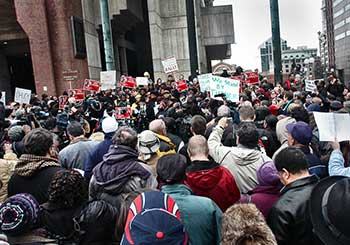
Hundreds support Chuck Turner at City Hall rally,
Nov. 24.
WW photo: Liz Green

At 6 a.m. on Nov. 21, seven armed FBI agents had gone to Turner’s front door, terrorizing his household. He was arrested an hour later at City Hall, where he was already beginning his work day, and taken in handcuffs to Worcester, 45 minutes from Boston.

At the first word of the arrest, activists and allies went into high gear. Rank-and-file union leaders from United Steel Workers Local 8751—the Boston School Bus Drivers—along with organizers from the International Action Center, Women’s Fightback Network, Restore Our Heat & Lights Campaign, the Boston Workers Alliance, the youth group FIST (Fight Imperialism, Stand Together) and other community groups came forward to mobilize solidarity, defend the Turner household and offer whatever assistance was necessary.

People’s lawyers Barry Wilson and John Pavlos were secured and political supporters gathered in Worcester. Turner left the court surrounded by 40 supporters holding up signs and chanting, “Chuck, Chuck, Chuck!” He immediately spoke out to the throng of media, proclaiming his innocence and condemning the FBI abuse as well as the attack on his constituents’ right to the representative of their choice.

Horrific attacks on Turner from the Boston media and all corners of the capitalist establishment have thrown the concept of “innocent until proven guilty” out the window. In an unprecedented action, City Council President Maureen Feeney stripped him of all his committee chair positions and called for a special session of the City Council to consider removing him.

On Nov. 24 Turner, along with 500 supporters, held a rally and news conference on the steps of City Hall to demand that Feeney call off the City Council hearing and restore him to his committee positions. Feeney had to cancel the session.

About 70 community and grassroots supporters, including a delegation of more than 35 rank-and-file members of Local 8751, participated in another news conference and rally at Turner’s district office in Roxbury on Nov. 26. Turner said: “The media has not produced one story on the fact that I am the only Boston city councilor who in the modern era has maintained an office in the community. There has not been one story around the fact that my campaign owes Terri [Turner’s spouse] and I $140,000 because of our investment of our own resources in the maintenance of the district office.”

A mass meeting is scheduled for Dec. 2, and a Solidarity Day rally for Dec. 9. Turner’s next court appearance is at 3 p.m. on Dec. 10 at the Moakley Federal Court House in Boston. Visit SupportChuckTurner.com for details.

Turner’s massive support is based on four decades of grassroots activism and community organizing. He fought for jobs through the Third World Jobs Clearinghouse and United Community Construction Workers. He was a founder of the Boston Workers Alliance, the only organization of unemployed workers in the state, which also fights for formerly incarcerated workers’ right to a job.

Turner has fought on every community and progressive issue, from immigrant rights to foreclosure and eviction blockades and against war. Recently he spearheaded a campaign to restore heat and lights to those whose utilities have been shut off.

The attack on Turner seeks to cut off the grassroots leadership necessary to bring about the change people are looking and hoping for.

U.S. Attorney for the District of Massachusetts Michael Sullivan, who is prosecuting Turner as well as State Sen. Dianne Wilkerson (see Workers World, Nov. 13), is a notorious right-wing Republican whose specialty is politically motivated false prosecutions. He prosecuted the Plymouth 25—Native activists and allies who were the victims of a police riot against their peaceful demonstration on the National Day of Mourning (“Thanksgiving” Day) in 1997.

Turner’s case is part of a national campaign of racist, politically motivated prosecutions. These include the cases of: African-American Milwaukee Alderman Michael McGee, who was convicted in October based on similar FBI entrapment and trial by media; Rep. William Jefferson of Louisiana, who was subjected to an unprecedented FBI raid of his congressional office and was forced out of his committee positions by Speaker Nancy Pelosi even before being indicted; and Rep. Cynthia McKinney, who was lambasted for defending herself from racist guards at the Capitol in Washington, D.C.

These are but the most recent chapters in a long history of racist political frame-ups and abuse by the FBI that goes back to the attacks on Dr. Martin Luther King Jr., Malcolm X, the Black Panthers, Adam Clayton Powell and Shirley Chisholm.

Robert Traynham of the International Action Center said: “Sullivan should be fired for politically motivated, racist frame-up prosecutions and abuse of the FBI. The FBI should cease and desist from its longstanding pattern of frame-ups and harassment of oppressed community leaders.”


Articles copyright 1995-2008 Workers World. Verbatim copying and distribution of this entire article is permitted in any medium without royalty provided this notice is preserved.

Workers World, 55 W. 17 St., NY, NY 10011
Email: ww@workers.org
Subscribe wwnews-subscribe@workersworld.net
Support independent news http://www.workers.org/orders/donate.php
Page printed from:
http://www.workers.org/2008/us/boston_1211/

While Some of Us Are Hoping for Change, Others Are Literally Starving for It

By Chris Hedges, Truthdig
http://www.alternet.org/story/108622/

Elba Figueroa worked as a nurse’s aide until she got Parkinson’s disease. She lost her job. She lost her health care. She receives $703 a month in government assistance. Her rent alone costs $750. And so she borrows money from friends and neighbors every month to stay in her apartment. She laboriously negotiates her wheelchair up and down steps and along the frigid sidewalks of Trenton, N.J., to get to soup kitchens and food pantries to eat.

“Food prices have gone up,” the 47-year-old Figueroa said, waiting to get inside the food pantry run by the Crisis Ministry of Princeton and Trenton. “I don’t have any money. I run out of things to eat. I worked until I physically could not work anymore. Now I live like this.”

The pantry, which occupies a dilapidated three-story art deco building in Old Trenton, one of the poorest sections of the city, is one of about two dozen charities that struggle to provide shelter and food to the poor. Those who quality for assistance are permitted to come once a month and push a shopping cart in a U shape around the first floor where, clutching a piece of paper with allotted points, they can stock up on items using the pantry’s point system according to the number of people in a household. The shelves of the pantry hold bags of rice, jars of peanut butter, macaroni and cheese and cans of beets, corn and peas. Two refrigerated cases hold eggs, chickens, fresh carrots and beef hot dogs. “All Fresh Produce 2 pounds = 1 point,” a sign on the glass door of the refrigerated unit reads. Another reads: “1 Dozen EGGS equal 3 protein points. Limit of 1 dozen per household.”

The swelling numbers waiting outside homeless shelters and food pantries around the country, many of them elderly or single women with children, have grown by at least 30 percent since the summer. General welfare recipients receive $140 a month in cash and another $140 in food stamps. This is all many in Trenton and other impoverished areas have to live on.

Trenton, a former manufacturing center that has a 20 percent unemployment rate and a median income of $33,000, is a window into our current unraveling. The financial meltdown is plunging the working class and the poor into levels of destitution unseen since the Depression. And as the government squanders taxpayer money in fruitless schemes to prop up insolvent banks and investment houses, citizens are callously thrown onto the street without work, a place to live or enough food.

The statistics are already grim. Our banking and investment system, holding perhaps $2 trillion in worthless assets, cannot be saved, even with the $700 billion of taxpayer money recklessly thrown into its financial black hole. Our decline is irrevocable. The number of private sector jobs has dropped for the past 10 months and at least a quarter of all businesses say they plan to cut more jobs over the next year. The nation’s largest banks, including Citigroup, face collapse. Retail sales fell in October by the largest monthly drop on record. Auto companies are on the edge of bankruptcy. The official unemployment figures, which duplicitously mask real unemployment that is probably now at least 10 percent nationwide, are up to 6.1 percent and headed higher. We have lost 1.2 million jobs since January. Young men of color have 50 percent unemployment rates in cities such as Trenton. Twelve million houses are worth less than their mortgages and a million people will lose their homes this year in foreclosures. The current trends, if not swiftly reversed, mean that one in 33 home owners will face foreclosure.

There are now 36.2 million Americans who cope daily with hunger, up by more than 3 million since 2000, according to the Food Research and Action Center in Washington, D.C. The number of people in the worst-off category -- the hungriest -- rose by 40 percent since 2000, to nearly 12 million people.

“We are seeing people we have not seen for a long time,” said the Rev. Jarret Kerbel, director of the Crisis Ministry’s food pantry, which supplies food to 1,400 households in Trenton each month. “We are seeing people who haven’t crossed that threshold for five, six or seven years coming back. We are seeing people whose unemployment has run out and they are struggling in that gap while they reapply and, of course, we are seeing the usual unemployed. This will be the first real test of [Bill] Clinton’s so-called welfare reform.”

The Crisis Ministry, like many hard-pressed charities, is over budget and food stocks are precariously low. Donations are on the decline. There are days when soup kitchens in Trenton are shut down because they have no food.

“We collected 170 bags of groceries from a church in Princeton and it was gone in two days,” Kerbel said. “We collected 288 bags from a Jewish center in Princeton and it was gone in three days. What you see on the shelves is pretty much what we have.”

The largess of Congress to Wall Street bankers and investors does not extend to the growing ranks of the poor. The U.S. Department of Agriculture’s Emergency Food Assistance Program donated $240 million in surplus food in 2003 to food banks and other programs. Those donations fell last year to $59 million.

States, facing dramatic budget shortfalls, are slashing social assistance programs, including Medicaid, social services and education. New Jersey’s shortfall has tripled to $1.2 billion and could soar to $5 billion for the next fiscal year. Tax revenue has fallen to $211 million less than projected. States are imposing hiring freezes, canceling raises and cutting back on services big and small, from salting and plowing streets in winter to heating assistance programs. Unemployment insurance funds, especially with the proposed extension of benefits, are running out of money. Governors such as Arnold Schwarzenegger in California and David A. Paterson in New York have called special legislative sessions to deal with the crisis.

If Barack Obama continues to turn to the elites who created the mess, if he does not radically redirect the nation’s resources to assist the working class and the poor, we will become a third-world country. We will waste gargantuan amounts of money we cannot afford on our military, our national security state and bloated corporations while we damn the middle and working class to the whims, idiocy and greed of an entrenched, corporate oligarchy. Obama’s appointments of Timothy Geithner as treasury secretary and Lawrence Summers as director of the National Economic Council are ominous signals that these elites remain entrenched.

Dolores Williams, 57, sat in the cramped waiting room at the Crisis Ministry clutching a numbered card, waiting for it to be called. She has lived in a low-income apartment block known as The Kingsbury for a year. Two residents, she said, recently jumped to their deaths from the 19th floor. She had a job at Sam’s Club but lost it. No one, she says, is hiring. She is desperate.

She handed me a copy of The Trentonian, a local paper. The headline on the front page read: “Gangster Slammed for Bicycle Drive-By.” It was the story of the conviction of a man for a fatal drive-by shooting from a bicycle. The paper, as I flipped through it, was filled with stories like these, the result of social, economic and moral collapse. Poverty breeds more than hunger. It destroys communities. There was a report about a 56-year-old woman who was robbed and pistol-whipped in the middle of the afternoon. There was an article about the plight of four children whose two parents had been shot and seriously wounded. “Libraries OK Now, but Future Is Murky” a headline read. Another announced: “Still No Arrests in Hooker Slayings.”

“It is like this every day,” Williams said.

So while our nation crumbles, physically and morally, while our empire implodes, while our economy tanks, the bankrupt elites who got us here play the merry-go-round game of power in Washington. They will continue to oversee our demise, including the obscene drain of our military and security budget, which now accounts for half of all discretionary spending. Pentagon officials have reportedly asked the Obama transition team for $581 billion, an increase of $67 billion. This increase does not, of course, include the $3 trillion for the wars in Afghanistan and Iraq. We will pay these loans later.

Banks, automotive companies and investment firms, all sinking under the weight of their own incompetence and greed, head to Washington, usually in private jets, to engage in the largest looting of the treasury in American history. And Congress doles out our money without oversight in the greatest transference of wealth upwards in modern times.

As this pitiful march of folly rolls forward, children in Trenton and across America go to bed hungry.

Chris Hedges, a Pulitzer prize-winning reporter, is a Senior Fellow at the Nation Institute. His latest book is Collateral Damage: America's War Against Iraqi Civilians.

ABC's Overpaid Autoworkers

picture of ABC broadcast
(Watch clip on YouTube.)

In an attempt to explain the plight of the Big Three U.S. automobile manufacturers, ABC's World News used a wildly misleading statistic regarding autoworkers' pay.

On the December 3 edition of the ABC newscast, reporter Chris Bury took aim at the supposed inflexibility of the United Auto Workers: "But the union did not offer to give back the big stuff, pay and benefits that remain a fundamental problem. Ford, Chrysler and GM pay union workers more than $73 an hour in wages and benefits. Japanese plants here shell out just over $44. For GM, that translates into $1,500 more per car more than Toyota has to pay."

This factoid, which is a favorite of the industry--and, increasingly, of the media as well (see Media Matters, 11/22/08)--has been exposed as misleading for some time. In the New Republic (11/21/08), Jonathan Cohn called it "wildly misleading," and cited an analyst for the Center for Automotive Research who determined that "average wages for workers at Chrysler, Ford and General Motors were just $28 per hour as of 2007." The much higher figure, according to Cohn, results from a mathematical sleight of hand. "The cost of all employer-provided benefits--namely, health insurance and pensions--and then dividing by the number of workers." In other words, costs related to retired workers, who well outnumber current employees, are used to create an inflated figure that is misleadingly labeled as current labor costs.

Writing in Portfolio (11/18/08), Felix Salmon called it a "ridiculous number," adding: "Now that GM's healthcare obligations are being moved to a UAW-run trust, even that fictitious number is going to fall sharply. But anybody who uses it as a rhetorical device suggesting that U.S. car companies are run inefficiently is being disingenuous." The United Auto Workers also has a page on their website debunking the industry figures (http://www.uaw.org/barg/07fact/fact02.php).

And as the Wall Street Journal reported (11/20/08), "During the past three years, the union agreed to eliminate tens of thousands of production jobs, reduce healthcare coverage for union retirees and slash wages for new hires--moves that essentially level the playing field between the Big Three auto makers and their foreign-owned rivals." The paper went on to explain that these concessions are significant: "Analysts believe the changes will bring the average cost of union labor to less than $50 an hour by 2010 or 2011, in line with Toyota Motor Corp.'s labor costs. The Harbour Report, a closely watched scorecard of auto-plant productivity, earlier this year found that in 2007 the average per-vehicle labor costs for the Big Three in 2007 was no more than $260 above Toyota's"--far from the $1,500 premium ABC claimed GM pays.

ABC did include a quote from UAW president Ron Gettelfinger, saying that he "bristled at blaming auto workers"--but ABC's newscast was as much behind the finger-pointing as the industry is. As economist Dean Baker noted (Beat the Press, 11/18/08), this misinformation has serious consequences: "It certainly can affect public support for a bailout if they are led to believe that autoworkers are paid much more than is actually the case." ABC should correct the record.

ACTION:
Tell ABC that it should correct its December 3 report that inaccurately characterized autoworker salaries.

CONTACT:
ABC World News

Phone:
212.456.4040

Webform:
http://abcnews.go.com/Site/page?id=3271346&cat=World%20News%20with%20Charles%20Gibson

Wednesday, December 03, 2008

Ten Ways the Corporate Media Tried To Convince You That Obama Was a Progressive

1. Cherry picked a 2007 National Journal ranking which concluded that Obama was the most liberal Senator. This despite the fact that it was an outlier with a deeply flawed methodology that no other ranking confirmed, and only a true nitwit would swallow credulously the notion that Obama was more liberal than Russ Feingold or Bernie Sanders.

2. Nodded approvingly as Clinton campaign pushed "Obama is too liberal" meme. Ignored the fact that even in the National Journal ranking, of the 267 issues on which they both cast votes in 2007, they differed by only 10 votes. "The policy differences between Clinton and Obama are so slight they are almost nonexistent to the average voter," said Rutgers University political scientist Richard Lau.

3. Turned into complete bobbleheads as McCain campaign and a woman who excised the letter "g" from the alphabet endlessly repeat the same.

4. Refused to listen when "liberal bloggers" pointed out that Obama wasn't all that liberal (see video above).

5. Assumed that the only thing meaningful about Obama's expression of admiration for Ronald Reagan was that it pissed off liberal bloggers.

6. Hyperventillated over Jeremiah Wright as if he was capable of some kind of Vulcan mind control.

7. Deduced, like Larry Kudlow, that if given the chance Obama would appoint Bill Ayers Secretary of State.

8. Preached the gospel of America as "center-right nation" after the election when all evidence was to the contrary, because -- well, they and all their friends are "center right" and that must mean something.

9. Demanded that Obama must "govern from the center" to make themselves the country happy.

10. Reacted with shock and delight when Obama appoints "conservative" Hillary Clinton, a woman whose voting record on Iraq was nearly identical to his own, as Secretary of State -- repudiating liberal bloggers who were obviously hoping for Bill Ayers.

Digg!

Tagged as: media, obama, bloggers, liberal, corporate media sucks

Jane Hamsher is the founder of FireDogLake. Her work has also appeared on the Huffington Post, Alternet and The American Prospect.

Tuesday, December 02, 2008

The Mythology of the War on Terrorism

By WILLIAM BLUM

On November 8, three men were executed by the government of Indonesia for terrorist attacks on two night clubs in Bali in 2002 that took the lives of 202 people, more than half of whom were Australians, Britons and Americans. The Associated Press8 reported that "the three men never expressed remorse, saying the suicide bombings were meant to punish the United States and its Western allies for alleged atrocities in Afghanistan and elsewhere."

During the recent US election campaign, John McCain and his followers repeated a sentiment that has become a commonplace – that the War on Terrorism has been a success because there hasn't been a terrorist attack against the United States since September 11, 2001; as if terrorists killing Americans is acceptable if it's done abroad. Since the first American strike on Afghanistan in October 2001 there have been literally scores of terrorist attacks against American institutions in the Middle East, South Asia and the Pacific, more than a dozen in Pakistan alone: military, civilian, Christian, and other targets associated with the United States. The year following the Bali bombings saw the heavy bombing of the US-managed Marriott Hotel in Jakarta, Indonesia, the site of diplomatic receptions and 4th of July celebrations held by the American Embassy.

The Marriott Hotel in Pakistan was the scene of a major terrorist bombing just two months ago. All of these attacks have been in addition to the thousands in Iraq and Afghanistan against US occupation, which Washington officially labels an integral part of the War on Terrorism. Yet American lovers of military force insist that the War on Terrorism has kept the United States safe.

Even the claim that the War on Terrorism has kept Americans safe at home is questionable. There was no terrorist attack in the United States during the 6 1/2 years prior to the one in September 2001; not since the April 1995 bombing of the federal building in Oklahoma City. It would thus appear that the absence of terrorist attacks in the United States is the norm.

An even more insidious myth of the War on Terrorism has been the notion that terrorist acts against the United States can be explained, largely, if not entirely, by irrational hatred or envy of American social, economic, or religious values, and not by what the United States does to the world; i.e., US foreign policy. Many Americans are mightily reluctant to abandon this idea. Without it the whole paradigm – that we are the innocent good guys and they are the crazy, fanatic, bloodthirsty bastards who cannot be talked to but only bombed, tortured and killed – falls apart. Statements like the one above from the Bali bombers blaming American policies for their actions are numerous, coming routinely from Osama bin Laden and those under him.

Terrorism is an act of political propaganda, a bloody form of making the world hear one's outrage against a perceived oppressor, graffiti written on the wall in some grim, desolate alley. It follows that if the perpetrators of a terrorist act declare what their motivation was, their statement should carry credibility, no matter what one thinks of their cause or the method used to achieve it.

William Blum is the author of Killing Hope: U.S. Military and CIA Interventions Since World War II, Rogue State: a guide to the World's Only Super Power. and West-Bloc Dissident: a Cold War Political Memoir.

He can be reached at: BBlum6@aol.com

Monday, December 01, 2008

Obama to be next neocon US president?

Global Research, December 1, 2008

The next US government might not be able to keep its promise on 'Change' and might turn into a war-oriented administration, a prominent historian says.

President-elect Barack Obama, who inspired Americans during his presidential campaign, defeated his Republican rival John McCain thanks to the new slogans in a historic election last month.

During his transition time, Obama has been trying to name his administration among American Israel Public Affairs Committee (AIPAC) lobbyists, foreign relation advisers, and congressmen.

Selecting Joe Biden as vice president who supported the Iraq war before it became unpopular was a surprising decision when Obama himself opposed the war. "He [Biden] is a strong supporter of Israel. He even made a statement 'I am a Zionist'," Stephen Sniegoski, US historian and author, told Press TV correspondent in Washington.

Obama's decision to name Rahm Manuel as the White House chief of staff was another indicator of the influence of pro-Israeli lobby in his campaign.

"Rahm Manuel is a very strong Zionist, even he went to Israel to help out the military during the first Persian Gulf war," said Sneigoski.

On Monday, the Democrat is expected to pick former rival Hillary Clinton as secretary of state, another Democrat who has been at odds with Obama in the past over foreign policy, including Iran.

"Hillary Clinton made a statement that she would if Iran attacks Israel, that the United States should annihilate Iran," said Sneigoski.

Speculation runs high that despite Obama's campaign promises to open up dialogue with Iran, his policy could be changed with the new members of his cabinet and advisers who are supportive of Israel.

During his campaign, the president-elect declared his full support for Israel, saying that 'I will always keep the threat of military action on the table to defend our security and our ally Israel'.

The US author, Sneigoski concluded that the Obama administration would be a war-oriented administration.

Meanwhile, Dennis Ross, a former member of AIPAC, is reportedly angling for top positions in the Obama administration. Dennis Ross, an adviser to Hillary Clinton, said in a study by Bipartisan Policy Council last month that Washington 'might have little time and fewer options to deal with Iran. Military strike is feasible, but last resort'.

The US and Israel accuse the Islamic Republic of making efforts to produce nuclear weapons; Iran insists its nuclear program is directed at peaceful purposes.

The UN nuclear watchdog responsible for investigating Iranian nuclear activities confirmed in its latest report that it has "been able to continue to verify the non-diversion of declared nuclear material in Iran."

The body has conducted the highest number of investigations in the history of the organization on Iran's nuclear sites.

Right-Wingers and Neocons Love Obama's Cabinet Appointments

By Jeremy Scahill, AlterNet
http://www.alternet.org/blogs/waroniraq/109160/right-wingers_and_neocons_love_obama%27s_cabinet_appointments/

As Barack Obama's opus, Team of Rivals, continues its rolling debut, the early reviews are in and the "critics" are full of praise for the cast:

"[T]he new administration is off to a good start."
-- Senate Republican leader, Mitch McConnell.

"[S]uperb ... the best of the Washington insiders ... this will be a valedictocracy -- rule by those who graduate first in their high school classes."
-- David Brooks, conservative New York Times columnist

"[V]irtually perfect ... "
-- Senator Joe Lieberman, former Democrat and John McCain's top surrogate in the 2008 campaign.

"[R]eassuring."
-- Karl Rove, "Bush's brain."

"I am gobsmacked by these appointments, most of which could just as easily have come from a President McCain ... this all but puts an end to the 16-month timetable for withdrawal from Iraq, the unconditional summits with dictators, and other foolishness that once emanated from the Obama campaign ... [Hillary] Clinton and [James] Steinberg at State should be powerful voices for 'neo-liberalism' which is not so different in many respects from 'neo-conservativism.'"
-- Max Boot, neoconservative activist, former McCain staffer.

"I see them as being sort of center-right of the Democratic party."
-- James Baker, former Secretary of State and the man who led the theft of the 2000 election.

"[S]urprising continuity on foreign policy between President Bush's second term and the incoming administration ... certainly nothing that represents a drastic change in how Washington does business. The expectation is that Obama is set to continue the course set by Bush ... "
-- Michael Goldfarb of the neoconservative Weekly Standard.

"I certainly applaud many of the appointments ... "
-- Senator John McCain

"So far, so good."
-- Senator Lamar Alexander, senior Republican Congressional leader.

Hillary Clinton will be "outstanding" as Secretary of State
-- Henry Kissinger, war criminal

Rahm Emanuel is "a wise choice" in the role of Chief of Staff
-- Republican Senator Lindsey Graham, John McCain's best friend.

Obama's team shows "Our foreign policy is non-partisan."
-- Ed Rollins, top Republican strategist and Mike Huckabee's 2008 campaign manager

"The country will be in good hands."
-- Condoleezza Rice, George W. Bush's Secretary of State

**Team of Rivals will be playing all day, every day for at least the next four years**

Jeremy Scahill pledges to be the same journalist under an Obama administration that he was during Bill Clinton and George Bush's presidencies. He is the author of Blackwater: The Rise of the World's Most Powerful Mercenary Army and is a frequent contributor to The Nation and Democracy Now! He is a Puffin Foundation Writing Fellow at the Nation Institute.
Anti-terror law requires God be acknowledged

By John Cheves
jcheves@herald-leader.com

Under state law, God is Kentucky's first line of defense against terrorism.

The 2006 law organizing the state Office of Homeland Security lists its initial duty as "stressing the dependence on Almighty God as being vital to the security of the Commonwealth."

Specifically, Homeland Security is ordered to publicize God's benevolent protection in its reports, and it must post a plaque at the entrance to the state Emergency Operations Center with an 88-word statement that begins, "The safety and security of the Commonwealth cannot be achieved apart from reliance upon Almighty God."

State Rep. Tom Riner, a Southern Baptist minister, tucked the God provision into Homeland Security legislation as a floor amendment that lawmakers overwhelmingly approved two years ago.

As amended, Homeland Security's religious duties now come before all else, including its distribution of millions of dollars in federal grants and its analysis of possible threats.

The time and energy spent crediting God are appropriate, said Riner, D-Louisville, in an interview this week.

"This is recognition that government alone cannot guarantee the perfect safety of the people of Kentucky," Riner said. "Government itself, apart from God, cannot close the security gap. The job is too big for government."

Nonetheless, it is government that operates the Office of Homeland Security in Frankfort, with a budget this year of about $28 million, mostly federal funds. And some administrations are more religious than others.

Under previous Gov. Ernie Fletcher, a lay Baptist preacher, Homeland Security interpreted the law at face value, prominently crediting God in its annual reports to state leaders and posting the required plaque.

Under Gov. Steve Beshear, officials this week said they didn't know about the plaque until the Herald-Leader called to ask whether it's still there. (They checked; it is.) The 2008 Homeland Security report, issued a month ago, did not credit God, but it did complain about a decline in federal funding from Washington.

Thomas Preston, Beshear's Homeland Security chief, said he isn't interested in stepping into a religious debate, and he hasn't given this part of his duties much thought.

"I will not try to supplant almighty God," Preston said. "All I do is try to obey the dictates of the Kentucky General Assembly. I really don't know what their motivation was for this. They obviously felt strongly about it."

There is no reference to God in Homeland Security's current mission statement or on its Web site, which displeases Riner.

"We certainly expect it to be there, of course," Riner said.

But state Sen. Kathy Stein, D-Lexington, said Homeland Security should worry about public safety threats instead of preaching religious homilies.

"It's very sad to me that we do this sort of thing," said Stein, a frequent critic of efforts to mix religion and government. "It takes away from the seriousness of the public discussion over security, and it clearly hurts the credibility of this office if it's supposed to be depending on God, first and foremost."

A Police Officer’s View on Drugs

by Tony Smith, Contributing Writer

November 29, 2008

For 28 years, I served as a member of the Vancouver Police Department, and spent most of that time at the street level, in and around Vancouver’s poorest area commonly known as “Skid Road.” This area is Canada’s poorest postal code zone. It is an area of cheap fleabag hotels, bars, and drugs. The only people who reside here are those whom society has cast aside because of disability, personality disorders, or sheer bad luck. It has been like this for at least 50 years. Only the faces and preferences of the addicts have changed.

Quite early in my career as a law enforcement officer, it became very obvious to me that the most dangerous drug was a legal drug. That drug is alcohol. Every riot, every disturbance, every assault, every serious late night motor vehicle accident, every homicide, and every sexual assault almost always involved alcohol.

Where were the horrific crimes caused by drug addicts? They were there, but generally speaking they were non-violent property crimes and prostitution. It has been estimated that somewhere between 75-80% of all property crimes are committed by addicts. This begets the question that most policemen in our major cities have asked themselves countless times: why not treat addicts for their addictions, not as criminals, and supply their drugs temporarily until they get help. Apparently, a significant reduction in property crime, reduced jail costs, and lower medical costs is not a sufficient answer.

The biggest question, which really changed my thinking toward the criminalization of drugs was, is why do we persist with laws that guarantee that serious criminals will become immensely rich, powerful, and violent toward any other criminals who stand in their way. If drugs were legally available, there would be no profits for the gangsters. U.S. history teaches us of a parallel situation that occurred during alcohol prohibition in the early twenty century, when gangsters became rich and powerful supplying bootleg alcohol. Al Capone’s South Side Gang and similar gangs murdered whoever stood in their way. The crime rate shot up 200%. Finally, when alcohol prohibition was canceled, most of the gangs disappeared as the profits were gone, the murder rate returned to what it was before prohibition, AND everyone didn’t become an alcoholic overnight!

Let’s ask ourselves a question. If heroin and cocaine were legal, would you use them? Virtually everyone says no, which is really no surprise if you think about it. We also know that up until the 1920s these substances were legal. Laudanum, a mixture of opium and alcohol was the drug of choice to the Victorians. Today the percentage of drug addicts, by which I mean those unable to function in society due to their addictions, remains the same as before there were any drug laws. Hardly a round of applause for the billions of dollars spent on enforcement over the past 80 years. Indeed if drug prohibition were a business that received payment for its results, it would not have lasted a year.

Everyone fears change, and one of the big fears of the general public is the fear of drugs becoming more readily available to our children. Today most of our children can in fact more easily obtain drugs than they can obtain liquor. The gangsters make sure this is the case by ensuring that dealers are present outside most of our schools. These dealers pay no heed to our children’s health, and they often have little knowledge of the substances cut with the drugs or even strength of their products. Drug prohibition causes this situation to persist.

If we look at the history of tobacco, we know education works. Tobacco eventually kills 50% of all regular smokers. Tobacco is legal. Yet through common sense and education, tobacco smoking is down by two thirds from thirty years ago. Education works, but only if honestly given. This spring I was approached by a grandmother whose granddaughter had phoned her in real distress. The Royal Canadian Mounted Police had been running the D.A.R.E. program in her school, and she was convinced that her parents’ occasional use of Marijuana would cause their deaths. If any of the information given is flawed, kids will reject all information given to them about drugs from parents and other authority figures.

I am a member of LEAP, which is an organization of retired policemen, judges, prison guards, others involved in law enforcement ,and many others. It was founded by a former highly commended U.S. drug enforcement officer, Jack Cole. Today it is worldwide. We all believe that drugs are not good, but it is “the War on Drugs” that is causing most of our problems. This war costs 2.5 billion dollars a year in Canada and 10 times that amount in the United States. WHY?

America's Child Soldiers: US Military Recruiting Children to Serve in the Armed Forces


Global Research, November 29, 2008

In violation of its pledge to the United Nations not to recruit children into the military, the Pentagon “regularly target(s) children under 17,” the American Civil Liberties Union(ACLU) says.

The Pentagon “heavily recruits on high school campuses, targeting students for recruitment as early as possible and generally without limits on the age of students they contact,” the ACLU states in a 46-page report titled “Soldiers of Misfortune.”

This is in violation of the U.S. Senate's 2002 ratification of the Optional Protocol to the UN Convention on the Rights of the Child.

Pentagon recruiters are enrolling children as young as 14 in the Junior Reserve Officer Training Corps (JROTC) in 3,000 middle, junior, and high schools nationwide, causing about 45 percent of the quarter of million students so enrolled to enlist, a rate much higher than in the general student population. Clearly, this is the outcome of underage exposure.

In some cities, such as Los Angeles, high school administrators have been enrolling reluctant students involuntarily in JROTC as an alternative to overcrowded gym classes! In Lincoln high school, enrollees were not told JROTC was involuntary. In Buffalo, N.Y., the entire incoming freshman class at Hutchinson Central Technical High School, (average age 14), was involuntarily enrolled in JROTC. In Chicago, graduating eighth graders (average age 13) are allowed to join any of 45 JROTC programs.

“Wartime enlistment quotas (for Iraq and Afghanistan) have placed increased pressure on military recruiters to fill the ranks of the armed services,” an ACLU report says. Trying to fill its quotas without reinstituting a draft “has contributed to a rise in allegations of misconduct and abuse by recruiters” that “often goes unchecked.”

The Pentagon also spends about $6 million a year to flog an online video game called “America’s Army” to attract children as young as 13, “train them to use weapons, and engage in virtual combat and other military missions learn how to fire realistic Army weapons such as automatic rifles and grenade launchers and learn how to jump from airplanes,” the ACLU reports. As of Sept., 2006, 7.5 million users were registered on the game’s website, which is linked to the Army’s main recruiting website.

And when Pentagon recruiters sign 17-year-olds into the inactive reserves under the Future Soldiers Training Program, (the idea being to let them earn their high school diploma), they frequently don’t tell the children they can withdraw with no penalty.

“Over the years, we have had reports from students who were told that if they change their minds, they would be considered deserters in war time and could be hunted down and shot,” the New York City-based Youth Activists-Youth Allies said. One young woman was told if she backed out of her enlistment her family would be deported. And Bill Galvin, of the Center on Conscience and War, said one young man who changed his mind about enlisting and was told by his recruiter: “If you don’t report, that’s treason and you will be shot.”

Singled out by the Pentagon for intense recruitment drives are urban centers such as Los Angeles and New York. The latter, in which low-income students account for 51% of all high school enrollment and where 71% are black or Latino, contains three of the nation’s top 32 counties for Army enlistment. In Los Angeles, 91% of the students are non-white and 75% are low-income.

And the Coalition Against Militarism in Our Schools says the 30 JROTC programs in Los Angeles Unified School District (with 4,754 students) are “Located in the most economically depressed communities of the city.”

African-Americans make up 16% of the civilian population of military age but 22% of the Army’s enlisted personnel, the ACLU notes. It charges bluntly: “The U.S. military’s practice of targeting low-income youth and students of color in combination with exaggerated promises of financial rewards for enlistment, undermines the voluntariness of their enlistment ”

JROTC also runs a Middle School Cadet Corp for children as young as 11, that militarizes them even before they graduate elementary school. “Florida, Texas, and Chicago, offer military-run after-school programs to sixth-, seventh-, and eighth-graders (that) involve drills with wooden rifles and military chants .and military history.” Children wear uniforms to school once a week for inspection.

While the U.S. claims “no one under age 17 is eligible for recruitment,” the Pentagon’s Joint Advertising Market Research & Studies database(JAMRS) scoops up data on eleventh graders, typically just 16. JAMRS has data on 30 million Americans between age 16 and 25 for recruitment purposes.

The ACLU says this data includes “e-mail addresses, grade point averages, college intentions, height and weight information, schools attended, courses of study, military interests, and racial and ethnic data” as well as Social Security numbers.

In the face of grim casualty reports from the Middle East, Pentagon recruiters appear increasingly desperate to make their quotas. About one in five, the New York Times reported in 2004, was found to have engaged in “recruiting improprieties” ranging from “threats and coercion to making false promises to young people that they would not be sent to Iraq.”

Given the Bush regime’s plunge into criminal wars of aggression that defy international law and the Geneva conventions, there is no reason why military recruitment of any kind should be allowed on any college campus, much less in the secondary schools. If the United States truly wished to spread democracy, (rather than seize oil fields), it would be assigning vast numbers of Peace Corps recruiters to college campuses, and the budgets of the Peace Corps and the Defense Department would be reversed.

As Eugene Debs, the presidential candidate on the Socialist ticket that went to prison for speaking against World War One, (he polled 913,000 votes in 1920) once said: “I would no more teach children military training than I would teach them arson, robbery or assassination.”

The fact that the Pentagon is having such a daunting time these days filling its ranks as it wages an illegal war speaks very well for the intelligence of the American people. That’s no excuse, though, for the Defense Department to illegally recruit impressionable children. #

Sherwood Ross is a Miami-based public relations consultant and columnist who previously worked for the Chicago Daily News, as a radio commentator, and as a columnist for wire services. Reach him at sherwoodr1@yahoo.com

Sunday, November 30, 2008

Watch out for Obama's Team Selling Conservative Policies as Progressive Politics

There seems to be a great deal of concern from the left-of-center bloggers about Mr. Obama's appointments. The quote below is a perfect distillation of my thoughts regarding presidential politics and the duopoly in general and my strong feelings regarding Obama in particular. He hasn't been co-opted by his election to the machine - he was never a progressive. That said, there will never be any significant social change resulting from establishment politics. Convince me otherwise, please.--Pete
By David Sirota, Open Left
http://www.alternet.org/story/108538/

"This is the violin model: Hold power with the left hand, and play the music with your right."-- David J. Rothkopf, a former Clinton official who wrote a history of the National Security Council, said on Friday, as news of Mrs. Clinton's and Mr. Geithner's appointments leaked.

This quote, from the New York Timesstory asserting that Barack Obama will govern from the center-right, highlights a very important dynamic in politics: the tendency of politicians to use the argot of progressivism in their public presentations (to "hold power with the left hand") -- all while wielding conservative policy ("playing the music with your right").

There's nothing surprising about this - the reason endangered politicians of both parties start airing populist progressive themes around election time is because they know those themes are popular among rank-and-file voters (thus the definition of "populism") - they know, in other words, that this is a decidedly center-left country, and when they have to answer to that country come election day, they go left. But once these politicians get into office and are far away from all of us, the unwashed masses, the pressures of money and media -- ie. the Establishment -- unleashes incredible pressure for them to actually write the details of policy in a way that preserves the conservative status quo.

Enter the Obama administration.

While there's not enough evidence to declare a full-on "trend" in the incoming Obama White House, it is notable that Obama's policy appointments (ie. Cabinet secretaries and White House policy advisers who actually craft policy) are almost all right-of-center, Establishment choices -- and almost none are, as The Nation's Chris Hayes has said, movement progressives. At the same time, many Obama appointments to exclusively political positions -- that is, positions that are focused on selling policy, whatever that policy may be -- are terrific movement progressives, people like Mike Lux (transition outreach to progressive orgs), Ellen Moran (communications director), Phil Schiliro (congressional liason) and Patrick Gaspard (political director). In other words, the initial structure seems to resemble the principle in American politics of politicians publicly selling their policies in progressive terms, while having those policies be crafted with much more conservative ideology.

Intra-administration ideological ghettoization isn't new. The last Democratic administration engaged in its share of conservative-progressive ghettoization - but rather than making the policy/politics barrier the wall of the two ghettos, it divided the two ideologies between the cabinet offices with different jurisdictions. The cabinet offices that oversaw economic regulation and defense largely went to conservatives, and the cabinet offices with powerful grassroots progressive constituencies like Labor, EPA, I and HUD went to progressives.

The potential ghettoization in the Obama administration -- and I stress again, it's only the potential -- is one where the policy sculptors are center-right Establishmentarians, and where the policy marketers (ie. the political team) is comprised of people who know how to package and sell policies in the language of progressivism, and sell those policies to progressive activists, a progressive-dominated Democratic congressional caucus and a center-left public at large. Certainly, Obama may mimic the Clinton administration and give Labor, EPA, Interior and HUD to progressives as well, but the politics-policy divide nonetheless seems to be the defining progressive-conservative boundary right now.

Obviously, the division of responsibility is never totally cut and dry. As Karl Rove showed, a White House political team can have a lot of influence over policy. So we can't draw any hard and fast conclusions about what this will mean in the Obama administration. It's very possible that the progressive political team will have a lot of policy say.

That said, I do think it is important for progressives to understand the difference between the policy and political machinery of an administration. Ghettoizing conservatives into the policy machine (to "play the music") and progressives into the political machine (to help Obama "hold power") would not bode well for all the progressive policy promises Obama made during the campaign. After all, if the details of policy are being forged by center-right Establishment insiders, those policies are more likely (though certainly not guaranteed) to represent a fairly center-right Establishment viewpoint, no matter how well those policies are draped in the salesmanship of a progressive political machinery.

This gets to the fundamental question about Obama that nobody really knows. Does Obama believe that in order to be a successful president and right the economy, he has to fulfill the decidedly progressive policy promises he made during the campaign? Or does he believe that if he combines his own personal salesmanship talents with a strong political team that is skilled at the language of progressivism, he can sell a right-of-center Establishment agenda as huge "change?"

Nobody knows the answer to this - and those who say they do are arguing with the same ridiculed faith that George W. Bush cited when he said he knew Vladimir Putin was a good guy because he looked into the Russian autocrat's eyes. The truth is, we just don't know what Obama thinks his path should be.

That's why it is important to keep a close eye on how the new administration is being constructed. The strategies we create to enact a progressive agenda (and I assume that, and not just Democratic Party dominance, is what progressives want) will have to be calibrated for the kind of administration that is ultimately built. An administration that has right-of-center policy sculptors and left-of-center policy sellers will have to be worked with differently than, say, an administration with progressive policy sculptors and conservative policy sellers.

Again, I'm not saying the administration is built yet, or that the initial staffing decisions delineate a full-fledged trend. But we should watch closely to see if a trend does, indeed, develop.

David Sirota is a best-selling author whose newest book, "The Uprising," was just released this month. He is a fellow at the Campaign for America's Future and a board member of the Progressive States Network -- both nonpartisan organizations. His blog is at www.credoaction.com/sirota.