Saturday, November 10, 2007

Billionaire mayor blames workers for deficits

Orders job freeze and budget cuts
Published Nov 9, 2007 12:29 AM

When the capitalist economy turns downward and the government, run by the rich, seeks to scrounge up more money, where does it turn? To the workers, who are already reeling from layoffs, slashed wages, and the loss of health benefits and pensions.

This time around it’s the city of New York that says it is short of cash. On Oct. 30 Mayor Michael Bloomberg imposed a hiring freeze on all government agencies as a solution to declining revenues. No discussion, no way for city employees or residents to debate what to do. The mayor did it by decree. He also told city commissioners to find ways to cut spending by 2.5 percent this fiscal year, which ends June 30, 2008, and by 5 percent next year.

What’s the reason for the city’s financial problems? News reports cite the crisis in credit and housing, a lack of large real estate transactions and a decline in Wall Street profits as factors for the city’s declining revenues. But city officials are trying to scapegoat the unions.

The officials recently submitted a revised spending plan to the Financial Control Board, which oversees the city’s finances, stating that labor costs will be responsible for 65 percent of the revenue deficit by 2011, while a decline in tax revenue will be responsible for 34 percent. (New York Times, Nov. 3)

Bloomberg “has agreed to more generous pay raises for union after union, leading to expenses that stand to outpace revenue, especially toward the end of the city’s four-year spending plan,” the article stated.

For the mayor to complain that workers are making too much money is particularly outrageous, given Bloomberg’s status as one of 946 billionaires in this country. This year he moved to No. 25 in Forbes magazine’s list of the 400 richest people in the U.S., with a net worth of $11.5 billion.

Bonuses to Wall Street executives last year hit a record $23.9 billion—more than 15 times what the city expects to save over the next two years through the budget cuts. (Bloomberg, Oct. 31) (Yes, THAT Bloomberg. The mayor owns this huge financial news network.)

Wall Street and the financial corporations located in the city are the mechanism for the transfer of hundreds of billions of dollars in profit, squeezed every year out of workers all over the world, to the idle rich.

Such problems as a budget deficit in a major city don’t exist in a socialist society, where the wealth is publicly owned. But in the meantime, workers can demand that, instead of eliminating jobs and slashing services, the city officials go after the corporations that make huge profits off the labor of workers while avoiding paying taxes.

Two years ago, Citizens for Tax Justice did a study of state corporate income taxes paid by 252 of the largest and most profitable corporations in the country. A portion of these taxes go to the cities. It found that 71 of these companies had not paid any state income taxes for at least one year from 2001 through 2003. And some companies, including giants AT&T, Boeing, Eli Lilly and Merrill Lynch, paid no net state income tax over the full three-year period.

Companies that did pay state income tax on average paid taxes on only 2.3 percent of their U.S. profits.


Articles copyright 1995-2007 Workers World. Verbatim copying and distribution of this entire article is permitted in any medium without royalty provided this notice is preserved.

Workers World, 55 W. 17 St., NY, NY 10011
Email: ww@workers.org
Subscribe wwnews-subscribe@workersworld.net
Support independent news http://www.workers.org/orders/donate.php

Page printed from:
http://www.workers.org/2007/us/nyc-1115/

Chrysler axes one third of jobs

Four days after contract ratification

Published Nov 9, 2007

Rarely do predators address their prey as “colleagues.”

Yet “Dear Colleagues” is how Chrysler CEO Bob Nardelli opened a Nov. 1 letter to employees. Nardelli was hired by Cerberus, the aptly named Wall Street private equity firm that took over the auto company this summer. Cerberus was a three-headed dog in Greek mythology that guarded the entrance to the underworld.

Nardelli’s letter outlined plans to eliminate one in every three Chrysler jobs in the U.S. and Canada.

The latest round of cuts was announced just four days after Chrysler workers, represented by the UAW, ratified a four-year contract. The package of givebacks had passed by at most a few thousand votes. That it passed at all was due to promises of job security. Now workers, not swayed by the phony niceties, believe they were lied to by the company and by their union leaders.

Whole shifts are being cut out at six plants in Michigan, Ohio and Illinois. The 12,000 jobs now set to be eliminated are on top of 13,000 announced last February in what the company, with its typical callous disregard for human consequences, called the Recovery and Transformation Plan. Those 13,000 were on top of 5,000 skilled trades jobs negotiated away in the 2003 contract, which in turn were on top of 26,000 jobs that Chrysler cut worldwide in 2001.

This shock comes after the majority of the workers reluctantly agreed to major concessions to help the new owners “be competitive.” New hires will start at $14 an hour and will not get health insurance or a traditional pension when—and if—they can afford to retire. At $14 an hour, 40 hours per week, with no layoffs during the year, these union workers would earn only one and one-half times the official federal poverty wage for a family of four. That wage, which is half the current pay of a UAW production worker at Ford, Chrysler and General Motors, is more than three dollars less than the average hourly wage nationwide.

Obviously, enough is never enough for this breed of predators. Days before the cuts were announced, Nardelli remarked that the auto industry “has an insatiable appetite for cash.”

Declining sales are what the Chrysler bosses are using to justify these catastrophic cuts, but the math doesn’t compute. October sales are down 9 percent compared to October 2006. Sales for the year are down only 4 percent.

Nardelli’s own argument for the cuts cites a projected industry-wide drop in annual sales from 17.2 million vehicles last February to as low as 15.5 million by the end of this year. Yet that’s 10 percent or less—not 33 percent.

In fact, this criminal act, this tearing away of some 25,000 workers from the few good-paying union jobs left, has nothing to do with temporary market fluctuations. As the Nov. 2 Detroit News commented, “The new, privately held Chrysler LLC will be a smaller, leaner and more selective automaker than the expansion-driven division it was under the German management of DaimlerChrysler AG.”

One could argue that such a drastic restructuring violates even the weak language of the just-passed contract. While it unfortunately permits “volume-related” and other specified layoffs, nowhere does the agreement allow for the permanent shrinking of the workforce as part of a “lean” corporate strategy.

Years ago, the United Auto Workers union would have been in the forefront of the fight to save these precious jobs. UAW President Ron Gettelfinger should be screaming bloody murder over this horrible deception and the scale of the cuts. In fact, the UAW leaders must have known in advance what was coming down. At meetings in Belvidere, Ill., where the last plant was voting on the contract, a union representative let the cat out of the bag by admitting that the third shift there would be eliminated.

The UAW had no immediate response to this latest outrage. It was only days later that Gettelfinger remarked he didn’t know that Chrysler would do what they did. Clearly, the fight won’t come from the top.

A new strategy must arise from below to put an end to such shameless collusion between labor and capital. The new fightback program must revive an old concept, popular during the time of the great sit-down strikes of 1936-37: that a job is a worker’s property right. Workers could advance the legal arguments expressed then by the UAW’s lead attorney, Maurice Sugar:

“Let us see if there is not a logical basis for the claim which the worker makes that he has a right in his job. We start by asserting that every worker has the right to live in decency and as a free man. Since the worker has the right to live in decency and as a free man and since his livelihood and his freedom actually depend upon his having a job, it follows that he has a right to a job.”

Such simple truths can form the basis of a militant campaign to defend workers’ jobs against those who promise economic security even as they conspire to destroy it.


Articles copyright 1995-2007 Workers World. Verbatim copying and distribution of this entire article is permitted in any medium without royalty provided this notice is preserved.

Workers World, 55 W. 17 St., NY, NY 10011
Email: ww@workers.org
Subscribe wwnews-subscribe@workersworld.net
Support independent news http://www.workers.org/orders/donate.php

Page printed from:
http://www.workers.org/2007/us/chrysler-1115/

ANALYSIS & EDITOR’S COMMENT: The blowback has yet to come

From War In Context

Crisis in Pakistan: Administration officials see few options for U.S.

For more than five months the United States has been trying to orchestrate a political transition in Pakistan that would manage to somehow keep Gen. Pervez Musharraf in power without making a mockery of President Bush’s promotion of democracy in the Muslim world.

On Saturday, those carefully laid plans fell apart spectacularly. Now the White House is stuck in wait-and-see mode, with limited options and a lack of clarity about the way forward.

General Musharraf’s move to seize emergency powers and abandon the Constitution left Bush administration officials close to their nightmare: an American-backed military dictator who is risking civil instability in a country with nuclear weapons and an increasingly alienated public. [complete article]

Editor’s Comment — While the neoconservatives are waging a hysterical campaign targeting unrealized nuclear risks in Iran, the fearmongers have had little to say about the nuclear actualities in Pakistan. Indeed, we now know that for decades American administrations and Congress looked the other way while Pakistan both developed its own weapons program and created the most extensive clandestine proliferation network ever known - a network that is believed to remain in tact and in operation even though in February 2004 its chief of operations, AQ Khan, was forced into what could best be described as early retirement. Paradoxically, while the drumbeat for bombing Iran grows increasingly loud, there is a stunning silence in response to the preeminent risk for nuclear terrorism. Washington’s Faustian pact with General Musharraf is now unraveling, yet we are blithely assured that Pakistan’s weapons and nuclear materials will remain safe, whoever rises to power. We have seemingly entered a Through-the-Looking-Glass world where nuclear weapons that do exist are less dangerous than those that can be imagined.

For more revelations on Washington and Islamabad’s twisted relations, read this:

‘Bush winked at Pakistan’s nuclear proliferation’
Chidanand Rajghatta, Times of India, September 5, 2007

Successive US administrations winked at Pakistan’s clandestine nuclearisation and its rampant proliferation activities, and Washington continues the charade of normalcy although proliferation activities continue to this day, an explosive new book on the subject has revealed.

The disclosures in the book Deception: Pakistan, the United States and the Secret Trade in Nuclear Weapons by Adrian Levy and Catherine Scott-Clark, which is to be released next week, are nothing short of stunning.

It charges US President Bush of perpetuating deceit in an elaborate American charade that forgave Pakistan for its nuclear transgressions as a price for keeping it from becoming an even more dangerous proposition - in other words, succumbing to Pakistani blackmail.

Describing the episode in which US officials confronted Pakistan’s military ruler Pervez Musharraf with evidence of its nuclear proliferation, the authors say “American officials knew that Musharraf had known about the nuclear trade all along. And Washington had itself not only turned a blind eye to Pakistan’s nuclear bomb project for decades but had covered it up for imperative geopolitical reasons, even when Islamabad began trading its secret technology.”

The authors credit then Deputy Secretary of State Richard Armitage of conceiving the drama in which Musharraf would promise to shut down Pakistan’s nuclear black market in return for winning continued US support for his unelected regime.

It was agreed that A Q Khan and his aides would be arrested and blamed for “privately” engaging in proliferation. “The country’s military elite - who had sponsored Khan’s work and encouraged sales of technology to reduce their reliance on American aid - were left in the clear,” the authors say, adding that “Bush subscribed to the deceit.”

However, in a worrying new claim for Washington’s non-proliferation pundits, who have spent the last two decades chasing WMD phantoms in all the wrong places, Pakistan’s proliferation has not stopped even now.

They say new intelligence reports show that Pakistan is procuring a range of materials and components that “clearly exceeds” what Islamabad needed for its domestic nuclear program.

KRL labs, A.Q.Khan’s old facility, had continued to coordinate the Pakistani sales programme and now runs a network of front companies in Europe, the Gulf and southeast Asia which deployed all the old tricks: disguising end-user certificates by shielding the ultimate destinations from sellers, and lying on customs manifests.

Most alarming, say the authors, was the finding that hundreds of thousands of components amassed by Khan, including canisters with radioactive material, had vanished since he had been put out of operation.

In other words, they write, Pakistan has continued to sell nuclear weapons technology (to clients known and unknown) even as Musharraf denies it - “which means either that the sales are being carried out with his secret blessing or that he is no more in control of Pakistan’s nuclear program than he is of the bands of jihadis in his country.”

The book then quotes Robert Gallucci, a former US diplomat who tracked Islamabad’s nuclear program from inception in 1972, as describing Pakistan as “the number one threat to the world at this moment.”

“If it all goes off, a nuclear bomb in a US or European city, I’m sure we will find ourselves looking in Pakistan’s direction,” says Gallucci.

Such observations, and other disclosures in the book, hasn’t made the slightest impression on Washington, which continues a decades-long wink-wink policy that has made Pakistan’s into what experts are increasingly
describing as the world’s most dangerous country.

The Bush administration continues to back Musharraf and is trying to engineer a coalition between the military ruler and former PM Benazir Bhutto. The latest experiment does not address the nuclear proliferation issue, where Washington is yet to even question A.Q.Khan even as Pakistan spirals out of control.

“The tragedy is that America’s gamble on Musharraf has not paid off…Musharraf presides over a country that is not only still a nuclear proliferator but the real source of the Islamist terrorism menacing the West,” say Levy and Clark-Scott.

http://timesofindia.indiatimes.com/articleshow/msid-2338421,prtpage-1.cms

ITMFA! (look it up)

Satire Alert

The Onion

Cheney Impeachment Resolution In Committee

A resolution to impeach Vice President Dick Cheney was sent to the House Judiciary Committee for review. What do you think?

Friday, November 09, 2007

Long live the Bolshevik Revolution!


EDITORIAL
Published Nov 7, 2007

In honor of the 90th anniversary of the great socialist revolution in Russia on Nov. 7, we offer a short excerpt from a document by Workers World Secretariat member Fred Goldstein, submitted in preparation for Workers World Party’s Nov. 17-18 conference. The entire document can be viewed at workersworld.net.

“Prior to [the fall of the Soviet Union and Eastern Europe], world imperialism’s political control over the geography and economic spheres of exploitation in the world had been contracting for 74 years, since the Russian Revolution of 1917.

“With the seizure of power by the Bolsheviks, one sixth of the globe had been lost to capitalism. In the period after World War II, socialism spread to Korea and Eastern Europe. One fourth of the human race was added with the Chinese Revolution in 1949, followed by Vietnam, Cuba, Cambodia, Laos, Angola, Mozambique, Guinea-Bissau, Ethiopia, and Yemen. Imperialism was being challenged from Nicaragua to El Salvador to Palestine. The revolutions in Iraq and later Iran freed those countries from the grip of the oil companies.

“In addition to the expansion of socialism as well as the national liberation struggles, the various bourgeois nationalist regimes seeking to sustain political independence and to reduce their vulnerability to economic penetration by transnational corporations and banks were able to lean on the socialist camp for support to counteract the overbearing influence of the imperialist camp.

“The world became divided into two class camps: the socialist camp allied with the formerly colonial countries versus the imperialist camp and its puppets, clients and agents around the world. However, with the collapse of the USSR imperialism reversed the historic trend of its contraction and began a rapid expansion not seen since the ‘scramble for Africa’ at the end of the 19th century. ... The removal of the economic and political force of the socialist camp as one able to retard the advance of the corporate ruling class into the so-called Third World paved the way for an escalation of the neo-liberalist offensive.”

This offensive is being felt by workers everywhere, including in the United States. But many throughout the world are fighting back, building alliances and struggling towards a worldwide socialist future. In this current period of political and economic crises for imperialism, the lessons of the Russian Revolution hold as true as ever.

Let’s follow the Bolshevik strategy of international solidarity, of using the current crises to speed an end to the capitalist system of oppression and exploitation!


Articles copyright 1995-2007 Workers World. Verbatim copying and distribution of this entire article is permitted in any medium without royalty provided this notice is preserved.

Workers World, 55 W. 17 St., NY, NY 10011
Email: ww@workers.org
Subscribe wwnews-subscribe@workersworld.net
Support independent news http://www.workers.org/orders/donate.php

Page printed from:
http://www.workers.org/2007/editorials/bolshevik-1115/

Thursday, November 08, 2007

The Worst Economy of Our Lifetime (Part One)

By Hale Stewart, HuffingtonPost.com
Posted on November 5, 2007
http://www.alternet.org/story/66976/

As we get closer and closer to the primaries and the general Presidential election voters will pay more and more attention to the presidential race. In addition, voters will start to make decisions based on issues that are important to them. While the Iraq war is sure to be one of those issues, the economy may become the stealth issue of the election. There are plenty of reasons for this. But the two most obvious reasons are the worse record of job creation in the last 30 years and stagnant median income.

First, a word about which time frame to use when describing this expansion. According to the National Bureau of Economic Analysis, the trough of the last recession occurred in November 2001. However, the Bush administration has repeatedly used the spring of 2003 as the starting point of the expansion for the simple reason this is when their second wave of tax cuts was implemented. The Republicans slavish devotion to the mantra of "tax cuts pay for themselves" requires them to move goalposts whenever it suits their political ends.

However, there are several reasons why using the Republican's measure is wrong. First, the Republicans completely forget they passed tax cuts in 2001 which failed to provide the panacea they promised. The bill started cutting tax rates in 2002 - not 2003 as many commenters have claimed. In fact, tax revenues decreased after the passage of this bill from $994.3 billion in 2001 to $793.7 billion in 2003.

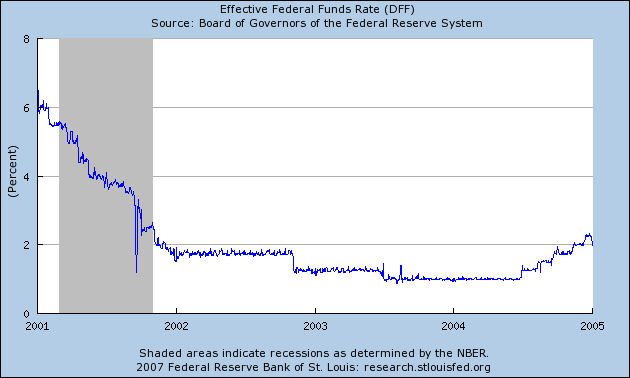
In addition, the Republican argument that their tax cuts are completely responsible for post 2003 growth completely ignores the impact of interest rate policy in the national economy. As this chart shows:

Click for larger version
(click for larger version)

The Fed started cutting the Fed Funds rate in 2001, lowering it near 0% by the end of 2001. Standard economic analysis gives interest rate cuts a lag time of 12-18 months. That means these cuts had their maximum impact in the Spring of 2003 when the economy started to really take-off.

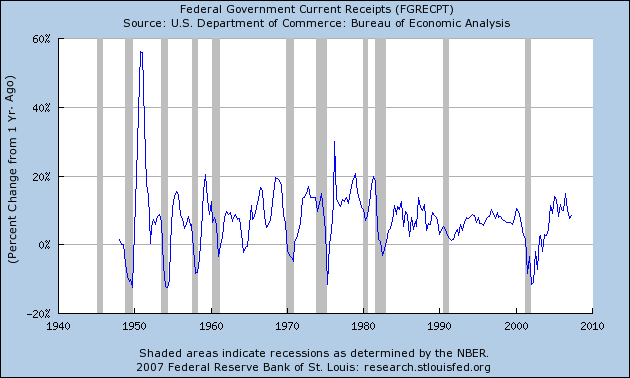
But finally, let's look at the "explosion in tax revenue" the Republicans claim their tax cuts generate. Here is a chart from the St. Louis Federal Reserve which shows the year-over-year percent change in tax receipts. Notice that in the 1980s and 2000s there is no meaningful difference in the percentage change in tax receipts when compared to non - supply - side policy years. In other words, supply-side tax cuts don't provide a meaningful difference in tax receipts when compared to non-supply side years.

Click for larger version
(click for larger version)

Now that I've spent far too much time debunking the latest Republican lies about the economy (on of the joys of living in a talk radio fact free world), let's move on to the reason this is the worst economy of a generation.

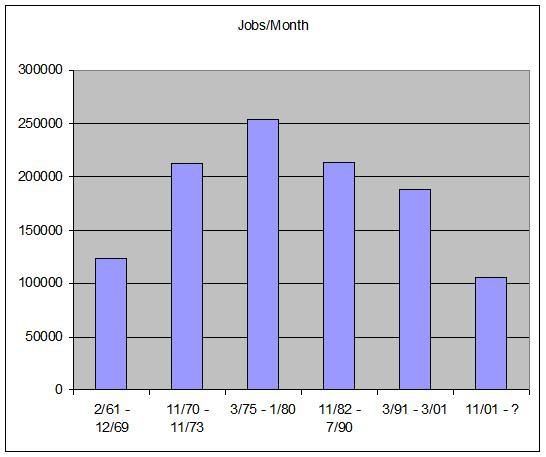
At the center of this issue is the incredibly weak job growth of this expansion. Here is a chart that breaks down job growth of the last 5 expansions into a per month figure. Notice that this expansion has the worst record by far.

Click for larger version
(click for larger version)

Here are two other charts from the Big Picture which show the weakness of job growth.

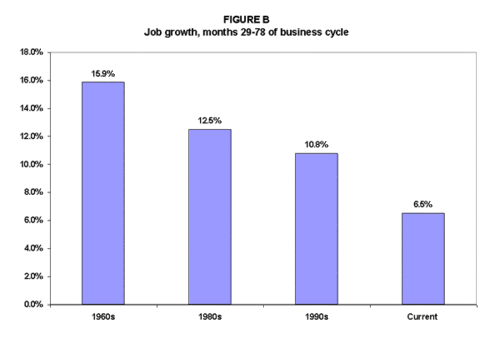
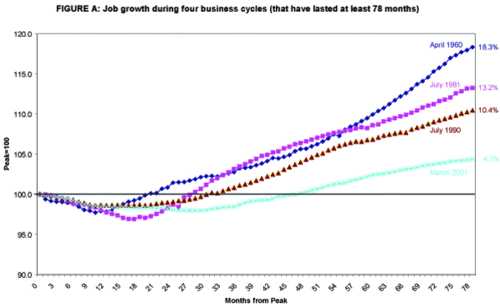
This chart shows the percent growth of jobs for months 29-78 of the last four business expansions. This is the range of months where we are currently in the latest cycle.

Click for larger version
(click for larger version)

This chart shows job growth in the last business cycles that lasted at least as long as the one we are in now.

Click for larger version
(click for larger version)

The bottom line is clear - this expansion ranks last in job creation by a wide margin.

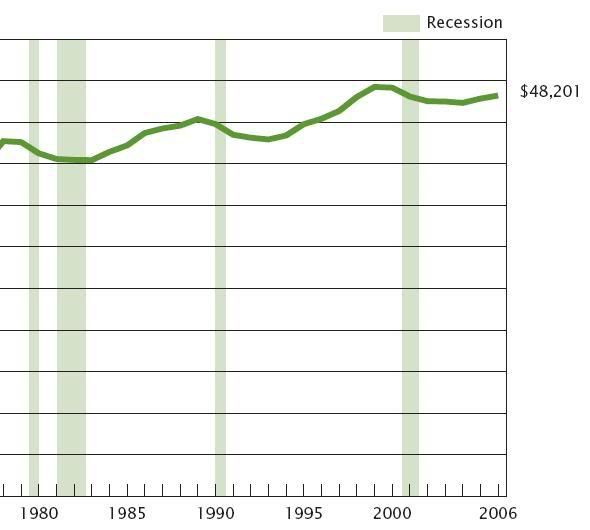
And weak job growth has lead to weak wage growth. Here is a chart from the Census Bureau that shows real median wage growth for the last 25 years. Notice that median income is down for this expansion.

Click for larger version
(click for larger version)

Let's stop right here because at this point we have a lot of information that explains public concern about the economy. First, the economy just isn't creating that many jobs when compared to other expansions. That leads to factor number two - declining median family income. When you put those two factors together you get unhappy people. Jobs aren't as plentiful as they were in previous expansions and people aren't getting raises. That alone is enough to cause widespread discontent. This is why this "greatest story never told" (according to Larry Kudlow) polls so poorly with people. The Republicans are convinced they need better PR. But their PR doesn't stack up to what people are seeing on the ground around them and in their bank accounts. And no amount of PR is going to turn that situation around.

Hale "Bonddad" Stewart is a former bond broker with several regional firms. He has been involved with the financial markets since 1995. He currently practices law in Houston, Texas. Stewart is the proprietor of the Bonddad Blog.

© 2007 Independent Media Institute. All rights reserved.
View this story online at: http://www.alternet.org/story/66976/

Trade Fight: Edwards is Right, Obama's Wrong, Clinton's Useless

By John Nichols, The Nation
Posted on November 8, 2007
http://www.alternet.org/story/67293/

The Peru Free Trade Agreement fight that is coming to a head in Congress pits George Bush and Nancy Pelosi against the workers of the United States and Peru.

As such, it is a test of whether Democrats are satisfied with Pelosi's compromises -- on the war, presidential accountability and domestic policies -- or prefer to oppose the least popular president since Richard Nixon at the height of the Watergate scandal.

Illinois Senator Barack Obama is with Bush and Pelosi. He says he'll vote for the Peru FTA.

New York Senator Hillary Clinton is not sure where she stands. As the House prepares to vote, she could raise her voice to counter that of Pelosi. Instead, she says she's "undecided."

Fortunately, dozens of House Democrats -- including Ohio Congressman Dennis Kucinich -- know where they stand. They will break with Bush and Pelosi to oppose the trade deal. It won't be easy. Pelosi and House Majority Leader Steny Hoyer are whipping Democrats in the chamber to get on board with Bush's plan. And many are doing just that, claiming that the Peru FTA contains meaningful protections for the rights of workers.

The deal's backers are either confused or corrupted.

They are, as well, wrong.

As Illinois Congressman Phil Hare, a former textile union leader who has led the fight against the Bush-Pelosi line, notes: Peru is currently threatening striking miners with the loss of their jobs if they do not return to the mines. That's not protecting the rights of workers. Indeed, says Hare, "The striking miners were fighting for, among other things, an eight hour work day. In addition, we recently learned that there are 2 million children working in Peru, many in these very same mines."

"Is this the progress the supporters of the Peru FTA were referring to?" asks Hare, who adds, "Today's news should serve as yet another wakeup call that the best thing to do for workers both at home and in Peru is defeat this unfair trade deal."

Hare's right. But he needs some allies among the party's leading presidential contenders.

Obama's wrong and Clinton's of no use.

Thankfully, John Edwards is reading the issue right.

"The Peru deal will continue the trade policies that have long failed our workers and cost American workers their jobs," says Edwards. "It's time to show some guts and backbone, stand up and oppose this trade deal, and demand trade policies that put families and workers first. I urge members of Congress to vote against this deal."

Adds the 2004 Democratic presidential nominee: "The fact that the Peru trade deal is supported by a bipartisan group of insiders, including George Bush and senior officials from the first Clinton Administration – many of whom are now lobbyists, corporate lawyers, and business consultants – should be proof-positive of why members of Congress should join with me and oppose this deal. The benefit to corporate lobbyists from both sides of the political aisle will come only at the expense of hard-working families. Senator Obama has chosen to support this bad deal. I strongly disagree with his position, but at least he has taken one. Senator Clinton, on the other hand, has refused to take any position. I urge Senator Clinton to publicly announce, today, her opposition and join with me in encouraging members of Congress to vote against the Peru trade deal."

Edwards is right to stand with Phil Hare, as opposed to Nancy Pelosi and George Bush.

For those who suggest that there are not enough differences between the Democratic frontrunners, here's an example of where one leading contender -- John Edwards -- stands head and shoulders above the others.

John Nichols is The Nation's Washington correspondent.

© 2007 Independent Media Institute. All rights reserved.
View this story online at: http://www.alternet.org/story/67293/

Wednesday, November 07, 2007

Jeremy Scahill on Blackwater: They're Christian Supremacists With a Conversion Agenda [VIDEO]

By Adam Howard, AlterNet
Posted on November 6, 2007
http://www.alternet.org/bloggers/www.alternet.org/67106/

Bill Maher interviewed Jeremy Scahill, author of Blackwater: The Rise of the World's Most Powerful Mercenary Army, on the most recent episode of Real Time. I a just a few minutes Scahill covers the mercenary army's origins (they're named after a swamp), its leader Erik Prince (who has deep ties with the extremist far right) and its plans for world domination (opening bases all over the country, thousands of men they can send to international and domestic conflicts of natural disasters.) Maher and Scahill also talk about how Blackwater mercenaries are better paid and have better armor than American troops in Iraq and how they make fighting the insurgency more difficult since they "commit crimes, shoot up Iraqis" and then the Iraqis retaliate against American troops. Check out the video here.

Adam Howard is the editor of PEEK.

© 2007 Independent Media Institute. All rights reserved.
View this story online at: http://www.alternet.org/bloggers/www.alternet.org/67106/

Tuesday, November 06, 2007

Two Good Reasons Why The Greens May Not Vote For The Democratic Presidential Candidate In 2008

ONE OF THE lies Democrats tell themselves and others is that Ralph Nader was responsible for Al Gore's loss in 2000. In fact:

- Between mid-September and the election, Bush went up about 14 percent in the polls while Nader went up 1 percent.

- As late as two weeks before the election, Gore was 7-10 points ahead in the polls. During this period, Nader changed only one or two points.

- As Michael Eisencher reported in Z Magazine, 20% of all Democratic voters, 12% of all self- identified liberal voters and 31% of all voting union members cast their ballots for Bush. All these constituencies were much larger than the Greens'.

- According to exit polling, those who voted for Nader were disproportionately under 30, independent, first time voters, formerly Perot voters and of no organized religion. In other words, many of his voters did not naturally belong to the Democratic party. In fact, half as many Republicans as Democrats voted for Nader. Six percent of independents and 7% of Perot voters supported Nader while only 2% of Democrats did.

- Perhaps the most important, but seldom mentioned, factor in the outcome was the impact of the Clinton scandals. 68% of voters thought Clinton would go down in history more for his scandals than for his leadership. 44% said that the scandals were somewhat to very important and 57% thought the country to be on the wrong moral track. In short, the individual who did the most harm to Gore (aside from himself) was Bill Clinton. If Gore had distanced himself from the Clinton moral miasma he would probably be president today.

But let's ignore the Democrat's desperate denial and their arrogant presumption that Greens - unlike any other constituency in the country - were meant to vote for Gore without receiving anything in return. What could the Democrats have subsequently done to improve matters with the Greens?

- They could have made it easier, not harder, for third parties to be on the ballot.

- They could have supported instant runoff voting which would have greatly aided Gore in 2000.

- They could have promised Greens a few key posts in their cabinet.

In other words, they could have done what every other sensible party does in democratic countries with a multi-party system: be nice to the people whose votes you want.

Instead, here are two examples of how the Democrats have reacted to the third party challenge. It is disgusting, but it's also kind of stupid.

[Ralph Nader, who ran as an independent last time, has filed a suit challenging the behavior of the Democrats and labor unions against his election campaign. The following - from an interview with Nader attorney Carl Mayer - is from a Democracy Now broadcast)

CARL MAYER - The core of the lawsuit is that these lawyers, led by Toby Moffett and Elizabeth Holtzman, and something called the Ballot Project, which was a 527 organization, systematically went around the country and filed lawsuit after lawsuit, twenty-four in all, plus five FEC complaints, to try to completely remove the Nader campaign from the ballot and to, in effect, bankrupt the campaign, which they succeeded in doing (emphasis mine-Pete). Not content with that, one of the defendants, Reed Smith, which is a large corporate law firm in Pittsburgh, Pennsylvania, they are now going after Ralph Nader's personal bank account to make him pay some of the cost of this litigation.

And, understand, despite being outspent by the Democratic Party and its affiliated lawyers, the vast majority of these lawsuits were won by the Nader campaign, which was a largely volunteer effort. And these lawsuits were won across the country, despite this organized effort of intimidation and harassment. It's basically abusive process and malicious prosecution. Those are common law torts. And it was very clear from the beginning that the Democratic Party was using the legal system for an improper purpose. In fact, Toby Moffett, who's a former congressman from Connecticut, said directly to The Guardian of London in an interview in December of 2004, this wasn't about the law. "I'd be less than honest if I said" this was not about the law; this was about getting Ralph Nader off the ballot. And that's what this effort was about. And it's a shameful anti-democratic process by a party that claims to be a democratic party (emphasis mine-Pete).

And on top of that, the Democratic Party, or its allies, filed five FEC complaints against the campaign, alleging improper . . . funding, improper finances, etc. They were all dismissed by the FEC.

Now, let me tell you how bad it got. There was an organized effort of harassment of petitioners who went around trying to collect signatures for the Nader campaign in Ohio, in Oregon and in Pennsylvania. In Ohio, for example, lawyers were hired to call up petitioners and tell them that if they didn't verify the signatures on the petition, they would be guilty of a felony. They were called at home by -- and they were, in many cases, visited by private investigators and told -- this is voter intimidation of the worst order. . .

The SEIU was involved in trying to keep Nader off the ballot by using its members, for example in Oregon, to go into the convention, but in other states -- in other states, to try to actually void petitions by signing in the wrong place. The complaint -- and this is all documented. . . It's a seventy-three-page complaint, over 250 paragraphs, chapter and verse, about how, for example, the SEIU came up with the strategy of getting its members to go and write signatures in the wrong place on a petition, on Nader's petitions, which would then invalidate the entire petition. So this was a coordinated anti-democratic activity, which in my view has little precedent in American history, and any third-party candidate of whatever stripe -- leftwing, rightwing, populist, conservative -- they should be outraged by what occurred in this case.

And we think we have a tremendous case before the D.C. Superior Court and other legal actions we will take, because . . . they were so adamant and vociferous about it, and the paper trail is very clear. And we're not even into discovery. We can't wait to take the depositions of the party activists, Toby Moffett, Terry McAuliffe, Elizabeth Holtzman, etc., who were at the center of this. . .

It doesn't matter whether it's Ralph Nader or Michael Bloomberg or any other third-party candidate. The point is, we need as much competition in the political arena as we have in other areas of American life. And it's time to stop rigging the game.

And what's unbelievable is that the laws on the books already pose a tremendously high hurdle for third-party candidates. Tens of thousands of signatures, it takes, to get on the ballot in states like Texas and the Carolinas. And there's no other country where it's so difficult to get on the ballot. And those laws are passed by the Democrat and Republican Party to preserve their monopoly. . .

And recall also that in the history of the country, third parties were very important. In the nineteenth century, it was much easier to get on the ballot. The smaller third parties championed first important issues like ending slavery, women's right to vote, Social Security; those were all first advocated by third parties. And if you exclude third parties from the ballot and from the debate, our democracy withers and atrophies. . .

[In Maine, where Greens have been more successful than elsewhere, the Democrats have engaged in similar bad sport tactics. When a Green won the first state legislative seat in the country, the Democrats redistricted his seat. And it hasn't stopped. Remember these are the folks the Democrats are going to blame if they lose in 2008]

KELLEY BOUCHARD, PORTLAND PRESS HERALD - A well-known Portland Democrat has begun a campaign to oppose the election of Green Independent Party candidates in Tuesday's city election. Anthony Buxton, a founder of Democracy Maine and a leader of the state's Hillary Clinton campaign, has started putting up signs blaming Greens for problems on Portland's City Council and School Committee.

Buxton said he plans to post as many as 200 signs throughout Maine's largest city that read, "These Greens Cause Chaos." The signs show the last names of John Anton and Benjamin Meiklejohn crossed out in red. He filed a campaign expense report of $3,000 Tuesday at City Hall.

Anton is an at-large candidate for City Council. Meiklejohn is an at-large candidate seeking a third term on the School Committee.

Although the city's elections are nonpartisan, Greens recently have gained ground in Portland, where Democrats traditionally dominate.

Greens hold three of nine seats on the School Committee and two of nine seats on the City Council. Four Greens are among 14 candidates for a total of six open seats on the two panels.

Saturday, November 03, 2007

Low Morale Has U.S. Troops in Iraq Pretending to Patrol

By Dahr Jamail, IPS News
Posted on October 26, 2007
http://www.alternet.org/story/66160/

New York -- Iraq war veterans now stationed at a base here in upstate New York say that morale among US soldiers in the country is so poor, many are simply parking their Humvees and pretending to be on patrol, a practice dubbed "search and avoid" missions.

Phil Aliff is an active duty soldier with the 10th Mountain Division stationed at Fort Drum. He served nearly one year in Iraq from August 2005 to July 2006, in the areas of Abu Ghraib and Fallujah, both west of Baghdad.

"Morale was incredibly low," said Aliff, adding that he joined the military because he was raised in a poor family by a single mother and had few other prospects. "Most men in my platoon in Iraq were just in from combat tours in Afghanistan."

According to Aliff, their mission was to help the Iraqi army "stand up" in the Abu Ghraib area of western Baghdad, but in fact his platoon was doing all the fighting without support from the Iraqis they were supposedly preparing to take control of the security situation.

"I never heard of an Iraqi unit that was able to operate on their own," said Aliff, who is now a member of the group Iraq Veterans Against the War (IVAW). "The only reason we were replaced by an Iraqi army unit was for publicity."

Aliff said he participated in roughly 300 patrols. "We were hit by so many roadside bombs we became incredibly demoralized, so we decided the only way we wouldn't be blown up was to avoid driving around all the time."

"So we would go find an open field and park, and call our base every hour to tell them we were searching for weapons caches in the fields and doing weapons patrols and everything was going fine," he said, adding, "All our enlisted people became very disenchanted with our chain of command."

Aliff, who suffers from post-traumatic stress disorder (PTSD), refused to return to Iraq with his unit, which arrived in Kirkuk two weeks ago. "They've already lost a guy, and they are now fostering the sectarian violence by arming the Sunnis while supporting the Shi'ites politically ... classic divide and conquer."

Aliff said he is set to be discharged by the military next month because they claim his PTSD "is untreatable by their doctors".

According to the Department of Veterans Affairs (VA), the number of Iraq and Afghanistan war veterans seeking treatment for PTSD increased nearly 70% in the 12 months ending on June 30.

The nearly 50,000 VA-documented PTSD cases greatly exceed the 30,000 military personnel that the Pentagon officially classifies as wounded in both occupations.

VA records show that mental health has become the second-largest area of illness for which veterans of the ongoing occupations are seeking treatment at VA hospitals and clinics. The total number of mental health cases among war veterans increased by 58%; from 63,767 on June 30, 2006, to 100,580 on June 30, 2007, according to the VA.

Other active duty Iraq veterans tell similar stories of disobeying orders so as not to be attacked so frequently.

"We'd go to the end of our patrol route and set up on top of a bridge and use it as an over-watch position," Eli Wright, also an active duty soldier with the 10th Mountain Division, said. "We would just sit with our binoculars and observe rather than sweep. We'd call in radio checks every hour and say we were doing sweeps."

Wright added, "It was a common tactic, a lot of people did that. We'd just hang out, listen to music, smoke cigarettes, and pretend." The 26-year-old medic complained that his unit did not have any armored Humvees during his time in Iraq, where he was stationed in Ramadi, capital of the volatile al-Anbar province.

"We put sandbags on the floors of our vehicles, which had canvas doors," said Wright, who was in Iraq from September 2003 until September 2004. "By the end of our tour, we were bolting any metal we could find to our Humvees. Everyone was doing this, and we didn't get armored Humvees in country until after we left."

Other veterans, like 25-year-old Nathan Lewis, who was in Iraq for the invasion of March 2003 until June of that year while serving in the 214th field artillery brigade, complained of lack of training for what they were ordered to do, in addition to not having armored Humvees for their travels.

"We never got training for a lot of the work we did," he explained. "We had a white phosphorous mortar round that cooked off in the back of one of our trucks, because we loaded that with some other ammo, and we weren't trained how to do it the right way."

The "search and avoid" missions appear to have been commonplace around much of Iraq for years now.

Geoff Millard served nine years in the New York Army National Guard, and was in Iraq from October 2004 until October 2005 working for a general at a Tactical Operation Center.

Millard, also a member of IVAW, said that part of his duties included reporting "significant actions", or SIGACTS, which is how the US military describes an attack on their forces.

"We had units that never called in SIGACTS," Millard, who monitored highly volatile areas like Baquba, Tikrit and Samarra, said. "When I was there two years ago, there were at least five companies that never had SIGACTS. I think 'search and avoids' have been going on there for a long time."

Millard said "search and avoid" missions continue today across Iraq. "One of my buddies is in Baghdad right now and we email all the time," he explained, "He just told me that nearly each day they pull into a parking lot, drink soda and shoot at the cans. They pay Iraqi kids to bring them things and spread the word that they are not doing anything and to please just leave them alone."

Dahr Jamail is an independent journalist who reports from Iraq.

© 2007 Independent Media Institute. All rights reserved.
View this story online at: http://www.alternet.org/story/66160/

Talking Points

Wednesday, October 31, 2007

The American Police State

http://www.truthdig.com/report/item/20071029_the_american_police_state/

Posted on Oct 29, 2007

By Chris Hedges

A Dallas jury, a week ago, caused a mistrial in the government case against this country’s largest Islamic charity. The action raises a defiant fist on the sinking ship of American democracy.

If we lived in a state where due process and the rule of law could curb the despotism of the Bush administration, this mistrial might be counted a victory. But we do not. The jury may have rejected the federal government’s claim that the Holy Land Foundation for Relief and Development funneled millions of dollars to Middle Eastern terrorists. It may have acquitted Mohammad el-Mezain, the former chairman of the foundation, of virtually all criminal charges related to funding terrorism (the jury deadlocked on one of the 32 charges against el-Mezain), and it may have deadlocked on the charges that had been lodged against four other former leaders of the charity, but don’t be fooled. This mistrial will do nothing to impede the administration’s ongoing contempt for the rule of law. It will do nothing to stop the curtailment of our civil liberties and rights. The grim march toward a police state continues.

Constitutional rights are minor inconveniences, noisome chatter, flies to be batted away on the steady road to despotism. And no one, not the courts, not the press, not the gutless Democratic opposition, not a compliant and passive citizenry hypnotized by tawdry television spectacles and celebrity gossip, seems capable of stopping the process. Those in power know this. We, too, might as well know it.

The Bush administration, which froze the foundation’s finances three months after the Sept. 11, 2001, terrorist attacks and indicted its officials three years later on charges that they provided funds for the militant group Hamas, has ensured that the foundation and all other Palestinian charities will never reopen in the United States. Any organized support for Palestinians from within the U.S. has been rendered impossible. The goal of the Israeli government and the Bush administration—despite the charade of peace negotiations to be held at Annapolis—is to grind defiant Palestinians into the dirt. Israel, which has plunged the Gaza Strip into one of the world’s worst humanitarian crises, has now begun to ban fuel supplies and sever electrical service. The severe deprivation, the Israelis hope, will see the overthrow of the Hamas government in Gaza and the reinstatement of Palestinian President Mahmoud Abbas, who has become the Marshal Pétain of the Palestinian people.

The Dallas trial—like all of the major terrorism trials conducted by this administration, from the Florida case against the Palestinian activist Dr. Sami al-Arian, which also ended in a mistrial, to the recent decision by a jury in Chicago to acquit two men of charges of financing Hamas—has been a judicial failure. William Neal, a juror in the Dallas trial, told the Associated Press that the case “was strung together with macaroni noodles. There was so little evidence.”

Such trials, however, have been politically expedient. The accusations, true or untrue, serve the aims of the administration. A jury in Tampa, Chicago or Dallas can dismiss the government’s assaults on individual rights, but the draconian restrictions put in place because of the mendacious charges remain firmly implanted within the system. It is the charges, not the facts, which matter.

Dr. al-Arian, who was supposed to have been released and deported in April, is still in a Virginia prison because he will not testify in a separate case before a grand jury. The professor, broken by the long ordeal of his trial and unable to raise another million dollars in legal fees for a retrial, pleaded guilty to a minor charge in the hopes that his persecution would end. It has not. Or take the case of Canadian citizen Maher Arar, who in 2002 was spirited away by Homeland Security from JFK Airport to Syria, where he spent 10 months being tortured in a coffin-like cell. He was, upon his release, exonerated of terrorism. Arar testified before a House panel this month about how he was abducted by the U.S. and interrogated, stripped of his legal rights and tortured. But he couldn’t testify in person. He spoke to the House members on a video link from Canada. He is forbidden by Homeland Security to enter the United States because he allegedly poses a threat to national security.

Those accused of being involved in conspiracies and terrorism plots, as in all police states, become nonpersons. There is no rehabilitation. There is no justice.

"He was never given a hearing nor did the Canadian consulate, his lawyer, or his family know of his fate,” Amnesty International wrote of Arar. “Expulsion in such circumstances, without a fair hearing, and to a country known for regularly torturing their prisoners, violates the U.S. Government’s obligations under international law, specifically the Convention against Torture and Other Cruel, Inhuman, or Degrading Treatment or Punishment.”

You can almost hear Dick Cheney yawn.

The Bush administration shut down the Holy Land Foundation for Relief and Development six years ago and froze its assets. There was no hearing or trial. It became a crime for anyone to engage in transactions with the foundation. The administration never produced evidence to support the charges. It did not have any. In the “war on terror,” evidence is unnecessary. An executive order is enough. The foundation sued the government in a federal court in the District of Columbia. Behind closed doors, the government presented secret evidence that the charity had no opportunity to see or rebut. The charity’s case was dismissed.

The government has closed seven Muslim charities in the United States and frozen their assets. Not one of them, or any person associated with them, has been found guilty of financing terrorism. They will remain shut. George W. Bush can tar any organization or individual, here or abroad, as being part of a terrorist conspiracy and by fiat render them powerless. He does not need to make formal charges. He does not need to wait for a trial verdict. Secret evidence, which these court cases have exposed as a sham, is enough. The juries in Tampa, Chicago and Dallas did their duty. They spoke for the rights of citizens. They spoke for the protection of due process and the rule of law. They threw small hurdles in front of the emergent police state. But the abuse rolls on. I fear terrorism. I know it is real. I am sure terrorists will strike again on American soil. But while terrorists can wound and disrupt our democracy, only we can kill it.

Why Did We Invade Iraq Anyway?

Putting a Country in Your Tank
By Michael Schwartz

Lately, even Democratic candidates for president have been weighing in on why the U.S. must maintain a long-term, powerful military presence in Iraq. Hillary Clinton, for example, used phrases like protecting our "vital national security interests" and preventing Iraq from becoming a "petri dish for insurgents," in a major policy statement. Barack Obama, in his most important speech on the subject, talked of "maintaining our influence" and allowing "our troops to strike directly at al Qaeda." These arguments, like the constantly migrating justifications for invading Iraq, serially articulated by the Bush administration, manage to be vaguely plausible (with an emphasis on the "vaguely") and also strangely inconsistent (with an emphasis on the "inconsistent").

That these justifications for invading, or remaining, are unsatisfying is hardly surprising, given the reluctance of American politicians to mention the approximately $10-$30 trillion of oil lurking just beneath the surface of the Iraq "debate" -- and not much further beneath the surface of Iraqi soil. Obama, for example, did not mention oil at all in his speech, while Clinton mentioned it twice in passing. President Bush and his top officials and spokespeople have been just as reticent on the subject.

Why then did the U.S. invade Iraq? Why is occupying Iraq so "vital" to those "national security interests" of ours? None of this makes sense if you don't have the patience to drill a little beneath the surface – and into the past; if you don't take into account that, as former Deputy Secretary of Defense Paul Wolfowitz once put it, Iraq "floats on a sea of oil"; and if you don't consider the decades-long U.S. campaign to control, in some fashion, Middle East energy reservoirs. If not, then you can't understand the incredible tenaciousness with which George W. Bush and his top officials have pursued their Iraqi dreams or why -- now that those dreams are clearly so many nightmares -- even the Democrats can't give up the ghost.

The Rise of OPEC

The United States viewed Middle Eastern oil as a precious prize long before the Iraq war. During World War II, that interest had already sprung to life: When British officials declared Middle Eastern oil "a vital prize for any power interested in world influence or domination," American officials agreed, calling it "a stupendous source of strategic power and one of the greatest material prizes in world history."

This led to a scramble for access during which the United States established itself as the preeminent power of the future. Crucially, President Franklin Delano Roosevelt successfully negotiated an "oil for protection" agreement with King Abdul Aziz Ibn Saud of Saudi Arabia. That was 1945. From then on, the U.S. found itself actively (if often secretly) engaged in the region. American agents were deeply involved in the overthrow of a democratically elected Iranian government in 1953 (to reverse the nationalization of Iran's oil fields), as well as in the fateful establishment of a Baathist Party dictatorship in Iraq in the early 1960s (to prevent the ascendancy of leftists who, it was feared, would align the country with the Soviet Union, putting the country's oil in hock to the Soviet bloc).

U.S. influence in the Middle East began to wane in the 1970s, when the Organization of the Petroleum Exporting Countries (OPEC) was first formed to coordinate the production and pricing of oil on a worldwide basis. OPEC's power was consolidated as various countries created their own oil companies, nationalized their oil holdings, and wrested decision-making away from the "Seven Sisters," the Western oil giants -- among them Shell, Texaco, and Standard Oil of New Jersey -- that had previously dominated exploration, extraction, and sales of black gold.

With all the key oil exporters on board, OPEC began deciding just how much oil would be extracted and sold onto international markets. Once the group established that all members would follow collective decisions -- because even a single major dissenter might fatally undermine the ability to turn the energy "spigot" on or off -- it could use the threat of production restrictions, or the promise of expansion, to bargain with its most powerful trading partners. In effect, a new power bloc had emerged on the international scene that could -- in some circumstances -- exact tangible concessions even from the United States and the Soviet Union, the two superpowers of the time.

Though the United States was largely self-sufficient in oil when OPEC was first formed, the American economy was still dependent on trading partners, particularly Japan and Europe, which themselves were dependent on Middle Eastern oil. The oil crises of the early 1970s, including the sometimes endless gas lines in the U.S., demonstrated OPEC's potential.

It was in this context that the American alliance with the Saudi royal family first became so crucial. With the largest petroleum reserves on the planet and the largest production capacity among OPEC members, Saudi Arabia was usually able to shape the cartel's policies to conform to its wishes. In response to this simple but essential fact, successive American presidents strengthened the Rooseveltian alliance, deepening economic and military relationships between the two countries. The Saudis, in turn, could normally be depended upon to use their leverage within OPEC to fit the group's actions into the broader aims of U.S. policy. In other words, Washington gained favorable OPEC policies mainly by arming, and propping up a Saudi regime that was chronically fragile.

Backed by a tiny elite that used immense oil revenues to service its own narrow interests, the Saudi royals subjected their impoverished population to an oppressively authoritarian regime. Not surprisingly, then, the "alliance" required increasing infusions of American military aid as well political support in situations that were often uncomfortable, sometimes untenable, for Washington. On its part, in an era of growing nationalism, the Saudis found overt pro-American policies difficult to sustain, given the pressures and proclivities of its OPEC partners and its own population.

The Neocons Seize the Unipolar Moment

The key year in the Middle East would be 1979, when Iranians, who had lost their government to an American and British inspired coup in 1953, poured into the streets. The American-backed Shah's brutal regime fell to a popular revolution; American diplomats were taken hostage by Iranian student demonstrators; and Ayatollah Khomeini and the mullahs took power. The Iranian revolution added a combustible new element to an already complex and unstable equation. It was, in a sense, the match lit near the pipeline. A regime hostile to Washington, and not particularly amenable to Saudi pressure, had now become an active member of OPEC, aspiring to use the organization to challenge American economic hegemony.

It was at this moment, not surprisingly, that the militarization of American Middle Eastern policy came out of the shadows. In 1980, President Jimmy Carter -- before his Habitat for Humanity days -- enunciated what would become known as the "Carter Doctrine": that Persian Gulf oil was "vital" to American national interests and that the U.S. would use "any means necessary, including military force" to sustain access to it. To assure that "access," he announced the creation of a Rapid Deployment Joint Task Force, a new military command structure that would be able to deliver personnel from all the armed services, together with state-of-the-art military equipment, to any location in the Middle East at top speed.

Nurtured and expanded by succeeding presidents, this evolved into the United States Central Command (Centcom), which ended up in charge of all U.S. military activity in the Middle East and surrounding regions. It would prove the military foundation for the Gulf War of 1990, which rolled back Saddam Hussein's occupation of Kuwait, and therefore prevented him from gaining control of that country's oil reserves. Though it was not emphasized at the time, that first Gulf War was a crystalline application of the Carter Doctrine -- that "any means necessary, including military force," should be used to guarantee American access to Middle Eastern oil. That war, in turn, convinced a shaky Saudi royal family -- that saw Iraqi troops reach its border – to accept an ongoing American military presence within the country, a development meant to facilitate future applications of the Carter Doctrine, but which would have devastating unintended consequences.

The peaceful disintegration of the Soviet Union at almost the same moment seemed to signal that Washington now had uncontested global military supremacy, triggering a debate within American policy circles about how to utilize and preserve what Washington Post columnist Charles Krauthammer first called the "unipolar moment." Future members of the administration of Bush the younger were especially fierce advocates for making aggressive use of this military superiority to enhance U.S. power everywhere, but especially in the Middle East. They eventually formed a policy advocacy group, The Project for a New American Century, to develop, and lobby for, their views. The group, whose membership included Dick Cheney, Donald Rumsfeld, Paul Wolfowitz and dozens of other key individuals who would hold important positions in the executive branch after George W. Bush took office, wrote an open letter to President Clinton in 1998 urging him to turn his "administration's attention to implementing a strategy for removing Saddam's regime from power." They cited both the Iraqi dictator's military belligerence and his control over "a significant portion of the world's supply of oil."

Two years later, the group issued a ringing policy statement that would be the guiding text for the new administration. Entitled Rebuilding America's Defenses, it advocated what would become known as a Rumsfeldian-style transformation of the Pentagon. U.S. military preeminence was to be utilized to "secure and expand'' American influence globally and possibly, in the cases of North Korea and Iraq, used "to remove these regimes from power and conduct post-combat stability operations." (The document even commented on the problem of defusing American domestic resistance to such an aggressive stance, noting ominously that public approval could not be obtained without "some catastrophic and catalyzing event -- like a new Pearl Harbor.")

Saddam's Iraq and Oil on the Brain

The second Bush administration ascended to the presidency just as American influence in the Middle East looked to be on the decline. Despite victory in the first Gulf War and the fall of the Soviet Union, American influence over OPEC and oil policies seemed under threat. That sucking sound everyone suddenly heard was a tremendous increase in the global demand for oil. With fears rising that, in the very near future, such demand could put a strain on OPEC's resources, member states began negotiating ever more vigorously for a range of concessions and expanded political power in exchange for expanded energy production. By this time, of course, the United States had joined the ranks of the energy deficient and dependent, as imported oil surged past the 50% mark.

In the meantime, key ally Saudi Arabia was further weakened by the rise of al-Qaeda, which took as its main goal the overthrow of the royal family, and its key target -- think of those unintended consequences -- the American troops triumphantly stationed at permanent bases in the country after Gulf War I. They seemed to confirm the accusations of Osama bin Laden and other Saudi dissidents that the royal family had indeed become little but a tool of American imperialism. This, in turn, made the Saudi royals increasingly reluctant hosts for those troops and ever more hesitant supporters of pro-American policies within OPEC.

The situation was complicated further by what was obvious to any observer: The potential future leverage that both Iraq and Iran might wield in OPEC. With the second and third largest oil reserves on the planet -- Iran also had the second largest reserves of natural gas -- their influence seemed bound to rise. Iraq's, in particular, would be amplified substantially as soon as Saddam Hussein's regime was freed from severe limitations imposed by post-war UN sanctions, which prevented it from either developing new oil fields or upgrading its deteriorating energy infrastructure. Though the leaders of the two countries were enemies, having fought a bitter war in the 1980s, they could agree, at least, on energy policies aimed at thwarting American desires or demands -- a position only strengthened in 1998 when the citizens of Venezuela, the most important OPEC member outside the Middle East, elected the decidedly anti-American Hugo Chavez as president. In other words, in January 2001, the new administration in Washington could look forward to negotiating oil policy not only with a reluctant Saudi royal family, but also a coterie of hostile powers in a strengthened OPEC.

It is hardly surprising, then, that the new administration, bent on unipolarity anyway and dreaming of a global Pax Americana, wasted no time implementing the aggressive policies advocated in the PNAC manifesto. According to then Secretary of the Treasury Paul O'Neill in his memoir The Price of Loyalty, Iraq was much on the mind of Defense Secretary Donald Rumsfeld at the first meeting of the National Security Council on January 30, 2001, seven months before the 9/11 attacks. At that meeting, Rumsfeld argued that the Clinton administration's Middle Eastern focus on Israel-Palestine should be unceremoniously dumped. "[W]hat we really want to think about," he reportedly said, "is going after Saddam." Regime change in Iraq, he argued, would allow the U.S. to enhance the situation of the pro-American Kurds, redirect Iraq toward a market economy, and guarantee a favorable oil policy.

The adjudication of Rumsfeld's recommendation was shuffled off to the mysterious National Energy Policy Development Group that Vice President Cheney convened as soon as Bush took occupancy of the Oval Office. This task force quickly decided that enhanced American influence over the production and sale of Middle East oil should be "a primary focus of U.S. international energy policy," relegating both the development of alternative energy sources and domestic energy conservation measures to secondary, or even tertiary, status. A central goal of the administration's Middle East focus would be to convince, or coerce, states in that region "to open up areas of their energy sectors to foreign investment"; that is, to replace government control of the oil spigot -- the linchpin of OPEC power -- with decision-making by multinational oil companies headquartered in the West and responsive to U.S. policy needs. If such a program could be extended even to a substantial minority of Middle Eastern oil fields, it would prevent coordinated decision-making and constrain, if not break, the power of OPEC. This was a theoretically enticing way to staunch the loss of American power in the region and truly turn the Bush years into a new unipolar moment in the Middle East.

Having determined its goals, the Task Force began laying out a more detailed strategy. According to Jane Mayer of the New Yorker, the most significant innovation was to be a close collaboration between Cheney's energy crew and the National Security Council (NSC). The NSC evidently agreed "to cooperate fully with the Energy Task Force as it considered the 'melding' of two seemingly unrelated areas of policy: 'the review of operational policies towards rogue states,' such as Iraq, and 'actions regarding the capture of new and existing oil and gas fields.'"

Though all these deliberations were secret, enough of what was going on has emerged in these last years to demonstrate that the "melding" process was successful. By March of 2001, according to O'Neill, who was a member of both the NSC and the task force:

"Actual plans.... were already being discussed to take over Iraq and occupy it -- complete with disposition of oil fields, peacekeeping forces, and war crimes tribunals -- carrying forward an unspoken doctrine of preemptive war."

O'Neill also reported that, by the time of the 9/11 attacks on the World Trade Center and the Pentagon, the plan for conquering Iraq had been developed and that Secretary of Defense Rumsfeld indeed urged just such an attack at the first National Security Council meeting convened to discuss how the U.S. should react to the disaster. After several days of discussion, an attack on Iraq was postponed until after al-Qaeda had been wiped out and the Taliban driven from power in Afghanistan. It took only until January 2002 -- three months of largely successful fighting in Afghanistan -- before the "administration focus was returning to Iraq." It wasn't until November 2002, though, that O'Neill heard the President himself endorse the invasion plans, which took place the following March 20th.

The Logic of Regime Change

With this background, it's easier to understand the recent brief, but highly significant, flurry of controversy over a single sentence in The Age of Turbulence, the bestselling, over-500-page memoir by longtime Federal Reserve Chairman Alan Greenspan. He wrote simply, as if this were utterly self-evident: "I am saddened that it is politically inconvenient to acknowledge what everyone knows: the Iraq war is largely about oil." As the first major government official to make such a statement, he was asked repeatedly to explain his thinking, particularly since his comment was immediately repudiated by various government officials, including White House spokesman Tony Fratto, who labeled it "Georgetown cocktail party analysis."

His subsequent comments elaborated on a brief explanation in the memoir: "It should be obvious that as long as the United States is beholden to potentially unfriendly sources of oil and gas, we are vulnerable to economic crises over which we have little control." Since former ally Saddam Hussein was, by then, unremittingly unfriendly, Greenspan felt that (as he told Washington Post reporter Bob Woodward) "taking Saddam out was essential" in order to make "certain that the existing system [of oil markets] continues to work." In an interview at Democracy Now! he elaborated on this point, explaining that his support for ousting Hussein had "nothing to do with the weapons of mass destruction," but rather with the economic "threat he could create to the rest of the world" through his control over key oil reserves in the Persian Gulf region.

Greenspan's argument echoes the logic expressed by the Project for a New American Century and other advocates of aggressive military solutions to the threat of OPEC power. He was concerned that Saddam Hussein, once an ally, but by then a sworn enemy of U.S. interests in the Middle East, would control key oil flows. That, in turn, might allow him to exercise economic, and so political, leverage over the United States and its allies.

The former Fed chief then elaborated further, arguing that the threat of Saddam could be eliminated "by one means or another" -- either by "getting him out of office or getting him out of the control position he was in." Replacing Saddam with a friendly, pro-American government seemed, of course, like such a no-brainer. Why have a guy like that in a "control position" over oil, after all? (And think of the possibility of taking those embarrassing troops out of Saudi Arabia and stationing them at large permanent bases in nearby, well-situated, oil-rich Iraq.) Better by far, as the Cheney Energy Task put it, "to open up areas of [Iraq's] energy sectors to foreign investment." Like the Task Force members, Greenspan believed that removing oil -- not just from Saddam's control, but from the control of any Iraqi government -- would permanently remove the threat that it or a broken OPEC could continue to wield economic leverage over the United States.

Revealingly enough, Greenspan saw the invasion of Iraq as a generically conservative action -- a return, if anything, to the status quo ante that would preserve unencumbered American access to sufficient Middle Eastern oil. With whole new energy-devouring economies coming on line in Asia, continued American access seemed to require stripping key Middle Eastern nations of the economic and political power that scarcity had already begun to confer. In other words, Greenspan's conservative urge implied exactly the revolutionary changes in the political and economic equation that the Bush administration would begin to test out so disastrously in Iraq in March 2003. It's also worth remembering that Iraq was only considered a first pit stop, an easy mark for invasion and occupation. PNAC-nurtured eyes were already turning to Iran by then as indicated by the classic prewar neocon quip, "Everyone wants to go to Baghdad. Real men want to go to Tehran."

And beyond this set of radical changes in the Middle East lay another set for the rest of the world. In the twenty-first century, expanding energy demand will, sooner or later (probably sooner), outdistance production. The goal of unfettered American access to sufficient Middle Eastern oil would, if achieved and sustained, deprive other countries of sufficient oil, or require them to satisfy U.S. demands in order to access it. In other words, Greenspan's conservative effort to preserve American access implied a dramatic increase in American leverage over all countries that depended on oil for their economic welfare; that is, a radical transformation of the global balance of power.

Notice that these ambitions, and the actions taken to implement them, rested on a vision of an imperial America that should, could, and would play a uniquely dominant, problem-solving role in world affairs. All other countries would, of course, continue to be "vulnerable to economic crises" over which they would have "little control." Only the United States had the essential right to threaten, or simply apply, overwhelming military power to the "problem" of energy; only it had the right to subdue any country that attempted to create -- or exploit -- an energy crisis, or that simply had the potential and animus to do so.

None of this was lost on the unipolar-minded officials who made the decision to invade Iraq -- and were more ready than any previous administration to spell out, shock-and-awe style, a new stronger version of the Carter Doctrine for the planet. According to Treasury Secretary O'Neill, Rumsfeld offered a vision of the grandiosity of these goals at the first Bush administration National Security Council meeting:

"Imagine what the region would look like without Saddam and with a regime that's aligned with U.S. interests. It would change everything in the region and beyond."

An even more grandiose vision was offered to the New York Times by presidential speech writer David Frum a few days later:

"An American-led overthrow of Saddam Hussein, and the replacement of the radical Baathist dictatorship with a new government more closely aligned with the United States, would put America more wholly in charge of the region than any power since the Ottomans, or maybe even the Romans."

As worldwide demand for hydrocarbons soared, the United States was left with three policy choices: It could try to combine alternative energy sources with rigorous conservation to reduce or eliminate a significant portion of energy imports; it could accept the leverage conferred on OPEC by the energy crunch and attempt to negotiate for an adequate share of what might soon enough become an inadequate supply; or it could use its military power in an effort to coerce Middle East suppliers into satisfying American requirements at the expense of everyone else. Beginning with Jimmy Carter, five U.S. presidents chose the coercive strategy, with George W. Bush finally deciding that violent, preemptive regime change was needed to make it work. The other options remain unexplored.

[Note: This commentary -- and most of the useful work on the role of oil in Middle East and world politics -- rests on the remarkable evidential and analytic foundation provided by Michael Klare's indispensable book, Blood and Oil,The Dangers and Consequences of America's Growing Dependency on Imported Petroleum. Readers who seek a full understanding of these issues should start with that text.]

Michael Schwartz, Professor of Sociology and Founding Director of the Undergraduate College of Global Studies at Stony Brook University, has written extensively on popular protest and insurgency, and on American business and government dynamics. His books include Radical Protest and Social Structure and Social Policy and The Conservative Agenda (edited, with Clarence Lo). His work on Iraq has appeared on numerous Internet sites, including Tomdispatch, Asia Times, Mother Jones, and ZNET; and in print in Cities, Contexts, Against the Current, and Z Magazine. His email address is Ms42@optonline.net.

Copyright 2007 Michael Schwartz

Cleveland march against police brutality

Published Oct 28, 2007

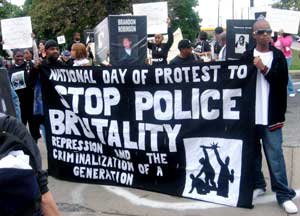
More than 100 angry, impassioned people marched along Cleveland’s Luke Easter Park and rallied in the parking lot of the Cleveland Police 4th District building against police brutality on Oct. 22.

While family members told of the killings of their loved ones, they turned and looked right up at the very police, watching from the rooftop balcony, who represent the source of their losses.

One speaker was the grandmother of Brandon McCloud, who at 15 was shot multiple times in his bedroom closet in her house. Other family members spoke of Jena 6-type scenarios of long prison sentences for young men of color innocent of any wrongdoing.

Others had died in police custody in that very building. At the end of the rally, the crowd marched into the police lobby, first silently, then singing, chanting, and praying. Everyone there vowed to build a movement for justice.

—Report and photo by Sharon Danann


Articles copyright 1995-2007 Workers World. Verbatim copying and distribution of this entire article is permitted in any medium without royalty provided this notice is preserved.

Workers World, 55 W. 17 St., NY, NY 10011
Email: ww@workers.org
Subscribe wwnews-subscribe@workersworld.net
Support independent news http://www.workers.org/orders/donate.php
site promotion

Page printed from:
http://www.workers.org/2007/us/cleveland-1011/

Tuesday, October 30, 2007

Return to Sender: Congress Takes Up Unfair Postal Rate Hikes

From Free Press, October 30, 2007


A key House Subcommittee will look into the devastating impact of new postal rate hikes on independent publications, including some of the country’s most important political journals.

In March 2007, the Postal Board of Governors, the body that regulates postal policy in the United States, voted to drastically hike postal rates on small and independent periodicals. The new rates — which are based on a proposal submitted by Time Warner — unfairly shift the burden of postal costs from magazines like Time and People with large circulations and heavy advertising onto smaller publications.

“The impact of the new postal rate increase on the flow of ideas and opinions in America is likely to be significant,” said Victor Navasky, chairman of the Columbia Journalism Review and publisher emeritus of The Nation. “Precisely those magazines that devote the most space to public affairs — to covering in-depth events like the hearings today — are being put in serious jeopardy.”

Navasky will testify before the Subcommittee on the Federal Workforce, Postal Service and the District of Columbia alongside Jeff Hollingsworth, vice president of Eagle Publishing, which produces Human Events and the Evans-Novak Political Report, among other publications.

“The postal regulators have given small publishers a nasty trick, not a treat, and it’s not funny at all,” Hollingsworth said. “Regrettably, all too often when it comes to dealings with government, it’s not about what it can do for you, but what it can do to you. Such is the case with the latest in a dizzying round of postal rate increases.”

Navasky and Hollingsworth will be representing a coalition of publications — which also includes The National Review, Mother Jonesz, The Weekly Standard and Ms. — that faces rate increases of as much as 20-30 percent. The hike will cost these publications hundreds of thousands of dollars, forcing the magazines to make significant cutbacks or even go out of business.

Working with the national, nonpartisan media policy group Free Press, publishers have alerted their readers about the threat from the unfair rate hikes. Nearly 100,000 concerned citizens have contacted their members of Congress via Free Press’ StopPostalRateHikes.com Web site.

“These unjust rate hikes go against more than 200 years of postal policy,” said Ben Scott, policy director of Free Press. “Our founders understood that a diversity of political speech and opinion was essential to the robust political debate that sustains our democracy. That debate has never been more important than it is today. Congress should act swiftly to restore fairness to the system and protect these vital publications.”

For more information, visit www.StopPostalRateHikes.com

This article is from Free Press. If you found it informative and valuable, we strongly encourage you to visit their Web site and register an account, if necessary, to view all their articles on the Web. Support quality journalism.

NPR Gets Invitation to an "Interrogation Session"

Action Alert

NPR Gives Torture Credibility
Report treats torture-based confessions as news

10/30/07

Good journalists don't base their stories on highly dubious "facts." And they try to avoid reports that will encourage violence. Unfortunately, a recent segment on NPR's Morning Edition (10/26/07) violated both rules.

NPR Iraq correspondent Anne Garrels' report was based around the accounts of three men who were being held prisoner by Shiite cleric Moqtada al-Sadr's militia. The captives were supposedly "renegade" members of Sadr's militia who said "they were trained in roadside bombs and car bombings in Iran...to attack Americans and sow suspicion and violence between Shiites and Sunnis." The details of the prisoners' accounts made up much of Garrels' report, despite her noting that "the three detainees had clearly been tortured."

"There was blood all over their clothes," Garrels reported. "They were in such bad shape they couldn't walk. They had to be dragged onto the chairs, and one of them was just sobbing."

Given the brutal treatment of the three men, there is no reason to put any stock whatsoever in the claims they made in the presence of their captors. As Alfred W. McCoy writes in his book A Question of Torture: "The past two millennia are rich with examples that confirm, time again... the strong can resist torture and the weak will say anything to end their pain." Nevertheless, Garrels began recounting their statements in response to anchor Steve Inskeep's asking "the question that's on the minds of many Americans right now, which is what is Iran's role in all this violence?" Why does NPR believe that stories produced by torture help to answer that question?

The one note of skepticism came in a follow-up question from Inskeep: "Well, if the story that these tortured prisoners told was true--if it's true--how were they sowing suspicion between Shiites and Sunnis?" Garrels ignored the opportunity to stress the unreliability of information derived from torture, and instead continued to relate details of the captives' stories as though they were newsworthy.

Airing information whose veracity is utterly dubious is a clear disservice to NPR's audience; it's doubtful that the network would have taken the claims seriously had the U.S. government not been "making the same claim about Iran this week," as Inskeep noted in an introduction to the story. (Try to imagine NPR airing the claims of people who had been tortured by an Iraqi militia into "confessing" that they had conducted terrorism on behalf of the U.S. government.)

In addition to its journalistic worthlessness, NPR's report sets a terrible precedent. Garrels described how she was "invited to an interrogation session of three renegade Sadr militiamen, apparently to show us how the movement is cleaning up its ranks." By airing the Sadr militia's torture-based claims on an influential U.S. radio network, NPR invited other violent groups to use torture to extract whatever statements are deemed useful to attract international press coverage.

ACTION:

Please call on NPR's ombud to address the network's irresponsible reporting of torture-based confessions.

CONTACT:

NPR Ombud Alicia Shepard
Email form on NPR's website:
http://www.npr.org/templates/contact/index.php?columnId=2781901