Saturday, April 07, 2007

"My Name Used to Be #200343"

By David Phinney, IPS News
Posted on April 7, 2007, Printed on April 7, 2007
http://www.alternet.org/story/50191/

A year ago, Donald Vance learned what its like to be falsely accused by the U.S. military of aiding terrorists. He was held without charge for more than three months in a high-security prison in Iraq, and interrogated daily after sleepless nights without legal counsel or even a phone call to his family.

On Wednesday, the former private security contractor was honored for his ordeal in Washington and for speaking out against the incident. At a luncheon at the National Press Club, Vance received the Ridenhour Prize for Truth-Telling, an award named in memory of Army helicopter gunner Ron Ridenhour who struggled to bring the horrific mass murders at My Lai to the attention of Congress and the Pentagon during the Vietnam War.

Vance was joined by former president Jimmy Carter, who won a lifetime achievement award, and journalist Rajiv Chandrasekaran of The Washington Post who was recognised for his recent book, "Emerald City: Inside Iraq's Green Zone".

As hundreds at the luncheon finished their lobster salad, Vance, a two-time George W. Bush voter and Navy veteran, recounted the events of his imprisonment and the grief of his fiancé and family. They did not know if he was alive or dead, he said. They were already making inquiries to the U.S. State Department on how to ship his body home.

He then drew a wider circle around his ordeal to include the countless others who have been held falsely without charge and denied normal legal constitutional protections under law. "My name used to be 200343," Vance said recalling his prisoner ID. "If they can do this to a former Navy man and an American, what is happening to people in facilities all over the world run by the American government?"

Vance's nightmare began last year on Apr. 15 when he and co-worker Nathan Ertel barricaded themselves in a Baghdad office after their employer, an Iraqi private security firm, took away their ID tags. They feared for their lives because they suspected the company was involved in selling unauthorised guns on the black market and other nefarious activity. A U.S. military squad freed them from the red zone in Baghdad after a friend at the U.S. embassy advised him to call for help.

Once they reached the U.S.-controlled Green Zone, government officials took them inside the embassy, listened to their individual accounts and then sent them to a trailer outside for sleep. Two or three hours later, before the crack of dawn, U.S. military personnel woke them. This time, however, Vance and Ertel, Shield Security's contract manager, were under arrest. Soldiers bound their wrists with zip ties and covered their eyes with goggles blacked out with duct tape.

The two were then escorted to a humvee and driven first to possibly Camp Prosperity and then to Camp Cropper, a high-security prison near the Baghdad airport where Saddam Hussein was once kept. Vance says he was denied the usual body armour and helmet while traveling through the perilous Baghdad streets outside the safety of the Green Zone or a U.S. military installation.

It was not the way the tall 29-year-old with an easy charm and keen mind had expected to be treated. Vance claims that during the months leading up to his arrest, he worked as an unpaid informant for the Federal Bureau of Investigation. Sometimes twice a day, he would share information with an agent in Chicago about the Iraqi-owned Shield Group Security, whose principals and managers appeared to be involved in weapons deals and violence against Iraqi civilians. One company employee regularly bartered alcohol with U.S. military personnel in exchange for ammunition they delivered, Vance said.

"He called it the bullets for beer programme," Vance claimed while relating the incident during an interview this week at a cigar bar just walking distance from the White House.

But his interrogators at Camp Cropper weren't impressed. Instead, his jailers insisted that Vance and Ertel had been detained and imprisoned because the two worked for Shield Group Security where large caches of weapons have been found -- weapons that may have been intended for possible distribution to insurgents and terrorist groups, Vance said.

In a lawsuit now pending against former Defence Secretary Donald Rumsfeld and "other unidentified agents," Vance and Ertel accuse their U.S. government captors of subjecting them to psychological torture day and night. Lights were kept on in their cell around the clock. They endured solitary confinement. They had only thin plastic mattresses on concrete for sleeping. Meals were of powdered milk and bread or rice and chicken, but interrupted by selective deprivation of food and water. Ceaseless heavy metal and country music screamed in their ears for hours on end, their legal complaint alleges.

They lived through "conditions of confinement and interrogation tantamount to torture", says the lawsuit filed in northern Illinois U.S. District Court. "Their interrogators utilised the types of physically and mentally coercive tactics that are supposedly reserved for terrorists and so-called enemy combatants."

Rumsfeld is singled out as the key defendant because he played a critical role in establishing a policy of "unlawful detention and torment" that Vance, Ertel and countless others in the "war on terror" have endured, the lawsuit asserts, noting that the former defence secretary and other high-level military commanders acting at his direction developed and authorised a policy that allows government officials unilateral discretion to designate possible enemies of the United States.

Because the incident and allegations are now in litigation, the Pentagon has no comment, spokesman Army Lieut. Col. Mark Ballesteros said. He referred all inquires to the U.S. Justice Department, which also had no comment for similar reasons.

But darker allegations are included in the complaint over false imprisonment. Because he worked with the FBI, Vance contends, U.S. government officials in Iraq decided to retaliate against him and Ertel. He believes these officials conspired to jail the two not because they worked for a security company suspected of selling weapons to insurgents, but because they were sharing information with law enforcement agents outside the control of U.S. officials in Baghdad.

"In other words," claims the lawsuit, "United States officials in Iraq were concerned and wanted to find out about what intelligence agents in the United States knew about their territory and their operations. The unconstitutional policies that Rumsfeld and other unidentified agents had implemented for 'enemies' provided ample cover to detain plaintiffs and interrogate them toward that end."

It may take some time to sort out the allegations as the legal process grinds forward, but, in the meantime, Vance is raising new questions about his detention. He still wonders why his jailers didn't just call the FBI and have him cleared. They had access to his computer and cell phone to determine if his claims were true.

"When I told them to do that, they just got angry and told me to stop answering questions I wasn't being asked," Vance said. "I think they were butting heads with the State Department. I just snitched on the wrong people. I took the bull by the horns and got the horn."

And why weren't managers with the Shield Group held and interrogated?

Interrogators were certainly interested in these other individuals, according to the lawsuit. They wanted to know about the company's structure, its political contacts, and its owners -- most of whom are related to a long-established Iraqi family who fled Iraq during the years the country was ruled by Saddam Hussein, Vance said.

More startling even now is that the company has reformed. At the time they left, Shield Security held U.S.-funded contracts with the Iraqi government, Iraqi companies, NGOs and U.S. contractors. As far as Vance knows, the company still does -- but under a different name: National Shield Security.

"I built their web site," he said. "And they are still being awarded millions of dollars in contracts."

David Phinney is a journalist and broadcaster based in Washington, DC, whose work has appeared in The Los Angeles Times, New York Times and on ABC and PBS. He can be contacted at: phinneydavid@yahoo.com.

© 2007 Independent Media Institute. All rights reserved.
View this story online at: http://www.alternet.org/story/5019

Wal-Mart and Target Spy on Their Employees

By Barbara Ehrenreich, AlterNet
Posted on April 6, 2007, Printed on April 7, 2007
http://www.alternet.org/story/50058/

It reads like a cold war thriller: The spy follows the suspects through several countries, ending up in Guatemala City, where he takes a room across the hall from his quarry. Finally, after four days of surveillance, including some patient ear-to-the-keyhole work, he is able to report back to headquarters that he has the goods on them. They're guilty!

But this isn't a John Le Carré novel, and the powerful institution pulling the strings wasn't the USSR or the CIA. It was Wal-Mart, and the two suspects weren't carrying plans for a shoulder-launched H-bomb. Their crime was "fraternization." One of them, James W. Lynn, a Wal-Mart factory inspection manager, was traveling with a female subordinate, with whom he allegedly enjoyed some intimate moments behind closed doors. At least the company spy reported hearing "moans and sighs" within the woman's room.

Now you may wonder why a company so famously cheap that it requires its same-sex teams to share hotel rooms while on the road would invest in international espionage to ferret out mixed-sex fraternizers. Unless, as Lynn argues, they were really after him for what is a far worse crime in Wal-Mart's books: Openly criticizing the conditions he found in Central American factories supplying Wal-Mart stores.

In fact, the cold war thriller analogy is not entirely fanciful. New York Times reporter Michael Barbaro, who related the story of Wal-Mart's stalking of Lynn and his colleague, also reports that the company's security department is staffed by former top officials of the CIA and the FBI. Along the same lines, Jeffrey Goldberg provides a chilling account of his visit to Wal-Mart's Bentonville "war room" in the April 2nd New Yorker. Although instructed not to write down anything he saw, he found a "dark, threadbare room... its walls painted battleship gray," where only two out of five of the occupants will even meet his eyes. In general, he found the Bentonville fortress "not unlike the headquarters of the National Security Agency."

We've always known that Wal-Mart is as big, in financial terms, as many sizable nations. It may even have begun to believe that is one, complete with its own laws, security agency, and espionage system. But the illusion of state power is not confined to Wal-Mart. Justin Kenward, who worked at a Target store in Chino CA for three years, wrote to tell me about his six hour interrogation, in 2003, by the store's "Asset Protection" agents, who accused him of wrongly giving a fellow employee a discount on a video game a year earlier:

After about an hour of trying to tell them that I don't remember any thing about that day let alone that transaction, I had to use the restroom. I asked if I could and was denied. This goes on for about another hour when I say "Look I have to pee, bad, can I go to the restroom?" Once more I was told no. So I stand up and start walking out the door, and was stopped. At this point I thought to my self "They're looking to fire me!" So I start to think of ways that transaction might have came to be. I say something like "I would never give a discount unless an L.O.D. (Leader On Duty aka: a manager) or a Team Lead (aka: supervisor) told me to ......" I was interrupted and told that it sounds like I was trying to place my mistake on other people. 3 hours in to this and still needing to pee I was told that I need to write an apologetic letter to the company with the details, every detail, that we just went over and then I could use the rest room...

Kenward not only lost his job, but faced charges of theft.

My efforts to get a comment from Target were unavailing, but I did manage to track down a person who worked in security for the Chino store at the time of Kenward's detention. Because she still depends on Target for her health insurance, she asked not to be named, but she writes that Kenward's experience was not unusual:

What I know for a fact is that they took each of the twelve youngsters [Target employees] to their office separately. They locked them in an office without a telephone, would not let them phone their parents or anyone, and kept them there browbeating them for six to ten hours. They never told them they were being arrested...only that Target was disappointed in them and if they would write a letter of apology that they'd dictate they could go and all would be forgotten. None of these children knew their rights...all of them ended up writing the stupid letter. Of course this too was a lie...as soon as they had the letter in end the police were called and that person was hauled off in handcuffs and arrested.

This is the workplace dictatorship at its brass-knuckled best. When companies start imagining that they are nation-states, entitled to spy on, stalk, and imprison their own employees, then we are well down the road to an actual, full-scale dictatorship.

As for those "moans and sighs" that issued from the hotel room in Guatemala City: Maybe Lynn and his companion were reflecting on the sweatshop conditions they encountered in a Wal-Mart subcontractor's factory. Or maybe they were aware of the man spying on them, and were mourning the decline of democracy.

Barbara Ehrenreich is the author of 13 books, most recently "Bait and Switch: The (Futile) Pursuit of the American Dream."

© 2007 Independent Media Institute. All rights reserved.
View this story online at: http://www.alternet.org/story/50058/

Thursday, April 05, 2007

College Officers Profited by Sale of Lender Stock

The directors of financial aid at Columbia University, the University of Texas at Austin and the University of Southern California held shares in a student loan company that each of the universities recommends to student borrowers, and in at least two cases profited handsomely.

The personal stake of the three university officials in the company, now known as Student Loan Xpress, is the latest revelation in an expanding investigation by Attorney General Andrew M. Cuomo of New York into the relationships between student loan companies and universities. Student Loan Xpress is one of the “preferred lenders” recommended at all three universities.

Government filings show that the three officials sold shares in a stock offering by the parent company of Student Loan Xpress in 2003 and held additional stock options in the company, known as Education Lending Group. One of the officials made more than $100,000, according to documents and lawyers in Mr. Cuomo’s office. In one case, that of Texas, the official says he was invited to invest in the company.

The documents show the largest gains went to David Charlow, executive director of financial aid at Columbia University. Columbia said yesterday that it had put Mr. Charlow on paid leave “pending a full review.”

Mr. Charlow sold 7,500 shares for about $10 each and held options on 2,500 more shares. Officials in the attorney general’s office said he had originally bought the shares for about $1 each.

The officials said that Mr. Charlow sold additional shares — perhaps the result of exercising the 2,500 options — in 2005, and that he earned a total of more than $100,000 from all the sales. Student Loan Xpress was put on Columbia’s preferred lending list in 2005.

Mr. Charlow, who the officials said sat on Student Loan Xpress’s advisory board, did not return a call.

Officials at the university notified Mr. Cuomo of Mr. Charlow’s investments. The attorney general has now subpoenaed Columbia for documents describing its relations with loan companies.

Mr. Cuomo also sent subpoenas to Student Loan Xpress and its current parent company, CIT Group, seeking documents and testimony. And he wrote to the universities in Texas and California seeking more information.

Student Loan Xpress was acquired by CIT in 2005. C. Curtis Ritter, a spokesman for CIT, said the transactions at issue “occurred several years prior to CIT’s acquisition of the company.”

“We are currently seeking to determine the facts surrounding those transactions,” Mr. Ritter said in an e-mail message.

Student Loan Xpress accounts for nearly 39 percent of the federal loan volume to undergraduates at Columbia, according to Student Marketmeasure, a research firm that focuses on the student loan industry.

Student Loan Xpress has also featured praise from Mr. Charlow on its Web site. “We have worked with the Student Loan Xpress team for many years because they consistently meet the very high standards for service that our students and parents expect not only from our university, but also from our partners,” he was quoted as saying.

The revelations that financial aid administrators had investments in a student loan company come as state and federal lawmakers have stepped up their scrutiny of incentives that loan companies offer to curry favor with universities as tuitions — and student debt — rise. Last year, according to the College Board, students took out $85 billion in loans. Students rarely comparison shop and often rely on the preferred lenders list recommended by universities to take out a loan. Sometimes, only a handful of companies make the list.

“There’s an implicit assumption that the financial aid office is an impartial, informed intermediary,” said Michael Dannenberg, director of education policy at the New America Foundation, a public policy institute in Washington. “What we’re finding out now is that some colleges and some financial aid administrators may not be so impartial.”

The 2003 government filings show that Lawrence W. Burt, associate vice president and director of student financial aid at the University of Texas, and Catherine Thomas, associate dean of admission and director of financial aid at the University of Southern California, also had investments in the Education Lending Group.

Mr. Burt said yesterday that he had been invited to invest in the student loan company in 2001 at about $1 a share. Records show he sold 1,500 shares at about $10 a share two years later and held 500 options on additional shares.

Ms. Thomas also sold 1,500 shares and held 500 options. She did not return a call yesterday, and it was not clear whether she had initially bought stock at the same price as Mr. Burt and Mr. Charlow.

Mr. Burt said the University of Texas had not known that he owned stock in Student Loan Xpress. He said that Student Loan Xpress became a preferred lender at the university in the 2002-3 school year and that his ownership of stock in the company did not influence his decision about whether to place it on the list. He said he no longer held any stock in Student Loan Xpress.

Mr. Burt said the university received no financial benefit from putting Student Loan Xpress on its lender list. “We do not direct students to specifically choose one lender over another,” he said. “All the lenders on our lender list are only on our lender list because they provide good service and good borrower benefits.”

Juan C. Gonzalez, vice president for student affairs at the University of Texas, said in an e-mail message that the university would review how preferred lenders were selected. “In addition, we will review if any individual at the university has any perceived or real ‘conflict of interest’ in this selection process,” he said.

Under the rules of the University of Texas System, a state employee “may not have a direct or indirect interest, including financial and other interests, or engage in a business transaction or professional activity, or incur any obligation of any nature that is in substantial conflict with the proper discharge of the officer’s or employee’s duties in the public interest.”

James Grant, a spokesman for the University of Southern California, said the institution had “received the letter today from the attorney general, and will now review the information in the letter and respond.” It is not clear when Student Xpress became a preferred lender there.

The National Association of Student Financial Aid Administrators said in a statement yesterday that it “believes it would be inappropriate for a school to place a lender on a preferred lender list in exchange for shares of stock.” The group added, “We would also note that if the financial aid administrator purchased the stock with their own funds, their ownership of the shares may not be evidence of improper conduct, but would certainly present the appearance of a conflict of interest.”

The disclosures that university financial aid officers had a financial stake in a loan company came a few days after five other universities agreed in a settlement with Mr. Cuomo to pay back $3.2 million to students to resolve an investigation of arrangements in which the institutions were paid by lenders based on student loan volume. Citibank also agreed to pay $2 million to a fund to educate students and parents about student loans. The institutions all said they had done nothing wrong.

In Washington, the Education Department is considering whether to regulate preferred lending lists. Senator Edward M. Kennedy, the Massachusetts Democrat who is chairman of the committee on education, has requested information from lenders on their ties to universities, as has his counterpart in the House, Representative George Miller, Democrat of California.

At least one other state attorney general, Lori Swanson of Minnesota, has begun to look into such relationships as well.

Workers need 30-hour week more than ever

70 years after Flint sit-down
http://www.workers.org/2007/us/flint-0412/

The Flint sit-down strike of 1937 was organized around eight key demands. It was settled with the granting of one: union recognition. The others, such as seniority rights and a set hourly wage, are taken for granted by today’s auto workers.

Yet there is one demand that, 70 years later, no union in the U.S. has won: a six-hour day!

The concept of a 30-hour workweek was raised at least as early as 1922 during a national strike of coal miners. In 1932, in the midst of the Great Depression, the Black-Connery bill was introduced in the U.S. Senate as a means to put the millions of unemployed back to work. The bill would have required employers to pay time and a half after 30 hours; it also established a minimum wage and set limits on child labor.

Even the conservative head of the American Federation of Labor, William Green, was pushing hard for the bill. The unemployed had become so desperate that President Franklin D. Roosevelt’s predecessor, Herbert Hoover, had seen the shorter workweek as unavoidable.

Black-Connery passed the Senate with the backing of Roosevelt, but he later caved in to business pressure and withdrew support. The bill failed the House by the slimmest of margins.

The idea had caught workers’ imaginations, though, and couldn’t be legislated away so easily. In 1934 both the San Francisco longshore workers’ strike and the national textile strike kept the 30-hour week demand alive. Other workers during the 1930s struck for a 35-hour week. Rubber workers in Akron, due to the pace and the heavy nature of their jobs, worked only six-hour shifts. When they launched the sit-down movement in early 1936, it was in protest over having to work eight hours.

By 1937, most autoworkers were still out of work at least part of the year. When they worked, the increasing pace of the assembly line made even eight hours of work physically and mentally unbearable. So, as fantastic as it seems now, it was perfectly natural under those conditions for GM’s wage slaves to demand a 30-hour week.

For over a century a shorter work week had been the crucial demand of the labor movement, a matter of life and death for which many brave workers gave their lives. As early as 1825, carpenters in Boston struck for a 10-hour day; 10 years later children struck the silk mills in Paterson, N.J., for an 11-hour day. In 1877 the five Haymarket martyrs were hung in Chicago, framed up on murder charges stemming from the struggle a year earlier for the eight-hour day. May Day commemorates this historic battle.

In 1938 the Fair Labor Standards Act was finally passed, establishing not the 30 but the 40-hour work week, after which employers would have to pay time and a half. The 1938 version of Black-Connery was so watered down that the brother of the now deceased William Connery suggested the senator’s name be removed from the bill.

How were the masses of unemployed, whom Black-Connery was ostensibly designed to help, supposed to find work? What happened to those 10 hours needed for rest and leisure?

The workers on the line hungered for rest, the unemployed hungered for work, but the bosses hungered for profits. They could live with a 40-hour week—they knew that some leisure time would encourage spending—but the 30-hour week was something they wanted no part of and lobbied heavily against.

‘Gospel of consumption’

Business leaders had a plan to get workers to forget about that hugely popular notion. In 1927 economist Edward Cowdrick advocated for a “new economic gospel of consumption.” The idea gained steam in the 1930s as a counterweight to the 30-hour week. The plan was to flood the market with consumer goods, creating an artificial “need” for things and a willingness to work longer hours to attain them. Charles Kettering of GM remarked that “[t]he key to economic prosperity is the organized creation of dissatisfaction.”

In the eight decades since Cowdrick proclaimed his “gospel,” the high-tech revolution has accelerated the speed of the productive forces to unimaginable levels. The hours of labor needed to produce an automobile have been reduced to a fraction of what they were at the time of the sit-down strikes. Automation and robotics have reduced the workforce to less than half its peak strength of 1.5 million in the 1970s.

The false promise of automation was more leisure time. Even a Senate subcommittee in 1965 projected a 22-hour workweek in 20 years and a 14-hour workweek by the 21st century.

The opposite has happened. The average U.S. worker in 2000 worked 199 hours—five weeks—more per year than in 1973. Statistics from the International Labor Organization show U.S. workers put in nine weeks more than their West European counterparts.

Vulnerable oppressed workers—especially immigrant workers—must work long hours yet can barely make ends meet. Employers use the fear of deportation as a form of intimidation, and often do not pay time and a half for overtime.

The negative effects of overwork are many. The most obvious is the direct correlation between rising productivity and a shrinking workforce.

The health consequences are drawing the attention of an alarmed medical community. A study covering the years 1987 to 2000 showed that half of all occupation injuries involved working over 40 hours. The risk of automobile injury while driving home likewise goes up. Overwork has been found to increase the risk of hypertension by up to 29 percent for a 51-hour week.

Besides damaging the health of the workers, it even causes potential harm to the environment: studies show a tendency to consume fast food, with its excessive packaging, and to not take time to recycle.

Just as well documented as the detrimental effects of overwork are the economic benefits of shorter hours. When the 35-hour week was implemented in France in the 1990s, an estimated 400,000 jobs were created. In 1988 a UAW study concluded that if the Big Three auto companies simply cut overtime and held hourly workers to 40 hours per week, it would create 88,000 jobs.

Since 1938 not one piece of legislation has attempted to regulate hours of labor. We need a shorter workweek! What could be a more fitting tribute to the heroic Flint sit-downers and the Haymarket martyrs than to raise a slogan: “Thirty-hour day! No cut in pay!”


Articles copyright 1995-2007 Workers World. Verbatim copying and distribution of this entire article is permitted in any medium without royalty provided this notice is preserved.

Workers World, 55 W. 17 St., NY, NY 10011
Email: ww@workers.org
Subscribe wwnews-subscribe@workersworld.net
Support independent news http://www.workers.org/orders/donate.php
site promotion

Page printed from:
http://www.workers.org/2007/us/flint-0412/

ABC News Exclusive: The Secret War Against Iran

http://blogs.abcnews.com/theblotter/2007/04/abc_news_exclus.html

Define "state-sponsored" terror.--Pete

April 03, 2007 5:25 PM

Brian Ross and Christopher Isham Report:

A Pakistani tribal militant group responsible for a series of deadly guerrilla raids inside Iran has been secretly encouraged and advised by American officials since 2005, U.S. and Pakistani intelligence sources tell ABC News.

The group, called Jundullah, is made up of members of the Baluchi tribe and operates out of the Baluchistan province in Pakistan, just across the border from Iran.

It has taken responsibility for the deaths and kidnappings of more than a dozen Iranian soldiers and officials.

U.S. officials say the U.S. relationship with Jundullah is arranged so that the U.S. provides no funding to the group, which would require an official presidential order or "finding" as well as congressional oversight.

Tribal sources tell ABC News that money for Jundullah is funneled to its youthful leader, Abd el Malik Regi, through Iranian exiles who have connections with European and Gulf states.

Jundullah has produced its own videos showing Iranian soldiers and border guards it says it has captured and brought back to Pakistan.

The leader, Regi, claims to have personally executed some of the Iranians.

"He used to fight with the Taliban. He's part drug smuggler, part Taliban, part Sunni activist," said Alexis Debat, a senior fellow on counterterrorism at the Nixon Center and an ABC News consultant who recently met with Pakistani officials and tribal members.

"Regi is essentially commanding a force of several hundred guerrilla fighters that stage attacks across the border into Iran on Iranian military officers, Iranian intelligence officers, kidnapping them, executing them on camera," Debat said.

Most recently, Jundullah took credit for an attack in February that killed at least 11 members of the Iranian Revolutionary Guard riding on a bus in the Iranian city of Zahedan.

Last month, Iranian state television broadcast what it said were confessions by those responsible for the bus attack.

They reportedly admitted to being members of Jundullah and said they had been trained for the mission at a secret location in Pakistan.

The Iranian TV broadcast is interspersed with the logo of the CIA, which the broadcast blamed for the plot.

A CIA spokesperson said "the account of alleged CIA action is false" and reiterated that the U.S. provides no funding of the Jundullah group.

Pakistani government sources say the secret campaign against Iran by Jundullah was on the agenda when Vice President Dick Cheney met with Pakistani President Pervez Musharraf in February.

A senior U.S. government official said groups such as Jundullah have been helpful in tracking al Qaeda figures and that it was appropriate for the U.S. to deal with such groups in that context.

Some former CIA officers say the arrangement is reminiscent of how the U.S. government used proxy armies, funded by other countries including Saudi Arabia, to destabilize the government of Nicaragua in the 1980s.

Sit-down victory

Canadian auto workers take over plant, win demands

I certainly hope that this is a trend.--Pete
Published Apr 4, 2007 11:28 PM
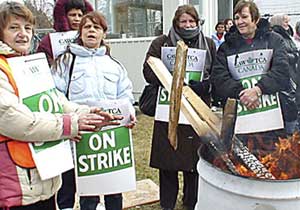
Striking Collins & Aikman workers, April 1.
Photo: CAW

After a two-day occupation of a plant near Toronto, Canada, a small local of the Canadian Auto Workers (CAW) has won a victory against one of the largest U.S. auto parts suppliers.

When Collins & Aikman declared bankruptcy in May 2005, the company, based in Southfield, Mich., had over 23,000 employees. After closings, layoffs and spinoffs, there are now only 14,000 workers in 45 facilities, producing carpeting and acoustics for the worldwide automotive industry. Among additional plants slated to be shuttered is a factory in Scarborough, Ont.

When it appeared the closing there was a done deal, the CAW negotiated severance packages to help the workers through hard times. When the company appeared to be shutting down early without compensation, workers swung into action. On March 31 about 100 union members stopped production and occupied the plant, while a few hundred more picketed and congregated outside.

The strike shut down the Brampton, Ont., Chrysler plant, which produces the high-end 300 series vehicles.

The sit-down, a first in a U.S. or Canadian plant in a long time, was a page out of labor history. Exactly 70 years after Flint auto workers ignited a wave of workplace occupations, the bosses’ fear of seizures reasserted itself.

Mustaq Mohammed, chairperson of Local 303 of the Canadian Auto Workers union, said the union had “inside information” that the company planned to remove equipment from the plant on April 1, meaning the factory would close three months before the July date the company had given the workers in negotiations.

That’s when the workers and union officials took over the plant in a 4:30 a.m. action, welding doors closed and barricading windows. Hundreds of other union members held a solidarity picket outside. (Scarborough Mirror, April 3)

When word spread of the sit-down, auto workers at the Guelph, Ont., Collins & Aikman plant went on a wildcat strike in support. When the Guelph workers walked out, management barricaded the turnstile entrances with chains and steel bars so they couldn’t re-enter and sit-in at that plant.

Auto workers at Ingersoll and Oshawa plants, also in Ontario, said that they’d shut down production on Monday, April 2, in a show of solidarity.

By the end of the day on April 1, with the threat of spreading solidarity actions, Collins & Aikman—with a pledge to help from Chrysler—agreed to make the severance payments.

Up until a few days before the 2005 bankruptcy was declared, Collins & Aikman was headed up by David Stockman, architect of the supply side theory behind Reaganomics. But as Marxists know, profits don’t trickle down. Workers have to fight for everything and fight again to keep it. If this sit-down and the sit-down of Delphi workers in Spain become a trend, the tide might begin to turn against concessions and demoralization.


Articles copyright 1995-2007 Workers World. Verbatim copying and distribution of this entire article is permitted in any medium without royalty provided this notice is preserved.

Workers World, 55 W. 17 St., NY, NY 10011
Email: ww@workers.org
Subscribe wwnews-subscribe@workersworld.net
Support independent news http://www.workers.org/orders/donate.php

Page printed from:
http://www.workers.org/2007/world/canada-auto-0412/

Tuesday, April 03, 2007

Privacy advocates fight for ground lost after 9/11

from the April 03, 2007 edition - http://www.csmonitor.com/2007/0403/p02s01-ussc.html

Five years after surrendering privacy for security, many challenge the scope of US government domestic surveillance.

| Staff writer of The Christian Science Monitor

The trade-off was one plenty of citizens and lawmakers willingly made after 9/11: less individual privacy for better national security. Five and a half years later, many are rethinking, even challenging, the government's expanded use of surveillance inside the US, spurred by revelations about the scope and number of new programs.

Among them:

•An FBI finding that agents "misused" their authority to obtain national security letters, which allow the bureau to collect information about someone's telephoning, reading, and buying habits. Congress is considering whether to revoke or limit the FBI's authority.

•News that the New York Police Department created hundreds of secret files on people who planned to protest at the 2004 Republican National Convention. Some protesters have sued the city and NYPD over the matter, and a federal judge is now weighing whether the police must release all those files.

•A lawsuit to halt the National Security Agency's electronic eavesdropping program, which had allowed the NSA to listen in on some Americans' phone conversations without first obtaining warrants.

During times of crisis, from the Civil War to the Vietnam War, the Fourth Amendment right to be free of "unreasonable searches and seizures" has lost some ground. Today is no exception. The 9/11 terror attack created, in the words of former congressman and 9/11 commission vice chairman Lee Hamilton, an "astounding intrusion into the lives of ordinary Americans."

But now, he says, things are beginning to change. "Since 9/11 ... the security folks have won all of the arguments," Mr. Hamilton said during a phone interview. "But now you're beginning to see some push back in the media, the courts, and in Congress."

Below is background on key government programs – at least those that are known – to try to ferret out individuals who may pose security threats inside the US.

1) National security letters

What's happened: In 1978, Congress granted the FBI the authority to send national security letters to companies, asking for information about the spending habits of people suspected of being foreign spies. Cooperation was voluntary. That changed in 1986, when Congress gave the FBI the authority to make companies comply. In 1994, the scope of NSLs was expanded to include anyone who had access to classified material.

After 9/11, the Patriot Act broadly expanded the use of NSLs, this time allowing the FBI to use them to obtain information on anyone – American or not, suspect or not – if the information could be relevant to an investigation on terrorism or espionage. Individuals served with NSLs are also forbidden to tell others they received a letter, although they can appeal.

Who's affected: The number of NSLs increased from 8,500 in 2000 to 147,000 between 2003 and 2005, according to the inspector general of the Justice Department.

For it: The FBI says that NSLs are an indispensable investigative tool that can help identify suspected terrorists. "Through the use of NSLs, the FBI has traced sources of terrorist funding, established telephone and e-mail linkages that resulted in further investigation and arrests, and arrested suspicious associates with deadly weapons and explosives," FBI Director Robert Mueller told the Senate Judiciary Committee last week.

Against it: Civil libertarians say that NSLs give the FBI unconstitutional latitude to obtain a person's private information without getting proper court review. They also the NSL gag orders violate the First Amendment. A recent inspector general's report found that the FBI has misused its authority to issue the letters, has an inadequate system for collecting the requested data, and had underreported to Congress the number of NSLs issued.

"You have a system that's badly broken, where the evidence isn't being collected or used effectively," says Michael Greenberger, director of the Center for Health and Homeland Security at the University of Maryland.

Where it stands: The American Civil Liberties Union challenged the constitutionality of NSL gag orders and won. The government is appealing the case. Congress is currently holding hearings on the FBI's mishandling of the NSLs.

2) Domestic surveillance by the NSA

What's happened: Shortly after 9/11, President Bush signed an executive order that allowed the National Security Agency (NSA), without getting a warrant, to wiretap the overseas communications of people suspected of having contact with Al Qaeda, even if the call ended in the United States. When the story broke in 2005, critics said it was a violation of the Foreign Intelligence Surveillance Act. Passed in 1978, this act established a special court, known as the FISA court, where intelligence agencies could seek approval for wiretaps in national-security investigations. Mr. Bush says that legislation passed after 9/11 gave him authority to supersede the FISA court.

Last year, as result of a suit by the American Civil Liberties Union, a federal district court ruled that the program was unconstitutional. The ruling has been stayed while the government appeals. Although Bush maintains he has the right to order such warrantless wiretapping, the administration announced in January that it was voluntarily putting the program under the FISA court's jurisdiction.

Who's affected: Thousands of people could be involved, but estimates are hard to make because the program is secret.

For it: The administration says the program gives it the speed and flexibility it needs – not only to track suspected terrorists, but also to help establish behavior patterns that could be used in detecting terrorism.

"In this world where bad guys can cross borders in a fraction of a second ... governments need to blow through every barrier to be able to track bad activity really fast," says Jonathan Winer, a terrorism expert who was deputy assistant secretary of State for international law enforcement under President Clinton. "But they also need to do so with rules and oversight and controls."

Against it: In 1967, the Supreme Court ruled that surveillance of communication constituted a "search" as defined by the Fourth Amendment, thus requiring court review.

"The Foreign Intelligence Surveillance Act was passed by Congress in an effort to constrain just the kind of surveillance the president says he's been doing," says Caroline Fredrickson, director of the Washington Legislative Office of the ACLU.

Where it stands: The Bush administration has asked the appeals court to throw out the ACLU case, saying the issue is moot since the program is now under FISA review. The ACLU says the suit is still relevant because the president maintains he has the right to conduct warrantless surveillance. A ruling is expected in the next few weeks. Congress is considering three bills that would reform the FISA system.

3) Surveillance of political activists

What's happened: Some 1,800 protesters were arrested in New York during the 2004 Republican National Convention (RNC). Some have filed a suit against the city and the New York Police Department (NYPD), claiming wrongful arrest and violation of their First Amendment free-speech rights.

Two weeks ago, a federal judge said their case is "of great public significance" because it concerns "the proper relationship" between protesters' rights and police efforts to maintain public order.

As a result of the suit, it became public this month that in the year before the convention, the NYPD sent undercover officers around the US, Canada, and Europe to learn how many protesters were coming and whether any planned violent acts. The officers went to political meetings, befriended activists, and scoured the Web for information about protesters' plans.

At the same time, the FBI also worked with local and state Joint Terrorism Task Forces to investigate protesters to learn if any planned violent acts at either political convention.

Who's affected: The NYPD collected hundreds of files on potential protesters.

The FBI identified 74 individuals, contacting 60 for interviews. The ACLU is seeking more information about FBI activity, on behalf of 150 groups who think they've been spied on.

For it: Police and the FBI say surveillance is crucial to investigating threats and potential criminal behavior. In New York, Mayor Michael Bloomberg and Police Commissioner Raymond Kelly defended the NYPD's actions. The commissioner noted that the officers' work helped prevent disruptive violent protests like those at World Trade Organization meetings in Seattle, Genoa, and Montreal. "Eight hundred thousand people here protested ... peacefully," the commissioner said last week.

Against it: Civil libertarians say some NYPD actions are blatant violations of a local 1971 accord that restricts police surveillance of political groups. "People will be less likely to exercise their protected right to lawful protest if they have to worry about 'big brother' spying on them," says Donna Lieberman of the New York Civil Liberties Union (NYCLU).

Where it stands: The wrongful arrest suit brought by the NYCLU is being litigated. The court is weighing whether to force the NYPD to release its RNC files.

At the US Justice Department, an internal investigation of the FBI's preconvention surveillance found, in April 2006, that the probe "did not substantiate the allegations that the FBI improperly targeted protesters ... in an effort to chill the exercise of their First Amendment rights...."

Other controversial security initiatives:

Pentagon Domestic Intelligence Units

In 2002, the Pentagon established the Counterintelligence Field Activity office which is charged with protecting military installations within the US. It keeps an extensive database on potential terrorist threats and criminal activity that could affect local military bases. But it has also collected data on domestic political groups engaged in lawful protests. After that was made public two years ago, the Pentagon says it purged its files of inappropriate data. The Pentagon has also increased its use of National Security Letters, which ask private institutions for an individual's personal data, such as bank records. Unlike the FBI, it does not have the authority to compel such information to be turned over. Still, critics say this expansion of military intelligence may create a dangerous intrusion into Americans rights because the Pentagon does not have to operate with the same statutory checks and balances as the FBI and local law enforcement.

REAL ID Act

In 2003, Congress passed a law that requires all states to issue what are essentially national identify cards that would be used as driver's licenses and for other activities that require identification. To get the card, the government may collect information such as home address, social security number, immigration status, tax records, and banking records. It would be held in a state-maintained database which would be shared with other states and the federal government.

Advocates contend that establishing a secure identity card is essential to fighting terrorism. Opponents claim it would create a huge national database that included constitutionally protected information that could be easily accessed by local, state, and federal authorities without a proper warrant. They also say it would make identity theft much easier since the database could be compromised by hackers or unethical government employees.

Three states, Maine, Arkansas, and Idaho have already passed legislation calling for the repeal of the REAL ID act.

Department of Homeland Security's Automated Targeting System

Since the mid-1990s, the federal government has collected data on individuals who fly internationally. It includes the person's destination, how they paid for the ticket, and whether it was a one-way or roundtrip flight. Originally, the program was designed to ferret out drug traffickers, who often paid in cash and bought one-way tickets. After 9/11, the system was expanded to include searches for possible terrorists.

Advocates claim that data collection comes from a publicly available source – the airlines and travel agencies – and is not intrusive in any way. They also contend that it's vital not only to track potential criminals, but also as a way to determine behavior patterns that could in the future be used to identify potential terrorists.

Opponents claim the program is an unconstitutional invasion of a traveler's personal information that was implemented without congressional approval.

Senator Patrick Leahy (D) of Vermont has said he plans to hold hearings on the system.

Bush mail-opening signing statement

In December, President Bush added a "signing statement" to the Postal Accountability and Enhancement Act. It asserts that the executive branch has the authority to open sealed mail without a warrant for "foreign intelligence collection."

Proponents contend that the president was simply reasserting authority he already had. Critics, including Sen. Susan Collins, (R) of Maine, contend the signing statement "does absolutely nothing to alter the protections of privacy and civil liberties provided by the Constitution and other federal laws." She's introduced a bill that would reinforce that.

Monday, April 02, 2007

Maryland May Join Pact to Bypass Electoral College

by Shreema Mehta, The NewStandard

Apr. 2 – The Maryland state senate recently passed a bill that would allow the nationwide popular vote – instead of the Electoral College – determine presidential elections. The bill has been passed on to the state's House of Representatives.

In passing the bill, state senators voted for Maryland to join a multi-state agreement that would require states to bypass the Electoral College and award its electoral votes to whichever presidential candidate won the state's popular vote. As previously reported by The NewStandard, the agreement goes into effect when enough states collectively holding the majority of electoral votes ratify the scheme.

This year, Arkansas, Colorado and Hawaii joined California in signing the agreement.


© 2007 The NewStandard. All rights reserved. The NewStandard is a non-profit publisher that encourages noncommercial reproduction of its content. Reprints must prominently attribute the author and The NewStandard, hyperlink to http://newstandardnews.net (online) or display newstandardnews.net (print), and carry this notice.

Sunday, April 01, 2007

Dianne Feinstein resigns committee post amid scandal; accused of war profiteering

By Joshua Holland
Posted on March 30, 2007, Printed on April 1, 2007
http://www.alternet.org/bloggers/joshua/49970/

This story is from the Silicon Valley Metro (ht: Robert, our intrepid copyeditor):

SEN. Dianne Feinstein has resigned from the Military Construction Appropriations subcommittee. As previously and extensively reviewed in these pages, Feinstein was chairperson and ranking member of MILCON for six years, during which time she had a conflict of interest due to her husband Richard C. Blum's ownership of two major defense contractors, who were awarded billions of dollars for military construction projects approved by Feinstein.
As MILCON leader, Feinstein relished the details of military construction, even micromanaging one project at the level of its sewer design. She regularly took junkets to military bases around the world to inspect construction projects, some of which were contracted to her husband's companies, Perini Corp. and URS Corp.
Perhaps she resigned from MILCON because she could not take the heat generated by Metro's expose of her ethics (which was partially funded by the Investigative Fund of the Nation Institute). Or was her work on the subcommittee finished because Blum divested ownership of his military construction and advanced weapons manufacturing firms in late 2005?
The MILCON subcommittee is not only in charge of supervising military construction, it also oversees "quality of life" issues for veterans, which includes building housing for military families and operating hospitals and clinics for wounded soldiers. Perhaps Feinstein is trying to disassociate herself from MILCON's incredible failure to provide decent medical care for wounded soldiers.
Two years ago, before the Washington Post became belatedly involved, the online magazine Salon.com exposed the horrors of deficient medical care for Iraq war veterans. While leading MILCON, Feinstein had ample warning of the medical-care meltdown. But she was not proactive on veteran's affairs.
Feinstein abandoned MILCON as her ethical problems were surfacing in the media, and as it was becoming clear that her subcommittee left grievously wounded veterans to rot while her family was profiting from the occupations of Iraq and Afghanistan.

I don't have much to add. For background, check out Joshua Frank giving it to the Senator with both barrels, here.

I'll just say this. Even if you think this criticism of Feinstein is unfair -- as I know some do -- you have to acknowledge that this kind of stuff sends the message that all of Washington is the same. It allows Republicans to hold onto the delusion that their brand of corruption over the past decade was run-of-the-mill -- just Standard Operating Procedure for the party in power -- and it just demoralizes progressives.

Joshua Holland is an editor and senior writer at AlterNet.

© 2007 Independent Media Institute. All rights reserved.
View this story online at: http://www.alternet.org/bloggers/joshua/49970/

An Open Letter To Bono Re: Debt Relief

By Danny Schechter

The News Dissector has a request for your upcoming special edition of VANITY FAIR: Link the growing debt burden of Americas and the better-known debt problems in Africa.

----------

Bono is in the news. (When is he not?) This time, the world's great rocker is being named to edit a special edition of the VANITY FAIR, the gliteratti magazine that influences our national buzz machine and cultural zeitgeist. One of his stated missions is to offer compelling non-stereotyped stories about the fight against AIDS and for debt relief in Africa that compassion fatigued Americans will tune in to.

As he reaches out to touch an American nerve, I am reaching out to touch his. I am doing so in the spirit of Nelson Mandela, with whom I did five films, and who once surprised me at a press event by staring right at me and asking-with a big smile-"Remember Me?" I know Bono remembers me. In fact we were both at Mandela's big anti-AIDS concert in Cape Town some years back. I was filming it; he was starring in it. We had a long talk.

Our first encounter took place many years earlier. It was also South Africa related, but well before Mandela helped free South Africa. It was at one of the last recording sessions for the anti-apartheid record "Sun City" that I was helping to produce back in 1985. We were in the basement of a now shuttered famous studio in the Village, the one Jimi Hendrix once owned. Musician Little Steven Van Zandt invited Bono there to sing on the project. Not only did he agree, but he was inspired to contribute an original song,

He created and did a solo rendition of a song called "Silver and Gold" which brilliantly put the apartheid crisis in an economic context, making the connection between all the suffering in that country and its great wealth and exploitation in its mines. He understood then how important it was to challenge financial power. In fact, it was the sanctions campaign, of which Sun City was a part, that helped bring down that racist system.

Bono went on to become a high-profile champion of Africa, as an artist, diplomat, lobbyist and negotiator. His eloquence, celebrity and Irish "moxie" enabled him to confront the rich and powerful from a mountain top in Davos to the General Assembly of the UN, from an outhouse in the bush of an impoverished African country to The White House and Congress, not to mention the stage of his sold out concerts and on every TV network. He has pushed, persuaded, cajoled, charmed and maneuvered the likes of Bill Gates, George Bush, and even Jesse Helms, to support debt relief and the fight against AIDS. He is a passionate campaigner. No one can say no to him.

And that's why I am writing to him/you now. If you want to get Americans to show solidarity with Africa, show some solidarity with them. Lets make the issue of Debt Relief in America part of the global fight for economic independence in our interdependent world.

True, the impoverished former colonies of the Third World have it worse, with many sick and hungry people living in dire poverty, often on $2 a day. But suffering is relative and often causes the same misery, disease and despair where ever you go. Ask the homeless in America. Read about our own pervasive and growing poverty. You know there is a festering and neglected third world in the innards of every "rich" country.

And don't stop there.

Look at the millions who are trapped in a debt they will never escape from, almost like modern serfs. Read about all the outsourced jobs, the closed auto plants, the wave of foreclosures as the housing bubble bursting, the credit card crunch, the rise in bankruptcies, the students leaving college with an average $40, 000 in loans, and the billions in outrageous interest rates and all kinds of fees. This does not just impact the poor but increasingly the middle class and even those who felt it could never affect them.

Predatory lending is not just an African problem. It is global.

The press is predicting, "More pain is on the way" as big banks falter and the scandalous "Subprime" lending sector-recently considered the "hottest" in the industry-implodes. The bankers and economic wise men who have been denying any problem are singing another tune now as the stock market melts down and the underlying problems of consumer and government debt are seen as the threat they are.

A problem of personal security is becoming an issue of national security and global insecurity. In many cases, the same banks, investment houses and hedge funds are profiting off of the anguish of untold millions in every country.

So Bono, please find some space in your Vanity Fair issue to make it about more than vanity with ads for the affluent and photo spreads of the rich and sexy. Let's tie the issues together for American readers and African "victims" by recognizing our common humanity and the need to find common ground in fighting shared problems.

Linking the growing debt burden of Americans-and the better-known debt problems in Africa is a start.

We are working on this issue now and need your help. We have created a campaign called AMERICANS FOR DEBT RELIEF NOW (Stopthesqueeze.org) and are promoting a film called IN DEBT WE TRUST (Indebtwetrust.com) to raise pubic awareness. We are reaching out to give a massive, but invisible, problem more visibility and a sense of urgency.

In the name of love, Bono, and our shared values and common beliefs, will you help us get the word out on this effort, support us as we support you, and make the issue and promise of global economic justice a reality?

Let me know if you will help!

- Danny Schechter, News Dissector Danny Schechter edits MediaChannel.org. Comments to Dissector@mediachannel.org

Wednesday, March 28, 2007

Khalid Sheikh Mohammed Confesses To Confessing Under Torture

Umm, sorta satire...Pete

March 28, 2007 | Issue 43•13

GUANTANAMO BAY, CUBA—Khalid Sheikh Mohammed, the alleged 9/11 mastermind who recently admitted to murdering journalist Daniel Pearl and planning more than 30 other terrorist acts, confessed on tape Monday that he had made his recent confessions under extreme physical and mental duress.

"I deeply regret any inaccuracies or exaggerations I may have uttered in my agitated mental state," a bloodied, visibly exhausted Mohammed said in a videotaped statement. "But the men with whom I was cooperating said the pain would only stop if I had in fact beheaded Pearl with my own hands, planned the September 11th attacks, and was actually Osama bin Laden after extensive plastic surgery. Again, I apologize for any difficulties that may arise from any misinformation I may have provided."

CIA and military intelligence officers said they were willing to intensify their interrogation of Mohammed if his torture claims prove inaccurate.

http://www.theonion.com/content/node/60009

Brzezinski on terror hysteria

[This issue is not unfamiliar to GetOffThis! readers but it is interesting that it is being raised by such a stolid member of the establishment and published in the equally stolid Washington Post. Google, incidentally, only reports four sites picking up this interesting development. Brezesinski is clearly a spoil sport, threatening the future of media hysteria on the topic]

ZBIGNIEW BRZEZINSKI, WASHINGTON POST - The "war on terror" has created a culture of fear in America. The Bush administration's elevation of these three words into a national mantra since the horrific events of 9/11 has had a pernicious impact on American democracy, on America's psyche and on U.S. standing in the world. Using this phrase has actually undermined our ability to effectively confront the real challenges we face from fanatics who may use terrorism against us.

The damage these three words have done -- a classic self-inflicted wound -- is infinitely greater than any wild dreams entertained by the fanatical perpetrators of the 9/11 attacks when they were plotting against us in distant Afghan caves. The phrase itself is meaningless. It defines neither a geographic context nor our presumed enemies. Terrorism is not an enemy but a technique of warfare -- political intimidation through the killing of unarmed non-combatants. . .

The culture of fear is like a genie that has been let out of its bottle. It acquires a life of its own -- and can become demoralizing. America today is not the self-confident and determined nation that responded to Pearl Harbor; nor is it the America that heard from its leader, at another moment of crisis, the powerful words "the only thing we have to fear is fear itself"; nor is it the calm America that waged the Cold War with quiet persistence despite the knowledge that a real war could be initiated abruptly within minutes and prompt the death of 100 million Americans within just a few hours. We are now divided, uncertain and potentially very susceptible to panic in the event of another terrorist act in the United States itself.

That is the result of five years of almost continuous national brainwashing on the subject of terror, quite unlike the more muted reactions of several other nations (Britain, Spain, Italy, Germany, Japan, to mention just a few) that also have suffered painful terrorist acts. In his latest justification for his war in Iraq, President Bush even claims absurdly that he has to continue waging it lest al-Qaeda cross the Atlantic to launch a war of terror here in the United States.

Such fear-mongering, reinforced by security entrepreneurs, the mass media and the entertainment industry, generates its own momentum. The terror entrepreneurs, usually described as experts on terrorism, are necessarily engaged in competition to justify their existence. Hence their task is to convince the public that it faces new threats. That puts a premium on the presentation of credible scenarios of ever-more-horrifying acts of violence, sometimes even with blueprints for their implementation.

How to respond to RIAA harrassment

[Just a bit from a classic legal letter to RIAA's attorneys composed by Attoprney Merl Ledford III of Visalia CA]

MERL LEDFORD III - It is not too late to correct your clients' (and your law firm's) mistakes.

Mr. and Mrs. Merchant's emotional condition puts a premium on immediate case resolution. Thus, although I generally do not make opening legitimate offers as defense counsel, the clients' non-monetary interests and their probability of recovering their fees and costs in this matter (at a minimum) suggest that a defense settlement offer would not be inappropriate. Therefore:

My clients are willing to accept dismissal of the litigation in exchange for

1. Payment of Mr. Merchant's reasonable fees and costs including retainer of $6,880.25. The payment represents good value considering what your own firm's billings will have been to date and use of those billing records as the loadstar rate for Mr. Merchant's award. . .

2. Apology on your firm's letterhead by your supervising partner for inappropriately filing and maintaining an action against Mr. Merchant without probable cause and for the emotional hardship that such litigation caused; and

3. Execution of a mutual general release of all claims in my office's usual form. The RIAA form of release I have seen will not be used. It is my practice in these kinds of cases to require that the plaintiffs indemnify my clients against claims by third parties as part of my general release language. (E.g., your clients sue a site for posting guitar tabs to copyrighted music; my client visits the site, read the tabs, plays them on his guitar, and get sued by way of cross-claim by the guitar tab site. . .

4. Confidentiality: It is my general practice to disfavor confidential settlements. Under the circumstances, and so long as your clients are prompt and candid in dealing with their mistaken, misplaced lawsuit, I would consider a reasonable confidentiality provision. Again, quick response, full payment, and immediate dismissal will allow confidentiality as an option. . .

The authorized settlement offer expressed in the preceding paragraphs of this email . . . may be accepted by signing a copy of this email and returning it to my office by fax no later than the close of business on Friday, March 30, 2007. . . It is the best offer that will be made in this litigation based on the facts and circumstances as they are known at this time. Substantial discovery, investigation, and exchange of information remains that could substantially alter the settlement position of the parties to the betterment of either side in ways that cannot now be responsibly predicted. The case settlement value will, however, trend upward the longer I have to work on it. And the emotional distress damages for willfully filing and thereafter maintaining claims for relief without probable cause will only increase as the matter drags on. . .

Procedurally, we need to address how best to move the case to the Fresno Branch so you can enjoy our new Courthouse and avoid Judge Levi's wrath for filing in the wrong court. . .

Once the case is moved to the Fresno Branch, your clients should consider cleaning up their complaint. The FRCP and collateral estoppel from other RIAA law and motion matters require much greater specificity in pleading than your clients provided in the complaint I reviewed. Dates of the alleged downloads, which plaintiff (or affiliate) holds which copyright to which track, etc. must be specifically pleaded and proven. You are as familiar as I am with the results in other cases where RIAA's general allegations have been challenged. Let's get over that hurdle without unnecessary law and motion practice. . .

Monday, March 26, 2007

Snapshots from Unschooling Part 3

By Cynthia Peters

Part 1: "Snapshots from School" http://www.zmag.org/sustainers/content/2006-12/12peters.cfm

Part 2: "Unenrolling My Daughter from School" http://www.zmag.org/sustainers/content/2007-02/09peters.cfm

When Zoe quit school in ninth grade, one of the saddest things to me was the response of the kids she left behind. Some assumed she was pregnant or in rehab. One got angry with her for "throwing her life away." But mostly, her decision was met with a deafening silence.

Once they couldn't slot her actions into familiar categories (pregnancy, drug problems, truancy), then her actions became too difficult to understand. They responded the way any of us would if we were, let's say, part of an English-speaking audience and someone stood up to give a lecture in Chinese. We wouldn't bother listening. What would be the point?

It felt sad because so few of the students seem to be getting so few of their needs met in school, and yet when confronted with an alternative, they tuned it out. It's understandable, I guess. It would be like me trying to tune into a lecture in Chinese. When I asked Zoe's friends what they thought of school, many of them responded simply, "We're used to it." That's a common response to even the most dysfunctional institutions. They seem immobile, so why hurt yourself more by crashing up against them? Better to get used to it. They seem unavoidable, so why pay attention to people who bushwhack a way out? Better to write them off.

For more on what I think is wrong with "getting used" to school, see Parts 1 and 2 of this series. This part, Part 3, turns away from school and looks instead at unschool.

First, let's be clear that with unschooling, we have a real paradigm shift. Not only are we speaking a different language in this family, but probably even the hand signals don't look familiar. Zoe is not doing any traditional schooling of any sort. Soon after leaving school, she signed up for a community Spanish class and a video class offered by a friend of a friend, and she considered having a math tutor, but she dropped out of the first two and ended up refusing the last. I was disappointed at first. It's easier to explain things to the relatives when you can point to familiar activities like classes. "Taking classes" is shorthand for "learning," after all. It was hard enough to explain why we let our 15-year old leave school, and now I had to confess that she hadn't managed to stick with even the most minimal "school work."

Why hadn't she? I think her answer would be that the model wasn't working for her. She didn't want to know Spanish badly enough to sit through a class on it. For the video class, she wanted to be able to hover and witness and learn by watching, but she did not want to produce anything. "Too much pressure," she said. My hard-working, Puritan ancestors turn in their graves at these words. But, yeah, that's how she sees it, so that's how it is - at least for her. Let's look a little more carefully, keeping in mind the limits to the lessons that can be learned from one experience, but being open to those lessons nonetheless.

"Hey, teachers! Leave those kids alone!" - Pink Floyd

Zoe didn't learn to read under pressure either. She liked stories and didn't have a facility for deciphering text. She had parents who read to her a lot, so, from her point of view, what on earth would be the benefit of slogging through those dreadful "early readers"? Our gut feeling was that she would read eventually, but perhaps not on the school system's timetable, so we took her out of first grade. She avoided being labeled. We avoided tense homework sessions and power struggles. She soaked up stories. We communicated a lot of trust in her abilities. She learned that she could be in charge of her learning. During the summer before what would have been fourth grade, she decided she wanted to learn to read, and so she did. She asked an adult friend up the street to tutor her, and within a couple of months, she was reading sophisticated novels. She started reading when her mind was ready and when she would be able to read at the level she was interested in. This last point is important. Reading held little interest for when she could not do it fluidly and at a sophisticated level.

At one point during the tutoring sessions, this friend up the street came to talk with me. She was worried Zoe might have some sort of dyslexia. We had wondered the same ourselves. How else could we make sense of her being so outside what the experts considered appropriate in terms of reading? We held off on taking her in for a diagnosis. "Let's give it a little more time," we said. After six weeks of minimal tutoring, Zoe was reading comfortably, and she has rarely been without a book since (except when she was in school, I should add, which she decided to try starting with eighth grade. Why did school seem to lessen her interest in reading? An easy answer is that with all the homework, she didn't have enough time. But probably that is not quite true. It's more likely that, having practiced tuning out all day at school, she didn't have the energy to tune in enough to read a book.)

Once a friend asked Zoe how she finally learned to read. Her answer was, "My parents waited until I was ready." Notice there was no actual mechanism that started her reading; rather, there was an absence of pressure. This is where you have to take a leap of faith into the new paradigm or agree to Chinese immersion. We think so often in terms of what we *do* to kids - what phonics program, what standardized tests, what homework, what toys, what preschool programs, what praise, what punishment, what treatment for attention deficit disorder - and perhaps not enough about how much we should *let them be.*

I don't mean let them be in the commercial-culture, school-based, lack-of-community sort of way that most of our kids are subjected to. I don't mean let them be so that corporate noise and teachers and loneliness fill up their lives. I mean be present for them, but not so directive. I mean making meaningful choices available, not layer upon layer of noise about lip glosses and video games. I mean allow learning and exploration to take place in multiple ways, not by some uniform method decided on by bureaucrats who are more driven by the (dys)function of large institutions than they are by the needs of actual children who have enormous wells of curiosity and energy.

"I'm trying to figure out what an education is."

This was Zoe's response to a friend who accused of her wasting time doing nothing. "At least I'm getting an education," he had said. On the surface Zoe appears to resist pressure, but in the paradigm shift of unschooling, she's taken on a lot of responsibility. She has no teachers or school system telling her what to do. She is not studying for tests or counting on a report card to let her know how she's doing. She wasn't interested in the stress of having to memorize Spanish verbs, and she had a bad case of performance anxiety in the video class, but in an odd twist, she has decided to bear significantly more pressure than most kids have to bear. Namely, she has taken responsibility for her own education.

Sometimes, I wonder if it's too much for a 15-year old. Maybe we should alleviate some of that stress by "telling" her what to do and "making" her do it. I suppose we could, but we know from experience how poorly that works. We've learned from her how she excels when she's ready. We honor our relationship with her enough not to impose our will. As her parents, we don't have too many requirements except that she help out with the dishes, earn some money for the things she wants to do, and practice moderation (as well as be safe and responsible) in her explorations of the world. Beyond that we offer the structure of our lives, the communities we've forged in the neighborhood and in our political work, and our trust in her.

Maybe in the end, those offerings have higher expectations embedded in them than any exhortations to get on the honor roll. They include the radical expectation or fundamental belief that she is part of a community, that her ideas matter, and that her participation makes a difference. The organizer at the grassroots community arts center where Zoe volunteers wonders how she got along before Zoe started helping her out. Zoe's work at Spontaneous Celebrations has connected her to the Bean Town Society, an organization led by neighborhood youth. She has helped organize festivals, written leaflets, input data, promoted events, and gotten to know a range of people working on a range of programming. Should I extrapolate the "educational" value of her volunteer efforts? I think not. When you dispose of a set of standards, you don't refer to them in an effort to figure out how you're doing. This is not to say, of course, that I have a problem with traditional academics. But most of the worthwhile stuff you learn in school, you could learn in a fraction of the time if it weren't so lost in the mind-anesthetizing aspects of school and the pressures of institutional norms.

"I'm not sure what's wrong with me. I just want to sleep."

The absence of externally imposed pressure does not equal the absence of stress. You don't work with a grassroots group and avoid stress. Racial politics in Boston have never been easy, and Zoe is in the thick of it. The essay she wrote as part of an application to work with youth doing social change work and study over the summer was all about her desire to explore the meaning of race. "Why does skin color matter so much," she wrote. "And how can I work to solve that?"

She's been helping to mobilize for an upcoming anti-war rally, and she's turned her MySpace page into commentary on Bush. She struggles a lot with coherent but somewhat flailing anger. In December she attended a Buddhist retreat, and came back stunned by meeting Vietnamese monks - "who have more right to be angry than anyone else," by her estimation - and yet who are able to be compassionate.

"No wonder you're tired," I'd like to tell her. "For one thing, you're a normal teenager, and normal teenagers need to sleep a lot. And for another thing, look at what you're dealing with." Racism, white privilege, the brutality of our nation's policies. Yeah, these things might be making her tired. Not to mention the plethora of other life changes that she has to negotiate, including becoming an adult, making and keeping friends, developing sexuality, and taking more and more responsibility for the world around her. These challenges make her no different from every other teenager in Boston; only, unlike them, she doesn't have to be at school at 7:20 am. She gets to sleep more.

"It's about trying to be happy."

This was Zoe's response when I asked her what unschooling meant to her. She's sought happiness in engagement with her community, grappling with hard issues, as well as other things I have not talked about too much here - staying up until all hours reading, listening to music, spending hours on the computer, taking photographs, teaching herself photoshop, watching movies with her sister, hanging out with friends, experimenting with all sorts of things that she'd probably prefer I not get into. We certainly don't have an absence of angst in our house. But we have more than our fair share of privilege. Zoe's dad and I enjoy interesting, empowering work that approaches paying the bills, and we have had two decades in this community - developing ties, doing political work, helping to create (in some ways) an infrastructure that Zoe can use to "scaffold" herself into adulthood.

And that's what I wish more kids and families had a choice about. Every time I read another article about education reform, I wince at the calls for extended school days, longer school years, more homework, more after-school enrichment, more ways for adults to tell kids what to do, spy on them while they do it, and then grade them on it. As a parent, I'll tell you what I need: policy changes that make it possible for all adults to be part of building a community, for there to be more "neighbors up the street" who can pitch in with tutoring sessions, and for there to be more meaningful mentoring opportunities for youth. Decent schools would be helpful, too. Classroom learning works for some people, and they should have access to it if they want it.

A benefit of quitting school, we might find, is that kids find themselves feeling happier. They at least realize they can seek happiness, which is not true for kids in school, many of whom have instead mastered a *tolerance* for their everyday life. Other truly radical changes might evolve as well. Kids will look inside for direction and to discover what moves them, and they will be shaped, too, by a community that cares about them and trusts them rather than authority figures that threaten them with punishment or seduce them with praise. Their (non-sleep-deprived) participation, freely given, will not just be an opportunity for personal growth, I'm guessing, but there will be benefits for all of us, as we get to enjoy the autonomous presence of all the eager, curious, energetic, creative kids who are currently locked away in school.

Thanks to Zoe, who declined the opportunity to write this piece herself, but who generously read it and offered her comments. Thanks also to Mary Goodson for her comments. For more information about unschooling teens, start by reading "The Teenage Liberation Handbook: How to Drop out of School and Get a Real Education" by Grace Llewlyn.

Unenrolling My Daughter from School Or Choosing Not to "Get Used to It", Part 2 of Snapshots from School

By Cynthia Peters

Read Part 1 first if you haven't already: http://www.zmag.org/sustainers/content/2006-12/12peters.cfm

Note: As I explained in my previous commentary (see "Snapshots from School", http://www.zmag.org/sustainers/content/2006-12/12peters.cfm, December 12, 2006) our family's relationship to schooling is unusual. Both our kids have homeschooled - in a mostly unschooling fashion - for most of their lives. Our shock at what we saw happening when our oldest daughter started attending school might seem wide-eyed and naïve to many. I'm sure it is. But perhaps there are some lessons in it. That said, this piece is written with apologies to those kids who don't have the option to go to school if they want to and to those who don't have (or don't think they have) the choice to leave. Also, apologies to the many teachers and administrators out there who continually reach out to kids despite institutional norms that pressure them to do the opposite.

"Dealing with schools was the worst part of parenting," a friend recently said. Her words rang in my head as my partner and I tried to support our 15-year old through her first term at a large public exam school in Boston. School was quite literally getting in the way of our relationship, and it was getting in the way of her growth and well-being. She was tuning out and turning off; and the more we coaxed her to hang in there, the more she got bashed. We couldn't see any way forward for her except to get used to it. Or not.

The worst part of parenting, in my opinion, is negotiating the pressure to seek private solutions (that will at least benefit your offspring) with the desire and need to find collective solutions (that will ultimately benefit all of us).

How do you support a kid to master the skills she needs to survive in school - when those skills themselves are anti-social, debilitating, and oppressive? For the first three months of the school year, it seemed like what Zoe needed the most was to be able to do what she was told without worrying about whether it was right, fair, or sensible; to shrug off the violence she witnessed; and to call on stamina and a thick skin to survive. Although there is perhaps a time and a place for all of these qualities, it seems illogical in the extreme (if your goal is education) to be systematically squashing kids' ability and desire to think, to be inuring them to violence, and to be training them to take it. It is not illogical at all, however, if your goal is to train future contributors to the institutions of work, leisure, and governance as they are currently defined. You might as well start early getting them used to the behaviors and pressures they'll experience in the future.

We tried different approaches to helping Zoe get what she wanted out of the school. She made good friendships; she became a member of the Gay/Straight Alliance; she discovered an interest in biology - so there were reasons why she wanted to be there. We helped her try to balance suffering through the rest of it with hanging in there in order to get the parts she wanted. But ultimately the balance was impossible to achieve. At least for her. On December 18, 2006, I unenrolled Zoe from school. The process was instructive.

At one point, we sat in the office for about twenty minutes. During that short time, we witnessed the "disciplinarian" (let's call him Mr. D) deal with several children. One kid - maybe a sophomore - was brought in to be reprimanded for skipping class. During the reprimand, the kid barely made eye contact with Mr. D. He basically looked like he was having an out-of-body and out-of-mind experience - which may have been a most effective escape route as Mr. D's apparent goal was to shame him, humiliate him, and threaten to take him off the ice hockey team.

There was no respect for privacy. The whole "conversation" happened in front of anyone who happened to be in the office. There was no attempt to find out what was going on with the kid or to explore why he wasn't going to class. Mr. D did not even seem particularly concerned about the fact that the kid was basically acting like a zombie. The whole charade seemed like a ritual enactment of the essence of mandatory education today. Mr. D represents institutional authority, the enforcer of the rules, the wielder of the carrot and the stick. He makes it clear that he doesn't care if the kid is *learning* so long as the kid is *showing up.*

After he left, a younger kid came in who apparently was not so alienated from authority and still retained some idea that you could get support navigating difficult situations in school. He was being bullied by kids in the lunchroom and he came in asking for help. Mr. D talked to him the same way he talked to the other kid - his words and his tone moving along the narrow spectrum between shaming, blaming, and humiliating. "What are you doing in here talking to me? I don't want to see you back here. We all have problems sometimes. Get back to class."

Violence, bullying, and mean behavior are expected and almost condoned in this way. It's an institutional norm. Get used to it. In Zoe's English class one day, three students walked in during the middle of the period to harass a girl who had supposedly stolen something from one of them. The teacher maintained a perfectly blank expression, did not engage the students, and called security. I don't blame her for not getting in the middle of what could have turned into a physical brawl. Eighty to 100 teachers are assaulted each year in Boston public schools, usually when they are trying to break up a fight (according to the "Boston Globe," 12/29/06). But after security came and removed the players in this particular episode, the teacher simply returned to the lesson. "Turn to page 56 of `Jane Eyre'." There was no attempt to process what had happened or make sense of the experience.

How did the kids in the class respond? "We were just laughing," said Zoe. I can imagine the nervous laughter that results from being trapped in a place where stuff like that happens, where it's considered normal, where everyone proceeds as if it hadn't happened, and where you take note for future reference of how these things are handled. An underlying but powerful current of violence is practically palpable.

It's not just evident in the fact that police confiscated 577 weapons from Boston public school kids last year or that many children say they fear for their safety, but it's clear in these other not-exactly-subtle ways as well. When class is disrupted and a brawl is threatened in the middle of 9th grade English, and the teacher does not even register the event in her countenance or her conversation, the lesson of that period is clear: that's how it is. Get used to it.

While waiting in the office, I had the opportunity to talk to Zoe's art teacher - the one who gave her an F on a project (and then supposedly threw it away) because she had neglected to list the section number at the top of the page. "What was the idea of failing her for what was just a slight bureaucratic error?" I asked.

"Well," he explained. "I have to sign in every morning when I get to work. If I don't, I get in trouble. She needs to learn how to follow the rules."

"Okay," I said, "Leaving aside whether art class is the appropriate place to teach future workplace rules, why did you throw the piece away? Don't you think that sends the wrong message - like the art itself doesn't matter?"

"Oh," he answered. "I didn't really throw it away. I just threatened to do that." He laughed. "I tell all the kids that, but I don't really throw them away."

More charades, in other words, like what happened in the office with the disciplinarian. The first kid who came to see Mr. D didn't really have to listen; he just had to present his body to the office so that the act of listening could be simulated. The second kid brought more of his whole self to the office, but learned the important lesson that that was a mistake. If you bring your whole self, then your whole self gets bashed.

It's not that they are in school to learn or to grow. It's that they're there to follow a script. Furthermore, it's fine - even preferred and expected - that kids do so in a zombie-like fashion. When I question a teacher for trashing my kid's work, his only words of comfort are that she wasn't singled out. I'm supposed to feel better because he does it to all the kids.

As we were leaving, the bell rang. "Uh oh," said Zoe. There was a two-second pause during which there was silence, and then mayhem as doors flew open and kids began sprinting in all directions down the hallways. We pressed ourselves up against the wall as the kids flew by. They had three minutes to do whatever they needed to do plus get to their next class on time. Three minutes is not enough time to get to your locker, stow books from your last class, get books for your next class, use the bathroom, or check in with a friend. It's barely enough time to traverse the enormous expanse of the school. It's certainly not enough time to change gears from Latin to geometry or history to gym or to reflect on what you're doing or to think. It's arbitrary regimentation, and it doesn't make sense for children or probably for any living things.

But everyone does it because it's the rule and because if you don't, you'll have to go see Mr. D., and play-act in the charade of dominance (his) and submission (yours), which, assuming you have the resources to make the calculation, takes more energy than hurrying up and getting to class on time.

Dropping out isn't the answer for everyone. The advantages and disadvantages of staying in school might balance out for some in favor of staying. I wrote a number of years ago in my review of the "Teenage Liberation Handbook" by Grace Llewlyn (http://www.zmag.org/sustainers/content/2000-03/20peters.htm) that it takes a certain amount of privilege to walk away from school. I am grateful that we were able to step outside the institution, but I'm appalled about what we left behind.

Furthermore, individual solutions, like the one our family found, don't begin to address the institutional nature of the problem. For that, we need a collective solution. Last year, Boston high-schoolers organized to force the school board to rescind its policy of locking out students who showed up to school late. If they can organize themselves to be let in, they can organize themselves to be let out or to have a say about what happens inside. They can say en masse that they refuse to participate in the charade anymore. The only thing that props up Mr. D's authority, after all, is the teenager's agreement to present his body for simulated listening. He has the power to refuse to do so - but it will only register if he organizes with others.

Workers do it when they strike. Soldiers do it when they refuse to fight. Students can do it too. Everyone has a right to meaningful, empowering education in a non-violent, non-oppressive environment. The responsibility to make that happen belongs with all of us.

To solve many of the pressing problems we face today, we need every one of those minds to be tuned in, interested, present, and cared for. That's just one reason (there are many) to have more humane, liberatory schools that help kids use their minds rather than coach them to turn off.

Stay tuned for Part 3 - "Snapshots from Unschool."