Sunday, June 08, 2008

Tellin' It How It Is: Hip-Hop Stands Up For Sean Bell

Jun 07, 2008 By Alexander Billet
Alexander Billet's ZSpace Page / ZSpace

"With the Sean Bell situation, New York is basically saying 'fuck niggas.'" Who in their right minds can honestly disagree with these words, bluntly stated by rapper/producer/activist David Banner? The April 25th aquittal of three New York City cops, who killed Bell after pumping fifty rounds into his car, sends a clear message to the African-American community: If the police can get away with gunning down one unarmed black man, they can get away with it again. Indeed, it happened several times over well before Bell. It's no wonder that the verdict has provoked outrage and frustration from religious leaders, local politicians and community activists.

Banner is certainly not alone as a rapper, either. The frustration, sadness and outrage provoked by the verdict has radiated through the entire hip-hop community, reaching even the upper echelons of the industry. Russell Simmons has spoke about the need for the police to be more accountable. His heir-apparent Jay-Z has set up a charity for Bell's fiancee, Nicole Paultre Bell. As always, though, the most meaningful solidarity hip-hop has to offer is that of the artists themselves.

This solidarity has, notably, not just been limited to the sector of "conscious hip-hop," that artificial category created by the music industry in order to cheapen the genre; a diverse array of artists have verbally trounced the verdict, ranging from Ice Cube to Immortal Technique to Chamillionaire. By now, it's become something of a cliche to repeat Chuck D's line about rap being "CNN for black people," but the staggering hypocrisy and gutter racism of the case has once again pushed artists into that role.

In the month since the verdict, there have been enough recordings dedicated to Bell to fill a compilation album. Posted on YouTube, Brooklyn MC Papoose (who also penned a song directly following the original shooting in November 2006) calls for a new civil rights movement in "We Shall Overcome." Though lyrically awkward at times, the track almost serves as a blow-by-blow of the entire trial, highlighting the arrogance of Judge Arthur Cooperman, the flimsy defence of the officers, and the complete dismissal of all witness testimony. As the song progresses, Pap lays into the past racist brutalities of the NYPD, bringing up the shooting of Amadou Diallo and the police torture of Abner Louima, and broadens the story even further to immigrants' rights and the shipping of poor black kids to fight in Iraq: "How can they find find freedom in south Iraq? Please! / They can't even find freedom in south-side Queens."

Papoose is only the tip of the iceberg. The web has been swarmed by tracks dedicated to Bell, sometimes released withing mere hours of the verdict. Major-label artists like The Game and Joell Ortiz have released songs on the web. Unsigned artists have been able to chime in too. Pittsburgh rapper Jasiri X (whose song about the Jena Six was named by hip-hop journalist Davey D as the best political rap of 2007), posted not one but two tracks about Bell on his MySpace page the very next day. A simple Google search for "Sean Bell" and "hip-hop" will yield literally thousands of results.

Artists who haven't necessarily had the chance to hit the studio in recent weeks have nonetheless done what they can to protest the verdict. The Roots, performing on the David Letterman Show three days afterwards, wore all black in mourning for Bell as well as pins with Bell's face on it. And then, of course, there is dead prez, whose first show after the verdict in Amhearst, Massachusetts was performed in the memory of Bell. Stic.man, speaking from the event on "Breakdown FM," radio show of hip-hop activist Davey D, summed up the all-encompassing question "what now?": "That verdict's been cast down on us since slavery. We've been denied justice way before April 26th, 2008... But it's not a time to be demoralized... it's a time to organize."

It's been two and a half years since Kanye West appeared on an NBC-televised Katrina benefit to tell the world the obvious: "George Bush doesn't care about black people." Last year, after the news that a group of black teenagers were being unjustly thrown in jail in Jena, Louisiana, many in hip-hop also protested the town's style of Jim Crow justice. Now, with the killers of Sean Bell getting off the hook, artists and MCs are once again raising their voices. The sentiments coming from artists like dead prez--that more organizing, more activism, is needed--are for obvious reasons finding resonance not only in the studios, but in the streets and communities. Hip-hop, born out of the deliberate neglect of black America, is finding itself pushed into the political arena more and more. Its message is simple: Enough is enough. Maybe this is the reason politicians find are so threatened by the mere presence of hip-hop.


Alexander Billet is a music journalist and socialist activist living in Washington, DC. He is a regular contributor to Znet, Dissident Voice, and SleptOn.com. His blog, Rebel Frequencies, can be viewed at http://rebelfrequencies.blogspot.com, and he can be reached at rebelfrequencies@gmail.com.


From: Z Net - The Spirit Of Resistance Lives
URL: http://www.zcommunications.org/zspace/commentaries/3516

Friday, June 06, 2008

Former Drug Czar Admits War Has Failed 1.5 Million Addicts

This is a bigger story than McClellan's "revelation" that he was wrong about Iraq. That one was to sell lots of books. This one is from the bulldog former drug czar for the Clinton Administration. He was nothing short of the biggest cheerleader for the War On Some Drugs that there ever was.

Apparently, he woke up.--Pete

ST LOUIS TODAY American taxpayers would save more than $46 billion if drug addicts now in prison were instead treated, according to a study released Friday at a national convention of drug court professionals. Retired Army Gen. Barry McCaffrey, a former U.S. drug czar, and actress Melanie Griffith joined experts in calling on lawmakers to increase funding for such courts. "This is not a war on drugs," McCaffrey said. "This is a problem for our families in America. In order to turn drugs around in this country, we're going to have to treat those 1.5 million people who are addicted.". . .

The study from the Urban Institute in Washington found that about 3 percent of arrested addicts are referred to a drug court, which offers supervised treatment to nonviolent offenders whose records are expunged if they complete the program. "Most addicts need something more than being warehoused," said Judge Charles Simmons Jr., a drug court judge in Greenville, S.C. "Drug courts are putting families back together, and they are decreasing crime at a tremendous savings to taxpayers."

Housing an inmate in prison can cost up to $40,000 a year while drug court treatment costs up to $3,500 per offender a year, Simmons said. McCaffrey said 15 years of research has yielded definitive proof that drug courts significantly reduce crime by as much as 35 percent. He said legislators and the public may get behind the system once they understand its cost savings.

Housing prices falling faster than during Great Depression

This is the time when the house-of-cards that is corporate crony capitalism will have to withstand the worst hit it has taken in its inequitable, wealth-to-the-wealthy history. The housing crisis is just the catalyst for the rest of the dominoes to fall.

It is a good thing to remember, though, that banks get bailed out while people get thrown out. The government, while not understanding how, will try to do everything to artificially prop up this dead dinosaur, beginning with the ridiculous "stimulus" rebates (used mine to pay down debt - not an approved usage). We need to be ready with our alternatives at the right time in the right place. Participatory Economics Now.--Pete

AMERICA'S HOUSE PRICES ARE FALLING EVEN FASTER THAN DURING THE GREAT DEPRESSION

ECONOMIST As house prices in America continue their rapid descent, market-watchers are having to cast back ever further for gloomy comparisons. The latest S&P/Case-Shiller national house-price index, published this week, showed a slump of 14.1% in the year to the first quarter, the worst since the index began 20 years ago. Now Robert Shiller, an economist at Yale University and co-inventor of the index, has compiled a version that stretches back over a century. This shows that the latest fall in nominal prices is already much bigger than the 10.5% drop in 1932, the worst point of the Depression. And things are even worse than they look. In the deflationary 1930s house prices declined less in real terms. Today inflation is running at a brisk pace, so property prices have fallen by a staggering 18% in real terms over the past year.

Thursday, June 05, 2008

Five tips to ensure the TSA doesn't steal your stuff

Before we delve into the article, let me state my opinion of these federal scabs. TSA is the result of the Bush administration's baggage inspector union-busting during our nation's crisis period post-September '01. These employees are barely trained bullies for the most part, all pumped up with "false authority syndrome". One of these scabs once held me for 40 minutes because I refused to remove my reading glasses so that he could "better identify me". At the point where his superior told him to stand down, I was ready to perpetrate physical violence upon his person, which would have resulted in my missing my flight and possibly being labeled a "suspected terrorist". My stepson Nick was once terrorized by an authority-crazed TSA employee repeatedly asking him in an accusing voice, "You picked up the red bowl, didn't you"? He did this in the presence of his mother and myself while virtually detaining us by letting others pass in the security line. This little Napolean also came close to spending a happy half-hour picking up his teeth while I was transported to the nearest detention center. They provide absolutely no real service (security? please!), and I say fuck 'em. One of my favorite ploys is to wear a badge that says, "Suspected Terrorist".--Pete

Five tips to ensure the TSA doesn't steal your stuff

By CHRISTOPHER ELLIOTT
Tribune Media Services

Taking. Something. Always.

That's what TSA means to airline passengers like Edward Fleiss, a sales manager from Huntington, N.Y. When screeners inspected his wife's carry-on bag at New York's John F. Kennedy Airport recently, he claims her designer eyeglasses were swiped.

"Great sleight of hand," he says. "We didn't even know they were gone until we got to Los Angeles."

Letters to the Transportation Security Administration — that's what TSA actually stands for, in case you were wondering — were met with a form response. "Dear traveler, thank you, but no reimbursement on a $500 pair of glasses," he recalls.

Thieving TSA? You might be forgiven for thinking so.

Since it was created in 2001, the agency has fired about 200 employees accused of stealing. Although the TSA has taken steps to discourage these government workers from helping themselves to our personal effects — including background checks on new hires, video cameras in screening areas and rules forbidding backpacks or lunchboxes at checkpoints — more and more passengers like Fleiss are coming forward to say they've been ripped off by the very people who are supposed to protect them.

It doesn't help that hardly a week goes by without another story about alleged TSA pilferage making headlines. Here's one from a Miami TV station, where 1,500 items (www.nbc6.net/news/15617249/detail.html) have been reported stolen at the airport since 2003. Here's someone who had his engagement ring filched (www.gadling.com/2008/01/08/engagement-ring-allegedly-stolen-by-lax-airport-security/) by screeners in Los Angeles. Here's another one involving a 12-year-old's heartbreaking loss (http://cbs13.com/seenon/Call.Kurtis.Consumer.2.464401.html) of $265 in birthday money.

You don't need a travel columnist to tell you this agency has a problem. The evidence speaks for itself.

But here's what you might not know. The stealing isn't as random as the TSA may want you to believe (www.tsa.gov/blog/2008/02/tsa-our-officers-public-and-theft.html). Fleiss visited an optometrist for a replacement pair of glasses, and learned that since the TSA was created seven years ago, he'd seen a "marked increase" in patients requesting receipts for insurance claims relating to security-related thefts. "He said there is a huge market for stolen designer eyewear frames in the New York area," he added. "You put it together."

One aviation insider I spoke with believes stealing is a systemic problem the federal agency is unable to control, particularly at problem airports like New York's LaGuardia Airport and Philadelphia International Airport. Not all of the screening areas in U.S. airports are under surveillance, and the TSA's rules have a big loophole that shifts liability for stolen baggage claims to the airline when luggage is delayed, he told me. In other words, there's little incentive for the stealing to stop. "It's the 800-pound gorilla no one wants to discuss at TSA," he says.

I contacted the TSA to get its side of the story. Sari Koshetz, a TSA spokeswoman, sent me an e-mail to say the agency is concerned about theft. "TSA aggressively investigates all allegations of misconduct," she wrote. "When infractions are discovered, it moves swiftly to end the federal careers of offenders." She added that travelers with questions should visit the TSA's Web site for claim information (www.tsa.gov/travelers/customer/claims/index.shtm).

I've got a better idea. Why not make sure your valuables aren't taken in the first place? Here are five tips:

Don't try to beat the system

If you think you can avoid a TSA theft by steering clear of LaGuardia or Philadelphia, think again. Reader David Cumpston had a $50 bottle of cologne stolen from his bag in San Francisco. They lifted a box of Montecristo cigars out of P.J. Zornosa's bag in Florida. "Hope someone enjoyed them," he grumbles. And Jeanne Rose lost one shoe — a brand-new Merrick clog — in Atlanta. Why just one shoe? Who knows? Point is, you can't predict where a TSA thief might strike next.

TSA-approved locks are useless, so don't even bother

Anyone can access your luggage after you've checked it. Anyone. Don't believe me? Here's how to break into a bag without the benefit of a TSA master key (http://mosh.nokia.com/content/3EB82A6FB8ADF170E040050AEE040FBA). Besides, the TSA likes to confiscate the locks after they're done rummaging through your belongings, according to readers like Paula Craig. "Sometimes, I get the Dear Paula, we have been through your luggage letter — and sometimes not," she says. "It's maddening."

Don't pack anything valuable in your checked in luggage

That's not just a bad idea because a TSA agent or an airline baggage handler might take something; it's also a terrible idea because if an airline loses it, you probably won't be reimbursed for it. Joe Zinno, a retiree from Seattle, slipped his digital camera in his luggage, from which he believes a TSA officer removed it on a recent trip. He contacted the agency to make a claim, and after "a very long time" it responded with a form letter. "They said there would be no compensation," he recalls. Airlines don't cover electronics in checked luggage, either.

Better yet, leave all of your valuables at home

Packing your valuables in carry-on luggage is no guarantee the TSA — or the airline — won't be able to get to it. For example, you might have to gate-check your carry-on if there's no room in the overhead bin on the plane. Or, like Fleiss, an agent could pull a fast one at the passenger screening area. Cheryl Wahlheim, an information systems manager from Boulder, Colo., had jewelry stolen out of her bag by what she suspects was a TSA employee. Making a claim proved impossible. "They sent me a form letter and basically I had to present them with a document containing pictures of all the stolen jewelry, receipts for all the jewelry and the current cost of the jewelry," she says. "Since most of the things were gifts given to me over the years, I had no receipts and no pictures."

If you can't live without it, carry it on your person

Items like wedding rings, cash and other valuables should be carried through the checkpoint, wherever possible. Mauranna Sherman of Lynchburg, Va., wishes her husband had kept a close eye on his medication when he passed through the TSA screening area a few years ago. "When we reached our hotel several hours later, it wasn't in his bag," she says. "We had to call our house sitter, who used her own money to deliver it to our family in Texas the next day. What a hassle."

Bottom line: if you want to see your valuables again, don't let a TSA agent near them.

There's one final myth about TSA thefts that needs to be busted, and it involves the claims process. In speaking with airline passengers who claim the TSA took their property, I hear about the same frustrating conclusion almost every time. In the end, they were denied compensation.

Well, the end isn't really the end. You can appeal your case to my counterpart at the TSA (www.tsa.gov/join/benefits/careers_benefits_ombudsman.shtm). Its ombudsman can be reached at TSA.Ombudsman@dhs.gov.

Send your questions to chris@elliott.org.

Wednesday, June 04, 2008

Chronology of a Lie

By Gary Leupp, Counterpunch

I
n his Antiwar.com columns investigative journalist and historian Gareth Porter has been doing a masterful job of exposing Dick Cheney’s relentless campaign to vilify Iran, build a case for an attack, bomb the country and produce regime change before the administration’s term ends. The campaign as many have noted parallels in several ways the propaganda blitz that preceded the War in Iraq. Cheney and his neocons cabal seek to skew the reports of mainstream intelligence agencies to confirm their allegations (in this case, the existence of an Iranian nuclear weapons program as an immanent threat to Israel and the U.S., Iranian Quds Force training of Iraqi “insurgents” in Iranian camps, Iranian provision of explosively formed projectiles (EFPs) to these “insurgents,” Iranian contacts with al-Qaeda, etc.). If they fail to do this, they circumvent the intelligence community and find ways of disseminating disinformation through their own announcements, editorials by their supporters, and stories planted in the corporate press. Since Cheney got Bush to sign an Executive Order giving his office the same powers to classify as the president has, his operations are shrouded in secrecy.

In his latest piece Porter follows the campaign to blame Iran for supplying EFPs to those attacking U.S. occupation forces in Iraq. In January 2007 some military officials asserted that EFPs that could penetrate U.S. armored vehicles were being manufactured in Iran and supplied to Iraqi Shiite militias by the Iranian government. They prepared a draft for a proposed military briefing to announce this claim, which then circulated in Washington and was leaked to the press. However, the document “met with unanimous objection from the State Department, Defense Department, and the National Security Council (NSC) staff, as administration officials themselves stated publicly.” Secretary of State Condoleezza Rice, Secretary of Defense Robert Gates, and National Security Adviser Stephen Hadley all wanted to build upon the negotiations with Iranian officials which had occurred in Iraq to that point. These had been based on the desire of both sides to support the Maliki government, which has warm ties with Tehran. The Cheney camp had opposed those talks.

In a press briefing on Jan. 24, 2007, Assistant Secretary of State for Public Affairs and Department Spokesman Sean McCormack was asked if the government has any evidence for Iranian supply of EFPs to Iraqi forces. He answered indirectly: “You don't necessarily have to construct something in Iran in order for it to be a threat to the U.S. or British troops from the Iranian regime.” He implied that outsiders might be instructing Iraqis on how to produce EFPs.

On February 2, Hadley distanced the National Security Council from the draft report. “The truth is,” he told reporters at a news briefing, “quite frankly, we thought the briefing was overstated. We sent it back to get it narrowed and focused on the facts.” Meanwhile the intelligence community was preparing a National Intelligence Estimate (NIE) that did not support the claim about EFPs but merely accused Iranians of training fighters of Mahdi Army led by Muqtada al-Sadr, the fiery nationalist who is not Iran’s favorite Iraqi politician although he may be the most popular man in the country. Rice and Gates both stated their expectation that the planned briefing on Iranian involvement in Iraq would reflect the views contained in the NIE.

Then Cheney made his move. On Feb. 9 presidential spokesperson Dana Perino was asked when the briefing would be held. “Decisions on that,” she replied, “are being made out in Baghdad.” Gen. David Petraeus (whom former CENTCOM commander Adm. William Fallon, a known opponent of an Iran attack, has described as an “ass-kissing little chicken-shit”) had just arrived to assume command of U.S. forces in Iraq. On February 11 three military officers in Iraq gave a briefing to the press in which they stated that the EFPs could only have been manufactured in Iran and were being supplied to Iraqi militiamen by the Quds Force of Iran’s Revolutionary Guards with the knowledge of the Iranian government.

“Cheney,” Porter writes, “had used the compliant Petraeus to do an end-run around the national security bureaucracy. Petraeus had already reached an agreement with the White House to take Cheney’s line on the EFPs issue and to present the briefing immediately without consulting State or Defense.” This circumventing of normal channels is of course Cheney’s modus operandi, as scathingly documented in the four-part series about Cheney in the Washington Post last July by Barton Gellman and Jo Becker.

The chairman of the Joint Chiefs of Staff, Gen. Peter Pace, stated that he could not “from his own knowledge” confirm that the Quds Force was providing bomb-making kits to Iraqis, and one of the officers at the briefing backed off the claim of Iranian complicity. Still, the story was “out there,” in the press, and as Porter writes, “Cheney now had a potential casus belli against Iran.” Or one might say, another one to try to foist upon an impressionable public. This, from the only top official who’s never backed off his claim that Saddam Hussein was involved in 9-11.

In September 2007, Congress passed the neocon and AIPAC-backed Kyl-Lieberman resolution designating the Iranian Revolutionary Guard a terrorist organization. In October the Treasury Department designated the Quds Force “terrorist”---“for providing material support to the Taliban and other terrorist organizations.” Very creative thinking there. Iran’s religious leadership hates the Taliban and almost went to war with Afghanistan when it was led by the group in 1998. It supports U.S.-backed Afghan puppet president Hamid Karzai, who told the Washington Post in January 2008: “We have had a particularly good relationship with Iran in the past six years. It’s a relationship that I hope will continue. We have opened our doors to them. They have been helping us in Afghanistan. The United States very wisely understood that it is our neighbor and encouraged that relationship.”

On May 8 Los Angeles Times correspondent Tina Susman reported from Baghdad: “A plan to show some alleged Iranian-supplied explosives to journalists last week in Karbala and then destroy them was cancelled after the United States realized none of them was from Iran.” Don’t you just love the matter-of- fact tone of that? They planned to lie, but somebody opposed to the lie and its consequences was apparently able to abort the effort. Isn’t it obvious that Cheney and the neocons in general believe it perfectly permissible to lie to the people in order to justify wars? And they just hate it when somebody gets in their way.

Remember how a member of Bush’s inner circle (Karl Rove?) told the New York Times’ Ron Suskind in summer 2002 the “the reality-based community” had it all wrong, that the world doesn’t “really work anymore” on the basis of “judicious study of discernible reality.” “We’re an empire now,” he boasted, “and when we act, we create our own reality. And while you're studying that reality—judiciously, as you will—we’ll act again, creating other new realities, which you can study too, and that’s how things will sort out. We’re history’s actors…and you, all of you, will be left to just study what we do.”

Combine that Nazi-like faith in the Big Lie; the liars’ smug confidence that the system will continue to protect them even as they’re exposed by the “reality-based” folks whom they find laughable; and the obvious fact that the Congress and media lack the will to call them on their lies. These evidences of system-wide bankruptcy are grounds for profound pessimism in the short term.

NBC’s Keith Olbermann last week talked with former Bush spokesperson Scott McClellan about the prospect for a U.S. attack on Iran. “So knowing what you know,” he asked, “if Dana Perino gets up there and starts making noises that sound very similar to what you heard from the administration, from Ari Fleischer in 2002, from other actual members of the administration and the cabinet, you would be suspicious?” “I would be,” replied McClellan. “I would be. I think that you would need to take those comments very seriously and be skeptical.”

We Americans are being hit by EFP (Extremely False Propaganda) designed to do much worse than penetrate the thin armor of our media-numbed and infotainment- conditioned brains. It’s designed to hurl us and our children into a Long War against the Islamic world. And those of us who are skeptical---or more than skeptical: aware, disgusted and alarmed---will I fear wake to the fait accompli of an attack before Cheney and Bush hand over power to successors who will patriotically go along with the program.

What we need is not mere skepticism, but the toppling of the liars.

Tuesday, June 03, 2008

United States of Insecurity

May, 24 2008

Based on an interview with Noam Chomsky conducted by Gabriel Matthew Schivone via telephone and e-mail at the Massachusetts Institute of Technology, November 27, 2007 through February 11, 2008. Parts of the text have been expanded by the author.


A State of Insecurity in the Post-9/11 World

GMS: In a recent interview, Abdel Bari Atwan, author and editor of the London-based Arabic daily newspaper Al-Quds Al Arabi, said that President Bush is not ending terrorism nor is he weakening it, as is one of his strongest assertions in his so-called "War on Terror", but that now Al-Qa'ida has powerfully developed into more of an ideology than an organization, as Atwan describes, expanding like Kentucky Fried Chicken, opening franchises all over the world. "That's the problem," he says. "The Americans are no safer. Their country is a fortress now, the United States of Security." Is this accurate?

CHOMSKY: Except for the last sentence, it's accurate. There's good reason to think that the United States is very vulnerable to terrorist attacks. That's not my opinion, that's the opinion of US intelligence, of specialists of nuclear terror like Harvard professor Graham Allison, and former Defense Secretary Robert McNamara and others, who have warned that the probability of even a nuclear attack in the United States is not trivial. So, it's not a fortress.

One of the things that Bush hasn't been doing is improving security. So, for example, if you look at the government commission after 9-11, one of its recommendations—which is a natural one—is to improve security of the US-Canadian border. I mean, if you look at that border, it's very porous. You or I could walk across it somewhere with a suitcase holding components of a nuclear bomb. The Bush administration did not follow that recommendation. What it did instead was fortify the Mexican border, which was not regarded as a serious source of potential terrorism. They in fact slowed the rate of growth of border guards on the Canadian Border.

But quite apart from that, the major part of Atwan's comment is quite correct. Bush Administration programs have not been designed to reduce terror. In fact, they've been designed in a way—as was anticipated by intelligence analysts and others—to increase terror.

Read More

Monday, June 02, 2008

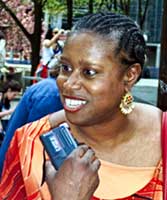
Cynthia McKinney on Israel: ‘Not in my name’

http://www.workers.org/2008/us/cynthia_mckinney_0605/
Cynthia McKinney

Cynthia McKinney
WW photo: John Catalinotto

On May 16, Cynthia McKinney, former congresswoman from Georgia, who is vying for the presidential nomination on the Green Party ticket, spoke at a rally in opposition to the 60th anniversary of the founding of the pro-Zionist state of Israel, deemed Al Nakba (The Disaster) by the Palestinian people. The following are remarks made by McKinney at the rally outside of the United Nations.

On my birthday last year, I declared my independence from a national leadership that, through its votes in support of the war machine, is now complicit in war crimes, torture, crimes against humanity and crimes against the peace.

I declared my independence from every bomb dropped, every veteran maimed and every child killed.

I noted that the Democratic leadership in Congress had failed to restore this country to constitutional rule by repealing the Patriot Acts, the Secret Evidence Act and the Military Commissions Act.

That it had aided and abetted illegal spying against the American people. And that it took impeachment off the table.

In addition, the Democratic congressional leadership failed to promote the economic integrity of this country by not repealing the Bush tax cuts. They failed to institute a livable wage, Medicare-for-all health care, and gave even more money to the Pentagon as it misuses our hard-earned dollars.

We can add to that list, too, an abject failure to stand up for human rights and dignity.

If the Democratic and Republican leadership won’t respect the right of return for Hurricanes Katrina and Rita survivors, how can we expect them to champion the right of return for Palestinians?

If this country’s leadership tolerates the wanton murder of unarmed Black and Latino men by law enforcement officials—extra-judicial killings—how can we expect them to stop or even speak out against targeted assassinations in the Middle East?

If the Democratic and Republican leadership accept ethnic cleansing in this country by way of gentrification and predatory lending, why should we expect them to put an end to it in Palestine?

If the leadership of this country impedes self-determination for Native peoples in this country, why should we expect them to support Indigenous rights for anyone abroad?

And sadly, the sensationalist corporate media would rather trick us into thinking that reporting on a pastor, a former vice presidential nominee and a former cable TV magnate constitutes this country’s much-needed discussion of its own apartheid past and present, so why should we expect an honest discussion of apartheid and Zionism?

I hope by now it is clear. Our values will never be reflected in public policy as long as our political parties and our country remain hijacked.

Hijacked by false patriots who usurp the applause of the people and all the while betray our values.

I’ve decided that neither the Democrats nor the Republicans will operate any longer as business as usual—not in my name.

That Democrats and Republicans will use my tax dollars and betray my values, not one day longer—not in my name; that neither the Democrats nor the Republicans have earned my most precious political asset—my vote.

And that now is the time to do some things I’ve never done before in order to have some things I’ve never had before.

And so here today, I declare my independence from weapons transfers, including Apache helicopters; F16s; sidewinder, hellfire and Stinger missiles.

I declare my independence from occupation, demolished homes, political prisoners and babies dying at checkpoints.

I declare my independence from U.N. vetoes, expropriated land, stolen resources and the installation of puppet regimes.

I declare my independence from all forms of dehumanization and I am not afraid to speak truth to power.

And I am happy to join with peace-loving people around the world who know that there can be no peace without justice.

Let us never tire in our work for justice. Thank you.


Articles copyright 1995-2008 Workers World. Verbatim copying and distribution of this entire article is permitted in any medium without royalty provided this notice is preserved.

Workers World, 55 W. 17 St., NY, NY 10011
Email: ww@workers.org
Subscribe wwnews-subscribe@workersworld.net
Support independent news http://www.workers.org/orders/donate.php

Pentagon scales back AFRICOM ambitions

When Pentagon strategists sought to create a new military command to oversee Africa, they believed they could build one that deemphasized military might and would serve as an exemplar of what so-called US soft power could do around the world.

But in recent months, the Pentagon has had to scale back its ambitious vision to adapt Africa's political terrain, military officials acknowledge, adding they remain committed to the original idea of a military command to promote peace in the region.

For now, officials have ruled out basing the headquarters anywhere in Africa and may in fact locate it on the East Coast, a senior defense official says. They have also backed away from selling the new command as a full "interagency" organization that spans military and nonmilitary entities.

"We sort of admitted all along that we were building something that we'd never built before," says one senior defense official, on how the command has changed. "So you gotta start somewhere, you gotta take a stab at it."

As the US Africa Command – or AFRICOM – works to stand on its own by October, the change in plans illustrates the limits of the US trying to use the military to try to broaden its influence across the globe.

The creation of AFRICOM represents a major reorganization of the Defense Department's family of six regional commands, and recognizes the strategic, security, and economic interests the US has begun to confront in Africa.

In addition to the continent's vast oil reserves, the US is wary of China's continued investment there. Military officials also believe the porous borders of many African countries allow havens for terrorist training and smuggling.

As the symbol of the new command's stature, the location of the headquarters has long been a source of controversy, with even some strong US allies refusing to host the command.

Countries like Liberia were privately receptive, say defense officials, who had launched an extensive lobbying effort to counter the notion that the US was trying to establish military bases on the continent. The effort even included a high-profile visit in February by President Bush.

Still, they were unable to sway opposition in African countries, where many viewed the new command as a neocolonialist move to secure US oil interests and counterbalance China's influence. American officials could not overcome the "paranoid rhetoric," said a defense official.

The headquarters will now either stay at its current home in Stuttgart, Germany, or be moved to the East Coast of the US. Technically, AFRICOM remains under European Command until its official launch October 1.

Officials have had to make other adjustments. Initially billed as a "whole of government" approach to solving the region's problems, the new, hybrid command had sought to marry military and civilian expertise.

"To make it more effective, we want to incorporate other nonmilitary US players working in Africa so the security piece is optimized," says Col. Pat Mackin, a spokesman for US Africa Command. But, he adds, "There is no government mechanism to create a true interagency headquarters."

The command of about 1,300 people will still be half civilian and half military, and agencies such as the US State Department will be given senior positions.

But the military will likely remain in the driver's seat. "They are significantly walking back from interagency," says Kathleen Hicks, a senior fellow at the Center for Strategic and International Studies in Washington. "What they're now saying is that they will more efficiently and effectively deliver military programs."

At the same time, officials now recognize that one entity can't do it all. Gen. William "Kip" Ward, AFRICOM's commander, has tried to soften a typically aggressive military approach and instead take a more deliberative tack.

General Ward has also sought to lower the command's public profile, notes Ms. Hicks, to focus on showing what it can do and move it away from controversy.

For example, Navy officials recently completed the first deployment of a program called the Africa Partnership Station, conducting training programs in more than a dozen nations. Capt. John Nowell Jr., commodore of the naval ships in the program, says the project is about "the maritime safety and security piece. And we think we do generate a lot of goodwill and in many cases come up with projects where we can combine the two, but we're not just out there for goodwill."

The command has also begun taking a different approach to public relations.

Its website hosts a chat room where people can post their views, a stark contrast to the stodgy sites of most military commands. One man, identified as Kuol Mangar, wrote in: "It is clear to me that General Ward would be seen as acting like those ancient Africa chiefs who sold the continent to the white man."

But several others countered his views. Stephanie, who identified herself as Kenyan by birth, wrote, "We always complained the US government did not pay Africa any attention, now they are listening and responding we still hear complaints from a few ignorant [people] that don't take the time to research and learn what the organization like AFRICOM is trying to do for the continent."


Find this article at:
http://www.csmonitor.com/2008/0516/p03s03-usmi.html

Sunday, June 01, 2008

In preparation for the Republican National Convention, the FBI is soliciting informants to keep tabs on local protest groups

By Matt Snyders

They were looking for an informant to show up at

They were looking for an informant to show up at "vegan potlucks" throughout the Twin Cities and rub shoulders with RNC protestors.

Paul Carroll was riding his bike when his cell phone vibrated.

Once he arrived home from the Hennepin County Courthouse, where he’d been served a gross misdemeanor for spray-painting the interior of a campus elevator, the lanky, wavy-haired University of Minnesota sophomore flipped open his phone and checked his messages. He was greeted by a voice he recognized immediately. It belonged to U of M Police Sgt. Erik Swanson, the officer to whom Carroll had turned himself in just three weeks earlier. When Carroll called back, Swanson asked him to meet at a coffee shop later that day, going on to assure a wary Carroll that he wasn’t in trouble.

Carroll, who requested that his real name not be used, showed up early and waited anxiously for Swanson’s arrival. Ten minutes later, he says, a casually dressed Swanson showed up, flanked by a woman whom he introduced as FBI Special Agent Maureen E. Mazzola. For the next 20 minutes, Mazzola would do most of the talking.

“She told me that I had the perfect ‘look,’” recalls Carroll. “And that I had the perfect personality—they kept saying I was friendly and personable—for what they were looking for.”

What they were looking for, Carroll says, was an informant—someone to show up at “vegan potlucks” throughout the Twin Cities and rub shoulders with RNC protestors, schmoozing his way into their inner circles, then reporting back to the FBI’s Joint Terrorism Task Force, a partnership between multiple federal agencies and state and local law enforcement. The effort’s primary mission, according to the Minneapolis division’s website, is to “investigate terrorist acts carried out by groups or organizations which fall within the definition of terrorist groups as set forth in the current United States Attorney General Guidelines.”

Carroll would be compensated for his efforts, but only if his involvement yielded an arrest. No exact dollar figure was offered.

“I’ll pass,” said Carroll.

For 10 more minutes, Mazzola and Swanson tried to sway him. He remained obstinate.

“Well, if you change your mind, call this number,” said Mazzola, handing him her card with her cell phone number scribbled on the back.

(Mazzola, Swanson, and the FBI did not return numerous calls seeking comment.)

Carroll’s story echoes a familiar theme. During the lead-up the 2004 Republican National Convention in New York City, the NYPD’s Intelligence Division infiltrated and spied on protest groups across the country, as well as in Canada and Europe. The program’s scope extended to explicitly nonviolent groups, including street theater troupes and church organizations.

There were also two reported instances of police officers, dressed as protestors, purposefully instigating clashes. At the 2004 Republican National Convention, the NYPD orchestrated a fake arrest to incite protestors. When a blond man was “arrested,” nearby protestors began shouting, “Let him go!” The helmeted police proceeded to push back against the crowd with batons and arrested at least two. In a similar instance, during an April 29, 2005, Critical Mass bike ride in New York, video footage captured a “protestor”—in reality an undercover cop—telling his captor, “I’m on the job,” and being subsequently let go.

Minneapolis’s own recent Critical Mass skirmish was allegedly initiated by two unidentified stragglers in hoods—one wearing a handkerchief over his or her face—who “began to make aggressive moves” near the back of the pack. During that humid August 31 evening, officers went on to arrest 19 cyclists while unleashing pepper spray into the faces of bystanders. The hooded duo was never apprehended.

In the scuffle’s wake, conspiracy theories swirled that the unprecedented surveillance—squad cars from multiple agencies and a helicopter hovering overhead—was due to the presence of RNC protesters in the ride. The MPD publicly denied this. But during the trial of cyclist Gus Ganley, MPD Sgt. David Stichter testified that a task force had been created to monitor the August 31 ride and that the department knew that members of an RNC protest group would be along for the ride.

“This is all part of a larger government effort to quell political dissent,” says Jordan Kushner, an attorney who represented Ganley and other Critical Mass arrestees. “The Joint Terrorism Task Force is another example of using the buzzword ‘terrorism’ as a basis to clamp down on people’s freedoms and push forward a more authoritarian government.”

Url: http://articles.citypages.com/2008-05-21/news/moles-wanted/
Home:
www.citypages.com
City Pages is the Online News and Arts Weekly of the Twin Cities

JROTC must go now

Military recruiting at the later elementary level needs to be stopped. This is a time when most haven't developed the critical faculties to realize the commitment being made. Culling a standing, offensive army from our vital young is and has always been a most inhumane and appalling practice.--Pete

By Riva Enteen and Tommi Avicolli Mecca, SFBG

OPINION In November 2006, San Francisco made history when the school board made this the first big city in the nation to ban JROTC [Junior Reserve Officer Training Corps]. The board's resolution, which called for phasing out JROTC from high schools this June, stated that "JROTC is a program wholly created and administrated by the United States Department of Defense, whose documents and memoranda clearly identify JROTC as an important recruiting arm."

A poison pill was added to the resolution at the last minute: it called for a task force to be set up to find an "alternative" program to JROTC. The school district administration, in a particularly despicable move, set up the task force with more than 10 members supporting JROTC, and only one member opposed.

Surprise! After sitting for almost a year, the task force failed to come up with an alternative, so the school board rolled over and, except for two courageous members — Mark Sanchez and Eric Mar — voted last December to extend JROTC for another year.

In 2005, San Franciscans passed Proposition I by almost 60 percent, declaring it "city policy to oppose military recruiting in public schools." That same year, by the Army's own report, 42 percent of JROTC graduates across the nation signed up for the military. As this country enters its sixth year of the illegal occupation of Iraq and Afghanistan, it's time for the school board to go back to its original decision to kick the military out of our schools.

The school board must end JROTC — now. JROTC is currently scheduled to be "phased out," but not until June 2009. By then both Sanchez and Mar will be off the school board, and there will be little to prevent the military from orchestrating a vote to extend JROTC indefinitely. If, on the other hand, the school board votes to end JROTC this June as their original resolution required, JROTC would be gone.

Two progressives on the board must be convinced to send the military packing: Kim-Shree Maufas and Green Party member Jane Kim.

Both received endorsements from progressives. To convince them that they risk such endorsements in the future, the JROTC Must Go! Coalition is circulating the following statement: "We will look very closely at the next school board vote on JROTC and will consider the votes carefully when making any endorsements for future candidates."

Within a week, the Tenants Union, the Harvey Milk LGBT Democratic Club, and the San Francisco Bay View newspaper signed the statement. If Maufas and Kim join Sanchez and Mar, we'll make history again.

Riva Enteen is the former program director for the National Lawyers Guild and the mother of two San Francisco school district graduates. Tommi Avicolli Mecca is a southern Italian queer atheist writer and activist. For more information contact the JROTC Must Go! Coalition: (415) 575-5543 or JROTCmustgo@gmail.com.

Wednesday May 14, 2008

Saturday, May 31, 2008

Majesty, We Have Gone Mad: An open letter to King Abdullah of Saudi Arabia

May, 31 2008 By George Monbiot
George Monbiot's ZSpace Page

Your Majesty,

In common with the leaders of most western nations, our prime minister is urging you to increase your production of oil. I am writing to ask you to ignore him. Like the other leaders he is delusional, and is no longer competent to make his own decisions.

You and I know that there are several reasons for the high price of oil. Low prices at the beginning of this decade discouraged oil companies from investing in future capacity. There is a global shortage of skilled labour, steel and equipment(1). The weak dollar means that the price of oil is higher than it would have been if denominated in another currency. While your government says that financial speculation is an important factor, the Bank of England says it is not(2), so I don't know what to believe. The major oil producers have also become major consumers; in some cases their exports are falling even as their production has risen, because they are consuming more of their own output(3).

But what you know and I do not is the extent to which the price of oil might reflect an absolute shortage of global reserves. You and your advisers are perhaps the only people who know the answer to this question. Your published reserves are, of course, a political artefact unconnected to geological reality. The production quotas assigned to its members by Opec, the oil exporters' cartel, reflect the size of their stated reserves, which means that you have an incentive to exaggerate them. How else could we explain the fact that, despite two decades of furious pumping, your kingdom posts the same reserves as it did in 1988?(4)

You say that you are saving your oil for the benefit of future generations(5). If this is true, it is a rational economic decision: oil in the ground looks like a better investment than money in the bank. But, reluctant as I am to question your majesty's word, I must remind you that some oil analysts are now wondering whether this prudence is a convenient fiction(6). Are you restricting supply because you want to conserve stocks and keep the price high, or are you unable to raise production because your fabled spare capacity does not in fact exist?

I do not expect an answer to this question. I know that the true state of your reserves is a secret so closely guarded that oil analysts now resort to using spy satellites to try to estimate the speed of subsidence of the ground above your oil fields(7), as they have no other means of guessing how fast your reserves are running down.

What I know and you may not is that the high price of oil is currently the only factor implementing British government policy. The government claims that it is seeking to reduce carbon dioxide emissions, by encouraging people to use less fossil fuel. Now, for the first time in years, its wish has come true: people are driving and flying less. The AA reports that about a fifth of drivers are now buying less fuel(8). A new study by the Worldwide Fund for Nature shows that businesses are encouraging their executives to use video conferences instead of flying(9). One of the most fuel-intensive industries of all, business-only air travel, has collapsed altogether(10).

In other words, your restrictions on supply - voluntary or otherwise - are helping the government to meet its carbon targets. So how does it respond? By angrily demanding that you remove them so that we can keep driving and flying as much as we did before. Last week Gordon Brown averred that it's "a scandal that 40% of the oil is controlled by Opec, that their decisions can restrict the supply of oil to the rest of the world, and that at a time when oil is desperately needed, and supply needs to expand, that Opec can withhold supply from the market."(11) In the United States, legislators have gone further: the House of Representatives has voted to a bring a lawsuit against Opec's member states(12), and Democratic senators are trying to block arms sales to your kingdom unless you raise production(13).

This illustrates one of our leaders' delusions. They claim to wish to restrict the demand for fossil fuels, in order to address both climate change and energy security. At the same time, to quote Britain's department for business, they seek to "maximise economic recovery" from their remaining oil, gas and coal reserves(14). They persist in believing that both policies can be pursued at once, apparently unaware that if fossil fuels are extracted they will be burnt, however much they claim to wish to reduce consumption. The only states which appear to be imposing restrictions on the supply of fuel are the members of OPEC, about which Gordon Brown so bitterly complains. Your majesty, we have gone mad, and you alone can cure our affliction, by keeping your taps shut.

Our leaders, though they do not possess the faintest idea of whether or not the oil supplies required to support it will be sustained, are also overseeing a rapid expansion of our transport infrastructure. In the United Kingdom we are building or upgrading thousands of miles of new roads and doubling the capacity of our airports, in the expectation that there will be no restriction in the supply of fuel. The government's central forecast for the long-term price of oil is just $70 a barrel(15).

Over the past few months I have been trying to discover how the government derives this optimistic view. In response to a parliamentary question, it reveals that its projection is based on "the assessment made by the International Energy Agency (IEA) in its 2007 World Energy Outlook."(16) Well last week the Wall Street Journal revealed that the IEA "is preparing a sharp downward revision of its oil-supply forecast". Its final report won't be released until November, but it has already concluded that "future crude supplies could be far tighter than previously thought."(17) Its previous estimates of global production were wrong for one simple and shocking reason: it had based them on anticipated demand, rather than anticipated supply(18). It resolved the question of supply by assuming that it would automatically rise to meet demand, as if it were subject to no inherent restraints.

Our government must have known this, but it has refused to conduct its own analysis of global oil reserves. Uniquely among possible threats to the economy and national security, it has commissioned no research of any kind into this question(19). So earlier this year I asked the department for business what contingency plans it possesses to meet the eventuality that the IEA's estimates could be wrong, and that global supplies of petroleum might peak in the near future. "The Government," it replied, "does not feel the need to hold contingency plans"(20). I am sure I do not need to explain the implications, if its forecasts turn out to be wildly wrong.

Your majesty, I recognise that this is not among your usual duties as the ruler of Saudi Arabia. But I respectfully beg you to save us from ourselves.

Yours Sincerely,

George Monbiot

www.monbiot.com

References:

1. Carola Hoyos, 19th May 2008. Running on empty? Fears over oil supply move into the mainstream. Financial Times.

2. Ambrose Evans-Pritchard, 22nd May 2008. Why oil could soon come barrelling down. The Daily Telegraph.

3. Jeff Rubin and Peter Buchanan, 10th September 2007. OPEC's Growing Call on Itself. Occasional Report # 62. CIBC World Markets. http://research.cibcwm.com/economic_public/download/occrept62.pdf

4. Eg Danny Fortson, 4th January 2008. Oil: the power to shock. The Independent.

5. Carola Hoyos, ibid.

6. Eg Ambrose Evans-Pritchard, 16th May 2008. Day of truth for US- Saudi axis. The Daily Telegraph.

7. Carola Hoyos, ibid.

8. BBC Online, 19th May 2008. Fuel prices 'keep cars off road'. http://news.bbc.co.uk/1/hi/business/7409166.stm

9. WWF, 2008. Travelling Light: why the UK's biggest companies are seeking alternatives to flying. http://www.wwf.org.uk/filelibrary/pdf/travelling_light.pdf

10. Eg Kevin Done, 23rd May 2008. Silverjet suspends shares amid funding crisis. Financial Times.

11. Gordon Brown, 19th May 2008. Speech to Google Zeitgeist Conference.
http://www.number-10.gov.uk/output/Page15587.asp

12. Suzy Jagger, 21st May 2008. Congress takes step towards Opec legal challenge. The Times.

13. Ian Black, 17th May 2008. Frustration for Bush as pledge to Saudis fails to win oil concession. The Guardian.

14. Eg, Department of Trade and Industry, May 2007. Meeting the Energy Challenge: a white paper on energy. Para 4.07, page 107.

15. Dan Milmo, 20th May 2008. Road policy oil assumptions attacked. The Guardian.

16. Malcolm Wicks, 2nd April 2008. Parliamentary Answer to question 197009. http://www.publications.parliament.uk/pa/cm200708/cmhansrd/cm080402/text/80402w0045.htm

17. Neil King Jr and Peter Fritsch, 22nd May 2008. Energy Watchdog Warns of Oil-Production Crunch. Wall Street Journal.

18. ibid.

19. I have asked the four departments with direct interests in future oil supply: DBERR, transport, environment, communities and local government.

20. DBERR, 8th April 2008. Response to FoI request Ref 08/0091.

Published in the Guardian 26th May 2008


From: Z Space - The Spirit Of Resistance Lives
URL: http://www.zcommunications.org/zspace/commentaries/3507

Saturday, May 24, 2008

Death-wish Hillary primes Manchurian Candidate

When I first heard about this statement, a chill went up my spine. I couldn't believe that this candidate was truly as nasty as I'd imagined. It would appear that my imagination fell far short.--Pete

By Alexander Cockburn, Counterpunch

Ever since she realized back in early March that Obama was going to take the nomination Hillary Clinton’s long-term strategy has been to do her best to ensure McCain will win this November so she can become the Democratic nominee in 2012. But she had a short term strategy too and on Friday she deliberately made it explicit in a newspaper office in Sioux Falls, South Dakota. There she suggested that some is likely to step up to the plate and assassinate Barack Obama in the waning moments of the California primary, just as Bobby Kennedy was forty years go almost to the day. The wish is mother to the deed. If anything does happen to Obama in California Mrs Clinton should surely be indicted as a co-conspirator.

How to else construe her grotesque remarks in Sioux Falls, South Dakota, in the editorial offices of the Argus Leader newspaper. Here she told the editors, "My husband did not wrap up the nomination in 1992 until he won the California primary somewhere in the middle of June, right? We all remember Bobby Kennedy was assassinated in June in California. I don't understand it," she said, dismissing calls to drop out.

There is no other way to construe these sentences, not thrown over her shoulder on a campaign walk, but delivered in measured tones to the Argus-Leader editorial board, but to interpret them as Mrs Clinton’s more or less explicit statement that she is spending a million a day just to keep her hat in the ring because Obama might well get killed. Then, just like the scenario at the end of the Manchurian candidate, Hillary will straddle Obama’s bleeding body, make the speech of her life and become the assured nominee. In fact, right now she’s probably sitting down with some numbed vet and whispering coyly in her best Angela Lansbury mode to the Lawrence Harvey stand-in, “How about passing the time by playing a little solitaire?" I pass on whether Hillary reprises Angela Lansbury’s famous incestuous kiss on her son’s lips. Perhaps Sid Blumenthal is the stand-in, though I doubt he’s a very good shot.

To get added insight into what a truly nasty woman Hillary Clinton is, remember that her remarks on Friday came a couple of days after Edward Kennedy was diagnosed with a malignant brain tumor. Next thing you know, his fellow senator is saying that California might well be celebrating the fortieth anniversary of his borther’s murder by killing the candidate he has endorsed for the nomination.

Now Hillary Clinton is dutifully saying that she was misunderstood, that she had no intention, no thought, that she might be taking about SOMEONE KILLING OBAMA, SOMEONE SHOOTING THE BLACK MAN DEAD, JUST LIKE SOMEONE SHOT BOBBY KENNEDY DEAD IN CALIFORNIA, IN CALIFORNIA, DEAD, REALLY DEAD. Oh my heavens no, the thought never crossed my mind.

Recall too that as Jeffrey pointed out in his Wednesday piece here, Mrs Clinton and her mouthpieces have been steadily raising the volume on their verbal-lynching. In South Dakota Mrs Clinton lit the fuse.

The Death of American Liberalism

Now a word about the wider picture: There’s certainly no effective liberal, let alone left presence in mainstream American politics any more. The political primary season, now in its final throes, has resoundingly buttressed this fact, albeit disguising the process by the crafty expedient of making a black man the all-but-certain Democratic nominee.

Take the scene in Portland, Oregon last Monday, on the eve of a vote in that north-western state which sent Barack Obama one step further in formally clinching the Democratic nomination. CounterPunch coeditor Jeffrey St Clair gave a most amusing and enlightening account of it this last Wednesday. How did Hillary Clinton try to remind Oregonians of her claims to be the authentic rep of white working-class America, without whose votes no Democrat can ever win the White House?

She held a press conference in the upscale Portland suburb of Beaverton, in a subdivision where $500,000 homes have gone unsold for the past year. She spoke movingly of the pain being experienced by the developer. A few miles north, homeless Oregonians were besieging the offices of Portland’s mayor, Tom Potter.

As noted above, almost exactly forty years ago John F. Kennedy’s younger brother Bobby was making a similar last-throw bid in California to win the state and seize the Democratic nomination, by dint of a populist campaign. Bobby reached out to California’s poor. There’s no way Bobby would have hunkered down with a property developer. He’d have been heading the homeless in a march to the mayor’s office to demand they be given rent-free accommodation in the unsold mansions.

As a reminder that some things don’t change, Bobby’s second strategy in California was to court the affluent Jewish vote on the West Side of Los Angeles. Just like Hilary he implied that his opponents were all too eager to parley with the sworn enemies of Israel. He demanded that the US government release F-4 Phantom jets to Israel. A young Palestinian called Sirhan Sirhan read of this demand in an article in the New York Review of Books by my dear friend, the late Andrew D. Kopkind. Thus edified by Andy, Sirhan promptly scrawled “RFK Must Die!” in his diary and headed to the Ambassador Hotel. There, shortly after midnight on June 5, 1968, he shot Kennnedy dead with a .22 Iver-Johnson revolver in the hotel kitchen, just as Bobby was shaking hands with a dishwasher. Bobby’s Israel and populist strategies had fatally collided.*

Bobby Kennedy’s younger brother Ted tried to sell the same populism as Bobby in his run for the nomination against Carter in 1978. Ten years later Jesse Jackson, the first black American to take a serious tilt at the Democratic nomination, led many a poor people’s march to City Halls across America.

Not any more. Hilary’s populism has been skin-deep in the literal sense of the term. It’s not been about rich developers, or predatory sub-prime loans. It’s only about the color of Obama’s skin, which Mrs Clinton opines is unsuitable in tint. You want irony? Try tracing the thread that runs from Fanny Lou Hamer and her comrades’ efforts to seat the Mississippi Freedom Democrats at the 1964 convention in Atlanta to Hillary Clinton’s claim that in trying to get Florida’s Democrats seated in the convention in Denver she’s taking us back to the most glorious struggles of the abolitionists against slavery.

The old truism about primary season used to be that Democratic candidates have to run left to capture crucial support from the sort of politically active progressives who vote in Democratic primaries and caucuses. Then, with the nomination secured, the nominee spends the rest of the year running right, to win over middle America.

But Obama has achieved the amazing feat of being the almost-certain nominee without barely a phrase on the record with which John McCain can belabor him for “loony-leftism” or even “outdated liberalism” in the months to come.

Bloated Pentagon budgets? This favored target in past primary seasons has flourished unscathed this year, even though the arms-spending to which Bush’s former defense secretary, Donald Rumsfeld, committed the US government promises certain budgetary catastrophe across the next fifteen years. Obama’s subservience to the US military has been evinced numerous times, most recently when he confided last week to David Brooks, one of the New York Times’s profuse stable of neo-con columnists, that “The [U.S.] generals are light-years ahead of the civilians. They are trying to get the job done rather than look tough.”

What about Wall Street, whose leading bankers have devastated middle-income America with the sub-prime scams? Obama has been tactful, meanwhile hauling in hefty campaign contributions from these same bankers as Pam Martens has described on this website. Health care? No relief for America’s 45 million uninsured from Obama, who offers “reforms” unreservedly deferential to the insurance and pharmaceutical industries. What about labor and the right to form a union – something virtually impossible to do in America today, where it’s (barely) legal to go on strike but almost entirely illegal to win one. Seldom has a Democrat won the nomination with less IOUs to organized labor than Obama.

But, you say, surely Obama prevailed over Hillary in large part because she voted for the war in Iraq and he didn’t. This year Obama’s statements on the war have been carefully hedged. McCain will have a tough time painting him into a corner as a peacenik without himself sounding like a crazed warmonger, (which he frequently does). The war in Iraq is not popular in America, but the antiwar movement is effectively dead.

As a presidential candidate the only politically unorthodox item on Obama’s record is that he has a black skin. As he runs against an elderly, unstable Republican candidate whose own mottled epidermis raises constant uneasy questions about possible battles with cancer Obama should thank Bush 1 for making a black man chairman of the Joint Chiefs of Staff and putting Clarence Thomas on the US Supreme Court, and Bush 2 for making Condoleezza Rice secretary of state. See? Blacks can be trusted! And Obama should thank the Republican Party for nominating a candidate weaker by far than any he might have dreamed of only six months ago. As a member of the Chaos Party I’m none to keen on the man. If McCain choses a real dunderhead as his running mate, I must just go for the Republican ticket.

To save conspiracists the trouble of writing to me, I should say that Kennedy had just passed the dishwasher, then twisted back and to his left to shake hands, which explains why the entry wound in his head seemed to indicate a shot from a quarter other than where Sirhan was standing.

Who Killed Colonel Sabow?

There was a time, I tell the younger crowd, when the first Arab-American to win a seat in the US Senate failed by only three votes to get a bill through the US senate breaking up the oil companies. This was Jim Abourezk, of South Dakota, who held one of South Dakota’s senate seats through most of the 1970s, and achieved much in his single term. In the latest issue of our newsletter Jim lays out in absorbing and convincing detail the evidence that a colonel in the USMC was murdered on base just before he was going to testify about clandestine arms-for-drugs slights to South America. Subscribe now. You’ll also get Alexander Cockburn on the Amazon. . . Hey, come back, y’all. I said, subscribe, dammit.

Footnote: portions of the first item ran on The First Post last Friday. Alexander Cockburn can be reached at alexandercockburn@asis.com

Thursday, May 22, 2008

Don't Bomb Iran!

This is the new ad campaign from Agit-Pop. It contains the sound-bite equivalent of a lifetime's worth of current global events education for the average FOX viewer concerning Iran. Check it, campers!--Pete

Tuesday, May 20, 2008

Billy O Goes Ballistic On Inside Edition In The Early 90's

Apparently Mr. O'reilly was given nothing to read on his teleprompter and became belligerent. He then decided that they were going to "do it live", meaning, for Billy at least, that he would have to improvise due to the obvious complete lack of a run-through. Watch for yourself:

See more funny videos at CollegeHumor

Our Government's Need For An Irrational Enemy

Daniel Larison, at the ACLU Blog, has an interesting piece about our government's absolute need for an irrational enemy. He posits that this is tied to the authorized use of torture by agents of said government.

Mr. Larison believes that in order to sell the use of torture by our own peace-loving government agents to the American public, that the enemy must be portrayed as being completely without a scintilla of rationality, and definitely not accepted as self-interested, rational parties to the general disagreement. For many, Larison has already crossed the line of thinkable thought, since they have been completely mesmerized by the spectacle on their televisual persuasion devices and have surrendered to the notion of "cooler heads in our leadership", a notion which has been shown to be completely ludicrous.

Be advised that Daniel Larison also writes for The American Conservative magazine.--Pete

Read more:
http://blog.aclu.org/2008/05/20/daniel-larison-on-the-necessity-of-an-irrational-enemy/

Friday, May 16, 2008

Dispatch from Post-Constitutional Amerikkka

AJ at Police America has a story regarding the police department's use of undue force in Dundalk, Maryland. This says so much about the true legacy of the illegitimate Bush Administration and its dismantling of our republic's hard-won civil liberties.

She was shot at 4:30 AM because police were rooting through her trash and found trace amounts of drugs. They then used a concussion grenade instead of knocking on the door and kicked in the bedroom door unannounced. She thought that intruders had broken in (they had!), and brandished a weapon - legally registered and pointed at the floor - in defense of herself and her family. Without being told to drop her weapon, she was executed, cop style.--Pete

Read more:
http://www.examiner.com/a-521595~Family__friends_remember_Dundalk_woman_killed_by_SWAT_team.html