Monday, July 16, 2007

A Picture of the GOP on Civil Rights

By Guest Blogger
Posted on July 14, 2007
http://www.alternet.org/bloggers/guest/56903/

This post, written by Jeffrey Feldman, originally appeared on Frameshop

Click for larger version
(click for larger version)

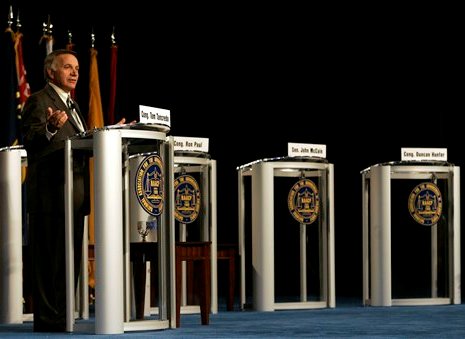
The one photo the GOP does not want anyone to see was snapped at yesterday's NAACP GOP Presidential Candidate Forum. The NAACP invited all 9 Republican candidates to the forum, but only one showed up: Tom Tancredo. All the Democratic Presidential hopefuls showed up for their forum.

The excuses given by the Republican campaigns mostly had to do with scheduling conflicts--just too busy to make it.

The resulting photo of Tancredo--standing on a stage of empty podiums--sums up the Republican party's commitment to civil rights in America: the only Republican interested is the guy running to deny immigrant workers their rights.

One has to wonder why this photo was not the lead on every morning show and on the front pages of every morning newspaper in America.

Click for larger version
(click for larger version)

The reason, most likely, is a coordinated effort by Republicans to pressure news agencies to downplay the obvious implications of having 8 out of 9 of their Presidential candidates as "no shows" for a debate at the NAACP.

What is keeping the obvious story about Republicans and racism out of today's headlines? David Beckham's arrival in Hollywood.

This is an ideal moment to stand up and demand the kind of news coverage we want in America. Contact your local TV stations and newspapers. Ask them to run this photo and to write an article about Republicans, civil rights and racism.

Jeffrey Feldman is the Editor and Founder of the blog Frameshop (also known by the web URL of the site: Frameshopisopen.com).

© 2007 Independent Media Institute. All rights reserved.
View this story online at: http://www.alternet.org/bloggers/guest/56903

How Berkeley can you be?


I had to add this one, it's a wonderful prototype presented in a somewhat jokey fashion. This is the Busycle, debuted at the "How Berkeley Can You Be" parade in '06. Completely workable, though. Click pic for larger image.

Vive la Velorution!


http://www.truthdig.com/avbooth/item/20070715_vive_la_velorution/
Posted on Jul 15, 2007

By Zuade Kaufman

The French didn’t invent the wheel, but with their latest urban project they’re reinventing how it’ll be used in their beloved capital. On July 15, Mayor Bertrand Delanoë and other green-minded Parisians were on hand at the launching of the “Velib’ ” program, which makes some 10,600 public-use bicycles available at 750 stations throughout the world’s most visited city.

Delanoë, once the head of Paris’ Socialist Party, started his campaign to cut down on traffic congestion when he ran for office in 2001. Since then, the city has become less user-friendly for car owners and more so for people using buses and bicycles: Free parking lots have become a thing of the past, parking tickets have gone up in price, and many two-way streets have been whittled down to one-way routes. Also, car lanes have been sacrificed throughout the city to make room for more bike traffic and to widen bus lanes. Around March of this year, the push to set up the program began in earnest. By January 2008 the city plans to double the number of bikes and stations.

The hope of the Velib’ initiative—the name is a combination of the French words velo (bike) and liberté (liberty)—is to make Paris greener and to expand bicycle culture. With Sunday’s Velib launch (a good day for the event, just after Bastille Day and right at the height of Tour de France fever), Paris joins other pedal-pushing European cities like Brussels, Copenhagen, Stockholm and Vienna, all of which have implemented similar programs. Bicycle traffic has been on the rise in recent years, and Paris now boasts 230 miles of bike lanes throughout the city. According to a Velib’ official, a single card allows users to both rent bicycles (with a range of subscription and pricing options) and ride public transportation. The three-speed touring bikes can be left at any of the bicycle stations in Paris. Because the program encourages brief rides of less than half an hour, the bikes are expected to be in heavy rotation.

Depending on their trades and preferred modes of transport, locals weighed in with a range of reactions about the “velorution” and whether it truly will be revolutionary for the average Parisian. Some service and delivery workers are nervous about having so many bikes on the street. Michael Jouer, an employee of the boiler manufacturing company e.l.m. leblanc, said: “It’s going to be a horror—very, very dangerous. Anyone can ride these bikes, and many of them don’t even know how. I’m afraid there’s really going to be a lot of accidents.”

However, taxi driver Homayoun Haghighi said he thinks Velib’ is a good initiative and doesn’t believe it will negatively impact his business. “We have our clientele,” he said, adding that the recent traffic changes have slowed cars down around the city and made travel by bike more efficient during high-congestion hours. “It’s like that; one just has to take their time driving in Paris,” he shrugged.

View the Photo Essay

Sunday, July 15, 2007

Amsterdam Bicycles


(82 ictures of bicycles taken during 73 minutes on 9/12/06 in Amsterdam, Netherlands)

Background and explanation:

I stopped in Amsterdam, Netherlands on my way back from a 2006_europe_motorcycle_trip. During a 73 minute period on 9/12/06 at one corner of Nieuw Markt (a nice open square in Amsterdam), I took the following 82 pictures of bicycles. Why? Because sitting there I noticed how remarkably different the whole Amsterdam bicycle scene was from my home, and at the same time certain very clear "Amsterdam Bicycle Trends" appeared I thought might be interesting to point out. I am from the San Francisco area, California, USA.

Categories that show differences between Amsterdam bicyclists and San Francisco bicyclists:

Here are a few of the differences I wanted to point out, with examples:

1. Formally Dressed Bicyclists - A whole set of Amsterdam bicyclists can be seen dressed very formally, like suit and tie for men, and dresses for women. NOBODY in San Francisco ever bicycles in a suit and tie, or in dress. But during this one hour photo shoot, I saw 20 or more incredibly well dressed bicyclists meander by.
2. Multiple Riders on One Bike - With or without any extra seats or foot-pegs for the extra riders, you will see 1 or 2 or even 3 extra passengers side-saddle, balancing precariously, standing, sitting, whatever it takes so they can hitch a ride with a buddy or parent. This is so common I had to stop taking pictures of it because it would prevent me from capturing some of the other trends. Almost 50 percent of the bicycles I saw had more than 1 person on them. In San Francisco the only time you would ever see two passengers is a small child on the back in a $300 government approved safety chair, and the child would be wearing a helmet (because it's the LAW). Click here for an unrelated rant on helmet laws. Which brings us to the next difference......
3. No Helmets EVER - It is amazing to me coming from San Francisco, land of 100 percent helmet covered heads, but in all of Amsterdam (population 750,000) there is not one bicycle helmet found anywhere in the city. Not ONE!! Contrast this with San Francisco, for anybody under the age of 18, there is a Mandatory Helmet Law, and everybody above 18 wears helmets anyway. Now faced with this shocking disparity, I think any reasonable person must come to the conclusion that either the people in Netherlands do not value the safety of their children, or San Francisco bicyclists are clumsy pansies with soft heads and weak minds that must be protected from hurting themselves no matter how much it infringes on individual rights. Click here for an unrelated rant on helmet laws.
4. Dogs on Bikes - Amsterdam bicyclists seem to commonly bring their furry friends along with them on the bicycle rides. I think that's nice.
5. Human Powered Generator (Dynamo) Bicycle Light - This one really does mystify me, some of the other trends more more sense to me. EVERY bicycle in Amsterdam is outfitted with a dynamo powered head lamp, where the rider has to pump extra super hard and the head lamp shines dimly. If you are younger than 35 years old, you probably have never seen one of these in the USA, we have very bright headlamps for bicycles that add much less weight and do not increase resistance. I haven't seen a single dynamo powered bicycle in San Francisco in over 20 years. Once I saw a "Simpsons" (animated comedy) episode where Bart turned on his dynamo bicycle headlamp and could barely make forward progress-> in the USA these dynamo powered headlamps are considered a JOKE, but almost a quarter million bicycles in Amsterdam all have them.
6. Spectacular Gigantic Unbreakable Security Chains - Almost all of the bicycles in Amsterdam are what I would call "beaters", which means they are beaten up, scraped, bent, out of tune, and have bad paint jobs. At the same time, all these beaters have these GIGANTIC security chains that look like they should be the chain on the anchor of an oil tanker ship. The ton of high tensile, military hardened steel in each security chain must be worth more than the bicycle it is keeping safe! The only other type of bicycle lock was a type of sliding circular rear wheel lock that was once sold in the USA (I owned one when I was 10 years old). The circular sliding read wheel locks lost popularity in the USA because they offer almost no security at all: 1) the criminal can always lift the bike and walk away with it, and 2) it is always easy to "guess" the combination. Strange dichotomy of lock choices in Amsterdam.
7. ....And More... - Several other trends are shown in the pictures below, including bicycles are commonly painted one big bright aftermarket color, Amsterdam residents like using their cell phones while riding their bikes, many bikes are outfitted with big buckets on the front for serious industrial deliveries, and there is a whole trend of this "small frame" bicycles with "untraditional" proportions (very small wheels and then very tall seats to make up for it). You can view the pictures below to get an idea.


See the remaining pics here

Discrepancies Reported in Versions of LA County E-Voting System Source Code as Submitted and Escrowed by ES&S

Letter Obtained by BRAD BLOG to Voting Machine Company Confirms Potential Violations Of California Election Law as Revealed During CA SoS Bowen's 'Top-to-Bottom Review' of E-Voting Systems

Matter May Have Far Reaching, National Consequences Concerning the Effectiveness of Escrowing Secret Vote-Counting Software...

Posted By John Gideon On 10th July 2007

Blogged by John Gideon and Brad Friedman

The results of California Secretary of State Debra Bowen's "top-to-bottom review" of electronic voting systems previously approved for use by her predecessor is still underway. But before any of the findings from her teams of security specialists, software analysts and voting systems experts have been made public, the unprecedented analysis has already revealed a disturbing anomaly which may have far-reaching implications for both state and federal voting systems laws across the country.

As The BRAD BLOG reported exclusively almost three weeks ago [1] --- precisely zero media outlets bothered to file their own reports on this matter until last weekend --- all voting machine vendors certified in California had submitted their source code to Bowen for the review, except for ES&S, America's largest voting machine company.

After their refusal to submit the code as required for the test, Bowen demanded the source code used for the InkaVote Plus voting systems marketed by ES&S, and used exclusively in Los Angeles, be released to the state by the escrow firm which had been holding it as per state law.

Following Bowen's demand to the escrow company, Iron Mountain Intellectual Property Management, ES&S reluctantly agreed [2] to give their own version of the source code to the state.

Oddly enough at the time, the voting machine company, in an arrogant letter to Bowen (posted here in full by The BRAD BLOG [3]), demanded that she withdraw her request to receive the version of the source code already stored in escrow at Iron Mountain. The letter succeeded in keeping our already-raised eyebrows at full perk, as the demand that Bowen not review the code in escrow, but rather look only at the one ES&S was sending, raised several troubling questions. Among them, we wondered at the time if perhaps the version stored in escrow was not the version actually used on the county's voting systems during last year's election. If so, there could be enormous ramifications for the company, and for the idea of escrowed source code for voting systems in general.

Over the weekend, an article in the Los Angeles Daily News, the first organization to jump into this matter following our series of reports, filed a story on the matter [4] which began to validate our suspicions. The paper reported that due to the late submission, the InkaVote Plus system would not be included in Bowen's "top-to-bottom review", presenting questions about which voting system would be allowed for use in 2008, in the country's most populous county. LA County is larger than many states in America.

It's as yet unclear whether Bowen will completely decertify the InkaVote Plus system for use, or whether she will take other steps.

Perhaps more disturbingly, however, the Daily News report includes comments from CA's Deputy SoS for Voting Systems, Lowell Finley, indicating that our concerns about differences in the submitted and escrowed source code may have been precisely on target.

We contacted Bowen's office for more details, and they shared with us the letter sent from Finley back to ES&S in response to the company's curious demands. The letter is posted in full at the end of this article. And if the issue Finley raises is indeed true, there may be a whole lotta trouble ahead...

Saturday, July 14, 2007

Judge Who Sentenced Libby Slams the Bush Commutation

By Guest Blogger
Posted on July 13, 2007
http://www.alternet.org/bloggers/guest/56833/

This post, written by Jane Hamsher, originally appeared on FireDogLake

Judge Walton weighs in (PDF):

In commuting the defendant’s thirty-month term of incarceration, the President stated that the sentence imposed by this Court was “excessive” and that two years of supervised release and a $250,000 alone are a “harsh punishment” for an individual convicted on multiple counts of perjury, obstruction of justice, and making false statements to federal investigators. Although it is certainly the President’s prerogative to justify the exercise of his constitutional commutation power in whatever manner he chooses (or even to decline to provide a reason for his actions altogether), the Court notes that the term of incarceration imposed in this case was determined after a careful consideration of each of the requite statutory factors, and was consistent with the bottom end of the applicable sentencing range as properly calculated under the United Stats Sentencing Guidelines.

Indeed, only recently the President’s Attorney General called for the passage of legislation to “restore the binding nature of the sentencing guidelines so that the bottom of the recommended sentencing range would be a minimum for judges, not merely a suggestion,” a stance that is fully consonant with the policies of this Administration as a whole. In light of these considerations, and given the indisputable importance of “provid[ing] certainty and fairness in sentencing . . . [and] avoid[ing] unwarranted sentencing disparities,” it is fair to say that the Court is somewhat perplexed as to how its sentence could be accurately be characterized as “excessive.” (my emphasis).

When guys like Walton, Fitzgerald and Comey loosen their ties and knock back a couple of beers, you gotta wonder what they are saying privately. I’m gonna guess that “well, the President was well within his rights, let’s all just ‘move on’” is probably not going to be uttered.

Jane Hamsher is the founder of FireDogLake

© 2007 Independent Media Institute. All rights reserved.
View this story online at: http://www.alternet.org/bloggers/guest/56833/

A dead Iraqi is just another dead Iraqi... You know, so what?'

Interviews with US veterans show for the first time the pattern of brutality in Iraq

By Leonard Doyle in Washington

Published: 12 July 2007

It is an axiom of American political life that the actions of the US military are beyond criticism. Democrats and Republicans praise the men and women in uniform at every turn. Apart from the odd bad apple at Abu Ghraib, the US military in Iraq is deemed to be doing a heroic job under trying circumstances.

That perception will take a severe knock today with the publication in The Nation magazine of a series of in-depth interviews with 50 combat veterans of the Iraq war from across the US. In the interviews, veterans have described acts of violence in which US forces have abused or killed Iraqi men, women and children with impunity.

The report steers clear of widely reported atrocities, such as the massacre in Haditha in 2005, but instead unearths a pattern of human rights abuses. "It's not individual atrocity," Specialist Garett Reppenhagen, a sniper from the 263rd Armour Battalion, said. "It's the fact that the entire war is an atrocity."

A number of the troops have returned home bearing mental and physical scars from fighting a war in an environment in which the insurgents are supported by the population. Many of those interviewed have come to oppose the US military presence in Iraq, joining the groundswell of public opinion across the US that views the war as futile.

This view is echoed in Washington, where increasing numbers of Democrats and Republicans are openly calling for an early withdrawal from Iraq. And the Iraq quagmire has pushed President George Bush's poll ratings to an all-time low.

Journalists and human rights groups have published numerous reports drawing attention to the killing of Iraqi civilians by US forces. The Nation's investigation presents for the first time named military witnesses who back those assertions. Some participated themselves.

Through a combination of gung-ho recklessness and criminal behaviour born of panic, a narrative emerges of an army that frequently commits acts of cold-blooded violence. A number of interviewees revealed that the military will attempt to frame innocent bystanders as insurgents, often after panicked American troops have fired into groups of unarmed Iraqis. The veterans said the troops involved would round up any survivors and accuse them of being in the resistance while planting Kalashnikov AK47 rifles beside corpses to make it appear that they had died in combat.

"It would always be an AK because they have so many of these lying around," said Joe Hatcher, 26, a scout with the 4th Calvary Regiment. He revealed the army also planted 9mm handguns and shovels to make it look like the civilians were shot while digging a hole for a roadside bomb.

"Every good cop carries a throwaway," Hatcher said of weapons planted on innocent victims in incidents that occurred while he was stationed between Tikrit and Samarra, from February 2004 to March 2005. Any survivors were sent to jail for interrogation.

There were also deaths caused by the reckless behaviour of military convoys. Sgt Kelly Dougherty of the Colorado National Guard described a hit-and-run in which a military convoy ran over a 10-year-old boy and his three donkeys, killing them all. "Judging by the skid marks, they hardly even slowed down. But, I mean... your order is that you never stop."

The worst abuses seem to have been during raids on private homes when soldiers were hunting insurgents. Thousands of such raids have taken place, usually at dead of night. The veterans point out that most are futile and serve only to terrify the civilians, while generating sympathy for the resistance.

Sgt John Bruhns, 29, of the 3rd Brigade, 1st Armoured Division, described a typical raid. "You want to catch them off guard," he explained. "You want to catch them in their sleep ... You grab the man of the house. You rip him out of bed in front of his wife. You put him up against the wall... Then you go into a room and you tear the room to shreds. You'll ask 'Do you have any weapons? Do you have any anti-US propaganda?'

"Normally they'll say no, because that's normally the truth," Sgt Bruhns said. "So you'll take his sofa cushions and dump them. You'll open up his closet and you'll throw all the clothes on the floor and basically leave his house looking like a hurricane just hit it." And at the end, if the soldiers don't find anything, they depart with a "Sorry to disturb you. Have a nice evening".

Sgt Dougherty described her squad leader shooting an Iraqi civilian in the back in 2003. "The mentality of my squad leader was like, 'Oh, we have to kill them over here so I don't have to kill them back in Colorado'," she said. "He just seemed to view every Iraqi as a potential terrorist."

'It would always happen. We always got the wrong house...'

"People would make jokes about it, even before we'd go into a raid, like, 'Oh fuck, we're gonna get the wrong house'. Cause it would always happen. We always got the wrong house."

Sergeant Jesus Bocanegra, 25, of Weslaco, Texas 4th Infantry Division. In Tikrit on year-long tour that began in March 2003

"I had to go tell this woman that her husband was actually dead. We gave her money, we gave her, like, 10 crates of water, we gave the kids, I remember, maybe it was soccer balls and toys. We just didn't really know what else to do."

Lieutenant Jonathan Morgenstein, 35, of Arlington, Virginia, Marine Corps civil affairs unit. In Ramadi from August 2004 to March 2005

"We were approaching this one house... and we're approaching, and they had a family dog. And it was barking ferociously, cause it's doing its job. And my squad leader, just out of nowhere, just shoots it... So I see this dog - I'm a huge animal lover... this dog has, like, these eyes on it and he's running around spraying blood all over the place. And like, you know, what the hell is going on? The family is sitting right there, with three little children and a mom and a dad, horrified. And I'm at a loss for words."

Specialist Philip Chrystal, 23, of Reno, 3rd Battalion, 116th Cavalry Brigade. In Kirkuk and Hawija on 11-month tour beginning November 2004

"I'll tell you the point where I really turned... [there was] this little, you know, pudgy little two-year-old child with the cute little pudgy legs and she has a bullet through her leg... An IED [improvised explosive device] went off, the gun-happy soldiers just started shooting anywhere and the baby got hit. And this baby looked at me... like asking me why. You know, 'Why do I have a bullet in my leg?'... I was just like, 'This is, this is it. This is ridiculous'."

Specialist Michael Harmon, 24, of Brooklyn, 167th Armour Regiment, 4th Infantry Division. In Al-Rashidiya on 13-month tour beginning in April 2003

"I open a bag and I'm trying to get bandages out and the guys in the guard tower are yelling at me, 'Get that fuck haji out of here,'... our doctor rolls up in an ambulance and from 30 to 40 meters away looks out and says, shakes his head and says, 'You know, he looks fine, he's gonna be all right,' and walks back... kind of like, 'Get your ass over here and drive me back up to the clinic'. So I'm standing there, and the whole time both this doctor and the guards are yelling at me, you know, to get rid of this guy."

Specialist Patrick Resta, 29, from Philadelphia, 252nd Armour, 1st Infantry Division. In Jalula for nine months beginning March 2004

'Every person opened fire on this kid, using the biggest weapons we could find...'

"Here's some guy, some 14-year-old kid with an AK47, decides he's going to start shooting at this convoy. It was the most obscene thing you've ever seen. Every person got out and opened fire on this kid. Using the biggest weapons we could find, we ripped him to shreds..."

Sergeant Patrick Campbell, 29, of Camarillo, California, 256th Infantry Brigade. In Abu Gharth for 11 months beginning November 2004

"Cover your own butt was the first rule of engagement. Someone could look at me the wrong way and I could claim my safety was in threat."

Lieutenant Brady Van Engelen, 26, of Washington DC, 1st Armoured Division. Eight-month tour of Baghdad beginning Sept 2003

"I guess while I was there, the general attitude was, 'A dead Iraqi is just another dead Iraqi... You know, so what?'... [Only when we got home] in... meeting other veterans, it seems like the guilt really takes place, takes root, then."

Specialist Jeff Englehart, 26, of Grand Junction, Colorado, 3rd Brigade, 1st Infantry. In Baquba for a year beginning February 2004

"[The photo] was very graphic... They open the body bags of these prisoners that were shot in the head and [one soldier has] got a spoon. He's reaching in to scoop out some of his brain, looking at the camera and smiling."

Specialist Aidan Delgado, 25, of Sarasota, Florida, 320th Military Police Company. Deployed to Talil air base for one year beginning April 2003

"The car was approaching what was in my opinion a very poorly marked checkpoint... and probably didn't even see the soldiers... The guys got spooked and decided it was a possible threat, so they shot up the car. And they [the bodies] literally sat in the car for the next three days while we drove by them.

Sergeant Dustin Flatt, 33, of Denver, 18th Infantry Brigade, 1st Infantry Division. One-year from February 2004

"The frustration that resulted from our inability to get back at those who were attacking us led to tactics that seemed designed simply to punish the local population..."

Sergeant Camilo Mejía, 31, from Miami, National Guardsman, 1-124 Infantry Battalion, 53rd Infantry Brigade. Six-month tour beginning April 2003

"I just remember thinking, 'I just brought terror to someone under the American flag'."

Sergeant Timothy John Westphal, 31, of Denver, 18th Infantry Brigade, 1st Infantry Division. In Tikrit on year-long tour beginning February 2004

"A lot of guys really supported that whole concept that if they don't speak English and they have darker skin, they're not as human as us, so we can do what we want."

Specialist Josh Middleton, 23, of New York City, 2nd Battalion, 82nd Airborne Division. Four-month tour in Baghdad and Mosul beginning December 2004

"I felt like there was this enormous reduction in my compassion for people. The only thing that wound up mattering is myself and the guys that I was with, and everybody else be damned."

Sergeant Ben Flanders, 28, National Guardsman from Concord, New Hampshire, 172nd Mountain Infantry. In Balad for 11 months beginning March 2004

The Other War: Iraq Vets Bear Witness, by Chris Hedges and Laila al-Arian, appears in the 30 July issue of The Nation

American Science is in Trouble

BENNETT GORDON, UTNE - Science in the United States is in trouble. "The numbers indicate that the American scientist population is not healthy," writes Marc Zimmer for Inside Higher Ed, "especially not in comparison to scientists in other countries." Only 13 percent of US graduate degrees are in the sciences, as opposed to 40 percent of degrees in Japan, South Korea, Sweden, and Switzerland. Numbers like these make Zimmer wonder if the American scientist is quickly becoming "an endangered species."

The blame for science's drop in popularity, according to Zimmer, can be squarely placed on a culture that does not respect the "authority and autonomy of science." Creationism and other "pseudosciences" are undermining the institution as a whole, and Americans just don't seem to care. "There are no modern Einsteins," Zimmer points out, "gracing the cover of Rolling Stone.". . .

Instead of blaming entertainment and the media, Chris Mooney, the Washington correspondent for Seed, writes that scientists themselves should take responsibility for the declining popularity of their field. Mooney believes scientists are "failing to communicate" effectively to the public when it comes to complex but important scientific issues. Take, for example, the clarity debacle surrounding global warming. In spite of an "ever-increasing scientific certainty" on the human causes of climate change, Mooney writes that many Americans still do not understand the issue, nor do they rank it as a high priority. Scientists should do a little of what they do best -- research -- to discover the most effective ways to convey their ideas, so that their analysis can actually inform and influence public opinion.

http://prorev.com/2007/07/american-science-is-in-trouble.htm

UPDATE: LARRY FLYNT SAYS STAY TUNED

He claims there are 20 more elected officials who he's investigating.

"If someone's living a life contrary to the way they're advocating ... then they become fair game," Flynt told reporters. "I don't want a man like that legislating for me, especially in the area of morality."

...The Vitter scandal has touched off new anxiety among Republicans over whether their party will pay the price for members who fail to live up to their moral principles. Flynt, an unabashed Democrat, acknowledged that the GOP provides him with easier targets.

"Republicans are more fun because they get caught so easily," Flynt said. "They've been living a repressed life all their life. Democrats are liberal - they wear it on their sleeve. Their sex life is what it is. They don't spend their whole life trying to cover it up."

From Down With Tyranny!

Howie Klein was president of his freshman class, drove to Afghanistan and Nepal, became the president of Reprise Records and started a blog called Down With Tyranny!. He's always hated tyrants.

Iraqi Oil Workers' Union Founder: U.S.-Backed Oil Law Is "Robbery"

By Amy Goodman, Democracy Now!
Posted on July 9, 2007
http://www.alternet.org/story/56301/

As the Iraqi cabinet approves part of a controversial oil law, we speak with Faleh Abood Umara, the general secretary of the Federation of Oil Unions and a founding member of the oil workers union in Iraq. He calls on Iraqi lawmakers to reject the legislation. We also speak with Hashmeya Muhsin Hussein, president of the Electrical Utility Workers Union and the first woman to head a national union in Iraq.

Amy Goodman: In Iraq, opposition is growing among some Sunni, Shia and Kurdish factions to a controversial oil law backed by Washington. Draft legislation on the distribution of oil wealth in Iraq was approved by the Iraqi cabinet last Tuesday and could go to parliament for review as early as this week. Prime Minister Nouri al-Maliki called the bill "the most important law in Iraq."

US lawmakers have demanded Iraq advance the measure before Congress approves additional war funding, but critics say the law would leave Iraq's oil open to foreign takeover. A parliamentary boycott by Sunni and Shia factions is expected to slow the bill's passage.

In addition, six Nobel Peace Prize laureates have released a statement in opposition to the legislation. The laureates include Betty Williams, Mairead Maguire, Rigoberta Menchu, Jody Williams, Shirin Ebadi and Wangari Maathai. The statement read, in part, "The Iraqi oil law could benefit foreign oil companies at the expense of the Iraqi people, deny the Iraqi people economic security, create greater instability and move the country further away from peace."

Last month, the Iraqi oil workers union went on a strike to protest the law. Two leading union members recently traveled to the United States to meet with members of Congress and attend last week's US Social Forum in Atlanta. Hashmeya Muhsin Hussein is president of the Electrical Utility Workers Union, the first woman to head a national union in Iraq. Faleh Abood Umara is the general secretary of the Federation of Oil Unions and a founding member of the oil workers union in Iraq. In 1998 he was detained by Saddam Hussein's regime for his activities on behalf of his coworkers. Well, they recently came to New York and joined us in our firehouse studio. I began by asking Faleh Abood Umara to describe the current situation for oil workers in Iraq and why he's protesting this proposed oil law.

Read More at Alternet

Friday, July 13, 2007

Republican Rep. Exposed Himself to Female Employee, Chased Her Screaming, "Suck It"

The hypocrisy of those on the right side of the American politic debate(?), so often on display in the news lately, has become quite clear. It is also glaringly apparent that they have no real moral soapbox to stand on anymore (but they can't resist! They are usually repressed beyond measure, which coincidently also serves as the font of their ideologies!).--Pete
By Guest Blogger
Posted on July 13, 2007
http://www.alternet.org/bloggers/guest/56796/

This post, written by Howie Klein, originally appeared on Down With Tyranny!

At least this one, North Carolina Rep. David Almond had the decency to resign almost as soon as word of his inappropriate behavior came out. The North Carolina House Republicans are trying to keep his transgression a secret, but they did force him to resign. An insurance agent, Almond was serving his second term in the House. Impeccable DWT sources tell me he exposed himself in front of a female employee and chased her around the room yelling "Suck it, baby, suck it." It is unclear whether or not there was physical contact. She filed a personnel complaint.

In a one-sentence letter to House Speaker Joe Hackney, the two-term Republican lawmaker from Stanly County immediately resigned his seat representing the 67th House District.

"A complaint has been filed against me with the Speaker. I intend to defend myself against these charges in whatever forum may be appropriate," Almond said in a written statement released by House GOP leaders.

"In the meantime, I have concluded that it is in the best interest of my family and the constituents of my district to resign from the General Assembly."

Hackney said he received "a personnel complaint" involving Almond last week, but said state and federal confidentiality laws bar him from giving any details.

...Hackney, D-Orange, didn't meet with Almond personally, delegating that job to House Republican leader Paul Stam, who announced Almond's decision at a news conference Thursday but also declined to give details.

"Sadness" was Stam's response to the complaint, which he said he first heard about late Monday afternoon, and to Almond's resignation, Stam said.

Stam, R-Wake, said Republican leaders asked Almond to resign "if the allegations were true," but that Almond resigned on his own.

"He did it himself. The leaders of the caucus asked him to resign if the allegations were true. We don't know the truth or not," Stam said.

In true Republican fashion Almond was the vice chairman of the House committee on children, youth and families.

Howie Klein was president of his freshman class, drove to Afghanistan and Nepal, became the president of Reprise Records and started a blog called Down With Tyranny!. He's always hated tyrants.

© 2007 Independent Media Institute. All rights reserved.
View this story online at: http://www.alternet.org/bloggers/guest/56796/
Related Story: GOP Gone Wild!

Thursday, July 12, 2007

CNN vs. SiCKO

Ya know what pisses me off most about this shit is that those who control the conduits of information in America have the ear of the majority of the population. We have been lulled into believing that the "news" is completely neutral when read by a known anchor-person/talking head on television, even when faced with the fact that fewer and fewer (only 5 now, in 1960 it was 50!) mega-national corporations own those conduits.

It is glaringly apparent that the tenor of this Moore hit piece is hostile by nature and that Dr. Gupta is a dyed-in-the-wool corporate whore. Still, it is Michael who is made to look like the liar. Shameful!--Pete


7/11/07


Filmmaker Michael Moore appeared on CNN's Situation Room on July 9 to talk about his new film Sicko—but ended up having an animated discussion with host Wolf Blitzer about a CNN "fact check" of the film that made several embarrassing errors.

The piece--dubbed a "Reality Check" by senior medical correspondent Dr. Sanjay Gupta--claimed that Moore "fudged the facts" when critiquing the U.S. health care system (click here to watch the clip). Gupta starts by acknowledging that the U.S. healthcare system placed 37th in the World Health Organization's rankings. The fact that Moore contrasts this with the Cuban system led Gupta to "catch" him: "But hold on. That WHO list puts Cuba's healthcare system even lower than the United States, coming in at number 39."

The fact that the U.S.'s healthcare system does about as well as a Third World island that's been under economic sanctions for the past five decades isn't much of a catch to begin with. But Cuba's WHO ranking actually appears in Moore's film. (As Moore's website pointed out, when CNN aired the relevant clip from his film, a CNN logo covered up Cuba on the list.)

Gupta's next fact check:

"Moore asserts that the American healthcare system spends $7,000 per person on health, whereas Cuba spends $25 per person. Not true, but not too far off. The United States spends $6,096 a year per person versus $229 a year in Cuba."


Actually, Moore was much closer than Gupta: according to the Department of Health & Human Services, U.S. per capita healthcare spending was projected to reach $7,092 in 2006, and $7,498 for this year.

On a July 10 debate with Moore on CNN's Larry King Live, Gupta tried to claim that these projected numbers were somehow invalid, as if the continuously rising costs of healthcare should not be taken into account when discussing healthcare expenditures. Ironically, during the same discussion, Gupta cited Medicare's looming insolvency as a reason not to support expanding the program--a financial crunch that of course is also based on projections of steadily rising healthcare costs.

What's more—Gupta's "reality check" got the film's claims wrong: Moore said Cuba spent $251 per person, not $25.

Gupta went on to claim that Sicko portrays "medical utopia elsewhere," when in fact studies show the U.S. system is better in some respects:


"The film is filled with content Canadians and Brits sitting in waiting rooms, confident care will come. In Canada, you can be waiting for a long time. A survey of six industrialized nations found that only Canada was worse than the United States when it came to waiting for a doctor's appointment for a medical problem."


This is a grossly misleading characterization of the Commonwealth Fund's survey; instead of stressing that the study found that the United States did better than one country with universal care in terms of waiting time, Gupta could more relevantly have focused on the fact that four out of five of the universal healthcare countries studied (including Britain) outperformed the U.S. on the very measure that he singled out to show that you don't find "medical utopia elsewhere."

It's worth noting that the study that Gupta cited placed the U.S. as the worst overall of all the healthcare system studied, placing it last or next to last in all but one of eight criteria, while spending almost twice as much per capita as the next most expensive system. Gupta's example was a clear case of cherry-picking--selecting only the data that fits your argument--something he accused Moore of doing.

When Moore confronted CNN's Blitzer about the inaccuracies in their "reality check" segment, he responded: "Well, if we get that confirmed, obviously, we'll correct the record." And CNN did correct one thing—Gupta acknowledged his error about Cuba's per capita spending ($25 versus $251). On CNN's Newsroom (7/10/07), Gupta seemed taken aback by the whole thing, saying, "Yesterday there was a lot said by Michael, quite frankly, lots of numbers thrown around, and it can get admittedly somewhat confusing."

He did not apologize for criticizing Moore for using current healthcare figures rather than outdated ones, or for implying that Moore concealed Cuba's healthcare ranking, or for misleading viewers about the findings of the survey on waiting times. "We're comfortable with what we presented," Gupta said, aside from misrepresenting what Moore reported about Cuban healthcare costs by a factor of 10, which Gupta attributed to "an error of transcribing the number down incorrectly."

"As a journalist and a doctor the facts are extremely important to me," Gupta claimed. That priority is not at all evident from his report on Sicko, which instead suggested that his chief goal was discrediting Moore's film. In pursuit of that mission he ended up making more serious factual errors than any he actually found in Moore's film. Gupta's failure to retract the other falsehoods, beyond his "transcribing" error, suggests that facts are actually of little importance to him compared to maintaining the pretense that he is an expert and that activist/journalists like Moore are not to be trusted.

The tendency for mainstream journalists to resist criticism is not surprising. Gupta's CNN colleague Kyra Phillips perhaps said it best when she referred to the second part of Moore's interview with Blitzer: "You can tune in to the Situation Room at 4:00 Eastern for a little more unedited Moore interview, if you can stomach it."

The implication couldn't be clearer: If we make false claims about your work, it's downright rude of you to say something about it.


ACTION: Contact CNN's Situation Room and demand that they correct the other mistakes in Gupta's "fact check" on Michael Moore's film.

CONTACT:

CNN

Situation Room
situationroom@cnn.com

Comment page:
http://www.cnn.com/feedback/forms/form5.html?65

CNN President
Jonathan Klein
Phone: (212) 275-7800

For more background, go to:

http://www.michaelmoore.com/sicko/news/article_10017.php

Monday, July 09, 2007

Live Earth in the Balance

From PopPolitics

07.07.07

ShakiraNormally, we at PopPolitics don't like to feed the beast. The obsession with scantily-clad celebrities reflects a lowest common denominator approach to pop culture.

But having said that, we can't resist beginning a post on the complications and contradictions of today's Live Earth concerts with an image from the front page of Boston.com, Boston Globe's website.

Yes, as the caption indicates, that's Shakira doing her best to combat global warming (click on the image to see it in a broader context on the page).

Putting the visual irony aside, the image is very revealing (darn -- couldn't help myself). As Ben Sisario of The New York Times points out, the balance that Live Earth organizers are trying to strike between style and substance is somewhere between difficult and impossible:

Live Earth has already been hit by a predictable series of analytical arrows. Environmental bloggers questioned the need for big, energy-gorging concerts. News reports pointed out that performers would be making trips around the world in exhaust-spewing jets, and that some of them (Kanye West, Sheryl Crow) have songs in S.U.V. commercials.

And the ratio of political effectiveness to celebrity glitz is not always clear. Reebee Garofalo, a professor of media and technology at the University of Massachusetts, Boston, who has written about music’s role in mass movements, noted that many big charity events, like the concerts for Nelson Mandela, had tangible success; Mr. Mandela himself acknowledged the importance of music to the worldwide anti-apartheid movement.

But the event itself will fundamentally be about entertainment. "The people going are going to hear the music," Professor Garofalo said. "So the question then becomes: How do you use that event to promote the growth and expansion of a political movement that involves collective action?"

Read More at PopPolitics

Sunday, July 08, 2007

Senator, You Used to Be a Pot Head -- Now You're Talking Like a Narc

By Norman Kent, AlterNet
Posted on July 6, 2007
http://www.alternet.org/story/55830/

Editor's Note: The following is a letter addressed to Minnesota Republican Senator Norm Coleman -- a strong advocate of the brutal federal drug laws on the books -- reminding him that he used to be a happy, safe, fun-loving pot smoker.

My friend Norman,

Years ago, in a lifetime far away, you did not oppose the legalization of marijuana. Years ago, in our dorm rooms at Hofstra University, you, me, Billy, your future brother-in-law, Ivan, Jonathan, Peter, Janet, Nancy and a wealth of other students smoked dope.

Sure, we had to tape the doors shut, burn incense and open the windows, but we got high, and yet we grew up okay, without the help of the Office of National Drug Control Policy's advice.

We grew up to become lawyers. Our other friends, as you go down the list, are doctors, professors, parents, political consultants and professionals. No one ever got cancer from smoking pot or diabetes from using a joint. And the days of our youth we look back fondly upon as years where we stood up, were counted and made a difference, from Earth Day in 1970 to helping bring down a president and end a war in Southeast Asia a few years later. We smoked pot when we took over Weller Hall to protest administrative abuses of students' rights. You smoked pot as you stood on the roof of the University Senate protesting faculty exclusivity. As the President of the Student Senate in 1969, you condemned the raid by Nassau County police on our dormitories, busting scores of students for pot possession.

You never said then that pot was dangerous. What was scary then, and is as frightening now, is when national leaders become voices of hypocrisy, harbingers of the status quo, and protect their own position instead of the public good. Welcome to the crowd of those who have become a likeness of which they despised. Welcome to the mindless myriad of legislators who gather in cocktail lounges to manhandle their martinis while passing laws against drunk driving.

We have seen more people die last year from spinach then pot. We have endured generations of drug addicts overdosing on a multitude of drugs, from heroin to crystal methamphetamine. In your public life, as an attorney general, mayor and United States senator, you have been in the forefront of speaking out against abuses which are harmful. You have been a noble and honorable public servant. How about not being such a dope on dope?

How about admitting that if the Rockefeller drug laws were applied to Norman Bruce Coleman on Long Island in 1968, or to me, or to our friends, and fellow students, you, I and others we knew and loved might just be getting out of jail now? How about recognizing that for too long too many have been wrongly arrested, unjustly prosecuted and illegally incarcerated for unconscionable periods of time?

How about recognizing that you have peers who have smoked pot for 25 years or more and they are successful record producers, businessmen and parents?

How about standing up and saying you have heard and witnessed countless stories of persons who have used pot medicinally, as I have, to endure the effects of chemotherapy?

You who have travelled to Africa and seen the face of AIDS so up close and personal would deny medicinal marijuana relief to those souls wasting away from malnutrition, nausea and no access to fundamental medicines?

How about not adopting the sad and sorry archaic path of our office of drug control, which this week suggested pot smokers are more likely to become gang members than others?

How about standing up and saying: "I, Norm Coleman, smoked pot in 1969." That "I am not a gang member, a drug addict or a criminal."

How about saying: "I was able to responsibly integrate my prior pot use into my life, and still succeed on my own merits."

How about standing up not only for who you are, but who you were?

How about it, Norm?

I will always love, admire and cherish what you have achieved and accomplished and the goals you have met. I will always fondly look at the remarkable success of your present.

How about you looking back at your past and saying: "What I did was not so wrong and not so bad and not so hurtful that generations of Americans should still, decades later, be going to jail for smoking pot -- nearly one million arrests for possession last year."

Can't Norm Coleman come out of the closet in 2007 and say "These arrests are wrong -- that there is a better way, and we need to find it."

You might find more integrity and honor in that then adopting the sad and sorry policy of our Office of National Drug Control Policy.

You might find the person you were.

Norm Kent

Norm Kent is an attorney based in Ft. Lauderdale, FL, who specializes in criminal defense and appeals, media law and First Amendment issues. He serves on the Board of Directors for NORML, the National Organization for the Reform of Marijuana Laws.

© 2007 Independent Media Institute. All rights reserved.
View this story online at: http://www.alternet.org/story/55830/

'Supporting the troops' means withdrawing them

COMMENTARY | July 05, 2007

Gen. William Odom writes that opponents of the war should focus public attention on the fact that Bush’s obstinate refusal to admit defeat is causing the troops enormous psychological as well as physical harm.

By William E. Odom
diane@hudson.org

Every step the Democrats in Congress have taken to force the withdrawal of U.S. forces from Iraq has failed. Time and again, President Bush beats them into submission with charges of failing to "support the troops."

Why do the Democrats allow this to happen? Because they let the president define what "supporting the troops" means. His definition is brutally misleading. Consider what his policies are doing to the troops.

No U.S. forces have ever been compelled to stay in sustained combat conditions for as long as the Army units have in Iraq. In World War II, soldiers were considered combat-exhausted after about 180 days in the line. They were withdrawn for rest periods. Moreover, for weeks at a time, large sectors of the front were quiet, giving them time for both physical and psychological rehabilitation. During some periods of the Korean War, units had to fight steadily for fairly long periods but not for a year at a time. In Vietnam, tours were one year in length, and combat was intermittent with significant break periods.

In Iraq, combat units take over an area of operations and patrol it daily, making soldiers face the prospect of death from an IED or small arms fire or mortar fire several hours each day. Day in and day out for a full year, with only a single two-week break, they confront the prospect of death, losing limbs or eyes, or suffering other serious wounds. Although total losses in Iraq have been relatively small compared to most previous conflicts, the individual soldier is risking death or serious injury day after day for a year. The impact on the psyche accumulates, eventually producing what is now called "post-traumatic stress disorders." In other words, they are combat-exhausted to the point of losing effectiveness. The occasional willful killing of civilians in a few cases is probably indicative of such loss of effectiveness. These incidents don't seem to occur during the first half of a unit's deployment in Iraq.

After the first year, following a few months back home, these same soldiers are sent back for a second year, then a third year, and now, many are facing a fourth deployment! Little wonder more and more soldiers and veterans are psychologically disabled.

And the damage is not just to enlisted soldiers. Many officers are suffering serious post-traumatic stress disorders but are hesitant to report it – with good reason. An officer who needs psychiatric care and lets it appear on his medical records has most probably ended his career. He will be considered not sufficiently stable to lead troops. Thus officers are strongly inclined to avoid treatment and to hide their problems.

There are only two ways to fix this problem, both of which the president stubbornly rejects. Instead, his recent "surge" tactic has compelled the secretary of defense to extend Army tours to 15 months! (The Marines have been allowed to retain their six-month deployment policy and, not surprisingly, have fewer cases of post-traumatic stress syndrome.)

The first solution would be to expand the size of the Army to two or three times its present level, allowing shorter combat tours and much longer breaks between deployments. That cannot be done rapidly enough today, even if military conscription were restored and new recruits made abundant. It would take more than a year to organize and train a dozen new brigade combat teams. The Clinton administration cut the Army end strength by about 40 percent – from about 770,000 to 470,000 during the 1990s. Defense Secretary Donald Rumsfeld looked for ways to make the cuts even deeper. Thus this administration and its predecessor aggressively gave up ground forces and tactical air forces while maintaining large maritime forces that cannot be used in Iraq and Afghanistan.

Sadly, the lack of wisdom in that change in force structure is being paid for not by President Bush or President Clinton but by the ordinary soldier and his family. They have no lobby group to seek relief for them.

The second way to alleviate the problem is to withdraw U.S. forces from Iraq as soon as possible and as securely as possible. The electorate understands this. That is why a majority of voters favor withdrawing from Iraq.

If the Democrats truly want to succeed in forcing President Bush to begin withdrawing from Iraq, the first step is to redefine "supporting the troops" as withdrawing them, citing the mass of accumulating evidence of the psychological as well as the physical damage that the president is forcing them to endure because he did not raise adequate forces. Both Democrats and Republicans in Congress could confirm this evidence and lay the blame for "not supporting the troops" where it really belongs – on the president. And they could rightly claim to the public that they are supporting the troops by cutting off the funds that he uses to keep U.S. forces in Iraq.

The public is ahead of the both branches of government in grasping this reality, but political leaders and opinion makers in the media must give them greater voice.

Congress clearly and indisputably has two powers over the executive: the power of the purse and the power to impeach. Instead of using either, members of congress are wasting their time discussing feckless measures like a bill that "de-authorizes the war in Iraq." That is toothless unless it is matched by a cut-off of funds.

The president is strongly motivated to string out the war until he leaves office, in order to avoid taking responsibility for the defeat he has caused and persisted in making greater each year for more than three years.

To force him to begin a withdrawal before then, the first step should be to rally the public by providing an honest and candid definition of what "supporting the troops" really means and pointing out who is and who is not supporting our troops at war. The next step should be a flat refusal to appropriate money for to be used in Iraq for anything but withdrawal operations with a clear deadline for completion.

The final step should be to put that president on notice that if ignores this legislative action and tries to extort Congress into providing funds by keeping U.S. forces in peril, impeachment proceeding will proceed in the House of Representatives. Such presidential behavior surely would constitute the "high crime" of squandering the lives of soldiers and Marines for his own personal interest.

Lieutenant General William E. Odom, U.S. Army (Ret.), is a Senior Fellow with Hudson Institute and a professor at Yale University. He was Director of the National Security Agency from 1985 to 1988. From 1981 to 1985, he served as Assistant Chief of Staff for Intelligence, the Army's senior intelligence officer. From 1977 to 1981, he was Military Assistant to the President's Assistant for National Security Affairs, Zbigniew Brzezinski.
E-mail: diane@hudson.org

Saturday, July 07, 2007

Suspension brews a bitter taste

I have only just tried Suspension Ale, but Lagunitas IPA is an all-time favorite of mine. The story is great (I found myself squinting to read the tiny type on the side of a 22 ounce bottle at Safeway (no glasses!). I went home to look it up because you never know with Tony, who is known for his sense of humor. The beer is local and the vibe is buzzin', and cops will always be cops - FTP!

Here's the story. I especially love the Franklin quote. My sentiments exactly.--Pete


State Investigation Leads Lagunitas To Create A New Ale

May 15, 2006

By MARY CALLAHAN
THE PRESS DEMOCRAT

In another time, he might have stood in the town square passing out handbills or perhaps picketed a busy intersection with a hand-lettered sign outlining his complaints.

But when Lagunitas Brewing Co. founder Tony Magee decided to go public with his protest against state alcohol regulators, he naturally chose the medium he knows best.

The result is Undercover Investigation Shut-Down Ale, a new "especially bitter ale" brewed to commemorate a bust at a brewery party last year and a subsequent 20-day suspension of its state brewing license.

The label doesn't quite say it all -- it omits details of a two-month undercover investigation into smoking pot at weekly tasting parties and how said gatherings violated a city of Petaluma use permit --- but it says enough to convey Magee's resulting defiance and disgust.

A 149-word, libertarian-leaning polemic, written in tiny type at the edge of the label, declares: "From the first day of the first congress at the moment of the passage of the first law, we became weaker.

"The extra-large B. Franklin said it well that you can tell the strength of a society by the paucity of the pages in its' (sic) book of laws -- Tax law, civil law, criminal law, Statues and Bills. Laws that make large and small criminals of us all."

Elsewhere, the label warns the drinker: "Alc. 10.1% by Vol."

"This beer," the ever-colorful Magee said, "I wanted to be a knuckle sandwich. It's big, it's bitter and it's angry. It's unrepentant, and it's unforgiven."

Available for barely two weeks now, it's unclear what kind of reaction the powerful ale will provoke among those in the California Department of Alcoholic Beverage Control who were behind the events that launched it.

The agency's public information officer, John Carr, said the suspension served Jan. 12 to Jan. 31 allowed the brewery back to business as usual -- though a stayed revocation of its license means any more pot use on the premises before Nov. 18 could cost its license.

The 12-year-old brewery on North McDowell Boulevard in an industrial area of Petaluma has 26 employees and produces more than 36,000 barrels of beer a year. Though perhaps best known for its IPA (India Pale Ale), Dogtown Pale Ale and Censored Rich Copper Ale, its products include a variety of seasonal beers, including Shut-Down Ale.

Carr said it may have been a routine licensing visit that alerted ABC officers to potential problems at the brewery, whose Thursday afternoon open-house tastings were billed on the brewery Web site under "420" -- code among pot smokers for "time to light up."

Magee, Lagunitas' brewmaster and chief executive officer, said he believes authorities saw an ad in the Bohemian alternative weekly that listed food and live music.

What he knows for sure -- and Carr confirmed -- is that undercover officers attended the parties for about eight weeks from January to March of last year to determine whether partygoers or employees were dealing dope at the gatherings.

It was during a heavily attended St. Patrick's Day affair that they whipped out their badges, arresting one employee and a patron, Carr said.

Magee, who once played in a reggae band before he made a career out of beer, acknowledged an awareness that some workers and guests smoked marijuana during tastings in the brewery's smoking area, but said there were cigars and cigarettes, too, and the situation wasn't closely monitored.

"We sell to people who by definition are counterculture: They're not drinking Budweiser. We never eschewed it (pot) as if it was somehow an evil thing. If it was part of the world, we let it in.

But investigators, Magee said, were sure they were going to uncover "major dealing going on here." They later told him "no one was willing to sell it to them, but everyone was willing to give it to them for free," he said.

Still, the pot-smoking on the premises was a problem, along with the parties themselves, which violated a rider on the ABC's license addressing city prohibitions on retail sales or patron gatherings at the site.

Though the city later said tastings as part of tours or sales events were OK, it was not aware of live music or large parties at the site until the ABC bust, Community Development Director Mike Moore said.

City planning, fire and police officials are now working with Magee to try to work out a compromise allowing for resumption of some sort of gatherings.

Magee said the 20-day suspension didn't hurt business because the brewery used the time to install a new bottling line.

The company was precluded from shipping beer but all the other activities needed to make beer continued. Distributing more beer than usual in December covered January sales.

Magee, who writes all his own beer labels, also used the shutdown to work on one for the new ale. "I kept the whole thing as quiet as I could until we paid the price so we could manage the fallout as best I could and then I could say anything I wanted to," he said.

What the label says mainly, under the beer's title, is: "We Brewed This Especially Bitter Ale In Remembrance of the 2005 St. Patrick's Day Massacre And in Celebration of Our 20-Day Suspension Back in January of This Year!"

"Whatever. We're Still Here."

You can reach Staff Writer Mary Callahan at 521-5249 or mcallahan@pressdemocrat.com.

Friday, July 06, 2007

Where have all the bees gone?

Published Jul 5, 2007 10:41 PM

I will arise and go now, and go to Innisfree,
And a small cabin build there, of clay and wattles made;
Nine bean rows will I have there, a hive for the honeybee,
And live alone in the bee-loud glade.
— Lake Isle of Innisfree,
William Butler Yeats, 1892

Right now in the U.S., Yeats would have a great deal of difficulty finding a “bee-loud glade” in which to pursue his poetry. Between 50 and 90 percent of the honeybees in 35 states have died since last fall, due largely to what is being called a “colony collapse disorder” (CCD).

Bees are not just important for poetical inspiration, honey and beeswax. As Yeats points out, in the oblique way poets employ, they are vital for the pollination that produces beans and about a third of all the food consumed in the U.S.

While there are other pollinators, like bumblebees and hummingbirds, the figure generally used is that honeybees are essential in producing about $15 billion worth of food a year.

Even the production of milk starts with pollination of alfalfa, a staple in the diet of dairy cows.

Bees have been dying in bunches for years from mites, fungal infections, bad weather, insecticides directed at pests and herbicides directed at “weeds,” but what makes CCD different is the absence of bodies. The queen is present, laying eggs with just a handful of workers. To put this in context, beekeepers generally start a hive with a queen and 12,000 workers; hives can contain as many as 600,000 workers before they split.

“It was like something had vacuumed the bees out of there,” William Palmer, owner of East Troy Honey, told the Milwaukee Journal Sentinel May 12. “The bees were missing.”

There have been several congressional hearings on CCD and some members of Congress have been trying to get the U.S. Department of Agriculture to spend more money to determine what is going on, since a major portion of the food supply is on the verge of being affected. The USDA is only spending $7.5 million, though some severely afflicted states are spending considerable sums.

The National Academy of Science is calling for more basic research because scientists are not even sure about what wild pollinators are significant for which crops.

Mid-Atlantic Apiculture Research and Extension Consortium (maarec.cas.psu.edu) summarizes the possible causes for CCD under active investigation. Radiation from cell phone towers has been ruled out, because the disorder occurs in rural areas where cell phone service is not available. Genetically modified crops are not a major suspected cause, because CCD also happens in areas where they aren’t planted.

According to MAAREC, scientists are examining the following research areas as priorities, but are not excluding other possible causes:

• chemical residue/contamination in the wax, food stores and bees

• known and unknown pathogens in the bees and brood

• parasite load in the bees and brood

• nutritional fitness of the adult bees

• level of stress in adult bees as indicated by stress induced proteins

• lack of genetic diversity and lineage of bees

According to some scientists, the chief culprit is the most commonly used insecticide on the planet: imidacloprid. This potent chemical can be sprayed on plants or coated on seeds, which then release the insecticide as the plants grow. According to a 1999 study by the Environmental Protection Agency, about 6 billion tons of insecticides are used each year.

The New Jersey Star-Ledger reported on May 28: “In sublethal doses, however, research has shown that imidacloprid and other neonicotinoids [a class of synthetic pesticides—WW], such as fipronil, can impair honeybees’ memory and learning, as well as their motor activity and navigation. When foraging for food and collecting nectar, honeybees memorize the smells of flowers and create a kind of olfactory map for subsequent trips.”

According to the New Jersey Department of Environmental Protection, imidacloprid and fipronil combined for 56 percent of the total amount of insecticides used to combat household pests and termites. (Star-Ledger, May 20) New Jersey is one of the states where CCD has affected blueberry, cranberry and peach production.

U.S. agribusiness, which grows 80 percent of the world’s supply of almonds, uses half of all the commercially available beehives in the whole U.S. (Washington Post, June 1). Big 18-wheel trucks, full of hives, pour into California’s Central Valley in February and then are moved on to service crops all over the country.

Scientists feel that this constant moving might be stressful on the bees, but don’t yet have proof. CCD hit the big beekeepers first but now isn’t limited to their hives. Local producers are also being hit with CCD.

All the causes of this decline that are under investigation are really linked to how capitalism has structured agriculture—how it has stressed and intensely overexploited a single species in deep ignorance of the ecological consequences. Bees have declined rapidly in the past but not to such an extent.

This fairly desperate research effort may succeed. If it doesn’t, agribusiness may be able to import the bees it needs—of course, at a high cost that it will pass on with its profit margin to consumers. But the declines in bees, birds (see Workers World, Jun. 29), frogs and so many other species point to the fragility of life itself under capitalism. To really solve this crisis, we need to remove its root cause, the social system that has engendered capitalist production.


Articles copyright 1995-2007 Workers World. Verbatim copying and distribution of this entire article is permitted in any medium without royalty provided this notice is preserved.

Workers World, 55 W. 17 St., NY, NY 10011
Email: ww@workers.org
Subscribe wwnews-subscribe@workersworld.net
Support independent news http://www.workers.org/orders/donate.php
Page printed from:
http://www.workers.org/2007/us/bees-0712/

Rethinking Patriotism

By Lucinda Marshall
ZNET Sustainer Commentary
http://www.zmag.org/sustainers/content/2007-07/01marshall.cfm

Several months ago when I wrote an essay questioning the appropriateness of military air shows as a form of community-sponsored family entertainment, I received a number of responses. The gist of most of the letters was that the military defends our freedom and without it, I could not write these words. Indeed, I was told that to criticize militarism is unpatriotic and how dare I impugn the honor and integrity of those who serve in the armed forces defending the American way of life.

But what precisely is this American way of life that our military purportedly defends? We live in the richest country in the world, yet unlike other developed countries that have universal health care, tens of millions of people in this country do not have health insurance and our medical care system comes in dead last behind comparable countries. Millions of children go to bed hungry every night and our educational system is leaving far too many children behind. The standard of living of all but the rich has fallen and people are losing their homes. Our energy use and wastefulness is a toxic disgrace.

In the name of all this, we squander trillions of dollars to send our troops to fight a war that was justified by lies. In Iraq we have killed an uncountable number of innocent people and so destroyed the infrastructure of the country that millions of children are starving to death and one in eight children will die before their fifth birthday. Going to school or feeding one's family is all but impossible and millions have now become refugees living in unspeakable conditions. The result of all this is that violence continues to escalate, more and more people hate our country and the world is a far more dangerous place. And when all is said and done, we bring our wounded warriors home to the squalid conditions of Walter Reed Army Medical Center.

To defend a government that claims these actions in the name of "democracy" is hardly patriotic. At best, it might be construed as nationalism. As George Orwell once put it, "The nationalist not only does not disapprove of atrocities committed by his own side, but he has a remarkable capacity for not even hearing about them."

Indeed in the aftermath of the atrocities that occurred on Sept. 11, 2001, in a scene that seemed scripted by Orwell himself, American flags started to appear everywhere--on cars, lapels and babies' bottoms. That defecating on the flag to which we pledge allegiance could be construed as patriotism should surely have given us pause to wonder if perhaps the true meaning of patriotism has been hijacked.

Clearly what was conveniently forgotten in this unquestioning, reflexive flag-waving is that dissent in the face of tyranny is the ultimate act of patriotism, it is in fact how this country was founded. We Americans are long overdue for a very serious discussion of just what it is that we are defending, which by any definition is a far cry from democracy or freedom.

There is no excuse for putting the interests of our way of life over that of any other country or people and in doing so we only harm ourselves. Too continue to misconstrue militarism as defensible in the name of patriotism is bankrupting our country and imperiling the planet, its resources and all of its citizens. If we continue along this path, there will, in the end, be nothing left to defend.

As July 4th approaches, it may well be time to consider whether patriotism and the defense of national borders is in fact an outmoded concept. Instead of Independence Day, perhaps it is time to declare an Interdependence Day and to pledge allegiance as global citizens, to build our strength by nurturing our resources rather than plundering them, by nurturing all of the world's citizens, especially the young. Most of all, it is time to pledge to end the wanton destruction of the planet and the politics of hatred and greed that divide us.

**This piece appeared originally in my column, Connected Diss, in the Louisville Eccentric Observer. I am indebted to my son Josh for pointing me towards the Orwell quote.

Lucinda Marshall is a feminist artist, writer and activist. She is the Founder of the Feminist Peace Network, www.feministpeacenetwork.org. Her work has been published in numerous publications in the U.S. and abroad including, Counterpunch, Alternet, Dissident Voice, Off Our Backs, The Progressive, Countercurrents, Z Magazine , Common Dreams, In These Times and Information Clearinghouse. She also blogs at WIMN Online and writes a monthly column for the Louisville Eccentric Observer.

Wednesday, July 04, 2007

Bush spits in the face of the Law


Wealthy friends of the rogue Bush/Cheney administration need not serve their just sentences. Take that, you pot-smoking, liberal activist judge (Waddaya mean he was appointed by a Republican?)!

It has often been said that ours is a nation constituted of laws, not of men. That one man should be able to override the sentence meted out by an impartial judge and jury to a flagrant transgressor of the law puts the lie to that proclamation. Apparently our rogue president believes those very same laws are subject to his approval, should he deem them to be applied in an "excessive" manner, by a Republican-appointed judge (Doesn't he know what's expected of him?). Under creeping totalitarianism, there is no law for the wealthy and powerful, there is only Bush, the unitary executive officer who can always fix your parking tickets or obstructions of justice.

Of course, justice would be best served by a Bush resignation, with the miraculous (for Bush) realization that the nation should come before undeserved privilege, but that's not going to happen. Bush isn't as politically astute or patriotic as was Nixon, nor is he even remotely contrite for his callous disregard for the law. While this commutation, combined with the national wreckage of the last 6 years, is well and above the standard for impeachment of the top administration officials (no President Cheney, please), there will probably again be no constructive move in that direction. We The People have no true representatives in government, save for a few good men who can be counted on the fingers of one hand (not enough for a majority vote). The Impeach Cheney movement is almost cute, but it gives us hope that there is a sense of justice alive in the corporate brothel that is Congress. Bush will have no choice but to leave by the back door if it ever truly gains enough steam to roll his VP (formerly of the executive branch) out of office. We can only hope.--Pete

Monday, July 02, 2007

Big Oil and Big Media Vs. Hugo Chavez

ZNet: Big Oil and Big Media V. Hugo Chávez (6/30/07) by Stephen Lendman

On June 27, the New York Times and Wall Street Journal vied for attention with feature stories on oil giants ExxonMobil and ConocoPhillips "walking away from their multi-billion-dollar investments in Venezuela," as the Journal put it, or standing "Defiant in Venezuela," as the Times headlined. Both papers can barely contain their displeasure over Hugo Chávez wanting Venezuela to have majority ownership of its own assets and no longer let Big (foreign) Oil investors plunder them.... That's how it should be, but it can't stop the Journal and Times from whining about it.

Lendman contrasts how "the Wall Street Journal, New York Times and the rest of the dominant U.S. media shamelessly denounce Hugo Chávez for his courage and honor doing the right thing" with "their silence, and effective complicity, on what will be one of the greatest ever corporate crimes"—being the U.S. demanding its "puppet Iraqi parliament...pass its new 'Hydrocarbon Law' drafted in Washington and by big U.S. and UK oil companies."