This post from Alternet tells it like it is and has been for two decades.--Pete
By Tony Seton, AlterNet
Posted on August 10, 2005, Printed on August 12, 2005
http://www.alternet.org/story/24002/
There are very few deaths one should cheer, but there are far too many that generate undeserved accolades. Perhaps more carefully expressed: accolades without adequate qualification. When Richard Nixon died, many spoke of his checkered -- Checkers included -- past, but few talked substantively about his heinous record before and during the McCarthy era, his prolongation of the war in Vietnam, and his attempts to undermine civil liberties. Ronald Reagan, who squandered trillions on the military and presided over the purchase of Congress, was all but canonized.
So it is with Peter Jennings, the vaunted ABC News anchorman who died of lung cancer over the weekend at the age of 67. He had traveled the world, delivering news to tens of millions of people thousands of evenings over dozens of years. There will be a recitation of the historic events on which he reported and the myriad awards and other recognition that were bestowed upon him.
Though certainly he wasn't criminal in the sense of the politicians who are excessively fêted upon their demise, there is another side to the Jennings story that will likely go unreported because it involves nuance in a broad-strokes society. And because we're living with the results of his reign, it also involves consequences we don't want to acknowledge.
Peter Jennings, Dan Rather and Tom Brokaw were the catbirds during the decline of network television news. They not only anchored but they also had themselves credited as the managing editors of their broadcasts, so none of them can escape responsibility for what they did and didn't do. Let's make clear, too, that they weren't told what to say by their corporate bosses. And the result of their tenure that jumps out is the 50 percent decline in the television audience watching them every night.
Some might ascribe the drop in ratings to the wider choice presented by cable and satellite, but that is only part of the picture. The larger truth is that after Walter Cronkite left in 1981, the quality of the network news began to slip. The focus shifted from the steak to the sizzle. It was apparent in the ratio of features to hard news, a programming decision designed to attract more viewers for the "entertainment" value of such programming.
Another proof of the slide was the commercials, which shifted toward targeting an older audience, the only people still watching, mostly out of habit. Network news became something of a palliative, losing its relevance in a complicated world that required more time and better writing to explain. The producers, abetted by the anchors, decided the audience wouldn't sit still for any explanations that required thought, so they fed them pathos and pictures.
Here's a metaphor. Ask someone to complete the phrase, "A picture is worth ... " and 999 times out 1,000 the answer will be "a thousand words." However, if you look up the phrase in Bartlett's, you'll find that the original Chinese expression was "ten thousand words." Such is the power of the editor. If it takes too long to explain, leave it for the newspapers. TV news, its producers insist, is just a headline service.
Another failure of the network news operations, anchored by Jennings, Brokaw and Rather – plus MacNeil-Lehrer at PBS and the second-stringers who gravitated to cable -- was that they bent over backwards to avoid charges from Republicans that they were too liberal when they reported on the calamitous doings of the Reagan Administration. They let important stories slip from view after a news cycle because they didn't want to appear biased. In fact, they were biased -- in favor of avoiding being attacked for justly informing the American people on the critical issues of the day.
They never stood up again, and that is why so many in our country were deceived into believing there was justification for invading Iraq. If any of the network news anchors alone had insisted on reporting the truth, the invasion couldn't have happened, but all of them were cowed. They hid behind the excuse that the opposition party didn't object so there weren't any objections to report. Perhaps they had private misgivings, but probably not. You can't supplicate for two decades and still really care.
Indeed, what Jennings, Brokaw and Rather did borders on treason. If you think that's ridiculous hyperbole, consider what has happened to our country over the past quarter-century. An honest history of that time would illuminate the unconscionable interventions in Grenada, Beirut, Panama, Nicaragua and El Salvador; the instigation of the first Gulf War; the giveaways to the agriculture, telecommunications, energy, insurance and pharmaceutical industries; the purchase of our political system by special interests ... the wide spread degradation of our once-great nation.
And the fault lies squarely on the shoulders not just of politicians, but also of the media that allowed their lies to spread like a thick coating of manure over an undiscerning public. These purported news anchors were the color commentators as the naked emperor paraded his perversion through the corridors of power.
I worked with Peter Jennings during the 1970s, writing his copy when he anchored the news on "AM America" and producing news coverage when he was an anchor on "World News Tonight." He was a decent-enough fellow, though completely taken with himself. He could work very hard, strive for the finest in reportage but at times he was officious and other times lazy.
It is not unfair to compare him to long-term politicians by noting that during his tenure, the United States went from being the leading creditor nation to the leading debtor nation; that we now supply half the world's arms, we rank 40th in infant mortality, we have more people in prison than any other developed nation, and the gap between our rich and poor is astronomical.
Jennings, Brokaw and Rather had the power to do something, to solve problems, or at least to turn them around, by revealing the facts and exploring possibilities. They didn't. They had the attention of a news-hungry nation and they fed them a gruel-thin diet of meaninglessness masquerading as journalism. There were no major scoops, no Deep Throats, no holding to the fire the feet of the fools and miscreants who had taken over leadership of the nation.
Perhaps as we would love the sinner while hating the sin, it is appropriate to mourn the man. But if we are to be truthful about his record, it is necessary that we also rue the depth of his anchor.
© 2005 Independent Media Institute. All rights reserved.
View this story online at: http://www.alternet.org/story/24002/
Friday, August 12, 2005


New Setback for Evolution Education in Kansas
by Brendan Coyne
Aug 11 - In what many warn is a frightening setback for science education in the United States, the Kansas State Board of Education made a preliminary decision that the theory of evolution should be eliminated from required school curriculum yesterday.
Barry Lynn, executive director of Americans United for the Separation of Church and State, told CNN that the Kansas decision "took us back 100 years in science teaching and education."
The American Institute of Biological Sciences (AIBS) and National Center for Science Education (NCSE) warned that Kansas' school children will be unprepared for college and the adult world if they are not taught evolution.
The new rules will begin in the 2007-2008 school year. Reportedly, public school science classes across the state will no longer be required to teach evolution. Instead, districts, schools and teachers will be left to craft their own standards for teaching the origin and development of life on Earth.
© 2005 The NewStandard
Aug 11 - In what many warn is a frightening setback for science education in the United States, the Kansas State Board of Education made a preliminary decision that the theory of evolution should be eliminated from required school curriculum yesterday.
Barry Lynn, executive director of Americans United for the Separation of Church and State, told CNN that the Kansas decision "took us back 100 years in science teaching and education."
The American Institute of Biological Sciences (AIBS) and National Center for Science Education (NCSE) warned that Kansas' school children will be unprepared for college and the adult world if they are not taught evolution.
The new rules will begin in the 2007-2008 school year. Reportedly, public school science classes across the state will no longer be required to teach evolution. Instead, districts, schools and teachers will be left to craft their own standards for teaching the origin and development of life on Earth.
© 2005 The NewStandard
Wednesday, August 10, 2005
Drug War Hypocrisy
In the midst of a frenetic Department of Justice scramble to secure America against the sort of terrorists that assaulted us on 9/11, there stood Ashcroft and his colleagues, announcing the arrest of...Tommy Chong. For selling -- what else? -- bongs.
Although Chong's son Paris was the chief architect of the company Chong Glass -- as well as its Nice Dreams series of smoking pipes -- it was Tommy (the stoner icon that helped make Cheech and Chong one of 20th-century counterculture's funnier experiments) that "was the more responsible corporate officer, because he financed and marketed the product," U.S. Attorney Mary Beth Buchanan told LA Weekly. The punishment came down on Chong, ironically enough, on September 11, 2003: Nine-month prison bid, $20,000 fine and more than $100,000 in personal assets seized.
And while some may not blink at that sentence, it's fair to rewind the clock some before moving onward into America's continuing war on weed.
In the mid-'90s, when Dan Burton, Jr., son of the virulently anti-drug U.S. Rep. Dan Burton (R-IN), was busted in Louisiana for transporting almost eight pounds of marijuana, and was found a scant six months afterwards in his Indianapolis residence with 30 cannabis plants and a shotgun nearby, the feds declined to prosecute the case. Instead, Burton was ordered by a Louisiana judge to engage in community service. (This is the same Rep. Burton who tried to pass a bill that would subject some drug traffickers to the death penalty, and who obsessively helped rake President Clinton over Monica Lewinsky's coals.)
When Republican congressman Spencer Bachus' son Warren was apprehended in 1993 for possession of cannabis -- as well as possession of the kind of drug paraphernalia that cost Tommy Chong nine months of his life and a suitcase full of $100 dollar bills -- the younger Bachus wasn't even convicted. In fact, he was set free after paying $56 in court expenses.
Fast forward several years later and nothing, as far as the Drug Enforcement Agency (DEA) is concerned, seems to have changed on the cannabis front.
Unless you ask the 500 law enforcement and child welfare service agencies across the 45 states that participated in the National Association of Counties (NACO) recent survey on drugs, in which over 58 percent of those polled argued that meth -- not marijuana -- is the nation's top drug epidemic. In fact, less than 20 percent polled named cocaine as a major culprit, and an even smaller contingency laid the blame at the feet of cannabis. All of which seems to conflict with the arguments of the DEA and Office of National Drug Control Policy (ONDCP) -- which is managed by the nation's drug czar, John P. Walters -- who contend that cannabis is still the nation's de facto drug problem.
This attitude seems to fly in the face of scientific facts, whether they are provided by cannabis anti-jail groups like the Marijuana Policy Project (MPP) and National Organization to Reform Marijuana Laws (NORML), or hard-science advocates like the nonprofit Institute of Medicine (IOM), a component of the National Academy of Sciences which conducts research and dispenses advice to the nation-at-large on medicine, biology and health.
"Both the DEA and ONDCP[‘s missions are] to make sure that marijuana remains illegal," argues Keith Stroup, NORML's executive director. "ONDCP regularly puts out press releases and runs public service ads claiming marijuana is the number one drug problem we face in America today. Keep in mind, alcohol kills 50,000 people each year; tobacco kills 430,000 people each year. Marijuana has never killed anyone from an overdose in the history of mankind."
Article...
Although Chong's son Paris was the chief architect of the company Chong Glass -- as well as its Nice Dreams series of smoking pipes -- it was Tommy (the stoner icon that helped make Cheech and Chong one of 20th-century counterculture's funnier experiments) that "was the more responsible corporate officer, because he financed and marketed the product," U.S. Attorney Mary Beth Buchanan told LA Weekly. The punishment came down on Chong, ironically enough, on September 11, 2003: Nine-month prison bid, $20,000 fine and more than $100,000 in personal assets seized.
And while some may not blink at that sentence, it's fair to rewind the clock some before moving onward into America's continuing war on weed.
In the mid-'90s, when Dan Burton, Jr., son of the virulently anti-drug U.S. Rep. Dan Burton (R-IN), was busted in Louisiana for transporting almost eight pounds of marijuana, and was found a scant six months afterwards in his Indianapolis residence with 30 cannabis plants and a shotgun nearby, the feds declined to prosecute the case. Instead, Burton was ordered by a Louisiana judge to engage in community service. (This is the same Rep. Burton who tried to pass a bill that would subject some drug traffickers to the death penalty, and who obsessively helped rake President Clinton over Monica Lewinsky's coals.)
When Republican congressman Spencer Bachus' son Warren was apprehended in 1993 for possession of cannabis -- as well as possession of the kind of drug paraphernalia that cost Tommy Chong nine months of his life and a suitcase full of $100 dollar bills -- the younger Bachus wasn't even convicted. In fact, he was set free after paying $56 in court expenses.
Fast forward several years later and nothing, as far as the Drug Enforcement Agency (DEA) is concerned, seems to have changed on the cannabis front.
Unless you ask the 500 law enforcement and child welfare service agencies across the 45 states that participated in the National Association of Counties (NACO) recent survey on drugs, in which over 58 percent of those polled argued that meth -- not marijuana -- is the nation's top drug epidemic. In fact, less than 20 percent polled named cocaine as a major culprit, and an even smaller contingency laid the blame at the feet of cannabis. All of which seems to conflict with the arguments of the DEA and Office of National Drug Control Policy (ONDCP) -- which is managed by the nation's drug czar, John P. Walters -- who contend that cannabis is still the nation's de facto drug problem.
This attitude seems to fly in the face of scientific facts, whether they are provided by cannabis anti-jail groups like the Marijuana Policy Project (MPP) and National Organization to Reform Marijuana Laws (NORML), or hard-science advocates like the nonprofit Institute of Medicine (IOM), a component of the National Academy of Sciences which conducts research and dispenses advice to the nation-at-large on medicine, biology and health.
"Both the DEA and ONDCP[‘s missions are] to make sure that marijuana remains illegal," argues Keith Stroup, NORML's executive director. "ONDCP regularly puts out press releases and runs public service ads claiming marijuana is the number one drug problem we face in America today. Keep in mind, alcohol kills 50,000 people each year; tobacco kills 430,000 people each year. Marijuana has never killed anyone from an overdose in the history of mankind."
Article...
Big Brother Nixes Happy Hour
NLRB Green Lights Ban on Off-Duty Fraternizing Among Co-Workers
Workers Rights Watch Eye on the NLRBIt is a regular pastime for co-workers to chat during a coffee break, at a union hall, or over a beer about workplace issues, good grilling recipes, and celebrity gossip. Yet a recent ruling by the National Labor Relations Board (NLRB) allows employers to ban off-duty fraternizing among co-workers, severely weakening the rights of free association and speech, and violating basic standards of privacy for America's workers.
So how did the NLRB decide to weaken fundamental workplace protections? Security firm Guardsmark instituted a rule directing employees not to "fraternize on duty or off duty, date, or become overly friendly with the client's employees or with co-employees." In September 2003, the Service Employees International Union filed unfair labor practice charges with the NLRB against Guardsmark, claiming that the company's work rules inhibited its employees' Section 7 rights.
Section 7 of the National Labor Relations Act grants workers the right to "self-organization, to form, join, or assist labor organizations…and to engage in other concerted activities for the purpose of collective bargaining or other mutual aid or protection..." While the law allows employers to ban association among co-workers during work hours, Guardsmark's rule was broader in that it applied to the off-duty association of co-workers.
On June 7, 2005, the Board ruled 2 to 1 that Guardsmark's fraternization rule was lawful. The Board majority argued that workers would likely interpret the fraternization rule as merely a ban on dating, and not a prohibition of the association among co-workers protected by Section 7. But the dissenting member of the Board pointed out that since the rule already mentions dating, workers would understand fraternization to mean something else. She noted, "the primary meaning of the term 'fraternize…[is] to associate in a brotherly manner'…and that kind of association is the essence of workplace solidarity."
While there are reasons for employers to ban dating among co-workers (namely to prevent sexual harassment), prohibiting off-duty fraternization is something quite different. Such a ban inevitably chills collective action of any sort—be it on a purely social basis or related to employees discussing whether to form a union or not.
Since employers are not obligated to inform employees of their legally-protected right to associate with their co-workers, how can we expect any employee to assume that a rule banning fraternization doesn't interfere with these rights? And why would someone risk violating a no-fraternization rule, given that most employees work 'at will'—meaning they can be fired for no reason?
America's workers need more opportunities to come together to discuss vexing workplace issues, or just to make personal connections with those we spend most of our waking hours with. But the NLRB gives employers the green light to invade our privacy and chip away at our most basic rights in the workplace.
Growing Workforce, Shrinking Protection
Number of U.S. workers for every employee of the NLRB:
In 1980: 30,1762
In 2003: 69,4073
Workers Rights Watch Eye on the NLRBIt is a regular pastime for co-workers to chat during a coffee break, at a union hall, or over a beer about workplace issues, good grilling recipes, and celebrity gossip. Yet a recent ruling by the National Labor Relations Board (NLRB) allows employers to ban off-duty fraternizing among co-workers, severely weakening the rights of free association and speech, and violating basic standards of privacy for America's workers.
So how did the NLRB decide to weaken fundamental workplace protections? Security firm Guardsmark instituted a rule directing employees not to "fraternize on duty or off duty, date, or become overly friendly with the client's employees or with co-employees." In September 2003, the Service Employees International Union filed unfair labor practice charges with the NLRB against Guardsmark, claiming that the company's work rules inhibited its employees' Section 7 rights.
Section 7 of the National Labor Relations Act grants workers the right to "self-organization, to form, join, or assist labor organizations…and to engage in other concerted activities for the purpose of collective bargaining or other mutual aid or protection..." While the law allows employers to ban association among co-workers during work hours, Guardsmark's rule was broader in that it applied to the off-duty association of co-workers.
On June 7, 2005, the Board ruled 2 to 1 that Guardsmark's fraternization rule was lawful. The Board majority argued that workers would likely interpret the fraternization rule as merely a ban on dating, and not a prohibition of the association among co-workers protected by Section 7. But the dissenting member of the Board pointed out that since the rule already mentions dating, workers would understand fraternization to mean something else. She noted, "the primary meaning of the term 'fraternize…[is] to associate in a brotherly manner'…and that kind of association is the essence of workplace solidarity."
While there are reasons for employers to ban dating among co-workers (namely to prevent sexual harassment), prohibiting off-duty fraternization is something quite different. Such a ban inevitably chills collective action of any sort—be it on a purely social basis or related to employees discussing whether to form a union or not.
Since employers are not obligated to inform employees of their legally-protected right to associate with their co-workers, how can we expect any employee to assume that a rule banning fraternization doesn't interfere with these rights? And why would someone risk violating a no-fraternization rule, given that most employees work 'at will'—meaning they can be fired for no reason?
America's workers need more opportunities to come together to discuss vexing workplace issues, or just to make personal connections with those we spend most of our waking hours with. But the NLRB gives employers the green light to invade our privacy and chip away at our most basic rights in the workplace.
Growing Workforce, Shrinking Protection
Number of U.S. workers for every employee of the NLRB:
In 1980: 30,1762
In 2003: 69,4073
Tuesday, August 09, 2005
Car-Free News In Brief
- Ukranian president Victor Yuschenko has disbanded the country's traffic police department because they are too corrupt.
- In the wake of the attacks on the London Underground, cycling trips are up by 50,000 a week.
- If you walk up to a "drive-thru" window [where people can order burgers and coffee without getting out of their cars] at Dunkin' Donuts you will not get served.
- Polish Environment Minister Tomasz Podgajniak called his country's plans for a new motorway network behind the times because the "automotive industry is not so crucial for the development of the economy as it used to be."
- Chrysler is organising street parties (called "Rock the Block") for Chrysler owners only. For US$95 owners can learn cigar rolling and improve their golf swing.
- Denmark's vehicle registration tax is EUR16,000, the highest in Europe.
- The Indian state of Gujarat, writes the Institute for Transportatation and Development Policy, is promoting bike lanes in the capital, Ahmedabad.
- David Piper, the new head of General Motors Powertrain Europe, was hit and killed by a car, a day before he was scheduled to assume his new duties. He was riding his bicycle.
CHINA'S RAGE: THE BICYCLE VERSUS THE AUTOMOBILE
[submitted by Daniel Lerch and edited from "The Washington Post" report]
A minor traffic incident on a Sunday afternoon in Chizhou, China sparked a riot that evolved over eight chaotic hours into an "expression of rage against the Chinese Communist Party's new fascination with businessmen, profits and economic growth," reports the Washington Post. The following is the Post's account of what happened:
Liu Liang, a computer student, was pedaling his bicycle by the downtown vegetable market. Driving down the same street was Wu Junxing, deputy manager of a hospital. Liu's bicycle and Wu's sedan collided, sending Liu crashing to the ground. Almost immediately, witnesses said, Liu, 22, and Wu, 34, began arguing over who was at fault. In the heat of the dispute, they said, Liu damaged one of Wu's side-view mirrors, prompting Wu's bodyguards to beat the young man, leaving him bleeding from his mouth and ears.
After they saw what happened to Liu, Chizhou's self-described "common people" rose up against what they saw as their local government's willingness to side with rich outside investors [Wu was not from the area] against Chizhou's own. By the end of the evening, 10,000 Chizhou residents had filled the streets.
"When anger boils up in your heart so long, it has to burst," said a Chizhou man who was part of the crowd that night.
By 5 pm, the mob turned its attention to Wu's sedan, overturning it, pummeling it with rocks and then setting it afire with cigarette lighters, the witnesses said. Two police cars suffered the same fate an hour later, they added, and the police van was also trashed and set ablaze.
The crowd cheered and shouted at the sight of government vehicles burning.
Before calm returned to the streets, the disturbance had become a political rebellion against the increasingly intimate connection in modern China between big money and the Communist government.
- In the wake of the attacks on the London Underground, cycling trips are up by 50,000 a week.
- If you walk up to a "drive-thru" window [where people can order burgers and coffee without getting out of their cars] at Dunkin' Donuts you will not get served.
- Polish Environment Minister Tomasz Podgajniak called his country's plans for a new motorway network behind the times because the "automotive industry is not so crucial for the development of the economy as it used to be."
- Chrysler is organising street parties (called "Rock the Block") for Chrysler owners only. For US$95 owners can learn cigar rolling and improve their golf swing.
- Denmark's vehicle registration tax is EUR16,000, the highest in Europe.
- The Indian state of Gujarat, writes the Institute for Transportatation and Development Policy, is promoting bike lanes in the capital, Ahmedabad.
- David Piper, the new head of General Motors Powertrain Europe, was hit and killed by a car, a day before he was scheduled to assume his new duties. He was riding his bicycle.
CHINA'S RAGE: THE BICYCLE VERSUS THE AUTOMOBILE
[submitted by Daniel Lerch and edited from "The Washington Post" report]
A minor traffic incident on a Sunday afternoon in Chizhou, China sparked a riot that evolved over eight chaotic hours into an "expression of rage against the Chinese Communist Party's new fascination with businessmen, profits and economic growth," reports the Washington Post. The following is the Post's account of what happened:
Liu Liang, a computer student, was pedaling his bicycle by the downtown vegetable market. Driving down the same street was Wu Junxing, deputy manager of a hospital. Liu's bicycle and Wu's sedan collided, sending Liu crashing to the ground. Almost immediately, witnesses said, Liu, 22, and Wu, 34, began arguing over who was at fault. In the heat of the dispute, they said, Liu damaged one of Wu's side-view mirrors, prompting Wu's bodyguards to beat the young man, leaving him bleeding from his mouth and ears.
After they saw what happened to Liu, Chizhou's self-described "common people" rose up against what they saw as their local government's willingness to side with rich outside investors [Wu was not from the area] against Chizhou's own. By the end of the evening, 10,000 Chizhou residents had filled the streets.
"When anger boils up in your heart so long, it has to burst," said a Chizhou man who was part of the crowd that night.
By 5 pm, the mob turned its attention to Wu's sedan, overturning it, pummeling it with rocks and then setting it afire with cigarette lighters, the witnesses said. Two police cars suffered the same fate an hour later, they added, and the police van was also trashed and set ablaze.
The crowd cheered and shouted at the sight of government vehicles burning.
Before calm returned to the streets, the disturbance had become a political rebellion against the increasingly intimate connection in modern China between big money and the Communist government.
Why the Corporate Rich Oppose Environmentalism
By Michael Parenti
In 1876, Marx's collaborator, Frederich Engels, offered a prophetic caveat: "Let us not . . . flatter ourselves overmuch on account of our human conquest over nature. For each such conquest takes its revenge on us. . . . At every step we are reminded that we by no means rule over nature like a conqueror over a foreign people, like someone standing outside of nature--but that we, with flesh, blood, and brain, belong to nature, and exist in its midst. . . ." With its never-ending emphasis on production and profit, and its indifference to environment, transnational corporate capitalism appears determined to stand outside nature. The driving goal of the giant investment firms is to convert natural materials into commodities and commodities into profits, transforming living nature into vast accumulations of dead capital.
This capital accumulation process treats the planet's life-sustaining resources (arable land, groundwater, wetlands, forests, fisheries, ocean beds, rivers, air quality) as dispensable ingredients of limitless supply, to be consumed or toxified at will. Consequently, the support systems of the entire ecosphere--the Earth's thin skin of fresh air, water, and top soil--are at risk, threatened by global warming, massive erosion, and ozone depletion. An ever-expanding capitalism and a fragile finite ecology are on a calamitous collision course.
It is not true that the ruling politico-economic interests are in a state of denial about this. Far worse than denial, they have shown utter antagonism toward those who think the planet is more important than corporate profits. So they defame environmentalists as "eco-terrorists," "EPA gestapo," "Earth Day alarmists," "tree huggers," and purveyors of "Green hysteria" and "liberal claptrap."
The plutocracy's position was summed up by that dangerous fool, erstwhile Senator Steve Symms (R-Idaho), who once said that if he had to choose between capitalism and ecology, he would choose capitalism. Symms seemed not to grasp that, absent a viable ecology, there will be no capitalism or any other ism.
In July 2005, President Bush finally muttered a grudging acknowledgment: "I recognize that the surface of the Earth is warmer and that an increase in greenhouse gases caused by humans is contributing to the problem." But this belated admission of a "problem" hardly makes up for Bush's many attacks against the environment.
In recent years, Bushite reactionaries within the White House and Congress, fueled by corporate lobbyists, have supported measures to
(1) allow unregulated toxic fill into lakes and harbors,
(2) eliminate most of the wetland acreage that was to be set aside for a reserve,
(3) completely deregulate the production of chlorofluorocarbons (CFCs) that deplete the ozone layer,
(4) eviscerate clean water and clean air standards,
(5) open the unspoiled Arctic wildlife refuge in Alaska to oil and gas drilling,
(6) defund efforts to keep raw sewage out of rivers and away from beaches,
(7) privatize and open national parks to commercial development,
(8) give the remaining ancient forests over to unrestrained logging,
(9) repeal the Endangered Species Act,
(10) and allow mountain-top removal in mining that has transformed thousands of miles of streams and vast amounts of natural acreage into toxic wastelands.
Why do rich and powerful interests take this seemingly suicidal anti-environmental route? We can understand why they might want to destroy public housing, public education, Social Security, and Medicaid. They and their children will not thereby be deprived of a thing, having more than sufficient private means to procure whatever services they need for themselves.
But the environment is a different story. Do not wealthy reactionaries and their corporate lobbyists inhabit the same polluted planet as everyone else, eat the same chemicalized food, and breathe the same toxified air?
In fact, they do not live exactly as everyone else. They experience a different class reality, often residing in places where the air is somewhat better than in low and middle income areas. They have access to food that is organically raised and specially prepared. The nation's toxic dumps and freeways usually are not situated in or near their swanky neighborhoods. The pesticide sprays are not poured over their trees and gardens. Clearcutting does not desolate their ranches, estates, and vacation spots.
Even when they or their children succumb to a dread disease like cancer, they do not link the tragedy to environmental factors---though scientists now believe that present-day cancer epidemics stem largely from human-made causes. The plutocrats deny there is a serious problem because they themselves have created that problem and owe so much of their wealth to it.
But how can they deny the threat of an ecological apocalypse brought on by ozone depletion, global warming, disappearing top soil, and dying oceans? Do the corporate plutocrats want to see life on Earth---including their own lives---destroyed?
In the long run they indeed will be sealing their own doom, along with everyone else's. However, like us all, they live not in the long run but in the here and now. What is at stake for them is something more immediate and than global ecology. It is global capital accumulation. The fate of the biosphere seems a far-off abstraction compared to the fate of one's immediate investments.
Furthermore, pollution pays, while ecology costs. Every dollar a company spends on environmental protections is one less dollar in earnings. It is more profitable to treat the environment like a septic tank, to externalize corporate diseconomies by dumping raw industrial effluent into the atmosphere, rivers, and bays, turning waterways into open sewers.
Moving away from fossil fuels and toward solar, wind, and tidal energy could help avert ecological disaster, but six of the world's ten top industrial corporations are involved primarily in the production of oil, gasoline, and motor vehicles. Fossil fuel pollution means billions in profits. Ecologically sustainable forms of production directly threaten those profits. Immense and imminent gain for oneself is a far more compelling consideration than a diffuse loss shared by the general public. The social cost of turning a forest into a wasteland weighs little against the personal profit that comes from harvesting the timber.
This conflict between immediate personal gain on the one hand and seemingly remote public benefit on the other operates even at the individual consumer level. Thus, it is in one's long term interest not to operate an automobile that contributes more to environmental devastation than any other single consumer item (even if it's a hybrid). But again, we don't live in the long run, we live in the here and now, and we have an immediate everyday need for transportation, so most of us have no choice except to own and use automobiles.
Mind you, we did not choose this "car culture." Ecologically efficient and less costly mass transit systems and rail systems were deliberately bought out, privatized and torn up, beginning in the 1930s in campaigns waged across the country by the automotive, oil, and tire industries. These industries put "America on wheels," in order to maximize profits for themselves, and to hell with the environment.
Sober business heads refuse to get caught up in doomsayer "hysteria" about ecology. Besides, there can always be found a few stray experts who will obligingly argue that the jury is still out, that there is no conclusive proof to support the alarmists. Conclusive proof in this case would come only when the eco-apocalypse is upon us. Ecology is profoundly subversive of capitalism. It needs planned, environmentally sustainable production rather than the rapacious unregulated free-market kind. It requires economical consumption rather than an artificially stimulated, ever-expanding, wasteful consumerism. It calls for natural, relatively clean and low cost energy systems rather than high cost, high profit, polluting ones. Ecology's implications for capitalism are too challenging for the capitalist to contemplate.
The plutocrats are more wedded to their wealth than to the Earth upon which they live, more concerned with the fate of their fortunes than with the fate of humanity.
The struggle over environmentalism is part of the class struggle itself, a fact that seems to have escaped many environmentalists. The present ecological crisis has been created by the few at the expense of the many. This time the plutocratic drive to "accumulate, accumulate, accumulate" may take all of us down, once and forever.
Michael Parenti's recent books include Superpatriotism (City Lights) and The Assassination of Julius Caesar (New Press), both available in paperback. For more information, visit his website: www.michaelparenti.org.
In 1876, Marx's collaborator, Frederich Engels, offered a prophetic caveat: "Let us not . . . flatter ourselves overmuch on account of our human conquest over nature. For each such conquest takes its revenge on us. . . . At every step we are reminded that we by no means rule over nature like a conqueror over a foreign people, like someone standing outside of nature--but that we, with flesh, blood, and brain, belong to nature, and exist in its midst. . . ." With its never-ending emphasis on production and profit, and its indifference to environment, transnational corporate capitalism appears determined to stand outside nature. The driving goal of the giant investment firms is to convert natural materials into commodities and commodities into profits, transforming living nature into vast accumulations of dead capital.
This capital accumulation process treats the planet's life-sustaining resources (arable land, groundwater, wetlands, forests, fisheries, ocean beds, rivers, air quality) as dispensable ingredients of limitless supply, to be consumed or toxified at will. Consequently, the support systems of the entire ecosphere--the Earth's thin skin of fresh air, water, and top soil--are at risk, threatened by global warming, massive erosion, and ozone depletion. An ever-expanding capitalism and a fragile finite ecology are on a calamitous collision course.
It is not true that the ruling politico-economic interests are in a state of denial about this. Far worse than denial, they have shown utter antagonism toward those who think the planet is more important than corporate profits. So they defame environmentalists as "eco-terrorists," "EPA gestapo," "Earth Day alarmists," "tree huggers," and purveyors of "Green hysteria" and "liberal claptrap."
The plutocracy's position was summed up by that dangerous fool, erstwhile Senator Steve Symms (R-Idaho), who once said that if he had to choose between capitalism and ecology, he would choose capitalism. Symms seemed not to grasp that, absent a viable ecology, there will be no capitalism or any other ism.
In July 2005, President Bush finally muttered a grudging acknowledgment: "I recognize that the surface of the Earth is warmer and that an increase in greenhouse gases caused by humans is contributing to the problem." But this belated admission of a "problem" hardly makes up for Bush's many attacks against the environment.
In recent years, Bushite reactionaries within the White House and Congress, fueled by corporate lobbyists, have supported measures to
(1) allow unregulated toxic fill into lakes and harbors,
(2) eliminate most of the wetland acreage that was to be set aside for a reserve,
(3) completely deregulate the production of chlorofluorocarbons (CFCs) that deplete the ozone layer,
(4) eviscerate clean water and clean air standards,
(5) open the unspoiled Arctic wildlife refuge in Alaska to oil and gas drilling,
(6) defund efforts to keep raw sewage out of rivers and away from beaches,
(7) privatize and open national parks to commercial development,
(8) give the remaining ancient forests over to unrestrained logging,
(9) repeal the Endangered Species Act,
(10) and allow mountain-top removal in mining that has transformed thousands of miles of streams and vast amounts of natural acreage into toxic wastelands.
Why do rich and powerful interests take this seemingly suicidal anti-environmental route? We can understand why they might want to destroy public housing, public education, Social Security, and Medicaid. They and their children will not thereby be deprived of a thing, having more than sufficient private means to procure whatever services they need for themselves.
But the environment is a different story. Do not wealthy reactionaries and their corporate lobbyists inhabit the same polluted planet as everyone else, eat the same chemicalized food, and breathe the same toxified air?
In fact, they do not live exactly as everyone else. They experience a different class reality, often residing in places where the air is somewhat better than in low and middle income areas. They have access to food that is organically raised and specially prepared. The nation's toxic dumps and freeways usually are not situated in or near their swanky neighborhoods. The pesticide sprays are not poured over their trees and gardens. Clearcutting does not desolate their ranches, estates, and vacation spots.
Even when they or their children succumb to a dread disease like cancer, they do not link the tragedy to environmental factors---though scientists now believe that present-day cancer epidemics stem largely from human-made causes. The plutocrats deny there is a serious problem because they themselves have created that problem and owe so much of their wealth to it.
But how can they deny the threat of an ecological apocalypse brought on by ozone depletion, global warming, disappearing top soil, and dying oceans? Do the corporate plutocrats want to see life on Earth---including their own lives---destroyed?
In the long run they indeed will be sealing their own doom, along with everyone else's. However, like us all, they live not in the long run but in the here and now. What is at stake for them is something more immediate and than global ecology. It is global capital accumulation. The fate of the biosphere seems a far-off abstraction compared to the fate of one's immediate investments.
Furthermore, pollution pays, while ecology costs. Every dollar a company spends on environmental protections is one less dollar in earnings. It is more profitable to treat the environment like a septic tank, to externalize corporate diseconomies by dumping raw industrial effluent into the atmosphere, rivers, and bays, turning waterways into open sewers.
Moving away from fossil fuels and toward solar, wind, and tidal energy could help avert ecological disaster, but six of the world's ten top industrial corporations are involved primarily in the production of oil, gasoline, and motor vehicles. Fossil fuel pollution means billions in profits. Ecologically sustainable forms of production directly threaten those profits. Immense and imminent gain for oneself is a far more compelling consideration than a diffuse loss shared by the general public. The social cost of turning a forest into a wasteland weighs little against the personal profit that comes from harvesting the timber.
This conflict between immediate personal gain on the one hand and seemingly remote public benefit on the other operates even at the individual consumer level. Thus, it is in one's long term interest not to operate an automobile that contributes more to environmental devastation than any other single consumer item (even if it's a hybrid). But again, we don't live in the long run, we live in the here and now, and we have an immediate everyday need for transportation, so most of us have no choice except to own and use automobiles.
Mind you, we did not choose this "car culture." Ecologically efficient and less costly mass transit systems and rail systems were deliberately bought out, privatized and torn up, beginning in the 1930s in campaigns waged across the country by the automotive, oil, and tire industries. These industries put "America on wheels," in order to maximize profits for themselves, and to hell with the environment.
Sober business heads refuse to get caught up in doomsayer "hysteria" about ecology. Besides, there can always be found a few stray experts who will obligingly argue that the jury is still out, that there is no conclusive proof to support the alarmists. Conclusive proof in this case would come only when the eco-apocalypse is upon us. Ecology is profoundly subversive of capitalism. It needs planned, environmentally sustainable production rather than the rapacious unregulated free-market kind. It requires economical consumption rather than an artificially stimulated, ever-expanding, wasteful consumerism. It calls for natural, relatively clean and low cost energy systems rather than high cost, high profit, polluting ones. Ecology's implications for capitalism are too challenging for the capitalist to contemplate.
The plutocrats are more wedded to their wealth than to the Earth upon which they live, more concerned with the fate of their fortunes than with the fate of humanity.
The struggle over environmentalism is part of the class struggle itself, a fact that seems to have escaped many environmentalists. The present ecological crisis has been created by the few at the expense of the many. This time the plutocratic drive to "accumulate, accumulate, accumulate" may take all of us down, once and forever.
Michael Parenti's recent books include Superpatriotism (City Lights) and The Assassination of Julius Caesar (New Press), both available in paperback. For more information, visit his website: www.michaelparenti.org.
That Hissing Sound
By PAUL KRUGMAN
NYT Article Here...
This is the way the bubble ends: not with a pop, but with a hiss.
Housing prices move much more slowly than stock prices. There are no Black Mondays, when prices fall 23 percent in a day. In fact, prices often keep rising for a while even after a housing boom goes bust.
So the news that the U.S. housing bubble is over won't come in the form of plunging prices; it will come in the form of falling sales and rising inventory, as sellers try to get prices that buyers are no longer willing to pay. And the process may already have started.
Of course, some people still deny that there's a housing bubble. Let me explain how we know that they're wrong.
One piece of evidence is the sense of frenzy about real estate, which irresistibly brings to mind the stock frenzy of 1999. Even some of the players are the same. The authors of the 1999 best seller "Dow 36,000" are now among the most vocal proponents of the view that there is no housing bubble.
Then there are the numbers. Many bubble deniers point to average prices for the country as a whole, which look worrisome but not totally crazy. When it comes to housing, however, the United States is really two countries, Flatland and the Zoned Zone.
In Flatland, which occupies the middle of the country, it's easy to build houses. When the demand for houses rises, Flatland metropolitan areas, which don't really have traditional downtowns, just sprawl some more. As a result, housing prices are basically determined by the cost of construction. In Flatland, a housing bubble can't even get started.
But in the Zoned Zone, which lies along the coasts, a combination of high population density and land-use restrictions - hence "zoned" - makes it hard to build new houses. So when people become willing to spend more on houses, say because of a fall in mortgage rates, some houses get built, but the prices of existing houses also go up. And if people think that prices will continue to rise, they become willing to spend even more, driving prices still higher, and so on. In other words, the Zoned Zone is prone to housing bubbles.
And Zoned Zone housing prices, which have risen much faster than the national average, clearly point to a bubble.
In the nation as a whole, housing prices rose about 50 percent between the first quarter of 2000 and the first quarter of 2005. But that average blends results from Flatland metropolitan areas like Houston and Atlanta, where prices rose 26 and 29 percent respectively, with results from Zoned Zone areas like New York, Miami and San Diego, where prices rose 77, 96 and 118 percent.
Nobody would pay San Diego prices without believing that prices will continue to rise. Rents rose much more slowly than prices: the Bureau of Labor Statistics index of "owners' equivalent rent" rose only 27 percent from late 1999 to late 2004. Business Week reports that by 2004 the cost of renting a house in San Diego was only 40 percent of the cost of owning a similar house - even taking into account low interest rates on mortgages. So it makes sense to buy in San Diego only if you believe that prices will keep rising rapidly, generating big capital gains. That's pretty much the definition of a bubble.
Bubbles end when people stop believing that big capital gains are a sure thing. That's what happened in San Diego at the end of its last housing bubble: after a rapid rise, house prices peaked in 1990. Soon there was a glut of houses on the market, and prices began falling. By 1996, they had declined about 25 percent after adjusting for inflation.
And that's what's happening in San Diego right now, after a rise in house prices that dwarfs the boom of the 1980's. The number of single-family houses and condos on the market has doubled over the past year. "Homes that a year or two ago sold virtually overnight - in many cases triggering bidding wars - are on the market for weeks," reports The Los Angeles Times. The same thing is happening in other formerly hot markets.
Meanwhile, the U.S. economy has become deeply dependent on the housing bubble. The economic recovery since 2001 has been disappointing in many ways, but it wouldn't have happened at all without soaring spending on residential construction, plus a surge in consumer spending largely based on mortgage refinancing. Did I mention that the personal savings rate has fallen to zero?
Now we're starting to hear a hissing sound, as the air begins to leak out of the bubble. And everyone - not just those who own Zoned Zone real estate - should be worried.
E-mail: krugman@nytimes.com
NYT Article Here...
This is the way the bubble ends: not with a pop, but with a hiss.
Housing prices move much more slowly than stock prices. There are no Black Mondays, when prices fall 23 percent in a day. In fact, prices often keep rising for a while even after a housing boom goes bust.
So the news that the U.S. housing bubble is over won't come in the form of plunging prices; it will come in the form of falling sales and rising inventory, as sellers try to get prices that buyers are no longer willing to pay. And the process may already have started.
Of course, some people still deny that there's a housing bubble. Let me explain how we know that they're wrong.
One piece of evidence is the sense of frenzy about real estate, which irresistibly brings to mind the stock frenzy of 1999. Even some of the players are the same. The authors of the 1999 best seller "Dow 36,000" are now among the most vocal proponents of the view that there is no housing bubble.
Then there are the numbers. Many bubble deniers point to average prices for the country as a whole, which look worrisome but not totally crazy. When it comes to housing, however, the United States is really two countries, Flatland and the Zoned Zone.
In Flatland, which occupies the middle of the country, it's easy to build houses. When the demand for houses rises, Flatland metropolitan areas, which don't really have traditional downtowns, just sprawl some more. As a result, housing prices are basically determined by the cost of construction. In Flatland, a housing bubble can't even get started.
But in the Zoned Zone, which lies along the coasts, a combination of high population density and land-use restrictions - hence "zoned" - makes it hard to build new houses. So when people become willing to spend more on houses, say because of a fall in mortgage rates, some houses get built, but the prices of existing houses also go up. And if people think that prices will continue to rise, they become willing to spend even more, driving prices still higher, and so on. In other words, the Zoned Zone is prone to housing bubbles.
And Zoned Zone housing prices, which have risen much faster than the national average, clearly point to a bubble.
In the nation as a whole, housing prices rose about 50 percent between the first quarter of 2000 and the first quarter of 2005. But that average blends results from Flatland metropolitan areas like Houston and Atlanta, where prices rose 26 and 29 percent respectively, with results from Zoned Zone areas like New York, Miami and San Diego, where prices rose 77, 96 and 118 percent.
Nobody would pay San Diego prices without believing that prices will continue to rise. Rents rose much more slowly than prices: the Bureau of Labor Statistics index of "owners' equivalent rent" rose only 27 percent from late 1999 to late 2004. Business Week reports that by 2004 the cost of renting a house in San Diego was only 40 percent of the cost of owning a similar house - even taking into account low interest rates on mortgages. So it makes sense to buy in San Diego only if you believe that prices will keep rising rapidly, generating big capital gains. That's pretty much the definition of a bubble.
Bubbles end when people stop believing that big capital gains are a sure thing. That's what happened in San Diego at the end of its last housing bubble: after a rapid rise, house prices peaked in 1990. Soon there was a glut of houses on the market, and prices began falling. By 1996, they had declined about 25 percent after adjusting for inflation.
And that's what's happening in San Diego right now, after a rise in house prices that dwarfs the boom of the 1980's. The number of single-family houses and condos on the market has doubled over the past year. "Homes that a year or two ago sold virtually overnight - in many cases triggering bidding wars - are on the market for weeks," reports The Los Angeles Times. The same thing is happening in other formerly hot markets.
Meanwhile, the U.S. economy has become deeply dependent on the housing bubble. The economic recovery since 2001 has been disappointing in many ways, but it wouldn't have happened at all without soaring spending on residential construction, plus a surge in consumer spending largely based on mortgage refinancing. Did I mention that the personal savings rate has fallen to zero?
Now we're starting to hear a hissing sound, as the air begins to leak out of the bubble. And everyone - not just those who own Zoned Zone real estate - should be worried.
E-mail: krugman@nytimes.com
Academic Mercenaries
By Dan Hoyle, AlterNet
Posted on August 8, 2005
http://www.alternet.org/story/23931/
It would appear that capitalism is taught in its purest form in Nigerian universities.--Pete
"Nigerian President Olusegun Obasanjo has said he will not be slowed in his crusade against corruption, despite what critics may say ... " The BBC broadcast waves in and out on my shortwave radio. I boil water on my gas cooker (electricity's out again) for my morning cup of tea, and can't help but chuckle. For me, it's just another day in my life as a Fulbright scholar at the University of Port Harcourt in Nigeria.
Obasanjo's crusade feels as remote as it might were I hearing it on NPR in my hometown of San Francisco. Coming from the monotony of middle class urban-intellectual America, where the biggest drama in the day is the after-work race to the organic vegetable market to avoid the six o'clock line, Nigeria is a jungle. Everyday is different, but I can be sure that today I will witness, and perhaps participate in, some form of corruption.
It won't be embezzlement of billions of dollars in oil receipts, or the manufacturing of multi-million dollar contracts that never get completed -- it is for those reasons that Nigeria is a perennial contender for the number one ranking on Transparency International's list of Most Corrupt Countries. It will be corruption as most Nigerians experience it, from pacification money to low-level extortion, from inappropriate hustling to small-scale fraud. Of course, it might even include a little gun-slinging crude criminal activity.
Two months ago, as I bumbled into town I saw my first evidence of "jungle justice" as it is called. A pile of charred corpses, a leg sticking up like a submarine telescope, a face frozen in anguish, craning up to the sky. They were five thieves, convicted and burned on the spot for allegedly stealing 4.2 million naira [$30,600]. Even in the relatively protected University environment, corruption, with the invention of the Internet scams -- now one of Nigeria's staple commodities -- will certainly live another busy day.
As I walk out my gate in the morning, I greet the guards, and because it's been a few days since I last dashed them, I pull out a couple of twenty naira notes (about 30 cents), and push them into their palms. "Something small to chop," I say. They press the notes to their forehead, bow ceremoniously and shout, "God bless you, sir! Oga Dan!" They are twice my age, but as the only white student among 25,000, it's impossible to dodge "Oga" or "Big Man" status. Always better to leave the guards smiling at their dash than wondering where in my room I keep my camera.
I hop on one of the intercampus buses -- rusted, wobbly Nissans whose cushy seats have been exchanged for smaller benches so they can carry 18 passengers. As I squeeze out at my stop, the conductor refuses the bill I offer to pay with. "It's been taken care of," says a voice from behind belonging to a student who introduces himself as Bright, an appropriately smiling third-year economics student. "I am secretary of transportation. I will arrange free transport for you, no problem."
I refuse, knowing in Nigeria's "nothing for nothing" culture of mutual back-scratching it's best to decline anything for free unless the person is substantially more rich and powerful than you. Making friends is always a potentially dangerous commitment. Several of my friends on campus (I have dared) admit to me that they don't have any friends, just associates. "I say hello to everybody, but I don't really want to get too close to you, "says Jacob, a first-year theater arts student. "Friends betray you."
Article...
Posted on August 8, 2005
http://www.alternet.org/story/23931/
It would appear that capitalism is taught in its purest form in Nigerian universities.--Pete
"Nigerian President Olusegun Obasanjo has said he will not be slowed in his crusade against corruption, despite what critics may say ... " The BBC broadcast waves in and out on my shortwave radio. I boil water on my gas cooker (electricity's out again) for my morning cup of tea, and can't help but chuckle. For me, it's just another day in my life as a Fulbright scholar at the University of Port Harcourt in Nigeria.
Obasanjo's crusade feels as remote as it might were I hearing it on NPR in my hometown of San Francisco. Coming from the monotony of middle class urban-intellectual America, where the biggest drama in the day is the after-work race to the organic vegetable market to avoid the six o'clock line, Nigeria is a jungle. Everyday is different, but I can be sure that today I will witness, and perhaps participate in, some form of corruption.
It won't be embezzlement of billions of dollars in oil receipts, or the manufacturing of multi-million dollar contracts that never get completed -- it is for those reasons that Nigeria is a perennial contender for the number one ranking on Transparency International's list of Most Corrupt Countries. It will be corruption as most Nigerians experience it, from pacification money to low-level extortion, from inappropriate hustling to small-scale fraud. Of course, it might even include a little gun-slinging crude criminal activity.
Two months ago, as I bumbled into town I saw my first evidence of "jungle justice" as it is called. A pile of charred corpses, a leg sticking up like a submarine telescope, a face frozen in anguish, craning up to the sky. They were five thieves, convicted and burned on the spot for allegedly stealing 4.2 million naira [$30,600]. Even in the relatively protected University environment, corruption, with the invention of the Internet scams -- now one of Nigeria's staple commodities -- will certainly live another busy day.
As I walk out my gate in the morning, I greet the guards, and because it's been a few days since I last dashed them, I pull out a couple of twenty naira notes (about 30 cents), and push them into their palms. "Something small to chop," I say. They press the notes to their forehead, bow ceremoniously and shout, "God bless you, sir! Oga Dan!" They are twice my age, but as the only white student among 25,000, it's impossible to dodge "Oga" or "Big Man" status. Always better to leave the guards smiling at their dash than wondering where in my room I keep my camera.
I hop on one of the intercampus buses -- rusted, wobbly Nissans whose cushy seats have been exchanged for smaller benches so they can carry 18 passengers. As I squeeze out at my stop, the conductor refuses the bill I offer to pay with. "It's been taken care of," says a voice from behind belonging to a student who introduces himself as Bright, an appropriately smiling third-year economics student. "I am secretary of transportation. I will arrange free transport for you, no problem."
I refuse, knowing in Nigeria's "nothing for nothing" culture of mutual back-scratching it's best to decline anything for free unless the person is substantially more rich and powerful than you. Making friends is always a potentially dangerous commitment. Several of my friends on campus (I have dared) admit to me that they don't have any friends, just associates. "I say hello to everybody, but I don't really want to get too close to you, "says Jacob, a first-year theater arts student. "Friends betray you."
Article...
Sunday, August 07, 2005
PAGE ONE MUST!
LOBBYISTS FOR ISRAEL CHARGED WITH SPYING
Read the Wasington Times account, then read the report from Doug Ireland. All of this is courtesy of Undernews--Pete
JERRY SEPER, WASHINGTON TIMES - Two former employees of a pro-Israel lobbying group were indicted yesterday by a federal grand jury in Virginia on charges of illegally receiving and disclosing classified U.S. defense information they obtained from a veteran Pentagon analyst -- who was arrested in May on charges of leaking secret documents. Steven J. Rosen, of Silver Spring, a 63-year-old former director of foreign policy issues for the American Israel Public Affairs Committee, and Keith Weissman, of Bethesda, a 53-year-old former senior Iran analyst at the organization, were accused of receiving national defense information and giving it to unauthorized persons, including an agent of a foreign government. The analyst, Lawrence A. Franklin, 58, of Kearneysville, W. Va., was arrested by the FBI on charges of illegally disclosing classified information -- nearly two years after he first was
identified as suspected of having passed national security documents involving Iran to AIPAC. Mr. Franklin, who has pleaded not guilty in the case, has been a Defense Department employee since 1979 and held a "top secret" security clearance. . .
The indictment said Mr. Rosen and Mr. Weissman, in an effort to "influence persons within and outside the United States," cultivated relationships with Mr. Franklin and others "to gather sensitive U.S. government information, including classified information relating to the national defense." . . . The surveillance is thought to have targeted Naor Gilon, a political adviser at the Israeli Embassy in the District.
http://www.washtimes.com/national/20050804-114057-6702r.htm
DOUG IRELAND: PLAN INVOLVED ISRAELI ATTACK ON IRAN
DOUG IRELAND, DIRELAND - Here's what the stories in today's Washington Post and New York Times on the new indictments of the two AIPAC spies aren't telling you: their espionage was principally about helping to prepare an attack by Israel on Iran. And one of the Israeli embassy officials who knows all about AIPAC's role in helping plan the attack on Iran has been whisked out of the country and out of the reach of U.S. prosecutors, the Israeli daily Ha'aretz reports this morning.
The neo-cons in the Pentagon had long been arguing for an attack on Iran to take out its nuclear facilities that had the potential to be converted for development of nuclear weapons. Wolfie's man Doug Feith had been particularly assiduous in pressing the case for a "forward strategy" against Iran. Feith's views are madly extremist. . .
When, for purely electoral reasons with the Iraq occupation going so disastrously, the White House decided against a direct attack by the U.S. on Iran, the neo-cons went to Plan B -- an attack on Iran by proxy, from Israel. The principal classified documents leaked to Israel through AIPAC -- the leaks that that began the investigation of the AIPAC spy ring, which has been going on now for over a year -- concerned Iran. They were leaked by Feith's deputy, Larry Franklin, also now under a five-count indictment for spying.
The plan for an Israeli attack on Iran has been long envisioned -- both in Washington and by Sharon's government -- but this attack is now in a highy advanced state of planning and could come as quickly as Sharon snaps his fingers to order it. Back on March 13, the London Times -- in a report that was largely ignored in the U.S. -- reported that: "The inner cabinet of Ariel Sharon, the Israeli prime minister, gave 'initial authorization' for an attack at a private meeting last month on his ranch in the Negev desert,"
The London Times went on to describe how "Israeli forces have used a mock-up of Iran’s Natanz uranium enrichment plant in the desert to practise destroying it. Their tactics include raids by Israel’s elite Shaldag (Kingfisher) commando unit and airstrikes by F-15 jets from 69 Squadron, using bunker-busting bombs to penetrate underground facilities. The plans have been discussed with American officials who are said to have indicated provisionally that they would not stand in Israel’s way if all international efforts to halt Iranian nuclear projects failed...." And, the Times added, "US officials warned last week that a military strike on Iranian nuclear facilities by Israeli or American forces had not been ruled out should the issue become deadlocked at the United Nations."
Just a few weeks before that revelation of the concretization of Israeli plans for the Iran attack, Bush let the cat out of the bag in an off-the-cuff remark captured by London's Daily Telegraph, in a February 18 article headlined, "AMERICA WOULD BACK ISRAEL ATTACK ON IRAN." The Telegraph reported that Bush said: "Clearly, if I was the leader of Israel and I'd listened to some of the statements by the Iranian ayatollahs that regarded the security of my country, I'd be concerned about Iran having a nuclear weapon as well. And in that Israel is our ally, and in that we've made a very strong commitment to support Israel, we will support Israel if her security is threatened."
http://direland.typepad.com/direland/2005/08/the_real_aipac_.html
Read the Wasington Times account, then read the report from Doug Ireland. All of this is courtesy of Undernews--Pete
JERRY SEPER, WASHINGTON TIMES - Two former employees of a pro-Israel lobbying group were indicted yesterday by a federal grand jury in Virginia on charges of illegally receiving and disclosing classified U.S. defense information they obtained from a veteran Pentagon analyst -- who was arrested in May on charges of leaking secret documents. Steven J. Rosen, of Silver Spring, a 63-year-old former director of foreign policy issues for the American Israel Public Affairs Committee, and Keith Weissman, of Bethesda, a 53-year-old former senior Iran analyst at the organization, were accused of receiving national defense information and giving it to unauthorized persons, including an agent of a foreign government. The analyst, Lawrence A. Franklin, 58, of Kearneysville, W. Va., was arrested by the FBI on charges of illegally disclosing classified information -- nearly two years after he first was
identified as suspected of having passed national security documents involving Iran to AIPAC. Mr. Franklin, who has pleaded not guilty in the case, has been a Defense Department employee since 1979 and held a "top secret" security clearance. . .
The indictment said Mr. Rosen and Mr. Weissman, in an effort to "influence persons within and outside the United States," cultivated relationships with Mr. Franklin and others "to gather sensitive U.S. government information, including classified information relating to the national defense." . . . The surveillance is thought to have targeted Naor Gilon, a political adviser at the Israeli Embassy in the District.
http://www.washtimes.com/national/20050804-114057-6702r.htm
DOUG IRELAND: PLAN INVOLVED ISRAELI ATTACK ON IRAN
DOUG IRELAND, DIRELAND - Here's what the stories in today's Washington Post and New York Times on the new indictments of the two AIPAC spies aren't telling you: their espionage was principally about helping to prepare an attack by Israel on Iran. And one of the Israeli embassy officials who knows all about AIPAC's role in helping plan the attack on Iran has been whisked out of the country and out of the reach of U.S. prosecutors, the Israeli daily Ha'aretz reports this morning.
The neo-cons in the Pentagon had long been arguing for an attack on Iran to take out its nuclear facilities that had the potential to be converted for development of nuclear weapons. Wolfie's man Doug Feith had been particularly assiduous in pressing the case for a "forward strategy" against Iran. Feith's views are madly extremist. . .
When, for purely electoral reasons with the Iraq occupation going so disastrously, the White House decided against a direct attack by the U.S. on Iran, the neo-cons went to Plan B -- an attack on Iran by proxy, from Israel. The principal classified documents leaked to Israel through AIPAC -- the leaks that that began the investigation of the AIPAC spy ring, which has been going on now for over a year -- concerned Iran. They were leaked by Feith's deputy, Larry Franklin, also now under a five-count indictment for spying.
The plan for an Israeli attack on Iran has been long envisioned -- both in Washington and by Sharon's government -- but this attack is now in a highy advanced state of planning and could come as quickly as Sharon snaps his fingers to order it. Back on March 13, the London Times -- in a report that was largely ignored in the U.S. -- reported that: "The inner cabinet of Ariel Sharon, the Israeli prime minister, gave 'initial authorization' for an attack at a private meeting last month on his ranch in the Negev desert,"
The London Times went on to describe how "Israeli forces have used a mock-up of Iran’s Natanz uranium enrichment plant in the desert to practise destroying it. Their tactics include raids by Israel’s elite Shaldag (Kingfisher) commando unit and airstrikes by F-15 jets from 69 Squadron, using bunker-busting bombs to penetrate underground facilities. The plans have been discussed with American officials who are said to have indicated provisionally that they would not stand in Israel’s way if all international efforts to halt Iranian nuclear projects failed...." And, the Times added, "US officials warned last week that a military strike on Iranian nuclear facilities by Israeli or American forces had not been ruled out should the issue become deadlocked at the United Nations."
Just a few weeks before that revelation of the concretization of Israeli plans for the Iran attack, Bush let the cat out of the bag in an off-the-cuff remark captured by London's Daily Telegraph, in a February 18 article headlined, "AMERICA WOULD BACK ISRAEL ATTACK ON IRAN." The Telegraph reported that Bush said: "Clearly, if I was the leader of Israel and I'd listened to some of the statements by the Iranian ayatollahs that regarded the security of my country, I'd be concerned about Iran having a nuclear weapon as well. And in that Israel is our ally, and in that we've made a very strong commitment to support Israel, we will support Israel if her security is threatened."
http://direland.typepad.com/direland/2005/08/the_real_aipac_.html
Pocket Paradigm
The Democratic spin on terrorism - we would be tougher on it than the GOP - unconsciously explains why we have to worry so much about the topic: we refuse to accept the fact that for a half century or more our policy towards the Arab and Muslim world has been just plain wrong. The key to ending terror is not winning a war against it, but ending the policies that permit it to flourish.--Sam Smith, The Progressive Review
Anyone who believes differently is to be held blameless to a certain degree, since they are merely a fully-functional product of the American "education" system.--Pete
Anyone who believes differently is to be held blameless to a certain degree, since they are merely a fully-functional product of the American "education" system.--Pete
Dissident Unions Working Together to Organize Janitors
by Brendan Coyne, NewStandard
Aug 5 - In a sign that a newly-formed coalition of organized labor groups may be ready to co-ordinate efforts to bring more workers into the labor movement, five unions announced that they would do "whatever it takes" to support another union's efforts to organize janitors employed by the nation's largest cleaning company.
Friday, the Service Employees International Union (SEIU) announced that five member groups of the recently-formed Change to Win Coalition had pledged to support its ongoing organizing campaign against ABM Industries with people, resources "and any other assistance that may be necessary."
The unions, Unite Here, the Teamsters, United Food and Commercial workers, United Farm Workers and the Laborers, formed CTW as an effort to organize and mobilize workers in the US in June. SEIU, the Teamsters and UFCW left the AFL-CIO last week.
ABM Industries, which provides janitorial, parking, engineering, security and other services to companies nationwide, employs over 73,000 people and took in over $2.4 billion last year, according to company information. Over half of the company's workforce belongs to a union, ABM noted in a statement.
But according to news reports and the SEIU, unionized workers make substantially more than their non-unionized counterparts. Janitors in Houston, for instance, make little more than $5 an hour, and in Indianapolis they receive only about $7 an hour on average, the Daily Texan reported.
By comparison, the company pays its unionized janitors between $10 and $20 an hour and provides them with health benefits, according to SEIU.
ABM janitors in Houston and Indianapolis have been struggling for two years to organize a union. Near the end of July, the janitors walked off the job in both cities to protest what they claim were unfair labor practices by ABM, including harassing workers and threatening them with the loss of their jobs, SEIU said.
Employees of ABM in other cities quickly pledged to support the picketing workers, engaging in a one-day walkout three days after the strikes began, according to the Sacramento Bee.
The janitors returned to work ten days after the strike began, when ABM and SEIU agreed to terms that include the company agreeing to reinstate a fired worker and the union dropping a complaint filed with the National Labor Relations Board, the Houston Chronicle reported last Thursday.
According to statements from both sides, differences between the two have not been resolved.
The decision to actively support the SEIU drive is the first joint action the CTW Coalition has taken since its inception.
© 2005 The NewStandard
Aug 5 - In a sign that a newly-formed coalition of organized labor groups may be ready to co-ordinate efforts to bring more workers into the labor movement, five unions announced that they would do "whatever it takes" to support another union's efforts to organize janitors employed by the nation's largest cleaning company.
Friday, the Service Employees International Union (SEIU) announced that five member groups of the recently-formed Change to Win Coalition had pledged to support its ongoing organizing campaign against ABM Industries with people, resources "and any other assistance that may be necessary."
The unions, Unite Here, the Teamsters, United Food and Commercial workers, United Farm Workers and the Laborers, formed CTW as an effort to organize and mobilize workers in the US in June. SEIU, the Teamsters and UFCW left the AFL-CIO last week.
ABM Industries, which provides janitorial, parking, engineering, security and other services to companies nationwide, employs over 73,000 people and took in over $2.4 billion last year, according to company information. Over half of the company's workforce belongs to a union, ABM noted in a statement.
But according to news reports and the SEIU, unionized workers make substantially more than their non-unionized counterparts. Janitors in Houston, for instance, make little more than $5 an hour, and in Indianapolis they receive only about $7 an hour on average, the Daily Texan reported.
By comparison, the company pays its unionized janitors between $10 and $20 an hour and provides them with health benefits, according to SEIU.
ABM janitors in Houston and Indianapolis have been struggling for two years to organize a union. Near the end of July, the janitors walked off the job in both cities to protest what they claim were unfair labor practices by ABM, including harassing workers and threatening them with the loss of their jobs, SEIU said.
Employees of ABM in other cities quickly pledged to support the picketing workers, engaging in a one-day walkout three days after the strikes began, according to the Sacramento Bee.
The janitors returned to work ten days after the strike began, when ABM and SEIU agreed to terms that include the company agreeing to reinstate a fired worker and the union dropping a complaint filed with the National Labor Relations Board, the Houston Chronicle reported last Thursday.
According to statements from both sides, differences between the two have not been resolved.
The decision to actively support the SEIU drive is the first joint action the CTW Coalition has taken since its inception.
© 2005 The NewStandard
Saturday, August 06, 2005
Whitewash U.
by John Giuffo
August 2nd, 2005
The Village Voice
Imagine for a moment that you are a university administrator in charge of maintaining your school's public image, when one day you are given the power to control the content of your college's newspaper. Not only are you given editorial control, mind you, but prior review editorial control. Don't like that shrill exposé of cafeteria health violations? Best to take that one out before the issue goes to print. Has a colleague been identified in the paper as having improper photos on his office computer? That would be embarrassing—take it out too.
Well, university administrators, dream no more. That power is yours, thanks to the Seventh Circuit Court of Appeals. Until now, college journalists enjoyed the same First Amendment freedoms as their professional counterparts. But in a case watched closely by press experts, the Seventh Circuit ruled, on June 20 in Hosty v. Carter, for defendant and Governors State University dean Patricia Carter, who in October 2000 told the printer for the school newspaper The Innovator (staffed by grad students and undergrads) not to run off any more issues until she had seen them first. (The paper had published stories about lackluster professors and what it felt was an antagonistic administration.) Editors Margaret Hosty and Jeni Porche, both graduate students at the Illinois public university at the time, and writer Steven Barba, said that amounted to unconstitutional censorship and took Carter to court.
It's a convoluted case, with conflicting opinions from the judges, a vacated decision, and a long backstory. It's the sort of a case that, because of the subtlety of ceding publishing authority to administrators, can easily escape notice but nevertheless have a profound impact on press freedoms. "We haven't seen any evidence that anyone has attempted to use that authority," says Mark Goodman, executive director of the Arlington, Virginia–based Student Press Law Center (SPLC). "But in terms of what impact this decision will have on the law, I'm very concerned about it," says Goodman. His organization filed an amicus brief in support of the students' position and assisted them in other ways. "The fact that seven appellate court judges said in essence college students can be treated like teenagers is very disturbing."
When Hosty, Porche, and Barba first filed suit, a district court allowed the case to go forward against Carter, and the university appealed to the Seventh Circuit, where a three-judge panel ruled in April 2003 again for the plaintiffs. The court found that "Dean Carter's contention that she could not reasonably have known that it was illegal to order the Innovator's printer to halt further publication of the newspaper or to require prior approval of the newspaper's content defies existing, well-established law." But that decision was soon vacated, and the case was reheard by the entire 11-judge panel. The panel dismissed, by a vote of 7-4, the students' claims of constitutional violations by Carter, who argued that she should be granted qualified immunity from being sued, due to the fact that the law is not clearly established. The four dissenting judges, however, held that "[t]he majority's conclusion flows from an incorrect premise—that there is no legal distinction between college and high school students"—before going on to cite precedents that forbid prior review of student media.
Speaking for Illinois attorney general Lisa Madigan, who argued the case for the university, Solicitor General Gary Feinerman says that "Madigan strongly supports the free speech rights of college students," adding that the decision "defines what the rules are, and that's a good thing."
In coming to its decision, the Seventh Circuit essentially found that college students have no more right to make editorial decisions without administrative input than do high schoolers. The Supreme Court decided, in 1998's Hazelwood School District v. Kuhlmeier, that high school students have fewer First Amendment rights because they are younger, more emotionally immature, and more likely to be influenced by administrators' views.
It's no surprise, then, that when high school students are now asked about journalistic freedoms, a frighteningly high percentage of them distrust a free press. Here are a couple of facts to hasten curmudgeonhood: According to the John S. and James L. Knight Foundation, which released in January a study in conjunction with the University of Connecticut that analyzed the opinions of more than 100,000 high school students, about three-fourths of all high school students are ambivalent about the First Amendment or admit they take it for granted. More than one-third of all students polled said the First Amendment "goes too far." And only half of all high school students who do not take part in student media activities believe that journalists should be able to pursue controversial stories without governmental approval. This should be terrifying to anyone interested in the free exchange of ideas or in the press's ability to report on government.
"The Hazelwood decision has created a generation of young people that believe it is appropriate for the government to be dictating what is and isn't news," argues Goodman. "The irony is that most high school students don't even know what the Hazelwood decision is, and I think it definitely has had an impact on them."
Goodman says that Hosty, Porche, and Barba, who couldn't afford a lawyer and represented themselves before the Seventh Circuit Court, are planning an appeal to the Supreme Court. Hosty tells the Voice that Lee Levine, a media lawyer who has argued before the nation's highest court, will represent the plaintiffs in their petition to the Supreme Court and in writing the necessary briefs and arguing before the court, should the case receive a hearing.
If the court declines to hear the case, the Seventh Circuit's decision will stand, and Goodman's worry is that it could set a nationwide precedent. "It's kind of like encouragement for schools in other parts of the country that want to censor and are looking for some validation," he says.
In an effort to prevent that, the SPLC is spearheading a campaign to get college journalists to pressure their administrators to issue a statement recognizing that college newspapers are public forums. "If they refuse to do that, [to] publicize that," says Goodman, "we're going to be publishing all the names of those colleges and universities in the Seventh Circuit that haven't designated student media as a public forum, and we'll send the names of those schools to high school journalists and journalism groups to actively discourage them from attending those schools."
Call it the sunshine attack. Press freedoms often die quiet, unnoticed deaths. Other than going to the Supreme Court, the only remedy is to make such attacks on press freedoms embarrassingly public, argues Goodman. "We're seeing more college administrators who aren't embarrassed to be censorious, who seem to think it's appropriate and educationally defensible," he says. "Things have definitely gotten worse."
August 2nd, 2005
The Village Voice
Imagine for a moment that you are a university administrator in charge of maintaining your school's public image, when one day you are given the power to control the content of your college's newspaper. Not only are you given editorial control, mind you, but prior review editorial control. Don't like that shrill exposé of cafeteria health violations? Best to take that one out before the issue goes to print. Has a colleague been identified in the paper as having improper photos on his office computer? That would be embarrassing—take it out too.
Well, university administrators, dream no more. That power is yours, thanks to the Seventh Circuit Court of Appeals. Until now, college journalists enjoyed the same First Amendment freedoms as their professional counterparts. But in a case watched closely by press experts, the Seventh Circuit ruled, on June 20 in Hosty v. Carter, for defendant and Governors State University dean Patricia Carter, who in October 2000 told the printer for the school newspaper The Innovator (staffed by grad students and undergrads) not to run off any more issues until she had seen them first. (The paper had published stories about lackluster professors and what it felt was an antagonistic administration.) Editors Margaret Hosty and Jeni Porche, both graduate students at the Illinois public university at the time, and writer Steven Barba, said that amounted to unconstitutional censorship and took Carter to court.
It's a convoluted case, with conflicting opinions from the judges, a vacated decision, and a long backstory. It's the sort of a case that, because of the subtlety of ceding publishing authority to administrators, can easily escape notice but nevertheless have a profound impact on press freedoms. "We haven't seen any evidence that anyone has attempted to use that authority," says Mark Goodman, executive director of the Arlington, Virginia–based Student Press Law Center (SPLC). "But in terms of what impact this decision will have on the law, I'm very concerned about it," says Goodman. His organization filed an amicus brief in support of the students' position and assisted them in other ways. "The fact that seven appellate court judges said in essence college students can be treated like teenagers is very disturbing."
When Hosty, Porche, and Barba first filed suit, a district court allowed the case to go forward against Carter, and the university appealed to the Seventh Circuit, where a three-judge panel ruled in April 2003 again for the plaintiffs. The court found that "Dean Carter's contention that she could not reasonably have known that it was illegal to order the Innovator's printer to halt further publication of the newspaper or to require prior approval of the newspaper's content defies existing, well-established law." But that decision was soon vacated, and the case was reheard by the entire 11-judge panel. The panel dismissed, by a vote of 7-4, the students' claims of constitutional violations by Carter, who argued that she should be granted qualified immunity from being sued, due to the fact that the law is not clearly established. The four dissenting judges, however, held that "[t]he majority's conclusion flows from an incorrect premise—that there is no legal distinction between college and high school students"—before going on to cite precedents that forbid prior review of student media.
Speaking for Illinois attorney general Lisa Madigan, who argued the case for the university, Solicitor General Gary Feinerman says that "Madigan strongly supports the free speech rights of college students," adding that the decision "defines what the rules are, and that's a good thing."
In coming to its decision, the Seventh Circuit essentially found that college students have no more right to make editorial decisions without administrative input than do high schoolers. The Supreme Court decided, in 1998's Hazelwood School District v. Kuhlmeier, that high school students have fewer First Amendment rights because they are younger, more emotionally immature, and more likely to be influenced by administrators' views.
It's no surprise, then, that when high school students are now asked about journalistic freedoms, a frighteningly high percentage of them distrust a free press. Here are a couple of facts to hasten curmudgeonhood: According to the John S. and James L. Knight Foundation, which released in January a study in conjunction with the University of Connecticut that analyzed the opinions of more than 100,000 high school students, about three-fourths of all high school students are ambivalent about the First Amendment or admit they take it for granted. More than one-third of all students polled said the First Amendment "goes too far." And only half of all high school students who do not take part in student media activities believe that journalists should be able to pursue controversial stories without governmental approval. This should be terrifying to anyone interested in the free exchange of ideas or in the press's ability to report on government.
"The Hazelwood decision has created a generation of young people that believe it is appropriate for the government to be dictating what is and isn't news," argues Goodman. "The irony is that most high school students don't even know what the Hazelwood decision is, and I think it definitely has had an impact on them."
Goodman says that Hosty, Porche, and Barba, who couldn't afford a lawyer and represented themselves before the Seventh Circuit Court, are planning an appeal to the Supreme Court. Hosty tells the Voice that Lee Levine, a media lawyer who has argued before the nation's highest court, will represent the plaintiffs in their petition to the Supreme Court and in writing the necessary briefs and arguing before the court, should the case receive a hearing.
If the court declines to hear the case, the Seventh Circuit's decision will stand, and Goodman's worry is that it could set a nationwide precedent. "It's kind of like encouragement for schools in other parts of the country that want to censor and are looking for some validation," he says.
In an effort to prevent that, the SPLC is spearheading a campaign to get college journalists to pressure their administrators to issue a statement recognizing that college newspapers are public forums. "If they refuse to do that, [to] publicize that," says Goodman, "we're going to be publishing all the names of those colleges and universities in the Seventh Circuit that haven't designated student media as a public forum, and we'll send the names of those schools to high school journalists and journalism groups to actively discourage them from attending those schools."
Call it the sunshine attack. Press freedoms often die quiet, unnoticed deaths. Other than going to the Supreme Court, the only remedy is to make such attacks on press freedoms embarrassingly public, argues Goodman. "We're seeing more college administrators who aren't embarrassed to be censorious, who seem to think it's appropriate and educationally defensible," he says. "Things have definitely gotten worse."
Friday, August 05, 2005
ARMY, CIA TORTURE IRAQI GENERAL TO DEATH
Be advised, campers, that this means US! All of this is being done in our names but we are led to believe that we are completely powerless to stop it. It is truly and absolutely time to raise the black flags, citizens, is it not?--Pete
JOSH WHITE, WASHINGTON POST - Iraqi Maj. Gen. Abed Hamed Mowhoush was being stubborn with his American captors, and a series of intense beatings and creative interrogation tactics were not enough to break his will. On the morning of Nov. 26, 2003, a U.S. Army interrogator and a military guard grabbed a green sleeping bag, stuffed Mowhoush inside, wrapped him in an electrical cord, laid him on the floor and began to go to work. Again.
It was inside the sleeping bag that the 56-year-old detainee took his last breath through broken ribs, lying on the floor beneath a U.S. soldier in Interrogation Room 6 in the western Iraqi desert. Two days before, a secret CIA-sponsored group of Iraqi paramilitaries, working with Army interrogators, had beaten Mowhoush nearly senseless, using fists, a club and a rubber hose, according to classified documents.
Article...
JOSH WHITE, WASHINGTON POST - Iraqi Maj. Gen. Abed Hamed Mowhoush was being stubborn with his American captors, and a series of intense beatings and creative interrogation tactics were not enough to break his will. On the morning of Nov. 26, 2003, a U.S. Army interrogator and a military guard grabbed a green sleeping bag, stuffed Mowhoush inside, wrapped him in an electrical cord, laid him on the floor and began to go to work. Again.
It was inside the sleeping bag that the 56-year-old detainee took his last breath through broken ribs, lying on the floor beneath a U.S. soldier in Interrogation Room 6 in the western Iraqi desert. Two days before, a secret CIA-sponsored group of Iraqi paramilitaries, working with Army interrogators, had beaten Mowhoush nearly senseless, using fists, a club and a rubber hose, according to classified documents.
Article...
THE MYTH OF BOTTLED WATER
TOM STANDADGE, NY TIMES - Ounce for ounce, it costs more than gasoline, even at today's high gasoline prices; depending on the brand, it costs 250 to 10,000 times more than tap water. Globally, bottled water is now a $46 billion industry. Why has it become so popular?
It cannot be the taste, since most people cannot tell the difference in a blind tasting. Much bottled water is, in any case, derived from municipal water supplies, though it is sometimes filtered, or has additional minerals added to it.
Nor is there any health or nutritional benefit to drinking bottled water over tap water. In one study, published in The Archives of Family Medicine, researchers compared bottled water with tap water from Cleveland, and found that nearly a quarter of the samples of bottled water had significantly higher levels of bacteria. The scientists concluded that "use of bottled water on the assumption of purity can be misguided." Another study carried out at the University of Geneva found that bottled water was no better from a nutritional point of view than ordinary tap water.
Admittedly, both kinds of water suffer from occasional contamination problems, but tap water is more stringently monitored and tightly regulated than bottled water. New York City tap water, for example, was tested 430,600 times during 2004 alone.
What of the idea that drinking bottled water allows you to avoid the chemicals that are sometimes added to tap water? Alas, some bottled waters contain the same chemicals anyway - and they are, in any case, unavoidable.
Researchers at the University of Texas found that showers and dishwashers liberate trace amounts of chemicals from municipal water supplies into the air. Squirting hot water through a nozzle, to produce a fine spray, increases the surface area of water in contact with the air, liberating dissolved substances in a process known as "stripping." So if you want to avoid those chemicals for some reason, drinking bottled water is not enough. You will also have to wear a gas mask in the shower, and when unloading the dishwasher.
Article...
It cannot be the taste, since most people cannot tell the difference in a blind tasting. Much bottled water is, in any case, derived from municipal water supplies, though it is sometimes filtered, or has additional minerals added to it.
Nor is there any health or nutritional benefit to drinking bottled water over tap water. In one study, published in The Archives of Family Medicine, researchers compared bottled water with tap water from Cleveland, and found that nearly a quarter of the samples of bottled water had significantly higher levels of bacteria. The scientists concluded that "use of bottled water on the assumption of purity can be misguided." Another study carried out at the University of Geneva found that bottled water was no better from a nutritional point of view than ordinary tap water.
Admittedly, both kinds of water suffer from occasional contamination problems, but tap water is more stringently monitored and tightly regulated than bottled water. New York City tap water, for example, was tested 430,600 times during 2004 alone.
What of the idea that drinking bottled water allows you to avoid the chemicals that are sometimes added to tap water? Alas, some bottled waters contain the same chemicals anyway - and they are, in any case, unavoidable.
Researchers at the University of Texas found that showers and dishwashers liberate trace amounts of chemicals from municipal water supplies into the air. Squirting hot water through a nozzle, to produce a fine spray, increases the surface area of water in contact with the air, liberating dissolved substances in a process known as "stripping." So if you want to avoid those chemicals for some reason, drinking bottled water is not enough. You will also have to wear a gas mask in the shower, and when unloading the dishwasher.
Article...
Thursday, August 04, 2005
Musical Attention Deficit Disorder
At first I thought I was just tired of my music. I'd had an iPod for a year or so and increasily found myself skipping from song to song on shuffle mode, vetoing each one after about 5 seconds. Was I really tired of all 3,800 songs? Or was something else happening?
I dimly remembered using a CD player at one time and merrily rotating through maybe 10-20 CDs. I didn't have immediate access to seven Kinks albums and the entire recorded output of The Monochrome Set, but then again, I wasn't frantically changing CDs every ten seconds looking for the "right" song. I resigned myself to this being yet another symptom of my rapidly deteriorating attention span, like reloading Gawker every 3 minutes.
One day I saw a guy on the subway using his iPod in exactly the same way -- it bore as much resemblance to music listening as skimming a web page does to reading. I felt at once relief (it's not just me!) and despair (our culture is going down the tubes!).
So, people, are you having this problem too? Do we need a "slow music" movement where we dig out our old cassette and CD walkmen so we can learn to listen to whole albums again instead of skimming? I ask this question knowing full well that they'll have to pry this $300 hunk of white plastic from my cold, dead fingers (cue appropriate song, whatever that is).
(Don't even get me started on podcasts. I've caught myself many times trying to listen to a radio program and simultaneously read a web page or something. That, I assure you, works really well.)
Posted by Damian Chadwick on August 3, 2005
http://blog.stayfreemagazine.org/2005/08/musical_attenti.html
I dimly remembered using a CD player at one time and merrily rotating through maybe 10-20 CDs. I didn't have immediate access to seven Kinks albums and the entire recorded output of The Monochrome Set, but then again, I wasn't frantically changing CDs every ten seconds looking for the "right" song. I resigned myself to this being yet another symptom of my rapidly deteriorating attention span, like reloading Gawker every 3 minutes.
One day I saw a guy on the subway using his iPod in exactly the same way -- it bore as much resemblance to music listening as skimming a web page does to reading. I felt at once relief (it's not just me!) and despair (our culture is going down the tubes!).
So, people, are you having this problem too? Do we need a "slow music" movement where we dig out our old cassette and CD walkmen so we can learn to listen to whole albums again instead of skimming? I ask this question knowing full well that they'll have to pry this $300 hunk of white plastic from my cold, dead fingers (cue appropriate song, whatever that is).
(Don't even get me started on podcasts. I've caught myself many times trying to listen to a radio program and simultaneously read a web page or something. That, I assure you, works really well.)
Posted by Damian Chadwick on August 3, 2005
http://blog.stayfreemagazine.org/2005/08/musical_attenti.html
Where Do I Live?
By Cindy Sheehan
t r u t h o u t | Perspective
http://www.truthout.org/docs_2005/080305G.shtml
Wednesday 03 August 2005
One very positive aspect of my public anti-war, pro-peace stance is that it has put me in contact with so many people all over the world. I believe that my willingness to share my heart and tragic story (and in the process, tell the truth) helps people open up to me in ways that they cannot do with others. In the past few days, I have been bombarded with horror stories about what our government is doing to innocent Americans.
I was driving from one event to another the other day, and I got a call from an Iranian woman who is now a citizen of the United States and who has been in the US for 30 years, is married to an American, and has a 5 year old son and a brother who has been in prison for 9 months for wanting to serve America.
My new Iranian/American friend, I will call her Susie since her family is in danger of reprisal, told me that her brother signed up for the National Guard to give something back to the country that he has adopted as his own. He was lied to by his recruiter, who said he could have his student loans paid off and become an American citizen within a year. He also has severe learning disabilities, and his recruiter falsified his test scores and his application. Susie's brother was told that the mistakes would be "corrected" before the application was turned in. Like my KIA son Casey, Susie's brother naïvely trusted his recruiter.
One day, Susie's brother, who was at that time in training as a chemical specialist, was sitting in class when FBI agents came in and hauled him off to prison. He was told it was because he went to Iran twice after 9/11 (his country of birth and his family's country), and because he falsified his application to get in the National Guard. Susie's brother thought going into the National Guard was going to be a good and admirable thing, and he was deceived and betrayed. He didn't get his student loans paid off, he didn't get citizenship, but he did get thrown in jail without proper legal representation. Susie called her state's senators to see if they could help her and her brother, and she was told to quit making trouble or her entire family would be investigated.
Then yesterday when I was traveling from event to event again, I got another phone call from a hysterical mom, Summer, whose son had been killed in Iraq in April of this year. Her medic son was found face down on his bunk with some morphine bottles around him. Summer was told that he died of a drug overdose, and the report stated that her daughter-in-law and her son's battle buddies all said that he abused drugs in Iraq. Summer was devastated. She knew her boy. She knew her son didn't take drugs. She finally got a hold of the reports that contradicted what she was told by the military. All of the people interviewed said her son DID NOT abuse drugs. She received the toxicology report 2 months after her son died and he DID NOT have any drugs in his system. How did Summer's son die, and why is the Army trying to cover it up? Wasn't it bad enough that this government took Summer's son and killed him in an unjust, immoral, and illegal war? They had to lie to her, too?
This weekend, I also spent time at Kevin and Monica Benderman's house at Ft. Stewart, Georgia. Kevin, a conscientious objector who refused to go back to Iraq with the 3rd Infantry Division and kill innocent people and participate in other war crimes, was convicted in his court-martial on July 28th of "missing movement" and was sentenced to 15 months in federal prison. Kevin was obviously made an example to other soldiers who are also thinking of protesting this obscene occupation by refusing to kill blameless people, or die themselves. From the testimony that was given by the prosecution at the court-martial, it is clear that witnesses lied about Kevin and documents were falsified. I hate to see a brave, honorable, and patriotic American like Kevin railroaded to federal prison for standing up for what he knows is moral and correct. What makes Kevin's treatment even worse is that those who are responsible for killing and maiming tens of thousands of innocent people and for the destruction of an innocent country are roaming around the world free to unleash more death and pandemonium.
For my effort in trying to awaken America to the dirty tricks and fraud of our government and for trying to call attention to the fact that thousands of people are dying and in harm's way in Iraq for the lies, I am often called a traitor, terrorist supporter, Jane Fonda, unpatriotic, etc. I am called names that contain words that good Christian supporters of George should not even know, let alone use. I am accused of not supporting the troops, and people tell me that Casey would be spinning in his grave on which I am alternately: spitting, pissing, or s*itting.
What has happened to America? What has happened to our freedoms? Where did sanity go? Where is the due process that we have always been entitled to? Why do people feel free to castigate the mother of a "war hero" for exercising her freedom of speech, and why does our leadership feel free to lie to mothers of "war heroes?" Why aren't the liars being held to the same standards as the people who are trying to expose them?
Stories like those above are becoming more and more common in the USA. The un-Patriot Act and the total disregard for the Constitution by nearly everyone who holds an elected or appointed position in our federal government is starting to hit too close to home for many people. When will the rest of America finally come out of its coma? When, God forbid, the jack-booted thugs come pounding on their door some midnight?
People like the Bendermans, Summer, Susie, and her brother should be defended and supported by every true American. The injustice of what is happening to some good, hard working and honest Americans is overwhelming, unfair, and un-American.
Ben Franklin said: "Those who would sacrifice essential liberties for a little temporary safety deserve neither liberty nor safety." We are rapidly becoming a nation with neither. We should demand both, and refuse to give up any of our liberties or our security. These things are our birthrights. Please don't give up yours. I am not giving up mine.
(It is my belief that you can either be free or secure, but not both. Security requires curtailed liberty.--Pete)
t r u t h o u t | Perspective
http://www.truthout.org/docs_2005/080305G.shtml
Wednesday 03 August 2005
One very positive aspect of my public anti-war, pro-peace stance is that it has put me in contact with so many people all over the world. I believe that my willingness to share my heart and tragic story (and in the process, tell the truth) helps people open up to me in ways that they cannot do with others. In the past few days, I have been bombarded with horror stories about what our government is doing to innocent Americans.
I was driving from one event to another the other day, and I got a call from an Iranian woman who is now a citizen of the United States and who has been in the US for 30 years, is married to an American, and has a 5 year old son and a brother who has been in prison for 9 months for wanting to serve America.
My new Iranian/American friend, I will call her Susie since her family is in danger of reprisal, told me that her brother signed up for the National Guard to give something back to the country that he has adopted as his own. He was lied to by his recruiter, who said he could have his student loans paid off and become an American citizen within a year. He also has severe learning disabilities, and his recruiter falsified his test scores and his application. Susie's brother was told that the mistakes would be "corrected" before the application was turned in. Like my KIA son Casey, Susie's brother naïvely trusted his recruiter.
One day, Susie's brother, who was at that time in training as a chemical specialist, was sitting in class when FBI agents came in and hauled him off to prison. He was told it was because he went to Iran twice after 9/11 (his country of birth and his family's country), and because he falsified his application to get in the National Guard. Susie's brother thought going into the National Guard was going to be a good and admirable thing, and he was deceived and betrayed. He didn't get his student loans paid off, he didn't get citizenship, but he did get thrown in jail without proper legal representation. Susie called her state's senators to see if they could help her and her brother, and she was told to quit making trouble or her entire family would be investigated.
Then yesterday when I was traveling from event to event again, I got another phone call from a hysterical mom, Summer, whose son had been killed in Iraq in April of this year. Her medic son was found face down on his bunk with some morphine bottles around him. Summer was told that he died of a drug overdose, and the report stated that her daughter-in-law and her son's battle buddies all said that he abused drugs in Iraq. Summer was devastated. She knew her boy. She knew her son didn't take drugs. She finally got a hold of the reports that contradicted what she was told by the military. All of the people interviewed said her son DID NOT abuse drugs. She received the toxicology report 2 months after her son died and he DID NOT have any drugs in his system. How did Summer's son die, and why is the Army trying to cover it up? Wasn't it bad enough that this government took Summer's son and killed him in an unjust, immoral, and illegal war? They had to lie to her, too?
This weekend, I also spent time at Kevin and Monica Benderman's house at Ft. Stewart, Georgia. Kevin, a conscientious objector who refused to go back to Iraq with the 3rd Infantry Division and kill innocent people and participate in other war crimes, was convicted in his court-martial on July 28th of "missing movement" and was sentenced to 15 months in federal prison. Kevin was obviously made an example to other soldiers who are also thinking of protesting this obscene occupation by refusing to kill blameless people, or die themselves. From the testimony that was given by the prosecution at the court-martial, it is clear that witnesses lied about Kevin and documents were falsified. I hate to see a brave, honorable, and patriotic American like Kevin railroaded to federal prison for standing up for what he knows is moral and correct. What makes Kevin's treatment even worse is that those who are responsible for killing and maiming tens of thousands of innocent people and for the destruction of an innocent country are roaming around the world free to unleash more death and pandemonium.
For my effort in trying to awaken America to the dirty tricks and fraud of our government and for trying to call attention to the fact that thousands of people are dying and in harm's way in Iraq for the lies, I am often called a traitor, terrorist supporter, Jane Fonda, unpatriotic, etc. I am called names that contain words that good Christian supporters of George should not even know, let alone use. I am accused of not supporting the troops, and people tell me that Casey would be spinning in his grave on which I am alternately: spitting, pissing, or s*itting.
What has happened to America? What has happened to our freedoms? Where did sanity go? Where is the due process that we have always been entitled to? Why do people feel free to castigate the mother of a "war hero" for exercising her freedom of speech, and why does our leadership feel free to lie to mothers of "war heroes?" Why aren't the liars being held to the same standards as the people who are trying to expose them?
Stories like those above are becoming more and more common in the USA. The un-Patriot Act and the total disregard for the Constitution by nearly everyone who holds an elected or appointed position in our federal government is starting to hit too close to home for many people. When will the rest of America finally come out of its coma? When, God forbid, the jack-booted thugs come pounding on their door some midnight?
People like the Bendermans, Summer, Susie, and her brother should be defended and supported by every true American. The injustice of what is happening to some good, hard working and honest Americans is overwhelming, unfair, and un-American.
Ben Franklin said: "Those who would sacrifice essential liberties for a little temporary safety deserve neither liberty nor safety." We are rapidly becoming a nation with neither. We should demand both, and refuse to give up any of our liberties or our security. These things are our birthrights. Please don't give up yours. I am not giving up mine.
(It is my belief that you can either be free or secure, but not both. Security requires curtailed liberty.--Pete)
Tuesday, August 02, 2005
MILITARY MEMOS SUGGESTION GITMO TRIALS ARE RIGGED
LEIGH SALES, AUSTRALIAN BROADCASTING - Leaked emails from two former prosecutors claim the military commissions set up to try detainees at Guantanamo Bay are rigged, fraudulent, and thin on evidence against the accused. Two emails, which have been obtained by the ABC, were sent to supervisors in the Office of Military Commissions in March of last year - three months before Australian detainee David Hicks was charged and five months before his trial began.
The first email is from prosecutor Major Robert Preston to his supervisor. Maj Preston writes that the process is perpetrating a fraud on the American people, and that the cases being pursued are marginal.
"I consider the insistence on pressing ahead with cases that would be marginal even if properly prepared to be a severe threat to the reputation of the military justice system and even a fraud on the American people," Maj Preston wrote.
"Surely they don't expect that this fairly half-arsed effort is all that we have been able to put together after all this time."
Maj Preston says he cannot continue to work on a process he considers morally, ethically and professionally intolerable.
"I lie awake worrying about this every night," he wrote.
"I find it almost impossible to focus on my part of mission.
"After all, writing a motion saying that the process will be full and fair when you don't really believe it is kind of hard, particularly when you want to call yourself an officer and lawyer."
Maj Preston was transferred out of the Office of Military Commissions less than a month later.
The second email is written by another prosecutor, Captain John Carr, who also ended up leaving the department.
Capt Carr says the commissions appear to be rigged.
"When I volunteered to assist with this process and was assigned to this office, I expected there would at least be a minimal effort to establish a fair process and diligently prepare cases against significant accused," he wrote.
"Instead, I find a half-hearted and disorganized effort by a skeleton group of relatively inexperienced attorneys to prosecute fairly low-level accused in a process that appears to be rigged."
Capt Carr says that the prosecutors have been told by the chief prosecutor that the panel sitting in judgment on the cases would be handpicked to ensure convictions.
"You have repeatedly said to the office that the military panel will be handpicked and will not acquit these detainees and that we only needed to worry about building a record for the review panel," he said.
Article...
The first email is from prosecutor Major Robert Preston to his supervisor. Maj Preston writes that the process is perpetrating a fraud on the American people, and that the cases being pursued are marginal.
"I consider the insistence on pressing ahead with cases that would be marginal even if properly prepared to be a severe threat to the reputation of the military justice system and even a fraud on the American people," Maj Preston wrote.
"Surely they don't expect that this fairly half-arsed effort is all that we have been able to put together after all this time."
Maj Preston says he cannot continue to work on a process he considers morally, ethically and professionally intolerable.
"I lie awake worrying about this every night," he wrote.
"I find it almost impossible to focus on my part of mission.
"After all, writing a motion saying that the process will be full and fair when you don't really believe it is kind of hard, particularly when you want to call yourself an officer and lawyer."
Maj Preston was transferred out of the Office of Military Commissions less than a month later.
The second email is written by another prosecutor, Captain John Carr, who also ended up leaving the department.
Capt Carr says the commissions appear to be rigged.
"When I volunteered to assist with this process and was assigned to this office, I expected there would at least be a minimal effort to establish a fair process and diligently prepare cases against significant accused," he wrote.
"Instead, I find a half-hearted and disorganized effort by a skeleton group of relatively inexperienced attorneys to prosecute fairly low-level accused in a process that appears to be rigged."
Capt Carr says that the prosecutors have been told by the chief prosecutor that the panel sitting in judgment on the cases would be handpicked to ensure convictions.
"You have repeatedly said to the office that the military panel will be handpicked and will not acquit these detainees and that we only needed to worry about building a record for the review panel," he said.
Article...
Monday, August 01, 2005
A Call for Drug War Truce with Peace Negotiations
Preamble: No civilized nation makes war on its own citizens. We, the people, did not declare war on our government nor do we wish to fight its Drug War. Hence, we now petition for redress of grievances, as follows:
Whereas any just government derives its authority from a respect of the People's rights and powers; and
Whereas the government has resorted to unilateral military force in the Drug War without any good faith effort to negotiate a peace settlement;
Therefore, we hereby call for a Drug War Truce during which to engage our communities and governments in peace negotiations, under the following terms:
Article 1: The United States shall withdraw from, repudiate, or amend any and all international Treaties or agreements limiting its ability to alter domestic drug policy.
Article 2: No patient shall be prosecuted nor any health care professional penalized for possession or use of any mutually agreed upon medications.
Article 3: Drug policy shall henceforth protect all fundamental rights, as described below:
1. Each person retains all his inalienable Constitutional, and Human Rights, without exception. No drug regulation shall violate these rights.
2. The benefit of the doubt shall always be given to the accused and to any property or assets at risk. Courts shall allow the accused to present directly to the jury any defense based on these Rights; and explanation of motive, or any mitigating circumstances, such as religion, culture, or necessity.
3. No victim: no crime. The burden of proof and corroboration in all proceedings shall lie with the government. No secret witness nor paid testimony shall be permitted in court, including that of any government agent or informant who stands to materially gain through the disposition of a drug case or forfeited property. No civil asset forfeiture shall be levied against a family home or legitimate means of commercial livelihood.
4. Issues of entrapment, government motive, and official misconduct shall all be heard by the jury in any drug case, civil or criminal. Government agents who violate the law are fully accountable and shall be prosecuted accordingly.
5. Mandatory minimum sentences undermine our system of justice. The jury shall be informed of all penalties attached to any offense before deliberating a verdict. Courts shall have the discretion to reduce penalties in the interest of justice.
Artice 4: We propose a Drug War Truce and call for the immediate release of all non-violent and, aside from drug charges involving adults only, law-abiding citizens.
Article 5: No non-violent drug charges involving adults only shall be enforced or prosecuted until all parties have agreed to, and implemented, a drug policy based on full respect for fundamental Rights and personal responsibility.
Whereas any just government derives its authority from a respect of the People's rights and powers; and
Whereas the government has resorted to unilateral military force in the Drug War without any good faith effort to negotiate a peace settlement;
Therefore, we hereby call for a Drug War Truce during which to engage our communities and governments in peace negotiations, under the following terms:
Article 1: The United States shall withdraw from, repudiate, or amend any and all international Treaties or agreements limiting its ability to alter domestic drug policy.
Article 2: No patient shall be prosecuted nor any health care professional penalized for possession or use of any mutually agreed upon medications.
Article 3: Drug policy shall henceforth protect all fundamental rights, as described below:
1. Each person retains all his inalienable Constitutional, and Human Rights, without exception. No drug regulation shall violate these rights.
2. The benefit of the doubt shall always be given to the accused and to any property or assets at risk. Courts shall allow the accused to present directly to the jury any defense based on these Rights; and explanation of motive, or any mitigating circumstances, such as religion, culture, or necessity.
3. No victim: no crime. The burden of proof and corroboration in all proceedings shall lie with the government. No secret witness nor paid testimony shall be permitted in court, including that of any government agent or informant who stands to materially gain through the disposition of a drug case or forfeited property. No civil asset forfeiture shall be levied against a family home or legitimate means of commercial livelihood.
4. Issues of entrapment, government motive, and official misconduct shall all be heard by the jury in any drug case, civil or criminal. Government agents who violate the law are fully accountable and shall be prosecuted accordingly.
5. Mandatory minimum sentences undermine our system of justice. The jury shall be informed of all penalties attached to any offense before deliberating a verdict. Courts shall have the discretion to reduce penalties in the interest of justice.
Artice 4: We propose a Drug War Truce and call for the immediate release of all non-violent and, aside from drug charges involving adults only, law-abiding citizens.
Article 5: No non-violent drug charges involving adults only shall be enforced or prosecuted until all parties have agreed to, and implemented, a drug policy based on full respect for fundamental Rights and personal responsibility.
"The war is being waged by a large number of unrelated interests, by millions of people, and it is being fought largely within the United States. It is the first full-scale instance of American citizens fighting American citizens in a battle fought on domestic soil in over a century. The last conflict of this size was the 1861 Civil War, or the War between the States, which consumed our energies and wealth, and destroyed so many of our youth in that four year period. But our present war has been underway now for well over a decade, and there is no victory in sight. The intensity and costs have been continuously increasing, and the suffering and damage from it is without precedent."Alexander Shulgin, TiHKAL
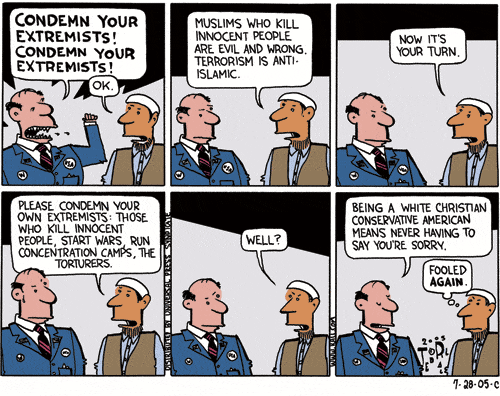
Veterans for Peace National Bus Tour - Calls for Impeachment
Veterans for Peace just announced a bus tour across the U.S. to take impeachment to the heartland.
They will leave California on Sept. 3 and head to Oregon, Washington, Canada, the midwest and northern states on their way to Washington D.C. for the big anti-war/impeachment march on September 24.
The tour organizers are looking for local activists along the way who could host stops: "We would love to help veterans start Veterans For Peace Chapter in their area. We will bring all the required information for forming a Veterans For Peace Chapter. We also want to support organizations that focus on youth and recruiting, We have a great deal of material to hand out. We also carry cases of the comic book 'Addicted To War' and Tie Die Tshirts that have the VFP logo and quotes from well known artists and peace activists that we sell to support the bus.
"For overnight stops, showers and overnight parking for the bus is required. Beds are an option as we have bunks on the bus. We usually have ten people on the bus, male and female.
For more info visit: http://www.vfproadtrips.org/
They will leave California on Sept. 3 and head to Oregon, Washington, Canada, the midwest and northern states on their way to Washington D.C. for the big anti-war/impeachment march on September 24.
The tour organizers are looking for local activists along the way who could host stops: "We would love to help veterans start Veterans For Peace Chapter in their area. We will bring all the required information for forming a Veterans For Peace Chapter. We also want to support organizations that focus on youth and recruiting, We have a great deal of material to hand out. We also carry cases of the comic book 'Addicted To War' and Tie Die Tshirts that have the VFP logo and quotes from well known artists and peace activists that we sell to support the bus.
"For overnight stops, showers and overnight parking for the bus is required. Beds are an option as we have bunks on the bus. We usually have ten people on the bus, male and female.
For more info visit: http://www.vfproadtrips.org/
Subscribe to:
Posts (Atom)