By Jim Hightower, Hightower Lowdown
Posted on November 17, 2007
http://www.alternet.org/story/68064/
Look out -- here they come again! Bush & Buckshot are riding their little stick horses, waving the bloody flag of 9/11, demonizing another Muslim nation, shouting warnings about weapons of mass destruction, bellowing for regime change, and generally trying to whoop up a new war. Having done so well in Iraq, George W and Cheney are pushing feverishly to hype up a national-security threat and commit our nation, our bedraggled military, our depleted treasury, and our country's already-tarnished name to another of their fantasyland, neocon, preemptive invasions of a sovereign people who are doing no harm to us. Their target this time: Iran.
You might be thinking, oh, come on, Hightower, surely not. You're paranoid -- even the Bushites aren't that crazy. I wish.
The drums of war
For such leading neocon zealots as Norman Podhoretz, bombing and even invading Iran are about protecting "our" Mideastern oil, strengthening Israel's regional power, and continuing Western control of the restive Muslim majority in the Middle East. Podhoretz and other true believers assert that there's an urgent need for Israel and the West to crush Iran's Muslim government now, frantically wailing that it intends to destroy America and control the world. Even though Iran has made no threats to the U.S., the neocons see regime change there as the key to winning "World War IV" (they insist that the Cold War was World War III) against what they have dubbed "Islamofacism."
How nutty are they? Podhoretz concedes that by attacking such an influential Islamic nation, Bush would "unleash a wave of anti-Americanism all over the world that will make the anti-Americanism we've experienced so far look like a lovefest." Yet this Dr. Strangelove maniacally declares, "I pray with all my heart that he will." Now there's a prayer to a truly fiendish god!
George W, who is so besotted by Podhoretz that he has bestowed the Presidential Medal of Freedom on him, has bought into this guy's insanity. Adopting Podhoretz's inflamed doomsday stance, Bush recently accused Iran of preparing for global war (though W only ranks it as WW III), and Bush's bombastic sidekick, Cheney, has now threatened that Tehran will suffer "serious consequences" if it doesn't do what Washington wants. Just as they did in the run-up to their 2003 Iraq attack, the Bushites are now pounding out a drumbeat of propaganda to soften up the public, enlist the compliant media, and cow soft-spined Democratic leaders. You'll recognize some familiar themes (a.k.a. lies) in BushCheney's rationale for a "preventive" war of aggression against Iran:
Claim: Iran is in cahoots with al Qaeda, the demons who crashbombed America on 9/11. Actually, no. Iran is a Shiite nation that has long been in opposition to the Sunni-exclusive Islam preached by al Qaeda. Indeed, even before al Qaeda's attacks on America, Iran's leaders vehemently opposed the terrorist group's presence in neighboring Afghanistan, and Iran was one of the first Muslim countries to condemn the 9/11 assault. Iran also has willingly turned over al Qaeda suspects to the U.S.
Claim: WMDs! Iran is on the brink of making a nuclear bomb, thus posing an imminent threat to America and to our national interests. Not so. Iran has no nuclear weapons and is nowhere near having the ability to build one. As a signer of the Nuclear NonProliferation Treaty, Iran has the right to enrich uranium to make electrical power (something our own country does every day). The Iranian government regularly allows inspectors from the International Atomic Energy Agency access to its nuclear facilities, and this UN agency (which is the one that turned out to be right about the lack of WMDs in Iraq) has found no evidence that Iran is trying to make a bomb. Even if it were, it would be years away from having one. There certainly is no imminent threat of an Iranian nuclear assault on any country, including our own, which is 7,000 miles away. Plus, Bush's own former top commander in Iraq, Gen. John Abizaid, points out that the U.S. lived with a nuclear Soviet Union throughout the Cold War and now lives with a number of nuclear nations, including China and Pakistan, so "there are ways to live with a nuclear Iran." It's simply a lie that the Bushites must rush to war to keep us from being nuked.
Claim: Those dastardly Iranians are meddling in our war in Iraq by supplying weapons to our enemies and by sending intelligence agents to undermine Iraq's government. Not likely. While some Iranianmade weapons have turned up in Iraq, there've been no findings of a large or regular influx and no evidence that the Iranian government itself is even tacitly behind it. Remember that Iran's leaders are Shiites who do not like al Qaeda and do not support the Sunni insurgency, so the only Iraqi force that Tehran would want to help is the Shiite majority that Bush himself has put in charge. As for Iranian "operatives" in Iraq, the two countries share long familial and cultural relationships, so there are a lot of Iranians in Iraq all the time. In fact, Iraq's Shiite-led government is pro-Iranian and has many economic and even military agreements with Tehran. Indeed, when U.S. troops "captured" a group of Iranians in a Baghdad hotel this summer, they turned out to be energy experts invited to Iraq by Prime Minister Maliki, who had them released.
On the warpath
Not that Iran's military/political/ theocratic leaders are a bunch of sweethearts, by any means. That country's loudmouth, Holocaust-denying president, Mahmoud Ahmadinejad, makes himself an easy target for Bushite demonization, and all peace-seeking governments must be vigilant toward Iran's potential for belligerence. This requires steady engagement, smart diplomacy, military subtlety, and careful consideration of the complexities embodied within Iran's rich, proud, 6,000-year-old culture.
Unfortunately, BushCheney doesn't do engagement, diplomacy, subtlety, or complexity. If there's an international need to shell a pecan, the Bushites go at it with a sledgehammer, blissfully ignorant of their own ignorance. Do you think, for example, that George W is even aware that President Ahmadinejad can rant and rave all he wants, but he is not in charge of his country's foreign policy, which is in the firm grip of Iran's supreme leader, Ayatollah Khamenei?
But realities did not deter Bush and the neocons from miring our country in Iraq, and now they are aggressively putting us on a path to war with Iran.
* In August, Bush announced, "I have authorized our military commanders in Iraq to confront Teheran's murderous activities."
* Investigative journalist Seymour Hersh revealed last month that Cheney has instructed the Joint Chiefs of Staff to draw up plans for attacking Iran.
* Hersh added that the bombing would be accompanied by selected "incursions" into Iran by U.S. Special Forces units.
* The London Telegraph reported in September that the Pentagon has developed a list of some 2,000 bombing targets in Iran.
* There are plans for both a limited "surgical" bombing of the Iranian military's training sites and a broad bombing that would include nuclear-power facilities and other targets.
* Two aircraft carriers, a flotilla of U.S. Navy warships, and numerous cruise missiles have been put in place at the Strait of Hormuz, on Iran's southern shore. In fact, half of our navy's warships now sit within striking distance of Iran.
* The Pentagon has suddenly started building a new U.S. military base near the Iraqi town of Badrah, right up against Iran's border.
* In September, Israel launched a preemptive raid in Syria to destroy a construction site that Israelis claim might have been the beginning of a nuclear reactor -- even though Syria has no nuclear-weapons program and could legally build a reactor for electric power. Cheney gave U.S. approval for Israel's strike only after leaders there refused his pleas that they bomb Iran's nuclear-power plant instead.
Yes, the U.S. Air Force and Navy have the razzle-dazzle firepower to destroy 2,000 Iranian targets in short order (not to mention thousands of Iranian civilians, for many of the targets are in populated places). But what happens the next day? Remember those neocon promises, just before the bombing of Iraq in 2003, that our troops would be showered with rose petals by a grateful public? Here we go again. Still intoxicated with the same ideological delusions, the neocons offer nothing but vague assurances that the Iranian masses will greet our forces as liberators and spontaneously overthrow the Tehran regime. In fact, opposition leaders inside Iran say that even the talk of a U.S. military attack is disastrous for their movement, for such reports strengthen hardliners in Iran and weaken those who want to reach out to the West. Iranians are Iranians first, and when a foreign power threatens to bomb or invade their country, they unite.
On Day Two (as well as on Days Three, Four, and so on), Iran most certainly will respond, and the results could be truly hellish for America. That furious wave of anti-Americanism that Podhoretz gleefully predicts would have explosive results in Iraq (further endangering our besieged troops), in such neighboring countries as Saudi Arabia, in the cities of Europe, and right here in the States, where our own citizens could become retaliatory targets.
Then there's oil. Iran and its allies could block the narrow Strait of Hormuz, which connects all of the oil-producing Persian Gulf states to their foreign markets. Up to twenty-five percent of the world's oil must pass through this strategic waterway, and shutting it down would cause prices to zoom astronomically, creating havoc for our oil-soaked economy.
What to do?
You might hope that cooler heads will prevail. Republican political operatives, for example, are aghast at the possible '08 fallout ("Every Republican is going to be defeated," cried one). Also, the generals don't want this -- they know that they don't have the manpower for a real war with Iran. Nor will Bush have a "coalition of the willing" this time -- even the doggishly loyal British government thinks attacking Iran is madness. Then there's Putin of Russia, who pointedly traveled to Iran last month to declare that no one should "even think of making use of force in this region."
However, as a former Bush official told Hersh, "Cheney doesn't give a rat's ass" about any of that, "and neither does the president." The chickenhawks are screeching for war, and they are immune to sanity.
Well, surely, you say, the Democrats will finally stand up to these knuckleheads. After all, Congress has all the power it needs to say no [see last month's Lowdown], and the time for saying it is now, before the shooting starts, before the Bushites start hiding behind the rhetorical cloak of "support the troops."
But the Democrats' congressional leadership is already waffling, and some of their presidential candidates are joining Bush in rattling our sabers at Iran, hoping to appear commander-in-chiefish. Astonishingly, the Senate passed a resolution on September 26 by a 76-22 vote that endorses Bush's confrontation with Tehran! The Kyl-Lieberman amendment buys into the Bushite myths about Iran, calls for the entire Iranian military to be designated "Global Terrorists" under a Bush executive order, and states that it should be U.S. policy to use all instruments of our national power (specifically including "military instruments") to confront the "destabilizing influence" of Iran.
Democrats -- especially Sen. Hillary Clinton -- are now trying to deny that their vote for this resolution gave Bush a free pass to go after Iran, claiming that the resolution was only meant to apply to Iranian interference in Iraq. Intentions are nice, but Bush is not. The amendment's language plainly allows plenty of wiggle room, and the Bushites have shown that they will interpret even an errant sneeze as permission to do whatever they want. Besides, why the hell would Democrats pass anything involving the expansion of this horrible war? Voters put them in charge of Congress to go the opposite way, not to buck up Bush with a new piece of warmongering that Sen. Jim Webb has called "Cheney's fondest pipe dream."
We the People have to be the leaders. More than ever, we have to get noisy. We can't just wring our hands -- there are things we can do:
* First, connect with our allies in Congress, including the 22 senators who voted against the Kyl-Lieberman surrender to Bush (list available here). Let antiwar lawmakers know you're behind them, ask them to get still noisier on this, and ask that they develop an inside-outside strategy to rally and focus our national outrage against expanding Bush's Iraq disaster into Iran.
* Second, demand that your Congress critters (whatever their stripe) use all their congressional powers (to control spending, launch investigations, declare war, etc.) to say that the president can take no preemptive military action against Iran without a full, constitutionally mandated declaration of war by Congress.
* Third, connect with any and all of the savvy grassroots groups in this issue's "Do Something" box. Use their information, sign all of their petitions, spread their materials, and join their actions.
* Fourth, talk, talk, talk, and talk some more -- in church, at school, with your neighbors and coworkers, at town hall meetings, in family phone calls or visits, on talk radio, at candidate forums, in supermarket check-out lines... wherever you can find an ear. The vast majority of Americans have not heard what Bush is up to, and they won't like it. The most effective way to reach them and activate them is by personal contact -- i.e., you. Talk to someone about it every day.
* Fifth, don't let Democrats waffle. Iraq was Bush's war (and his political debacle), but Iran would be a product of a Democratic-controlled Congress, and they will be responsible either for allowing it...or for stopping it.
* Sixth, come up with your own action idea, and let the rest of us know how we can support and spread it.
Be brave. Be loud. Your country needs you.
From "The Hightower Lowdown," edited by Jim Hightower and Phillip Frazer, November 2007. Jim Hightower is a national radio commentator, writer, public speaker and author of Thieves In High Places: They've Stolen Our Country and It's Time to Take It Back.
© 2007 Independent Media Institute. All rights reserved.
View this story online at: http://www.alternet.org/story/68064/
Sunday, November 25, 2007


Sure Would Be Nice to Have a State Department Right Now
From Blue Girl, Red State
If you lived through the time when we faced the Soviet bear--and it seems like a lifetime ago, I know--then when you see stories like this, it should make your blood boil:
And:
So--again. What the fuck? Why do we continue to see nothing but incompetence from our State Department? Why are they not seriously engaged on this issue? Why have we not recalled our ambassador or done something-anything-to respond to this type of incident?
People say that if a Democrat is elected next year, that Ambassador Holbrooke will be the next Secretary of State, and that, somehow, that's a bad thing. Well, Holbrooke's worst day as Secretary of State will be better by a mile than Rice's best day.
If you lived through the time when we faced the Soviet bear--and it seems like a lifetime ago, I know--then when you see stories like this, it should make your blood boil:
MOSCOW - Former chess champion Garry Kasparov was convicted of leading an opposition protest and sentenced to five days in jail by a Moscow court Saturday.
Kasparov and dozens of other demonstrators were detained hours earlier after riot police clashed with Kremlin opponents following a protest rally that drew several thousand people.
The former chess champion was forced to the ground and beaten, his assistant Marina Litvinovich said in a telephone interview from outside the police station where Kasparov was held."What you've heard is all lies," Kasparov said after the sentence was read. "The testimony is contradictory. There was not a single word of truth."
Two riot police testified in court that they had been given direct orders before the rally to arrest Kasparov, one of President Vladimir Putin's harshest critics. One of the policemen acknowledged that the two reports he had filed were contradictory.
Kasparov was charged with organizing an unsanctioned procession "of at least 1,500 people directed against President Vladimir Putin," of chanting anti-government slogans and of resisting arrest.
It sure would be nice to have a goddamned State Department right now, wouldn't it? Because we need a tough legion of diplomats to start going after the Putin regime on all fronts, in all areas, and in every way possible. We need to start squeezing them and engaging them and putting them in check, pun intended.
Unfortunately, we have a "Soviet" expert who has never gotten one thing right about Russia. We have Secretary Rice, shoe-shopping expert and blame shifting expert. Besides shoes and ducking responsibility for her inept management of the State Department, what is she good at? Piano? Sycophantic statements?
We have a serious problem brewing in Russia--who will succeed Putin? What will Russia continue to morph into?
Kasparov warned the world about Russia earlier this year when he told CBS News:
"We're facing a very dangerous regime that is threatening not only the future of my country but the stability of the whole world," Kasparov says.
And:
"I would probably say that Putin doesn't run the country, he runs a corporation. Call it KGB Incorporated," Kasparov says. "He is working on behalf of the ruling elite that wants to benefit from looting the country."
So--again. What the fuck? Why do we continue to see nothing but incompetence from our State Department? Why are they not seriously engaged on this issue? Why have we not recalled our ambassador or done something-anything-to respond to this type of incident?
People say that if a Democrat is elected next year, that Ambassador Holbrooke will be the next Secretary of State, and that, somehow, that's a bad thing. Well, Holbrooke's worst day as Secretary of State will be better by a mile than Rice's best day.
Saturday, November 24, 2007
BushCo Loses Another Lap Dog
Labor Party Wins Big In Australia
By ROHAN SULLIVAN, Associated Press Writer
Sat Nov 24
Conservative Prime Minister John Howard suffered a humiliating defeat Saturday at the hands of the left-leaning opposition, whose leader has promised to immediately sign the Kyoto Protocol on global warming and withdraw Australia's combat troops from Iraq.
Labor Party head Kevin Rudd's pledges on global warming and Iraq move Australia sharply away from policies that had made Howard one of President Bush's staunchest allies.
Rudd has named global warming as his top priority, and his signing of the Kyoto Protocol will leave the U.S. as the only industrialized country not to have joined it.
Rudd said he would withdraw Australia's 550 combat troops from Iraq, leaving twice that number in mostly security roles. Howard had said all the troops will stay as long as needed.
Official figures from the Australian Electoral Commission showed Labor far in front after more than 70 percent of the ballots had been counted — with 53 percent of the vote compared to 46.7 percent for Howard's coalition.
Using those figures, an Australian Broadcasting Corp. analysis showed that Labor would get at least 81 places in the 150-seat lower house of Parliament — a clear majority.
Rudd is expected to take office next week.
President Bush congratulated Rudd and the Australia Labor Party and also sent best wishes to Howard, without commenting on Rudd's intention to withdraw combat troops from Iraq.
"The United States and Australia have long been strong partners and allies and the president looks forward to working with this new government to continue our historic relationship," said Emily Lawrimore, a White House spokeswoman. "During his time as prime minister, Mr. Howard served the people of Australia well by pursuing policies that led to strong economic growth and a commitment to keeping Australians safe by fighting extremists and their ideology around the world."
The election was an embarrassing end to the career of Howard, Australia's second-longest serving leader.
As little as a year ago, Howard had appeared almost unassailable. But on Saturday he was in real danger of becoming only the second sitting prime minister in 106 years of federal government to lose his own seat in Parliament.
Howard took full blame for the drubbing handed to his center-right coalition.
"I accept full responsibility for the Liberal Party campaign, and I therefore accept full responsibility for the coalition's defeat in this election campaign," Howard said in his concession speech in Sydney.
A new government is unlikely to mean a fundamental change in Australia's close alliance with the United States — its most important security partner — or its growing economic and political ties with Asia.
At home, Rudd has pledged to govern as an "economic conservative," while pouring money into schools and universities. He will curtail sweeping industrial reforms laws that were perceived to hand bosses too much power, turning many working voters against Howard.
"Today Australia has looked to the future," Rudd said in a nationally televised victory speech, to wild cheers from supporters. "Today the Australian people have decided that we as a nation will move forward ... to embrace the future, together to write a new page in our nation's history."
In his concession speech, Howard announced he had phoned Rudd to congratulate him on "a very emphatic victory."
The change from Howard to Rudd also marks a generational shift for Australia.
Rudd, a 50-year-old former diplomat who speaks fluent Chinese, urged voters to support him because Howard, 68, was out of touch with modern Australia and ill-equipped to deal with new-age issues such as climate change.
Howard campaigned on his economic management, arguing that his government was mostly responsible for 17 years of unbroken growth, fueled by China's and India's hunger for Australia's coal and other minerals, and that Rudd could not be trusted to maintain prosperous times.
Labor has been out of power for more than a decade, and few in Rudd's team — including him — has any government experience at federal level. His team includes a former rock star — Midnight Oil singer Peter Garrett — a television journalist and former union officials.
But analysts say his foreign policy credentials are impeccable, and that he has shown discipline and political skill since his election as Labor leader 11 months ago.
Rudd's election as Labor leader marked the start of Howard's decline in opinion polls, from which he never recovered.
Howard's four straight election victories since 1996 made him one of Australia's most successful politicians. He refused to stand down before this election — even after being urged to do by some party colleagues.
Rebuilding New Orleans - for whom?
Published Nov 21, 2007
A majority white City Council has been elected in New Orleans for the first time in more than two decades. The election was held just when the demolition of 5,000 public housing units in the city had been projected to begin. Two seats in the Louisiana Legislature and a state court judgeship, previously held by Blacks, were taken by whites as well.
Not only did substantially more whites than Blacks vote in the elections, but the total number of votes decreased sharply—by more than 60,000—from the mayoral election in 2006. One explanation for this, according to the Nov. 20 New York Times, is the large number of absentee ballots that came in during the 2006 election as well as the effort made then by many displaced people who drove back to New Orleans to vote.
“The weekend election,” said the Times, “appeared to confirm what many had predicted immediately after the storm in 2005: New Orleans became almost overnight a smaller, whiter city with a much reduced black majority.”
This is exactly what organizers in the Black community have been warning of—that the white power structure wanted to make it as difficult as possible for Black people to come back in order to have unchallenged political control of the city.
The actual storm is only a small factor in the reduction of the Black population in New Orleans. Stronger factors include the continued neglect of the survivors and a push for gentrification that takes only the interests of the white elite into consideration.
Workers World reported on Nov. 15: “Other developments related to this racist gentrification conspiracy include the privatization of schools, which has led to the massive layoffs of thousands of public school teachers; the lack of health care, especially for the poor; an alarming increase in the homicide rate in the Black community; and more police brutality.”
A local demographic analyst, Gregory C. Rigamer, suggests in the Times article that “the lower voter turnout would indicate that some people ... have lost interest.” Yes, blame the victims. More likely, the struggle to survive for these mostly Black, low-income survivors has not abated, making voting extremely difficult for them. Indeed, in the 2006 elections it took a major grassroots effort to organize displaced persons across the country to vote.
However, protests have recently been held in New York, New Orleans and other cities where displaced Katrina survivors live, denouncing the federal go-ahead of the public housing demolition. A short reprieve may have been won due to these efforts, but the demolitions are still slated for sometime in December. Attorney Bill Quigley, who plans to continue fighting the demolitions, said they will “permanently displace thousands of long-term New Orleanians from their community and erase nearly 70 years of New Orleans culture and history.” (Times-Picayune, Nov. 16)
In light of the majority-white City Council development, Malcolm Suber—a well-known Black activist and a leader of the People’s Hurricane Relief Fund who ran for the City Council member-at-large seat this past October, representing the newly formed Reconstruction Party—has called for “the need for revolutionary/progressive Black working class leadership in the fight for the future of New Orleans and the Gulf Coast.”
His platform called for a “way back home” and real reconstruction for the people of the area, opposition to the privatization of education, jobs and living wages. He stated, “My ‘Six-Point Platform for the Recovery of New Orleanians’ is for the people, not the special interests of developers and political insiders.”
The struggle for the dignity, respect and right to return of Katrina survivors should be of great interest to all those interested in building anti-racist, class-wide solidarity.
Articles copyright 1995-2007 Workers World. Verbatim copying and distribution of this entire article is permitted in any medium without royalty provided this notice is preserved.
Workers World, 55 W. 17 St., NY, NY 10011
Email: ww@workers.org
Subscribe wwnews-subscribe@workersworld.net
Support independent news http://www.workers.org/orders/donate.php
Page printed from:
http://www.workers.org/2007/editorials/new-orleans-1129/
Wednesday, November 21, 2007
US Military Asks Wounded Soldiers to Return Signing Bonuses
By Steve Benen, The Carpetbagger Report
Posted on November 20, 2007
http://www.alternet.org/bloggers/http://www.thecarpetbaggerreport.com//68486/
This post, written by Steve Benen, originally appeared on The Carpetbagger Report
When Jordan Fox was serving in Iraq, his mother helped organize Operation Pittsburgh Pride, which sends thousands of care packages to U.S. troops from his hometown, which prompted a personal "thank you" from the White House. When Fox was seriously injured in Iraq, the president sent what appeared to be personal note, expressing his concerns to the Fox family.
But more recently, Fox received a different piece of correspondence from the Bush administration.
The U.S. Military is demanding that thousands of wounded service personnel give back signing bonuses because they are unable to serve out their commitments.
To get people to sign up, the military gives enlistment bonuses up to $30,000 in some cases.
Now men and women who have lost arms, legs, eyesight, hearing and can no longer serve are being ordered to pay some of that money back.
I watched the report from the CBS affiliate in Pittsburgh, and I kept thinking, "This can't be right." Apparently, it is.
In Jordan Fox's case, he was seriously injured when a roadside bomb blew up his vehicle, causing back injuries and blindness in his right eye. He was sent home, unable to complete the final three months of his military commitment.
Last week, the Pentagon sent him a bill: Fox owed the government nearly $3,000 of his signing bonus.
"I tried to do my best and serve my country. I was unfortunately hurt in the process. Now they're telling me they want their money back," Fox said.
Look, if a soldier signed a contract, collected a signing bonus, and then quit, I can understand the military asking for the signing bonus back.
But we're talking about troops who volunteered, served, and were seriously injured. It's not their fault they got hurt. How on earth is the Pentagon justified in asking for a refund?
In Jordan Fox's case, he doesn't have $3,000 lying around to give the government, and his injuries are such that he had to give up on his goal of becoming a police officer.
For what it's worth, Fox's congressman, Democrat Jason Altmire, has introduced a bill to prohibit the Bush administration from asking the troops for refunds.
Mr. Altmire, D-McCandless, held a news conference yesterday at the Ross municipal building with Spc. Kaminski and other veterans to tout legislation he has authored to aid wounded soldiers.
At the forefront was a bill introduced last week and sent to committee that targets a Defense Department policy preventing eligible soldiers from receiving their full bonuses if discharged early because of combat-related injuries.
"Hard as it may be to believe, the Department of Defense has been denying injured servicemen and women the bonuses that they qualified for," Mr. Altmire said.
He said he drafted the legislation after hearing "outrageous" examples of bonuses being denied.... Mr. Altmire's legislation, the Veterans Guaranteed Bonus Act, would require the Defense Department to pay bonuses in full within 30 days to veterans discharged because of combat-related wounds.
Seems like a no-brainer.
Steve Benen is a freelance writer/researcher and creator of The Carpetbagger Report. In addition, he is the lead editor of Salon.com's Blog Report, and has been a contributor to Talking Points Memo, Washington Monthly, Crooks & Liars, The American Prospect, and the Guardian.
© 2007 Independent Media Institute. All rights reserved.
View this story online at: http://www.alternet.org/bloggers/http://www.thecarpetbaggerreport.com//68486/
Tuesday, November 20, 2007
Violent Radicalization and Homegrown Terrorism Prevention Act
From Democracy Now
Listen to segment here
A little-noticed anti-terrorism bill quietly making its through Congress is raising fears of a new affront on activism and constitutional rights. The Violent Radicalization and Homegrown Terrorism Prevention Act was passed in an overwhelming 400 to six House vote last month. Critics say it could herald a new government crackdown on dissident activity and infiltration of universities under the guise of fighting terrorism. The bill would establish two government-appointed bodies to study, monitor and propose ways of curbing what it calls homegrown terrorism and extremism in the United States. The first body, a National Commission, would convene for eighteen months. A university-based "Center for Excellence" would follow, bringing together academic specialists to recommend laws and other measures.
Listen to segment here
A little-noticed anti-terrorism bill quietly making its through Congress is raising fears of a new affront on activism and constitutional rights. The Violent Radicalization and Homegrown Terrorism Prevention Act was passed in an overwhelming 400 to six House vote last month. Critics say it could herald a new government crackdown on dissident activity and infiltration of universities under the guise of fighting terrorism. The bill would establish two government-appointed bodies to study, monitor and propose ways of curbing what it calls homegrown terrorism and extremism in the United States. The first body, a National Commission, would convene for eighteen months. A university-based "Center for Excellence" would follow, bringing together academic specialists to recommend laws and other measures.
Critics say the bill's definition of "extremism" and "terrorism" is too vague and its mandate even more broad. Under a false veil of expertise and independence, the government-appointed commissions could be used as ideological cover to push through harsher laws.
Following last month's approval in the House, the Senate version is expected to go before the Judiciary Committee this week.
- Jessica Lee, reporter for the Indypendent, published by the NYC Indymedia Center. Her latest article is called "Bringing the War on Terrorism Home: Congress Considers How to 'Disrupt' Radical Movements in the United States"
- Kamau Karl Franklin, Racial Justice Fellow at the NY-based Center for Constitutional Rights. He is also co-chair of the National Conference of Black Lawyers and serves on the Executive Committee of the National Lawyers Guild.
Freedom's Watch Test Markets Language to Sell War With Iran
Mother Jones magazine is reporting a hawkish advocacy group connected to the White House has hired a Virginia company to begin test-marketing language that could be used to sell a war with Iran. The group Freedom's Watch first made headlines this summer when it launched a $15 million ad campaign in support of the surge of American troops in Iraq.
The group's leadership includes former White House spokesman Ari Fleischer and Bradley Blakeman, a former deputy assistant to President Bush. Freedom Group recently hired the company Martin Focus Groups in Alexandria, Virginia.
One participant who was paid to be part of a focus group told Mother Jones: "The whole basis of the whole thing was, "we're going to go into Iran and what do we have to do to get you guys to along with it."
The group's leadership includes former White House spokesman Ari Fleischer and Bradley Blakeman, a former deputy assistant to President Bush. Freedom Group recently hired the company Martin Focus Groups in Alexandria, Virginia.
One participant who was paid to be part of a focus group told Mother Jones: "The whole basis of the whole thing was, "we're going to go into Iran and what do we have to do to get you guys to along with it."
Monday, November 19, 2007
ZNet Commentary: Billionaires Up, America Down
By Holly Sklar
Commentaries are a premium sent to Sustainer Donors of Z/ZNet. To learn more consult ZNet at http://www.zmag.org
When it comes to producing billionaires, America is doing great.
Until 2005, multimillionaires could still make the Forbes list of the 400 richest Americans. In 2006, the Forbes 400 went billionaires only.
This year, you'd need a Forbes 482 to fit all the billionaires.
A billion dollars is a lot of dough. Queen Elizabeth II, British monarch for five decades, would have to add $400 million to her $600 million fortune to reach $1 billion. And she'd need another $300 million to reach the Forbes 400 minimum of $1.3 billion. The average Forbes 400 member has $3.8 billion.
When the Forbes 400 began in 1982, it was dominated by oil and manufacturing fortunes. Today, says Forbes, "Wall Street is king."
Nearly half the 45 new members, says Forbes, "made their fortunes in hedge funds and private equity. Money manager John Paulson joins the list after pocketing more than $1 billion short-selling subprime credit this summer."
The 25th anniversary of the Forbes 400 isn't party time for America.
We have a record 482 billionaires -- and record foreclosures.
We have a record 482 billionaires -- and a record 47 million people without any health insurance.
Since 2000, we have added 184 billionaires -- and 5 million more people living below the poverty line.
The official poverty threshold for one person was a ridiculously low $10,294 in 2006. That won't get you two pounds of caviar ($9,800) and 25 cigars ($730) on the Forbes Cost of Living Extremely Well Index. The $20,614 family-of-four poverty threshold is lower than the cost of three months of home flower arrangements ($24,525).
Wealth is being redistributed from poorer to richer.
Between 1983 and 2004, the average wealth of the top 1 percent of households grew by 78 percent, reports Edward Wolff, professor of economics at New York University. The bottom 40 percent lost 59 percent.
In 2004, one out of six households had zero or negative net worth. Nearly one out of three households had less than $10,000 in net worth, including home equity. That's before the mortgage crisis hit.
In 1982, when the Forbes 400 had just 13 billionaires, the highest paid CEO made $108 million and the average full-time worker made $34,199, adjusted for inflation in $2006. Last year, the highest paid hedge fund manager hauled in $1.7 billion, the highest paid CEO made $647 million, and the average worker made $34,861, with vanishing health and pension coverage.
The Forbes 400 is even more of a rich men's club than when it began. The number of women has dropped from 75 in 1982 to 39 today.
The 400 richest Americans have a conservatively estimated $1.54 trillion in combined wealth. That amount is more than 11 percent of our $13.8 trillion Gross Domestic Product (GDP) -- the total annual value of goods and services produced by our nation of 303 million people. In 1982, Forbes 400 wealth measured less than 3 percent of U.S. GDP.
And the rich, notes Fortune magazine, "give away a smaller share of their income than the rest of us."
Thanks to mega-tax cuts, the rich can afford more mega-yachts, accessorized with helicopters and mini-submarines. Meanwhile, the infrastructure of bridges, levees, mass transit, parks and other public assets inherited from earlier generations of taxpayers crumbles from neglect, and the holes in the safety net are growing.
The top 1 percent of households -- average income $1.5 million -- will save a collective $79.5 billion on their 2008 taxes, reports Citizens for Tax Justice. That's more than the combined budgets of the Transportation Department, Small Business Administration, Environmental Protection Agency and Consumer Product Safety Commission.
Tax cuts will save the top 1 percent a projected $715 billion between 2001 and 2010. And cost us $715 billion in mounting national debt plus interest.
The children and grandchildren of today's underpaid workers will pay for the partying of today's plutocrats and their retinue of lobbyists.
It's time for Congress to roll back tax cuts for the wealthy and close the loophole letting billionaire hedge fund speculators pay taxes at a lower rate than their secretaries.
Inequality has roared back to 1920s levels. It was bad for our nation then. It's bad for our nation now.
Holly Sklar is co-author of "Raise the Floor: Wages and Policies That Work for All of Us" and "A Just Minimum Wage: Good for Workers, Business and Our Future." She can be reached at hsklar@aol.com.
On the picket line
Published Nov 18, 2007
Nurses strike in W.Va., Ky.
More than 630 nurses at Appalachian Regional Hospitals in West Virginia and Kentucky have been on strike for nearly a month. Their pay was cut 10 percent in December 2005. Although an arbitrator found in favor of the nurses, ARH, which purchased the nine hospitals from the United Mine Workers in the 1970s, refuses to honor the ruling and appealed the case to federal court.
The Kentucky Nurses Association, which represents the nurses, called the strike to protest ARH’s unfair treatment of nurses and for allowing unsafe staffing for patients. To sign a petition demanding that ARH negotiate with the nurses, go to the Jobs with Justice Web site: www.jwj.org.
Possible Amtrak strike
Amtrak workers in eight unions may strike as early as Dec. 1 after more than half of their 15,000 members rejected mediation and entered a 30-day cooling-off period on Nov. 1. The issues include health insurance costs, work rules and back pay dating to 2000 when the last contract was approved.
Smithfield stops negotiating, sues union
On Oct. 15, Smithfield management thumbed its nose at the Food and Commercial Workers union by calling an end to negotiations. The UFCW has been struggling for more than a decade to represent the 5,500 workers at Smithfield’s Tar Heel, N.C., plant, the largest pork processing facility in the world.
Two days later, Smithfield pulled another punch and sued the union under the Racketeering Influenced and Corrupt Organizations (RICO) Act, which was originally passed to stop organized crime syndicates. The suit alleges that UFCW’s efforts to organize public support for the Tar Heel workers constitute attempted extortion.
As a union statement notes: “Clearly, the lawsuit is meant to be a distraction from the ongoing health and safety issues at the plant, and the latest roadblock to finding a long-term solution for workers who have been struggling for years to bring union representation into the plant. The UFCW intends to vigorously fight these baseless allegations.” (Oct. 22) For more about this struggle, go to www.smithfieldjustice.org.
Cintas workers protest death on the job
More than 50 people did not let torrential rain stop them from picketing Cintas’ annual shareholder meeting in Cincinnati on Nov. 6 to protest and mourn the death of follow worker Eleazar Torres Gomez—who was killed on the job in Oklahoma after being dragged into an industrial dryer. (Unite Here, Nov. 7)
Workers and community allies demanded that the uniform company address the lethal hazards that led to Torres Gomez’s death. The same dangers have been found at plants in California, New York, Ohio and Washington. Eleuteria Mazon, who works in Cintas’ Schaumburg, Ill., laundry, said, “We can see a continued lack of safety measures because the company only cares about production—not about the conditions that we work under.”
March on Burger King!
In 2005 the Coalition of Immokalee Workers, representing tomato pickers in Florida, won a precedent-setting agreement with Taco Bell. In May of this year McDonald’s agreed to the same terms, which boost the workers’ pay and help improve their working conditions.
As of Nov. 30, CIW is marching on Burger King with help from leaders of both the AFL-CIO and Change to Win. For more about CIW’s Campaign for Fair Food, go to the CIW Web site: www.ciw-online.org.
Articles copyright 1995-2007 Workers World. Verbatim copying and distribution of this entire article is permitted in any medium without royalty provided this notice is preserved.
Workers World, 55 W. 17 St., NY, NY 10011
Email: ww@workers.org
Subscribe wwnews-subscribe@workersworld.net
Support independent news http://www.workers.org/orders/donate.php
Page printed from:
http://www.workers.org/2007/us/picket-line-1122/
The credit crunch: Cyclical downturn or more severe?
Published Nov 18, 2007
The global capitalist economy is showing ever greater signs of instability. A question on the minds of many members of the multinational working class here in the U.S. and around the world is just how severe a capitalist crisis is coming.
Are the workers facing a cyclical boom-bust process of the type that has happened numerous times over the course of the development of capitalism? Or is this the prelude to a crisis that is much more severe? Is the current volatility on Wall Street heading toward a 1987-type market crash, or is it the opening stage of a crisis on a much larger scale?
Cyclical crises in capitalist economies
The boom-and-bust cycle is inherent to the capitalist mode of production. Under capitalism, periods of rapid expansion in production are followed by sharp slowdowns and recession. This cyclical process results from regular crises of overproduction.
As Karl Marx wrote in “Theories of Surplus Value,” “Overproduction is specifically conditioned by the general law of the production of capital: to produce to the limit set by the productive forces, that is to say, to exploit the maximum amount of labor with the given amount of capital, without any consideration for the actual limits of the market or the needs backed by the ability to pay.”
Overproduction leads to glutted markets. Glutted markets lead to falling profits for the capitalists. This causes the bosses to intensify their drive to slash wages and cut jobs, exacerbating the pain and suffering of the working class during recessionary periods.
In the U.S. today, signs of a cyclical downturn resulting from a crisis of overproduction are readily apparent. From 2000 to 2006 the housing sector was the primary engine for economic expansion in the U.S. The housing bubble of those years was characterized by an unprecedented spike in new home construction.
The rapid expansion in the production of homes brought a profit boom for the capitalist class. Home construction is a multiplier industry, so the bubble meant increased commodity sales in numerous other industries. This increase in commodity sales applied to everything from kitchen appliances and television sets to pickup trucks and building supplies used by construction workers.
The drive to increase production and profits irrespective of the limits of the market, or of the workers’ ability to pay for the goods they produce, was exemplified by the proliferation of infamous sub-prime mortgages during the recent housing bubble. These predatory loans proved unaffordable for millions of working-class families across the country. Delinquencies and defaults on mortgages in the U.S. have now hit record highs.
The housing market is glutted with millions of unsold homes as tidal waves of foreclosures have swept over entire working-class communities. Jobs are being cut and wages slashed with greater intensity in industries ranging from auto production to retail sales.
Is this crisis more severe?
Articles copyright 1995-2007 Workers World. Verbatim copying and distribution of this entire article is permitted in any medium without royalty provided this notice is preserved.
Workers World, 55 W. 17 St., NY, NY 10011
Email: ww@workers.org
Subscribe wwnews-subscribe@workersworld.net
Support independent news http://www.workers.org/orders/donate.php
Page printed from:
http://www.workers.org/2007/us/credit-crunch-1122/
Historically, the capitalist ruling class has dealt with crises of overproduction by increasing the money supply in concerted efforts to increase liquidity—easy access to credit—in the economy and increase aggregate consumer purchasing power. Responses to recent capitalist crises like those of 1987 and 1997 highlight this strategy. Both crises were met with the slashing of interest rates by the U.S. Federal Reserve and other central banks, flooding the global economy with liquidity and eventually stabilizing the markets.
It is not surprising that the capitalist ruling class has sought to do the same thing in recent months, ever since the stock markets began gyrating wildly. What makes this situation seemingly more severe is how remarkably little effect the massive liquidity infusions have had in terms of stabilizing the markets.
For months, central bankers and finance ministers in the U.S. and countries across the globe have been scrambling to inject billions upon billions of dollars worth of liquidity into the markets. The Federal Reserve in the U.S. has cut interest rates multiple times.
Thus far, every attempt to stem the growing crisis has seemingly failed. The major stock indexes have not recovered, foreclosures and bankruptcies continue unabated, the dollar continues to fall to new lows, and the price of oil continues to climb to record highs.
The current developing economic crisis appears to contain within it deep contradictions that yield to no easy solution from the capitalist class or its state. What does that mean for the future?
It is important to remember the words of Russian revolutionary V.I. Lenin in a speech to the Second Congress of the Communist International in July 1920. Lenin reminded comrades that no capitalist crisis would ever prove “terminal” without the work of committed revolutionaries dedicated to organizing and mobilizing the working class.
In his speech, Lenin said, “Comrades, we have now come to the question of the revolutionary crisis as the basis of our revolutionary action. On the one hand, bourgeois economists depict this crisis simply as ‘unrest,’ to use the elegant expression of the British. On the other hand, revolutionaries sometimes try to prove that the crisis is absolutely insoluble. This is a mistake. ... Practice alone can serve as real ‘proof’ in this and similar questions. All over the world, the bourgeois system is experiencing a tremendous revolutionary crisis. The revolutionary parties must now prove in practice that they have sufficient understanding and organization, contact with the exploited masses, and determination and skill to utilize this crisis for a successful, a victorious, revolution.”
Lenin’s words are as applicable today, as revolutionaries prepare ideologically for future upheavals, as they were when he delivered them.
Articles copyright 1995-2007 Workers World. Verbatim copying and distribution of this entire article is permitted in any medium without royalty provided this notice is preserved.
Workers World, 55 W. 17 St., NY, NY 10011
Email: ww@workers.org
Subscribe wwnews-subscribe@workersworld.net
Support independent news http://www.workers.org/orders/donate.php
Page printed from:
http://www.workers.org/2007/us/credit-crunch-1122/
Late Night Political Humor
"Ramsey Usef, you know that name? He was the mastermind of the first World Trade Center attack back in '93. He's been rotting in prison -- as he should -- for many years.
He said he's now converted to Christianity. He has seen the light. He can't wait to get out and bomb an abortion clinic"
--Bill Maher
He said he's now converted to Christianity. He has seen the light. He can't wait to get out and bomb an abortion clinic"
--Bill Maher
OPEC leaders debate ditching the dollar.
One of the comments on the original post read: "I remember one other Middle East leader who tried to sell oil for Euros a few years ago. I wonder what happened to that guy."--Pete
The Observer reports that during OPEC’s meeting this past weekend, leaders of the oil-producing nations “argued that pricing - and selling - oil using the crippled dollar was damaging the cartel.” The meeting was supposed to have been private, but was mistakenly broadcast to the media for more than half an hour after a technician had incorrectly plugged the TV feed into the wrong socket. (HT: The Zoo)
The Observer reports that during OPEC’s meeting this past weekend, leaders of the oil-producing nations “argued that pricing - and selling - oil using the crippled dollar was damaging the cartel.” The meeting was supposed to have been private, but was mistakenly broadcast to the media for more than half an hour after a technician had incorrectly plugged the TV feed into the wrong socket. (HT: The Zoo)
Sunday, November 18, 2007

Mercenaries, immune from prosecution, continue to kill indiscrimitely in Iraq, in our name
Witnesses shed new light on the killing of 17 Iraqis by American contractors in Baghdad.
Check out video on NYT
Check out video on NYT
Corporate U.S. Media Bends Truth Again Regarding Chavez Supporters
JoJo Farrell (ZNet): U.S. Media Bias and Recent Student Violence in Venezuela
Providing links to the major U.S. outlets' reporting "that following peaceful protests in downtown Caracas, masked Chavista gunmen attacked anti-government supporters on the campus of the Central University of Venezuela," Farrell cites "Chávez supporters, eyewitnesses and videotape recorded by the community TV station Catia TV" to show how the U.S. coverage "left out an important chunk of the story."
After last Wednesday's peaceful protest...opposition students, mainly from neighboring private universities, chased down a group of pro-Chávez students putting up signs in favor of the reform. The pro-Chávez group found refuge in the faculty of Social Work.... Opposition students surrounded the faculty, armed with weapons, rocks and gas masks, shouting, "We will lynch you all." According to reports, opposition students fired weapons, threw rocks at the students inside the building and lit fire to the entrance. Chávez supporters present that day affirm that the motorcyclists televised to the world as sinister gunmen arrived on the scene as part of a rescue mission.... They argue that this was necessary because the Venezuelan army or police force are, by law, not allowed to enter the grounds of the university.
While careful to note that "the entire truth is not known," Farrell considers how "the inability of the international press to report an unbiased account calls into question their journalistic integrity," and warns that "the consequences of this could lead to further violence in Venezuela."
Bush nominates judges who donated to his campaign.
On Thursday, President Bush nominated two judges for high-level positions who gave him campaign contributions while under consideration for positions, a practice ethics experts and many federal judges deem “inappropriate.” The Center for Investigative Reporting notes:
Bush nominated Judge Gene Pratter, of Pennsylvania, to the 3rd U.S. Circuit Court of Appeals, a level just below the U.S. Supreme Court. Pratter, who was featured in the CIR report, “Money Trails to the Federal Bench,” gave $2,000 to Bush in 2003, after interviewing with the White House for her judgeship.
Bush also picked Judge Mark Filip, of Illinois, to be deputy attorney general, the No. 2 spot in the Justice Department. Filip gave Bush $2,000 in 2003, after the president nominated him for his judgeship, as earlier reported by CIR.
Migra out of our schools!
Published Nov 15
On Nov. 6, nearly 100 high school students walked out of their classes and marched to the Tucson Police Station to demand that the Tucson Unified School District and the Tucson Police Department stop bringing Border Patrol agents into the schools. The students marched nearly five miles chanting, “Sí se puede” and “We are students, not criminals.” Many carried signs that read “Migra out of our schools!”
The march was in response to the arrest and deportation of two brothers, both students, and their family on Nov. 1. One of the students deported was very young—a middle school student—and he was pulled out of class without any warning after the Tucson police entered a high school and arrested his older brother for a small amount of marijuana found in his backpack.
The racist police demanded proof of citizenship from the high school student, and when the student failed to produce documents that satisfied the police, the Border Patrol was called into the school.
The deported family had peacefully resided in Tucson for six years and within a matter of hours were uprooted from their home and jobs and pushed out of the country, forced to leave everything behind.
The protesting students did manage to wring a concession from the school board and police. The Border Patrol will no longer be called into the schools.
These determined youth are showing that they can organize quickly and that fighting back against the racist, anti-immigrant onslaught can yield results.
Articles copyright 1995-2007 Workers World. Verbatim copying and distribution of this entire article is permitted in any medium without royalty provided this notice is preserved.
Workers World, 55 W. 17 St., NY, NY 10011
Email: ww@workers.org
Subscribe wwnews-subscribe@workersworld.net
Support independent news http://www.workers.org/orders/donate.php
Page printed from:
http://www.workers.org/2007/us/tucson-1122/
Persian Contradictions
By Vijay Prashad
ZNet Sustainer Commentary
Sustainer Commentaries are a premium sent to Sustainer Donors of Z/ZNet and that to learn more folks can consult ZNet at http://www.zmag.org
ZNet Sustainer Commentary
Sustainer Commentaries are a premium sent to Sustainer Donors of Z/ZNet and that to learn more folks can consult ZNet at http://www.zmag.org
I read the introduction of Iran's president by Columbia's president with embarrassment. "You exhibit all the signs of a petty and cruel dictator,"said Lee Bollinger, after he noted that the Iranian state had executed 210 people in 2007 (till September 24, the date of the lecture). The US state has only executed 42 people in this same time period (1099 since 1976, when the death penalty was reauthorized). In fact, in recent years, over ninety percent of all state executions have taken place in six countries: China, Iran, Iraq, Sudan, Pakistan and the USA. Iran's rate has doubled in the last few years, with the state taking the lives of people proven guilty of what had not previously amounted to capital crimes (including the execution of women, such as Nazarin, who fought off would be rapists with whatever means necessary, in her case with a pocket knife). Neither the US nor Iran has the high moral ground on the death penalty. Both routinely use it in "social" cases, against those whose crimes stem from imbalances of their mental state or their poverty, or else their resistance to sanctioned misogyny or racism.
For those with fewer means or with lesser power, both the US and the Iranian states act like "petty and cruel dictators."
Christopher de Bellaigue, a British writer who lives in Teheran with his Iranian wife and family, writes with the kind of humanistic dispatch that should embarrass Bollinger for his sub-academic introduction. A collection of de Bellaigue's essays written for the New York Review of Books is now out (The Struggle for Iran, NYRB, 2007), and it provides a useful and well-written counterbalance to the hysteria of the mainstream media. For one, de Bellaigue offers us an Iran that is complex, whose almost seventy one million people are divided by class and region, by political obligation and moral horizon. There are the conservatives (muhafazakaran) who hold the reins of political power. The Supreme Leader Ayatollah Ali Khamenei, a confidant of Ayatollah Khomeini, leads the conservative faction. Khamenei is not a well-regarded theologist (he is not a marja, an Object of Emulation), but he was twice elected President with enormous pluralities. Conservative power is not only derived from the state, but the clerics also used their power to insinuate themselves into the economic order (not only through the seminary system in places such as Qom, which is a beneficiary of the religious taxes, but also through the bonyads, or charity organizations that control just less than third of the economy), and through the state, which controls over three quarters of economic activity and which is under the control of the conservatives.
There is not enough economics in de Bellaigue, who is keener to emphasize the outbreak of reformism led, in the late 1990s, by the then president Mohammed Khatami. Politics of the reform kind, in de Bellaigue's formulation, happens far from its material conditions. The reformers (known as the Dovum Kurdadi after the month when Khatami won the election in 1997) are myriad. They include the well heeled who are de Bellaigue's neighbors in the northern Teheran district of Elahiyeh (Shemiran), and who drive up and down Fereshteh Avenue in fancy cars. For this section, liberty means not only the end to the social rituals of the conservatives, but also the privatization of the economy. It was this section that backed former President Akbar Hashemi Rafsanjani in the 2005 elections against the relatively obscure mayor of Teheran, Mahmoud Ahmadinejad. But the reformers also include an activist section that fights the Islamic Republic on gender rights, human rights, labor rights, free speech rights in other words, from the perspective of the Left. It is an unwieldy alliance, between those who want freedom for hedonism and those who want freedom from autocracy. We hear about the feminists (people such as Mehrangiz Kar and Shirin Ebadi) and the journalists (people such as Akbar Ganji), but nothing from those who work among the working class (such as Mansour Osanlou, head of the Syndicate of Workers of Teheran and Suburbs, and Mahoud Salehi, head of the Bakery Workers' Association, both in jail). De Bellaigue is a reformer in the style of his Elahiyeh neighbors, writing longingly for liberalization of the economy. Privatization and liberalization came on the agenda in the Khatami years, but the conservatives have largely endorsed it as a strategy as well.
In October 2006, Khamenei, the Supreme Leader, told the Cabinet, that in order to overcome the "class gap" in the country "the state should decrease its interferences in economy." Two years before this, the leadership had overturned Article 44 of the Iranian constitution, which mandated that the state should run the core infrastructure. The Elahiyeh reformers find succor in this new direction of the Supreme Leader, although they still chaff at the social constraints of the regime.
The 2005 election, which de Bellaigue intimates might have been stolen by the conservatives, did not clarify the social divisions. "Whatever else he is," writes de Bellaigue, Ahmadinejad is "a man of principle." He favors "principle against expediency," which is why he has interpreted privatization in a unique way. At a public event in October 2006, Ahmadinejad announced the idea of the Justice Share, where the state would divide shares to some companies among 4.6 million of the poorest Iranians, who would automatically become stockholders in the nation's wealth.
Ahmadinejad's policies are idiosyncratic, buoyed partly by high oil prices (returns of $55 billion this year as opposed to $23 billion in 2002-03) but stretched thin by the easy recourse to anti-Americanism. Washington makes it easy to draw on the Islamic Republic's stock dogmas, and it is to this that Ahmadinejad retreats when his economic forays falter. "The government's economic polices are quite transparent and based on planning and reason,"
Ahmadinejad told the press in July, but his own Parliament does not seem to agree. Tehran's delegate Alireza Mahjub told Parliament, "This crisis is growing worse every day."
De Bellaigue does not seem interested in these economic contradictions, but rather he usefully gives us the view from Tehran of the ongoing cultural wars in Iran and on the indifference of Iranians to the bellicosity from Washington. On the culture wars, de Bellaigue carefully shows us that it was stoked by the immorality of liberalization. "Some of the newly rich drank bootleg booze and held un-Islamic parties," he writes, "They drove expensive cars and wore flashy clothes." The rising economic inequality, the total awareness of the class based sacrifices during the Iran-Iraq War of the 1980s and the lack of secular alternatives probably play a significant role in the movement of the poor toward such characters as Ahmadinejad, who displays a personal piety and an antipathy to the nouveau riche, as well as a populism that appeals in the youth-depleted rural areas and in the slums of cities (44% of urban Iranians live in slums). Washington fulminates about autocracy in Iran and the bomb, but, as de Bellaigue writes, "for most Iranians, the price of food, and the government's failure to lower it, are more important" (this was written in January 2005, but in 2007 inflation in the food and fuel sector continues in Iran). Ahmadinejad's posture revives Iranian national pride as he stands up to US pressure, at the same time as his own personal lack of ostentation and his economic promises (along with high oil prices) mollifies a large section of the country. If he did not have that support he would not be able to cross the Supreme Leader, as he seems to have done.
Washington and Columbia University have made Ahmadinejad the focus of their ire, trying to convert him into Saddam as Cheneyism moves from Baghdad to Tehran. But, as de Bellaigue writes, on foreign and military policy, the President only has an "advisory role." It is the Supreme Leader, in this case Khamenei, who sets policy. Such may no longer be the case. Khamenei's man in the nuclear ring was Ali Larijani, and it is clear that when he resigned in October 20 from his post as chief nuclear negotiator, it exposed a feud between the Supreme Leader and the President. To replace Larijani, the government chose Saeed Jalili, a confidant of Ahmadinejad (who might have written the President's unread letter to Bush). Power struggles at the top and vibrancy below are signs that a new era of reformism might open up in Iran. But Washington is not interested in reformism, keener to speak in the language of force (harf-e zoor meezanam), to tell others what to do.
Bollinger, the sub-Bush, spoke just in that way.
Related Article:
Columbia president caught in lie
Published Nov 15, 2007 6:29 AM
When the president of Iran went to Columbia University this September for a scheduled speech, he was insulted and castigated by the school’s president. It was different when Pakistani dictator Pervez Musharraf visited Columbia in 2005, writes a student in the school’s Spectator newspaper on Nov. 9:
“Even University President Lee Bollinger, who apparently prides himself on his tough-talking, no-nonsense treatment of visiting ‘dictators,’ was found wanting when Musharraf came to Columbia in September 2005. ‘President Musharraf is a leader of global importance, and his contribution to Pakistan’s economic turnaround and the international fight against terror remain remarkable. It is rare that we have a leader of his stature at campus,’ Bollinger opined. Musharraf’s democratic credentials are far inferior to Mahmoud Ahmadinejad’s, but Bollinger and the U.S. government he worships have never given much play to the ideal of consistency.”
Articles copyright 1995-2007 Workers World. Verbatim copying and distribution of this entire article is permitted in any medium without royalty provided this notice is preserved.
Workers World, 55 W. 17 St., NY, NY 10011
Email: ww@workers.org
Subscribe wwnews-subscribe@workersworld.net
Support independent news http://www.workers.org/orders/donate.php
Page printed from:
http://www.workers.org/2007/us/box-1122/
Saturday, November 17, 2007
New Ad Campaign: ‘Progressive. And Proud Of It.’
[Our guest blogger is John Halpin, a Senior Fellow and Executive Speechwriter at the Center for American Progress focusing on the foundations of progressive thought, communications, and public opinion analysis.]
The Center for American Progress, in conjunction with the Glaser Progress Foundation, recently launched a multi-year effort to increase public understanding of what it means to be a progressive given our nation’s history and the challenges we face today.
The first part of the campaign involves a pilot experiment to begin defining progressivism in the public’s mind through a series of distinct advertisements that explain the progressive movement’s core values and policy ideas, its historical accomplishments, and its philosophical differences with conservatives.
Progressive reformers in the 20th century paved the way for a more humane society that ensured decent working conditions; fought corporate abuse and corruption; provided support for the elderly and unemployed; protected our natural resources; and expanded democratic opportunities for all citizens. Our ad campaign is a first attempt at bringing these progressive values and accomplishments to light for modern audiences.
We are just completing a three-week run of four ads in the Columbus, Milwaukee, and Indianapolis media markets. We look forward to hearing ideas from readers of Think Progress and other progressive blogs — let us know what you think:
Another outrage in New Orleans
Stop demolition of public housing
Articles copyright 1995-2007 Workers World. Verbatim copying and distribution of this entire article is permitted in any medium without royalty provided this notice is preserved.
Workers World, 55 W. 17 St., NY, NY 10011
Email: ww@workers.org
Subscribe wwnews-subscribe@workersworld.net
Support independent news http://www.workers.org/orders/donate.php
Page printed from:
http://www.workers.org/2007/us/new-orleans-1122/
Published Nov 15, 2007 6:51 AM
In what can only be viewed as another racist outrage against Hurricane Katrina survivors—especially those who are still displaced two years after the collapse of the levees—the Bush administration has passed a law calling for the demolition of 5,000 public housing units in New Orleans. They are now scheduled to be demolished on Nov. 19.
|
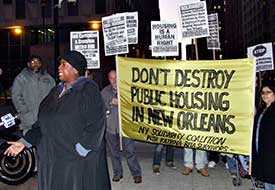
Many activists see the destruction of perfectly sound, affordable housing as another indication that the federal government is working hand-in-hand with the big real estate developers and some local and state officials to systematically push out the majority working-class, African-American population—making way for more luxury housing and condominiums for rich, affluent whites.
Along with the real threat of demolition, other developments related to this racist gentrification conspiracy include the privatization of schools, which has led to the massive layoffs of thousands of public school teachers; the lack of health care, especially for the poor; an alarming increase in the homicide rate in the Black community; and more police brutality.
The greatest devastation during Katrina took place in the Lower Ninth Ward, where the majority Black families lost their homes to flooding. To this day these families have been denied insurance coverage and governmental assistance to rebuild.
Progressive forces have called for a national day of protest against this demolition on Nov. 13 in a number of cities, especially where Katrina survivors have relocated. The New Orleans’ Public Housing and Right of Return Movement stated in a recent press release, “We oppose these plans not only because they are a clear violation of Human Rights but also for the corruption involved at every step.”
The statement goes on to say: “This corruption includes local officials’ ties to the federal government’s Housing and Urban Development (HUD). Jimmie Thorns, a businessman and close friend of Judge Ivan LeMelle, the federal judge that approved demolition, recently received a sweetheart $500,000 appraisal consulting contract from the HUD-controlled local housing authority.”
Since Katrina hit, the Housing Authority of New Orleans (HANO) and HUD have only reopened 1,600 public housing units. According to HANO’s records, HUD has approved plans to demolish four major housing developments: Lafitte, St. Bernard, B.W. Cooper and CJ Peete. HUD and HANO have leased the soon-to-be-empty lots to private developers for 99 years to build mixed housing, “mixed” meaning luxury and low-income housing together.
The current 4,600-plus public housing units in these four areas alone will be reduced to less than 750 units—an astounding 82 percent decline, according to HUD. The cost of redevelopment is estimated at $762 million, which does not include any current housing subsidies for low income families. Those subsidies come to about $1,000 per family per month, or $100 million so far.
Although the demolition is set for Nov. 19, there is a legal challenge to push this date to Nov. 28 to allow more time for activists from around the country to travel to New Orleans and participate in direct protests against this blatant injustice.
Articles copyright 1995-2007 Workers World. Verbatim copying and distribution of this entire article is permitted in any medium without royalty provided this notice is preserved.
Workers World, 55 W. 17 St., NY, NY 10011
Email: ww@workers.org
Subscribe wwnews-subscribe@workersworld.net
Support independent news http://www.workers.org/orders/donate.php
Page printed from:
http://www.workers.org/2007/us/new-orleans-1122/
Colombian Ironies: Political Prisoner Andrés Gil Unable to Attend Human Rights Forum
Government Continues its Legal Assault on a Key Rural Social Organization
By Dan Feder
The association, known by its Spanish initials ACVC, is one of Colombia’s most influential campesino organizations, working for the last 11 years in the conflictive Middle Magdalena region of the country and part of a national rural social movement fighting for better land and opportunities for the country’s rural poor. The ACVC has reported human rights violations and killings by the Colombian army, and is vocally opposed to the U.S.-imposed drug war policies of toxic crop fumigations that destroy farmers’ livelihoods and the surrounding environment.
By Dan Feder
Special to The Narco News Bulletin
November 16, 2007
When the European Commission invited veteran Colombian social fighter Andrés Gil Gutierrez to an annual human rights forum in Lisbon last week, the representative who sent the invitation was apparently one of the few who still hadn’t heard: Gil isn’t going to any such events for a long time. Since the first days of October he has been an inmate at the Modelo prison on Bucaramanga, northwest Colombia. Gil, and two of his fellow leaders of the Peasant-Farmer Association of the Cimitarra River Valley (along with one other member of the association), were arrested as the army and intelligence police raided a small village where they were meeting with townspeople, as well as the association’s office in the city of Barrancabermeja. (See a previous report here.)
 Andrés Gil Photo: D.R. 2007 International Peace Observatory |
The symbolism of this situation – where Colombia’s most important human rights defenders are being locked up or otherwise forced to suspend their work faster than international groups can keep track – will be lost on no one, and least of all Gil himself.
In a telephone interview from the Modelo prison, Gil said that he felt extremely frustrated that he would be unable to go. “There are so many things the association needs to say, so many things we need to denounce, so much information and facts that we need to clarify for all the participants of this important human rights forum in Lisbon. It is a space that we feel is very important to develop, as the Colombian state wants to silence the voices of the excluded, of the marginalized, of the persecuted, and here we have no spaces to be heard.”
From somewhere in a country called América,

Dan Feder
Editor-in-Chief
The Narco News Bulletin
www.narconews.com
Court strikes down BushCo gas-mileage exemptions
Federal Court Finds Bush Administration Violated Law by
Ignoring Global Warming in Setting National Gas-Mileage Standards,
Rejects Loophole for Trucks and SUVs
SAN FRANCISCO— The Ninth Circuit Court of Appeals today announced its ruling that the Bush government violated the law by ignoring global warming when it set national gas-mileage standards for SUVs and pickup trucks. The court sent the decision back to the National Highway Traffic Safety Administration for a full Environmental Review of the gas-mileage standards.
The ruling, written by Senior Circuit Judge Betty Binns Fletcher, found against the administration’s decision to exempt SUVs and light trucks from fuel-economy standards. “That class 2b trucks have never been regulated by NHTSA is not a reason for not regulating them now. We remand to NHTSA to revisit this issue and promulgate average fuel economy standards for these vehicles, or to provide a validly reasoned basis for continuing to exclude them from the regulation.”
“This ruling is a big help in holding the Bush administration accountable for its refusal to accept the realities of global warming and forcing it to start taking responsible actions to implement the obvious solutions,” said Kassie Siegel, Climate, Air, and Energy program director for the Center for Biological Diversity. “Raising fuel-economy standards is one of the most effective actions the government can take to quickly and significantly reduce greenhouse gas pollution. There’s no reason SUVs and light trucks should be exempt from these standards.”
The Ninth Circuit filed its decision on the case, Center for Biological Diversity v. National Highway Traffic Administration, No. 06-71891, heard by Senior Circuit Judge Betty Binns Fletcher, Circuit Judge Michael Daly Hawkins, and Sixth Circuit Senior Judge Eugene E. Siler. The case, filed on behalf of the Center for Biological Diversity by the Stanford Environmental Law Clinic, is consolidated with similar challenges by California, Connecticut, Maine, Massachusetts, Minnesota, New Jersey, New York, Oregon, Rhode Island, Vermont, District of Columbia, the city of New York, and four other public-interest groups, the Sierra Club, Natural Resources Defense Council, Public Citizen, and Environmental Defense.
Plaintiffs argued that the administration violated the Energy Policy and Conservation Act by setting low fuel-economy standards of 22.5, 23.1, and 23.5 miles per gallon for upcoming model years 2008, 2009, and 2010 respectively. Plaintiffs also argued that the administration violated the National Environmental Policy Act by failing to consider greenhouse gas emissions and global warming before selecting the low mileage standards.
"This is an important victory in the fight against global warming," said Deborah Sivas, director of the Stanford Environmental Law Clinic and the attorney of record on the case. "It's hard to imagine a federal action more significant to the problem of climate change than one which dictates fuel-consumption standards."
Congress passed the Energy Policy and Conservation Act in the wake of the 1973-1974 oil embargo as a technology-forcing statute to conserve energy and oil. The law requires the National Highway Traffic Safety Administration to set corporate average fuel-economy (CAFÉ) standards for SUVs and light trucks at the maximum feasible level.
The Ninth Circuit ruling can be downloaded at:
http://www.biologicaldiversity.org/swcbd/programs/policy/energy/CBD-vs-NHTSA-ruling-11-15-2007.pdf
The Center for Biological Diversity is a nonprofit conservation organization with more than 35,000 members dedicated to the protection of endangered species and wild places.
Contacts:Brian Nowicki, Center for Biological Diversity, (916) 201-6938 (cell)
Deborah Sivas, Stanford Environmental Law Clinic, (650) 723-0325 (office), (650) 269-2489 (cell)
Amy Poftak, Stanford Law School, (650) 725-7516 (office)
...and more killer cops
Police Shoot Unarmed 18-Year-Old Black Man in Brooklyn Twenty Times
By Gabriel Thompson, RaceWire
Posted on November 15, 2007
http://www.alternet.org/bloggers/http://www.racewire.org//67999/
This post, written by Gabriel Thompson, originally appeared on RaceWire
On the same day that ColorLines and The Chicago Reporter published a special joint investigation into fatal police shootings across the country, the New York Police Department shot to death an unarmed 18-year-old Black man in a public housing development in Bedford-Stuveysant, Brooklyn.
The mother of the deceased, Khiel Coppin, had called 911 and reported a domestic disturbance, and police reported that on the call they overheard a man saying he had a gun. When the NYPD arrived, Coppin climbed out of a first-floor window and was shot at twenty times by five officers. Thirteen bullets found their target, and after Coppin fell to the ground the police handcuffed him. The only object found on Coppin was a hairbrush, and he was pronounced dead at a local hospital.
An angry crowd immediately protested the shooting outside the development. The New York Times reported that one woman shouted a message to the police: "You need training--this is absurd!" Another outraged man told the cops: "I'm not trying to start a riot. I'm just saying it's not right."
The community's nearly instantaneous transformation from shock to anger can be best explained not just by the shooting of Coppin--details of which are still emerging--but also by the death of another unarmed Black man, Timothy Stansbury, in 2004. The 19-year-old Stansbury was climbing the stairs of the Louis Armstrong Development, three blocks from Coppin's apartment, when he met Officer Richard S. Neri Jr. Officer Neri was conducting a routine patrol of the complex with his gun drawn, loaded, and his finger on the trigger (despite the fact that he wasn't responding to a specific threat). When he met Stansbury he fired a fatal bullet through his chest. Neri was later acquitted by a grand jury, stating that he had been "startled."
Eyewitness accounts raise serious questions about the behavior of the police yesterday. As the Times reports: "Two bystanders who said they had seen the shooting said that Mr. Coppin was not armed, but was carrying a hairbrush when he climbed out the window and that he dropped it when the firing began. The two witnesses also said they both heard one officer yelling for the shooting to stop."
That doesn't sound good for the police, though the NYPD is clearly trying to control the narrative by offering a different story. As the Times continues: "According to the police, another witness described Mr. Coppin as concealing the hairbrush under his shirt, pointing it outward." This is nothing new, of course: when weapons don't appear, the police must offer a theory to explain the death of another unarmed victim.
Investigations are ongoing, so it is still too early to say what the results will be. But when an officer can kill an unarmed man like Stansbury and remain on the police force by citing a "startled" defense, one can only surmise that if the shooting was improper, the Coppin family will have a long road ahead in trying to hold the NYPD accountable.
Gabriel Thompson is a Brooklyn-based writer currently working on a book about Mexican immigrants.
© 2007 Independent Media Institute. All rights reserved.
View this story online at: http://www.alternet.org/bloggers/http://www.racewire.org//67999/
Friday, November 16, 2007
Brevitas
The journalist Bernard Fall noted that the French, after Dien Bien Phu, had no choice but to leave Southeast Asia. America, with its vast military, financial, and technological resources, was able to stay because it had the capacity to keep making the same mistakes over and over. Our war against "terrorism" has been in many ways a domestic version of our Vietnam strategy. We keep making the same mistakes over and over because, until now, we could afford to. One of these has been to define the problem by its manifestations rather than its causes. This turns a resolvable political problem into a irresolvable technical problem, because while, for example, there are clearly solutions to the Middle East crisis, there are no other solutions to the guerilla violence that grows from the failure to end it.
In other words, if you define the problem as "a struggle against terrorism" you have already admitted defeat because the guerilla will always have the upper hand against a centralized, technology-dependent society such as ours. There is one way to deal with guerilla warfare and that is to resolve the problems that allow it to thrive. The trick is to undermine the violence of the most bitter by dealing honestly with the complaints of the most rational. - Sam Smith
In other words, if you define the problem as "a struggle against terrorism" you have already admitted defeat because the guerilla will always have the upper hand against a centralized, technology-dependent society such as ours. There is one way to deal with guerilla warfare and that is to resolve the problems that allow it to thrive. The trick is to undermine the violence of the most bitter by dealing honestly with the complaints of the most rational. - Sam Smith
Democracy Belongs in the Workplace, Not Just in the Voting Booth
By Omar Freilla, Movement Vision Lab
Posted on November 12, 2007
http://www.alternet.org/story/67664/
Think about this question for a moment. How often do you experience democracy?
We've all been told that we live in a democracy. We've heard it repeated over and over by our schools, media, friends, family, co-workers and random people on the street. Democrats and Republicans alike say we've got so much of it here in the U.S. that we've got to export it overseas on fighter jets. Surprisingly though, whenever I ask people this question all I get is silence.
…So do you have an answer yet? Are you still thinking about it? Is it once a week, once a month, once a year, once every few years at the voting booth? Maybe you're wondering when the last time was? If you're wondering what my definition of democracy happens to be, then that in itself is a problem. After all, if I asked how often you experienced a car crash, unemployment, a full stomach, relaxation, anger or genuine happiness you probably wouldn't bother to wonder what I meant?
The fact of the matter is that, despite our rhetoric, most of us in the U.S. rarely experience democracy in our daily lives. We elect people within our political system to represent our interests at local, regional and national levels. And we take great pride in using "one person, one vote" to do it (the electoral college system being the one great exception). Feminism has brought democracy into a small yet growing number of our homes. But by and large the institutions of our daily lives, the places where we work, play, learn, and live are fundamentally anti-democratic. Children learn form their parents to do as they're told. Teachers take over the reigns from parents, placing more emphasis on command and control than on critical thinking. They, in turn, pass the product (us) on to our final destination -- our jobs -- where bosses tell us what to do and when to do it. Throughout the whole chain of command we're expected to merely do as we're told. Asking for input or sharing decision-making is not part of the equation. Parents, teachers and bosses who cultivate our desires and help us find our own path are the celebrated exception rather than the rule.
For the most part we have little say in the institutions that govern our daily lives. Is it any wonder then that so few people turn out to the voting booth to influence the political institutions that govern our country, regions, cities, and towns? If there's one exception to all of this, it's probably consumption. Shopping -- assuming you've got the cash to do it -- is perhaps the only part of daily life where we feel a sense of power and influence. Is it any wonder then that shopping is the thing we do most when we're not working, or that we consume so much that we're trashing the planet?
If what we want is a healthy life, liberty, and the pursuit of happiness, then perhaps we should be paying greater attention to making democracy a part of our daily lives. A democratic economy requires more than conscious consumption or pushing politicians to keep closer tabs on corporations. Bringing democracy to our workplaces requires a fundamental restructuring of ownership. It may seem exotic, grand, and far-fetched but there is a very real and growing movement of people in this country who are doing just that by establishing worker-owned cooperatives.
Worker co-ops have achieved great successes in other parts of the world, from the Mondragon Cooperatives in the Basque region of northern Spain, to the Emilia-Romagna region of Italy, and on to Argentina, worker-run businesses have been gathering strength and establishing an alternative to the economy we've been raised on. Here at home, the U.S. Federation of Worker Cooperatives is helping to grow the worker co-op movement. And as unlikely as it may seem to those who associate co-ops with hippies and lava lamps, the worker co-op movement has taken a foothold even in the South Bronx, birthplace of hip hop. The largest worker co-op in the U.S. is the 1,000-brown-women-strong Cooperative Home Care Associates. Nearby, we at Green Worker Cooperatives are doing our own part for a "green collar" job-filled economic democracy, incubating worker co-ops in the South Bronx that are also good to the earth. And in just a few months we'll be launching our first worker co-op, ReBuilders Source, the first worker cooperative reuse center for building materials in the country.
The alternatives are already here. That other world we hope for is already happening. And we don't have to go very far to see it. Greening the economy and holding corporations accountable mean we each have to do our part to extend the dream of democracy into new realms, break old taboos, and live in ways that are genuinely fulfilling. It's democracy -- where it counts.
Omar Freilla is the Executive Director of Green Worker Cooperatives in the Bronx, NY.
© 2007 Independent Media Institute. All rights reserved.
View this story online at: http://www.alternet.org/story/67664/
Thursday, November 15, 2007
Sources: Latest Senate FISA Bill Does Not Contain Telecom Immunity
Good Tentative News!--Pete
This is pretty big. As some people have been speculating today, aides to Senate Majority Leader Harry Reid have confirmed to me that the version of the FISA bill that was just reported out of the Judiciary Committee does not -- repeat, does not -- contain retroactive immunity for the telecom companies.
And a source close to Reid says that this is "most likely" the version that the Majority Leader will file a motion to proceed on. The aide declined to comment when this might happen, however, saying that it could happen next month.
All in all, it looks like a big victory for opponents of telecom immunity.
Late Update: Here's a bit more detail on what happened on the Judiciary Committee today. Sources say Senator Russ Feingold offered an amendment that would have stripped telecom immunity from the bill, but it was defeated. Then Senator Arlen Specter, the ranking GOPer on the committee, offered a "compromise" amendment saying that in these lawsuits the Federal government, and not the telecoms, would be the defendants.
But because of a procedural difficulty Specter's amendment wasn't voted on -- and Senator Patrick Leahy, the chair of the committee, essentially went around Specter's amendment and moved to have a vote to report the bill out of committee without any telecom immunity in it. That passed along strictly party lines. And that's where we are.Wednesday, November 14, 2007
POCKET PARADIGMS
The wondrous mystery of America is found not in its perfection but in its ability to improve, its perpetual search for a more perfect union. The idea had been fading for some time, not just because we came to think of power as an adequate substitute, but because we came to ignore such mundane matters as teaching children democracy with the same vigor that we teach them how to drive or about the dangers of drugs. And so we tried to recover from 9/11 with a flag and loyalty to a place called America, but without its dream. We used instead military power, anti-democratic security measures, seductive technology, and yet another elephantine bureaucracy -- offering still more temptations for guerillas with simple weapons and no love of life. The 9/11 attackers, and the tens of millions around the world who share some measure of their anger, have only seen our money and our fist -- not the decency, democracy and dream that made America strong in the first place. These virtues are still lying in the rubble. Our job is to recover them, revive them, share them, and become once more a model rather than a target. Only then will we be both safe and free. - Sam Smith
Subscribe to:
Posts (Atom)