Friday, July 06, 2007

Where have all the bees gone?

Published Jul 5, 2007 10:41 PM

I will arise and go now, and go to Innisfree,
And a small cabin build there, of clay and wattles made;
Nine bean rows will I have there, a hive for the honeybee,
And live alone in the bee-loud glade.
— Lake Isle of Innisfree,
William Butler Yeats, 1892

Right now in the U.S., Yeats would have a great deal of difficulty finding a “bee-loud glade” in which to pursue his poetry. Between 50 and 90 percent of the honeybees in 35 states have died since last fall, due largely to what is being called a “colony collapse disorder” (CCD).

Bees are not just important for poetical inspiration, honey and beeswax. As Yeats points out, in the oblique way poets employ, they are vital for the pollination that produces beans and about a third of all the food consumed in the U.S.

While there are other pollinators, like bumblebees and hummingbirds, the figure generally used is that honeybees are essential in producing about $15 billion worth of food a year.

Even the production of milk starts with pollination of alfalfa, a staple in the diet of dairy cows.

Bees have been dying in bunches for years from mites, fungal infections, bad weather, insecticides directed at pests and herbicides directed at “weeds,” but what makes CCD different is the absence of bodies. The queen is present, laying eggs with just a handful of workers. To put this in context, beekeepers generally start a hive with a queen and 12,000 workers; hives can contain as many as 600,000 workers before they split.

“It was like something had vacuumed the bees out of there,” William Palmer, owner of East Troy Honey, told the Milwaukee Journal Sentinel May 12. “The bees were missing.”

There have been several congressional hearings on CCD and some members of Congress have been trying to get the U.S. Department of Agriculture to spend more money to determine what is going on, since a major portion of the food supply is on the verge of being affected. The USDA is only spending $7.5 million, though some severely afflicted states are spending considerable sums.

The National Academy of Science is calling for more basic research because scientists are not even sure about what wild pollinators are significant for which crops.

Mid-Atlantic Apiculture Research and Extension Consortium (maarec.cas.psu.edu) summarizes the possible causes for CCD under active investigation. Radiation from cell phone towers has been ruled out, because the disorder occurs in rural areas where cell phone service is not available. Genetically modified crops are not a major suspected cause, because CCD also happens in areas where they aren’t planted.

According to MAAREC, scientists are examining the following research areas as priorities, but are not excluding other possible causes:

• chemical residue/contamination in the wax, food stores and bees

• known and unknown pathogens in the bees and brood

• parasite load in the bees and brood

• nutritional fitness of the adult bees

• level of stress in adult bees as indicated by stress induced proteins

• lack of genetic diversity and lineage of bees

According to some scientists, the chief culprit is the most commonly used insecticide on the planet: imidacloprid. This potent chemical can be sprayed on plants or coated on seeds, which then release the insecticide as the plants grow. According to a 1999 study by the Environmental Protection Agency, about 6 billion tons of insecticides are used each year.

The New Jersey Star-Ledger reported on May 28: “In sublethal doses, however, research has shown that imidacloprid and other neonicotinoids [a class of synthetic pesticides—WW], such as fipronil, can impair honeybees’ memory and learning, as well as their motor activity and navigation. When foraging for food and collecting nectar, honeybees memorize the smells of flowers and create a kind of olfactory map for subsequent trips.”

According to the New Jersey Department of Environmental Protection, imidacloprid and fipronil combined for 56 percent of the total amount of insecticides used to combat household pests and termites. (Star-Ledger, May 20) New Jersey is one of the states where CCD has affected blueberry, cranberry and peach production.

U.S. agribusiness, which grows 80 percent of the world’s supply of almonds, uses half of all the commercially available beehives in the whole U.S. (Washington Post, June 1). Big 18-wheel trucks, full of hives, pour into California’s Central Valley in February and then are moved on to service crops all over the country.

Scientists feel that this constant moving might be stressful on the bees, but don’t yet have proof. CCD hit the big beekeepers first but now isn’t limited to their hives. Local producers are also being hit with CCD.

All the causes of this decline that are under investigation are really linked to how capitalism has structured agriculture—how it has stressed and intensely overexploited a single species in deep ignorance of the ecological consequences. Bees have declined rapidly in the past but not to such an extent.

This fairly desperate research effort may succeed. If it doesn’t, agribusiness may be able to import the bees it needs—of course, at a high cost that it will pass on with its profit margin to consumers. But the declines in bees, birds (see Workers World, Jun. 29), frogs and so many other species point to the fragility of life itself under capitalism. To really solve this crisis, we need to remove its root cause, the social system that has engendered capitalist production.


Articles copyright 1995-2007 Workers World. Verbatim copying and distribution of this entire article is permitted in any medium without royalty provided this notice is preserved.

Workers World, 55 W. 17 St., NY, NY 10011
Email: ww@workers.org
Subscribe wwnews-subscribe@workersworld.net
Support independent news http://www.workers.org/orders/donate.php
Page printed from:
http://www.workers.org/2007/us/bees-0712/

Rethinking Patriotism

By Lucinda Marshall
ZNET Sustainer Commentary
http://www.zmag.org/sustainers/content/2007-07/01marshall.cfm

Several months ago when I wrote an essay questioning the appropriateness of military air shows as a form of community-sponsored family entertainment, I received a number of responses. The gist of most of the letters was that the military defends our freedom and without it, I could not write these words. Indeed, I was told that to criticize militarism is unpatriotic and how dare I impugn the honor and integrity of those who serve in the armed forces defending the American way of life.

But what precisely is this American way of life that our military purportedly defends? We live in the richest country in the world, yet unlike other developed countries that have universal health care, tens of millions of people in this country do not have health insurance and our medical care system comes in dead last behind comparable countries. Millions of children go to bed hungry every night and our educational system is leaving far too many children behind. The standard of living of all but the rich has fallen and people are losing their homes. Our energy use and wastefulness is a toxic disgrace.

In the name of all this, we squander trillions of dollars to send our troops to fight a war that was justified by lies. In Iraq we have killed an uncountable number of innocent people and so destroyed the infrastructure of the country that millions of children are starving to death and one in eight children will die before their fifth birthday. Going to school or feeding one's family is all but impossible and millions have now become refugees living in unspeakable conditions. The result of all this is that violence continues to escalate, more and more people hate our country and the world is a far more dangerous place. And when all is said and done, we bring our wounded warriors home to the squalid conditions of Walter Reed Army Medical Center.

To defend a government that claims these actions in the name of "democracy" is hardly patriotic. At best, it might be construed as nationalism. As George Orwell once put it, "The nationalist not only does not disapprove of atrocities committed by his own side, but he has a remarkable capacity for not even hearing about them."

Indeed in the aftermath of the atrocities that occurred on Sept. 11, 2001, in a scene that seemed scripted by Orwell himself, American flags started to appear everywhere--on cars, lapels and babies' bottoms. That defecating on the flag to which we pledge allegiance could be construed as patriotism should surely have given us pause to wonder if perhaps the true meaning of patriotism has been hijacked.

Clearly what was conveniently forgotten in this unquestioning, reflexive flag-waving is that dissent in the face of tyranny is the ultimate act of patriotism, it is in fact how this country was founded. We Americans are long overdue for a very serious discussion of just what it is that we are defending, which by any definition is a far cry from democracy or freedom.

There is no excuse for putting the interests of our way of life over that of any other country or people and in doing so we only harm ourselves. Too continue to misconstrue militarism as defensible in the name of patriotism is bankrupting our country and imperiling the planet, its resources and all of its citizens. If we continue along this path, there will, in the end, be nothing left to defend.

As July 4th approaches, it may well be time to consider whether patriotism and the defense of national borders is in fact an outmoded concept. Instead of Independence Day, perhaps it is time to declare an Interdependence Day and to pledge allegiance as global citizens, to build our strength by nurturing our resources rather than plundering them, by nurturing all of the world's citizens, especially the young. Most of all, it is time to pledge to end the wanton destruction of the planet and the politics of hatred and greed that divide us.

**This piece appeared originally in my column, Connected Diss, in the Louisville Eccentric Observer. I am indebted to my son Josh for pointing me towards the Orwell quote.

Lucinda Marshall is a feminist artist, writer and activist. She is the Founder of the Feminist Peace Network, www.feministpeacenetwork.org. Her work has been published in numerous publications in the U.S. and abroad including, Counterpunch, Alternet, Dissident Voice, Off Our Backs, The Progressive, Countercurrents, Z Magazine , Common Dreams, In These Times and Information Clearinghouse. She also blogs at WIMN Online and writes a monthly column for the Louisville Eccentric Observer.

Wednesday, July 04, 2007

Bush spits in the face of the Law


Wealthy friends of the rogue Bush/Cheney administration need not serve their just sentences. Take that, you pot-smoking, liberal activist judge (Waddaya mean he was appointed by a Republican?)!

It has often been said that ours is a nation constituted of laws, not of men. That one man should be able to override the sentence meted out by an impartial judge and jury to a flagrant transgressor of the law puts the lie to that proclamation. Apparently our rogue president believes those very same laws are subject to his approval, should he deem them to be applied in an "excessive" manner, by a Republican-appointed judge (Doesn't he know what's expected of him?). Under creeping totalitarianism, there is no law for the wealthy and powerful, there is only Bush, the unitary executive officer who can always fix your parking tickets or obstructions of justice.

Of course, justice would be best served by a Bush resignation, with the miraculous (for Bush) realization that the nation should come before undeserved privilege, but that's not going to happen. Bush isn't as politically astute or patriotic as was Nixon, nor is he even remotely contrite for his callous disregard for the law. While this commutation, combined with the national wreckage of the last 6 years, is well and above the standard for impeachment of the top administration officials (no President Cheney, please), there will probably again be no constructive move in that direction. We The People have no true representatives in government, save for a few good men who can be counted on the fingers of one hand (not enough for a majority vote). The Impeach Cheney movement is almost cute, but it gives us hope that there is a sense of justice alive in the corporate brothel that is Congress. Bush will have no choice but to leave by the back door if it ever truly gains enough steam to roll his VP (formerly of the executive branch) out of office. We can only hope.--Pete

Monday, July 02, 2007

Big Oil and Big Media Vs. Hugo Chavez

ZNet: Big Oil and Big Media V. Hugo Chávez (6/30/07) by Stephen Lendman

On June 27, the New York Times and Wall Street Journal vied for attention with feature stories on oil giants ExxonMobil and ConocoPhillips "walking away from their multi-billion-dollar investments in Venezuela," as the Journal put it, or standing "Defiant in Venezuela," as the Times headlined. Both papers can barely contain their displeasure over Hugo Chávez wanting Venezuela to have majority ownership of its own assets and no longer let Big (foreign) Oil investors plunder them.... That's how it should be, but it can't stop the Journal and Times from whining about it.

Lendman contrasts how "the Wall Street Journal, New York Times and the rest of the dominant U.S. media shamelessly denounce Hugo Chávez for his courage and honor doing the right thing" with "their silence, and effective complicity, on what will be one of the greatest ever corporate crimes"—being the U.S. demanding its "puppet Iraqi parliament...pass its new 'Hydrocarbon Law' drafted in Washington and by big U.S. and UK oil companies."

Fidel Castro Ruz: 'They will never have Cuba'

Published Jul 1, 2007 11:19 PM
http://www.workers.org/2007/world/cuba-0705/

June 17—I hope that no one says that I am gratuitously attacking Bush. Surely they will understand my reasons for strongly criticizing his policies.

Robert Woodward is an American journalist and writer who became famous for the series of articles published by the Washington Post, written by him and Carl Bernstein, and which eventually led to the investigation and resignation of Nixon.

He is author and co-author of 10 bestsellers. With his fearsome style he manages to wrench confessions from his interviewees. In his book “State of Denial,” he says that on June 18, 2003, three months after the Iraq war had begun, as he was on the way out of his White House office following an important meeting, Bush slapped [Lt. Gen.] Jay Garner on the back and said to him:

“‘Hey, Jay, you want to do Iran?’

“‘Sir, the boys and I talked about that and we want to hold out for Cuba. We think the rum and the cigars are a little better. ... The women are prettier.’

“Bush laughed, ‘You got it. You got Cuba.’”

Bush was betrayed by his subconscious. It was in his mind when he declared what scores of dark corners should be expecting to happen and Cuba occupies a special place among those dark corners.

Garner, a recently retired three-star general who had been appointed Head of the Post-War Planning Office for Iraq, created by secret National Security Presidential Directive, was considered by Bush an exceptional man to carry out his war strategy.

Appointed for the post on Jan. 20, 2003, he was replaced on May 11 of that same year at the urging of Rumsfeld. He didn’t have the nerve to explain to Bush his strong disagreements on the matter of the strategy to be pursued in Iraq. He was thinking of another one with identical purpose.

In the past few weeks, thousands of marines and a number of U.S. aircraft carriers, with their naval supporting forces, have been maneuvering in the Persian Gulf, a few miles off the Iranian territory.

It will very soon be 50 years since our people started suffering a cruel blockade; thousands of our sons and daughters have died or have been mutilated as a result of the dirty war against Cuba, the only country in the world to which an Adjustment Act has been applied inciting illegal emigration, yet another cause of death for Cuban citizens, including women and children; more than 15 years ago Cuba lost her principal markets and sources of supply for foods, energy, machinery, raw materials and long-term low-interest financing.

First the socialist bloc collapsed followed almost immediately by the USSR, dismantled piece by piece. The empire tightened and internationalized the blockade; the proteins and calories which were quite well distributed despite our deficiencies were reduced approximately by 40 percent; diseases such as optical neuritis and others appeared; the shortage of medicines, also a result of the blockade, became an everyday reality. Medicines were allowed to enter only as a charitable act, to demoralize us; these, in their turn, became a source of illegal business and black-market dealings.

Inevitably, the “special period” struck. This was the sum total of all the consequences of the aggression and it forced us to take desperate measures whose harmful effects were bolstered by the colossal media machine of the empire. Everyone was awaiting, some with sadness and others with oligarchic glee, the crumbling of the Cuban Revolution.

The access to convertible currency greatly harmed our social consciousness, to a greater or a lesser degree, due to the inequalities and ideological weaknesses it created.

Throughout its lifetime, the Revolution has taught the people, training hundreds of thousands of teachers, doctors, scientists, intellectuals, artists, computer engineers and other professionals with university and post-graduate degrees in dozens of professions.

This storehouse of wealth has allowed us to reduce infant mortality to low levels, unthinkable in any Third World country, and to raise life expectancy as well as the average educational level of the population up to the ninth grade.

By offering Cuba oil under favorable terms of payment at a time when oil prices were escalating dramatically, the Venezuelan Bolivarian Revolution brought a significant relief and opened up new possibilities, since our country was already beginning to produce her own energy in ever-growing amounts.

Concerned over its interests in that country, the empire had for years been planning to destroy that Revolution, and so it attempted to do it in April 2002, as it will attempt to do again as many times as it can. This is why the Bolivarian revolutionaries are preparing to resist.

Meanwhile, Bush has intensified his plans for an occupation of Cuba, to the point of proclaiming laws and an interventionist government in order to install a direct imperial administration.

Based on the privileges granted to the United States in Bretton Woods [monetary and financial agreements for the post-war period signed by the Allied countries in 1944—WW] and Nixon’s swindle when he removed the gold standard, which placed a limit on the issuing of paper money, the empire bought and paid with paper tens of trillions of dollars, more than 12-digit figures.

This is how it preserved an unsustainable economy. A large part of the world currency reserves are in U.S. Treasury bonds and bills. For this reason, many would rather not have a dollar crisis like the one in 1929 that would turn those paper bills into thin air.

Today, the value of one dollar in gold is at least 18 times less than what it was in the Nixon years. The same happens with the value of the reserves in that currency.

Those paper bills have kept their low current value because fabulous amounts of increasingly expensive and modern weapons can be purchased with them; weapons that produce nothing. The United States exports more weapons than anyone else in the world. With those same paper bills, the empire has developed a most sophisticated and deadly system of weapons of mass destruction with which it sustains its world tyranny.

Such power allows it to impose the idea of transforming foods into fuels and to shatter any initiative and commitment to avoid global warming, which is visibly accelerating.

Hunger and thirst, more violent hurricanes and the surge of the sea is what Tyranians and Trojans stand to suffer as a result of imperial policies. It is only through drastic energy savings that humanity will have a respite and hopes of survival for the species; but the consumer societies of the wealthy nations are absolutely heedless of that.

Cuba will continue to develop and improve the combative capacities of her people, including our modest but active and efficient defensive weapons industry, which multiplies our capacity to face the invaders no matter where they may be and the weapons they possess. We shall continue acquiring the necessary materials and the pertinent fire power, even though the notorious Gross Domestic Product as measured by capitalism may not be growing, for their GDP includes such things as the value of privatizations, drugs, sexual services and advertising, while it excludes many others like free educational and health services for all citizens.

From one year to the next the standard of living can be improved by raising knowledge, self-esteem and the dignity of people. It will be enough to reduce waste and the economy will grow. In spite of everything, we will keep on growing as necessary and as possible.

“Freedom costs dearly, and it is necessary to either resign ourselves to live without it or to decide to buy it for its price,” said [José] Martí.

“Whoever attempts to conquer Cuba will only gather the dust of her soil soaked in blood, if he does not perish in the fight,” exclaimed [Antonio] Maceo.

We are not the first revolutionaries to think that way! And we shall not be the last!

One man may be bought, but never a people.

Fate decreed that I could survive the empire’s murderous machine. Shortly, it will be a year since I became ill and, while I hovered between life and death, I stated in the Proclamation of July 31, 2006: “I do not harbor the slightest doubt that our people and our Revolution will fight until the last drop of blood.”

Mr. Bush, don’t you doubt that either!

I assure you that you will never have Cuba!


Articles copyright 1995-2007 Workers World. Verbatim copying and distribution of this entire article is permitted in any medium without royalty provided this notice is preserved.

Workers World, 55 W. 17 St., NY, NY 10011
Email: ww@workers.org
Subscribe wwnews-subscribe@workersworld.net
Support independent news http://www.workers.org/orders/donate.php
Page printed from:
http://www.workers.org/2007/world/cuba-0705/

U.S./NATO bombs slaughter Afghan civilians

Published Jul 1, 2007 11:25 PM
Worker's World Article

Long-range attacks by U.S. and NATO forces, both air strikes and artillery fire, killed more than 100 Afghan civilians—mainly women, children and old men—in a 10-day period in late June.

These deaths have caused such a fury among the Afghan people that Hamid Karzai, the president installed by the U.S. with the blessing of NATO, had to call a press conference on the lawn of the presidential palace to denounce the attacks.

Karzai said, “You don’t fight a terrorist by firing a field gun from 37 kilometers away into a target. That is definitely bound to cause civilian casualties. You don’t hit a few terrorists with field guns.”

Before Karzai was anointed president of Afghanistan, he was a consultant for Unocal, the U.S. oil company that wanted to build a pipeline linking Turkmenistan and Pakistan, which would allow billions of dollars of natural gas from what used to be part of the Soviet Union to be sold on the capitalist world market. Karzai was such a U.S. creation that the bodyguards protecting him until 2005 were U.S. mercenaries, who didn’t leave until they had trained a special group of Afghans to take over.

All throughout his reign in Kabul from 2002 on, Karzai has protested against U.S. and NATO “excesses,” but not to much avail, since they still continue. Even the Associated Press reported on June 23 that U.S. and NATO forces have killed at least 203 civilians so far this year, while the Afghan resistance has killed 178 civilians.

This report was picked up by over 1,300 newspapers throughout the world. There are now contingents from over 37 countries in Afghanistan, though few of them are soldiers on the ground. The U.S. and other NATO governments are pressuring other imperialist powers and also client states to provide additional troops. The ruling group in Japan, whose constitution prohibits sending its armed forces abroad, has indicated it is willing to change its constitution.

The oil and natural gas resources in Central Asia, including those of the Caspian Sea, are largely unexploited but are believed to be the second largest in the world after the Persian Gulf. The governments participating in the occupation of Afghanistan are looking for a share of those resources.

Canada is one of the largest oil exporters in the world. It has sent significant forces to Afghanistan, which has aroused a significant protest movement within Canada. Prime Minister Stephen Harper, who has allied closely to the U.S., nevertheless had to promise that “this mission will end in February 2009,” while speaking on June 23 at a public ceremony in Quebec City to send a new Canadian brigade to Afghanistan.

Of course, Harper would like Canada to stay in Afghanistan because he wants a share in what is at stake there. Washington insists that all who want to get a share in imperialist plunder of the region share in the military intervention, from Britain and Spain to Germany and even Poland, all of which have contingents in Afghanistan.

Wall Street’s economic and financial stakes in Afghanistan, namely grabbing the vulture’s share of these reserves, are so high that the Pentagon has maintained a sizable force there—10,000 to 18,000 troops—even though its ground forces are stretched to the maximum with the occupation of Iraq.

The geostrategic position of Afghanistan is also highly significant and this area was an area of imperialist interest and contention even before oil was involved.

As long ago as the middle of the 19th century, imperial Russia and imperial Britain were competing for control of Central Asia. Frederick Engels, who with Karl Marx founded scientific socialism, wrote an article in 1858 that is still relevant. Describing the British invasion of Afghanistan from its Indian colony, Engels said: “The conquest of Afghanistan seemed accomplished [in 1839] and a considerable portion of the troops was sent back. But the Afghans were no ways content to be ruled by the European infidels, and during the whole of 1840 and 1841, insurrection followed on insurrection in every part of the country.”

The costs of the occupation proved to be so high that the British had to cut back on their payments to the local chiefs, now called warlords.

The very day that W. McNaghten, the executive assistant to the British governor general of India, did this, “the chiefs formed a conspiracy for the extermination of the British, and thus McNaghten himself was the means of bringing about the concentration of those insurrectionary forces, which hitherto had struggled against the invaders singly, and without unity or concert; though it is certain, too, that by this time the hatred of British dominion among the Afghans had reached the highest point.”


Articles copyright 1995-2007 Workers World. Verbatim copying and distribution of this entire article is permitted in any medium without royalty provided this notice is preserved.

Workers World, 55 W. 17 St., NY, NY 10011
Email: ww@workers.org
Subscribe wwnews-subscribe@workersworld.net
Support independent news http://www.workers.org/orders/donate.php
Page printed from:
http://www.workers.org/2007/world/afghan-0705/

Taking Mike Gravel Seriously

I really like Mike Gravel. He filibustered the military draft to death in '71. He was instrumental in bringing the Pentagon Papers to light. To watch the talking heads naysay and belittle him makes me like him even more, they being mere tools of their corporate paymasters. If we had Instant Runoff Voting and Proportional Representation in this allegedly democratic nation, I would surely vote for him, because I dread having to vote for the vile, corrupt HRC or the DLC machine candidate Obama.--Pete

By Matt Hutaff
Jun 26, 2007

In my last column I promoted no-nonsense presidential candidate Ron Paul, Republican Congressman from Texas. He's the Internet's champion (and recipient of the coveted "Colbert Bump"), and his platform—abolishing the Internal Revenue Service, ending our wars abroad, and canceling a host of bloated social programs the government is ill-suited to operate—is something a lot of war-weary Americans can agree with.

But what if you like subsidized health care and Social Security? What if, God forbid, intractable fears of voting outside party lines force you to look at Democratic candidates? Well, friends, you're still in luck. Mike Gravel, former senator from Alaska, has the credentials to bring reform to the steps of Capitol Hill without abandoning the New Deal society that's emerged from the ashes of World War II.

Students of history recall Gravel as the man who both single-handedly filibustered an end to the military draft in 1971 and brought the Pentagon Papers (which Wikipedia laughably reduces to "a large collection of secret government documents pertaining to the Vietnam War") the widespread attention it deserved. An ardent opponent of war, Gravel has signaled his intent to bring American troops home and secure our borders from invasion and illegal immigration. He has no love for the IRS, either; expect it to fall by the wayside should he win the presidency.

But while Gravel and Ron Paul agree on many things, they differ on the role of government in everyday life. Like many classical Republicans, Paul believes in a strictly limited government that doesn't interfere with how foreign nations conduct themselves or how we as citizens manage our health. To him, government should be limited to essential services only a federal body can provide, leaving states the right of self-determination on issues ranging from education and welfare to abortion.

Many people, fairly, don't like that. Having birthed three generations since Roosevelt forged his social compact, the United States has accepted welfare, Medicaid, and Social Security as a part of life. And, ideally, these programs sound pretty great: federally-secure pensions, managed health care, education for children, and food and housing assistance for the poor. But we don't live in an ideal world, and Gravel acknowledges these programs are in disarray. His agenda to repair the tattered fabric of America, then, includes:

  • Universal Health Care vouchers giving every American the ability to seek medical care on their own terms, from whomever they want, relieving businesses and individuals of the costs;
  • Restructuring NAFTA to clear up trade imbalances that have led to unprecedented illegal immigration over the past decade;
  • Instituting a Fair Tax that generates revenue from a progressive national Sales Tax on new products and services;
  • Funding Veterans Affairs so, for once, they're treated like human beings by the government they've given their lives to defend;
  • Decriminalizing marijuana;
  • Granting same-sex unions the same privileges given to normative couples;
  • Upholding abortion rights granted under both the 14th Amendment and Roe v. Wade; and
  • Ceasing war with Iraq, and opposing future conflicts in the Middle East (namely, Iran).

It's an impressive list of goals, to be certain. And I like the candor Gravel promotes when talking about these issues. Frankly, I'd like to live in the world he talks about, and if you do, too, he's definitely worth a moment of your consideration.

The cynic in me, however, dismisses Mike Gravel because it just sounds too good, too broad in scope to imagine coming to fruition. And I have serious issues with his stance on gun registration, global warming, and taxation, to say the least. But I confess, if Gravel can pull off even a fraction of what he wants to do—namely, give equal rights to the gay and transgendered, roll back our military/industrial complex, and treat our veterans with the respect they deserve—I'll applaud him.

The battle for the Democratic nomination is an embarrassing hodgepodge of career politicians who've done little but prop up the status quo until it suits them to levy charges against it. I'd more or less written off the group, but Gravel's recent pounding on Hillary Clinton, "Why Hillary Scares Me," shows there are Big Government proponents with a soul. As Gravel says himself:

...[W]e can continue to compartmentalize ourselves from the truth, remove the troops and blame the rubble on the Iraqis. We can feed the collective fantasy that our good intentions and heroic efforts were thwarted by the cowardice and incompetence of others. But if that's what we take from our experience in Iraq, we will never learn the true lessons and we will be condemned to repeat the same mistakes. The inability to admit a mistake and assume responsibility is not just a morally bankrupt way to walk through life; it is a dangerous and deadly way to lead a nation.

Gravel's fellow contenders may have the polling numbers, but they're prepared to continue the U.S. on its current trajectory, one where core values are abandoned in favor of ruthless bloodshed and religious demagoguery. Social programs favored by Democrats are bankrupt financially and morally because they refused to make a stand against the executive office. Mike Gravel is an outsider, a maverick politician from a bygone era that recognized government should better our lives, not itself. Of those running on the Democratic ticket, he's the only one who doesn't see Janus when he looks in the mirror.

It boils down to this: Popular candidates are not in our best interests. They weren't in high school, and they sure aren't in Washingtonian politics. Ron Paul and Mike Gravel are taking the difficult stance that the United States is wrong, and we need to make it right quickly. If you think the best way to go about this involves retooling our limitless supply of socialist programs, let Mike Gravel lead the way. Hillary Clinton and Barack Obama may be media darlings, but they're dangerously disconnected from what makes a good leader, and they certainly have no clue what it takes to implement broad stroke visions like, oh, ending the war in Iraq.

Or making gays feel like regular citizens.

Or even picking campaign songs that don't bring bile to the tip of your tongue. (Although they do have what it takes to make picking a campaign song into a newsworthy event.)

Mike Gravel is a true Democrat. If that's how you vote, he should be your only choice.


Copyright © 1998-2006 TheSimon.com
View this story online and more at: http://www.thesimon.com/magazine/articles/canon_fodder/01410_taking_mike_gravel_seriously.html

Poll shows Republicans not as conservative as they (we?) think they are

Via The Hill

AARON BLAKE, THE HILL
- A large nationwide poll of Republican voters shows that an increasing number consider themselves conservative, that about half favor universal healthcare and allowing gays in the military, and that the vast majority say spreading democracy shouldn't be the United States' top foreign policy goal.

The poll, conducted by GOP consultant Tony Fabrizio 10 years after he conducted a similar study, also casts some doubts on the conventional wisdom about moral-issues voters, thought to be the key constituency for President Bush in 2004. It showed that the group hasn't grown significantly in recent years and is surprisingly willing to vote for former New York Mayor Rudy Giuliani despite his differences with it on social and moral issues.

The survey of 2,000 self-described Republican voters, titled "The Elephant Looks in the Mirror 10 Years Later," showed that 71 percent consider themselves conservative, a 16 percent increase over the 1997 numbers.

Fifty-one percent of the GOPers said universal healthcare coverage should be a right of every American, and 49 percent favored allowing gays and lesbians to serve openly in the military. . .

Nearly four in five Republicans said that U.S. foreign policy should be based on protecting economic and national security interests, versus 16 percent who preferred basing it on spreading democracy.

Bosses, Democrats and Single Payer Health Care

Which Side Are You On, Michael Moore?

By CORPORATE CRIME REPORTER


Via Counterpunch

Michael Moore has made a great movie.

Sicko.

Everyone should see it.

And take the kids.

The movie's message in a nutshell -- we need single payer.

In the United States.

Now.

But Senate Democrats are trying to co-opt the message.

On Capitol Hill today, SEIU held a rally for a couple of hundred health care workers.

The group was addressed by six Senators.

None support single payer.

Senator Ben Cardin (D-Maryland) -- does not support single payer.

Senator Sheldon Whitehouse (D-RI) -- does not support single payer.

Senator Ron Wyden (D-Oregon) -- does not support single payer.

Senator Harry Reid (D-Nevada) -- does not support single payer.

Senator Claire McCaskill (D-Missouri) -- does not support single payer.

Senator Amy Klobuchar (D-Minnesota) -- does not support single payer.

We asked Dawn Lee, a spokesperson for SEIU, whether SEIU supported HR 676 -- the single payer bill in the House.

She said SEIU takes no position on that bill.

SEIU -- does not support single payer.

At the SEIU rally, all spoke in favor of "universal health care."

That is code for -- keep the insurance companies in the game.

Single payer would take them out.

Martese Chism was at a similar rally in Chicago last month.

Chism is a registered nurse at Cook County Hospital in Chicago.

She also sits on the board of the California Nurses Association (CNA).

CNA is pro-single payer.

Chism was attending an SEIU rally in Chicago in support of Illinois Governor Rod Blagojevich's "universal health care" bill that would keep the insurance companies in the game.

Chism says that the SEIU members who gathered for the rally were being actively misled by SEIU.

"SEIU members are being led to believe that universal health care means free health care for all -- single payer," Chism told Corporate Crime Reporter. "But it doesn't mean that. It means keeping the insurance companies in the game. I had to leave because I couldn't take it anymore. The insurance companies and SEIU are misleading people."

CNA president Rose Ann DeMoro is a touch less subtle.

"Rather than being on the side of the workers, SEIU continues to be on the side of the bosses," DeMoro told Corporate Crime Reporter. "And it's a disgrace."

"And the problem is that SEIU is giving cover to these Senators -- it makes them look like they are accomplishing something when in fact they are accomplishing nothing. These legislators are gutless, and the SEIU is giving them cover."

DeMoro is using the movie Sicko to generate public support for single payer around the country.

Unfortunately, the powers that be in the Democratic Party are working -- with SEIU and other unions -- to undermine public support for single payer.

And soon, Michael Moore too will have to choose.

Between single payer -- and the corporate Democratic Party's candidate for President.

That candidate will be -- if past is prologue -- opposed to single payer.

And the question will remain, as always -- which side are you on?

Corporate Crime Reporter is located in Washington, DC. They can be reached through their website.

The Impeach Cheney Movement Gains More Congressional Support

By Guest Blogger
Posted on July 2, 2007
http://www.alternet.org/bloggers/guest/55731/

This post, written by Michael Roston, originally appeared on Raw Story

A Democratic Congressman from Washington state became the latest Member of Congress to add his voice to the calls for the impeachment of Vice President Dick Cheney. The move came the same night that House Democrats failed to unite their party around a measure to cut the funding for the Office of the Vice President in response to Cheney's declaration that his office was not a part of the executive branch.

Rep. Jim McDermott (D-WA) declared in an address on the House floor Thursday night that he was in favor of impeaching the vice president.

"It is time for a new exit strategy, one that removes the Vice President of the United States from office, voluntarily, if he chooses, but by impeachment if he stonewalls," said the Seattle Democrat and Progressive Caucus member. "I have struggled mightily with this matter for a long time...Since the President permits the flagrant disregard of the Constitution, it is up to the Congress to act and defend the American people. With each new revelation, America has seen only glints of what has been done totally in secret."

McDermott said that he was adding his name to H.Res. 333, the Articles of Impeachment introduced by Rep. Dennis Kucinich (D-OH) and already supported by nine additional Congress members. But he also made it clear that he was concerned with crimes beyond those called out in the Ohio Democrat's legislation.

"The Vice President holds himself accountable to no one," Rep. McDermott argued. "He ordered the Secret Service to destroy visitors logs, and we have learned in the Washington Post recently, that the Vice President circumvented every check and balance inside the White House to force through his own agenda, to spy on Americans through illegal wire traps, creating the gulag at Guantanamo, and subverting civil liberties and free speech at every turn."

Note: Text and video of McDermott's speech are available at the Congressman's website.

In a conference call on Thursday afternoon, Democratic Speaker of the House Nancy Pelosi made it clear that the decisions of Democrats like McDermott were not enough to change her mind on impeachment, which she continued to insist was off the table.

"It's a choice that has to be made," she said. "I made a decision...one year ago that impeachment was something we could not be successful with, and that would take up the time we needed to do some positive things to establish a record of our priorities and their shortcomings. The president isn't worth impeaching. If it were the beginning of his term, people might think of it differently, but he's at the end of his term...the last two years of his term, we just want to be rid of him."

Rep. supports impeachment, but funded Cheney's office

While McDermott announced Thursday night that he was in favor of impeaching Cheney, he also lined up with 23 Democratic colleagues to defeat an amendment that would have cut all funds for the Vice President's office in the next fiscal year.

RAW STORY had reported on Thursday that some Democratic leaders expected a party line vote on the amendment to the Financial Services Appropriations bill. But a curious assortment of Blue Dog Democrats, Congressional Progressive Caucus members, House Committee chairs, and others banded together to produce the 209-217 vote against Rep. Rahm Emanuel's (D-IL) amendment.

Reps. David Obey (D-WI) and John Murtha (D-PA), powerful members of the House Appropriations Committee who cast a rare vote with Republican lawmakers on the measure, could not be reached for comment Friday.

But McDermott's spokesman told RAW STORY that he didn't think the amendment was appropriate.

"Rep. McDermott shares the frustration of others with the vice president's office, but there really was a constitutional question of whether that was possible," said Mike DeCesare, the Seattle-based Communications Director for the Congressman.

A spokeswoman for Rep. Michael Capuano (D-MA), another Progressive who voted with the Republicans on the measure, also questioned the usefulness of the measure.

"Congressman Capuano believes firmly that the Vice President's actions warrant investigation," said spokeswoman Alison Mills in an e-mail. "Nevertheless, he did not support eliminating funding for the Office of the Vice President. He viewed this as merely a symbolic measure that would not produce the results we all desire. Defunding would not make the Office of the Vice-President transparent or accountable."

While the measure was defeated, a spokesperson for Rep. Emanuel, the Chairman of the Democratic Caucus, still claimed victory.

"Democrats forced the Vice President to abandon the assertion that he was not part of the executive branch," the spokesperson told RAW STORY in a statement. "Democrats will continue to hold the Vice President accountable and fight to ensure our government is open and honest."

But while Emanuel's office claimed the Illinois Democrat's measure had whipped Cheney back into line, the Vice President's office spun it as a bipartisan victory of their own.

"We are pleased to see a bipartisan majority reject this political stunt," Cheney spokeswoman Megan McGinn told the Associated Press on Thursday night.

Michael Roston joined Raw Story in June 2006. After a brief hiatus to work at the United Nations in the fall, he rejoined the website in his current position as Associate Editor in December 2006.

© 2007 Independent Media Institute. All rights reserved.
View this story online at: http://www.alternet.org/bloggers/guest/55731/

How to Make Ann Coulter Disappear


By Guest Blogger
Posted on June 29, 2007
http://www.alternet.org/bloggers/guest/55554/

This post, written by Bill Scher, originally appeared on The Huffington Post

How to deal with a noxious but prominent commentator like Ann Coulter? Confront her bigoted remarks and outright falsehoods? Or ignore her in hopes of dimming her spotlight?

It would seem to be a lose-lose proposition.

Getting a rise out of her political opponents is her job, so challenging her on the merits only helps her sell books, which keeps her on TV.

But unless you buy out Rupert Murdoch and control your own media empire, dimming her spotlight is seemingly impossible, no matter how tightly you shut your eyes and close your ears.

Bob Borosage notes that TV producers, desperate for ratings, have no shame in booking the vapid Coulter. And I'm not holding my breath waiting for shame to arise.

Coulter's train wreck qualities practically guarantee a ratings bump for all audience-starved newstainment shows -- both from hard-core fans and disgusted opponents.

So can anything stop her from filling the national discourse with more hate and lies?

Yes. If she loses her fans.

That's not as crazy as it sounds.

After she called Muslims "ragheads" at the 2006 Conservative Political Action Conference, and John Edwards a "faggot" at the following year's conference, open letter posted on several conservative blogs last March said:

Coulter's invective is a sign of weak thinking and unprincipled politicking. CPAC sponsors, the Age of Ann has passed. We, the undersigned, request that CPAC speaking invitations no longer be extended to Ann Coulter. Her words and attitude simply do too much damage.

Sage advice.

Coulter is arguably as much of a personification of the failure of conservatism as George W. Bush.

While Bush epitomizes the substantive failure of conservative policies, Coulter represents the failure to speak to the daily concerns of most Americans.

Her protestations that no one listens to her ideas mask her clear preference for insults over ideas -- the more hateful and sophomoric, the more she can claim persecution by political correctness.

As a liberal, am I afraid of Coulter? No. Read the last five years of my writings, she barely comes up.

There are hundreds of conservatives that work harder, influence more news, and generate far more unchallenged misinformation for me to worry about.

But she's a distraction who impedes a serious engagement over ideas.

Conservatism is headed towards its nadir, and conservatives can deal with that reality in two ways.

They can choose to enable Coulter, lash out at the world and wallow in a persecution complex.

Or they can choose to let her rants languish on the shelves.

When her sales drop, so will her bookings. With her off the stage and ceasing to be a distraction, conservatives will better able to engage in a factual debate over the direction of our country.

It's up to conservatives to decide if that's what they really want.

Originally posted at the Campaign for America's Future blog

Bill Scher is the executive editor of LiberalOasis.com and the online writer/editor for Campaign for America's Future.

© 2007 Independent Media Institute. All rights reserved.
View this story online at: http://www.alternet.org/bloggers/guest/55554/

Sunday, July 01, 2007

Three Words for Bush and His Judges

Truthdig article

Posted on Jun 29, 2007

By E.J. Dionne

WASHINGTON—Just say no.

The Senate’s Democratic majority—joined by all Republicans who purport to be moderate—must tell President Bush that this will be the answer to any controversial nominee to the Supreme Court or to the appellate courts.

The Senate should refuse even to hold hearings on Bush’s next Supreme Court choice, should a vacancy occur, unless the president reaches agreement with the Senate majority on a mutually acceptable list of nominees.

And no Bush nominee to a lower court deserves any deference now that we learn that U.S. Circuit Court Judge Brett Kavanaugh may have misled the Senate during his confirmation hearings. Kavanaugh claimed he was not involved in administration discussions about setting the rules for the treatment of enemy combatants. The Washington Post reported that he actually was.

Although a spokeswoman for Kavanaugh insisted that his testimony was “accurate,” Senate Judiciary Chairman Patrick Leahy said, “I don’t believe that he was truthful with us.”

As for the Supreme Court, we now know that the president’s two nominees, Chief Justice John Roberts and Associate Justice Samuel Alito, are exactly what many of us thought they were: activist conservatives intent on leading a judicial counterrevolution. Thursday’s 5-4 ruling tossing out two school desegregation plans was another milestone on the court’s march to the right.

Even after he was confirmed, Roberts was talking about something other than the 5-4 conservative court we saw this year on case after case. In a speech at Georgetown University Law School in May 2006, Roberts rightly argued that “the rule of law is strengthened when there is greater coherence and agreement about what the law is.” It’s a shame this quest for broader majorities had so little bearing on the 2007 Roberts-led court.

Especially troubling was the opinion offered by Roberts and Alito this week eviscerating the rather modest restrictions on sham “issue” ads in the McCain-Feingold law. The provision, which applies for 30 days before a primary and 60 days before a general election, is aimed at preventing large amounts of corporate and union money from getting around campaign finance restrictions.

Three conservative justices, Antonin Scalia, Clarence Thomas and Anthony Kennedy, were willing to admit that in voiding the law they were overturning a precedent set by the court only four years ago. But Roberts and Alito pretended to follow the earlier ruling while ripping its guts out. Scalia called this “faux judicial restraint.”

“The court (and, I think, the country) loses when important precedent is overruled without good reason,” Justice David H. Souter wrote for the dissenters. Exactly. But upsetting precedent, directly or indirectly, is a major goal of this new conservative majority.

As Norman Ornstein of the American Enterprise Institute noted this week in Roll Call, the issue-ad decision demonstrated “not a careful, conservative deference to Congress” but instead “a willingness by Roberts to toss aside Congress’ conclusions to fit his own ideological predispositions”—the very definition of judicial activism.

If another conservative replaces a member of the court’s moderate-to-liberal bloc, the country would be set on a conservative course for the next decade or more, locking in today’s politics at the very moment when the electorate is running out of patience with the right.

That’s why a majority of senators should warn Bush now that they will not take up his nominee unless he strictly construes the Constitution’s provision that he appoint justices with “the Advice and Consent of the Senate.” The rule should be: If advice isn’t taken, there will be no consent.

And if conservatives claim to believe the president is owed deference on his court appointees, they will be—I choose this word deliberately—lying. In 2005, conservatives had no problem blocking Bush’s appointment of Harriet Miers because they could not count on her as a strong voice for their legal causes. They revealed that their view of judicial battles is not about principle, but power. When they went after Miers, conservatives lost the deference argument.

Much has been written about how the judicial confirmation process is “broken.” A more accurate view is that the ideological struggles in our politics have moved to the courts, and that the formal processes of the Senate don’t deal well with such conflicts.

It would be far better to be honest about what’s going on. The Senate should be unapologetic in saying no, upfront, to loading the bench with conservative judicial activists. If Bush is given this warning and still refuses to engage in serious consultation, the burden will be on him.

E.J. Dionne’s e-mail address is postchat(at symbol)aol.com.

© 2007, Washington Post Writers Group

U.S. Border Fence Protrudes Into Mexico, naturally...


AP Photo
AP Photo/Guillermo Arias


COLUMBUS, N.M. (AP) -- The 1.5-mile barrier along the U.S.-Mexico border was designed to keep cars from illegally crossing into the United States. There's just one problem: It was accidentally built on Mexican soil. Now embarrassed border officials say the mistake could cost the federal government more than $3 million to fix.

The barrier was part of more than 15 miles of border fence built in 2000, stretching from the town of Columbus to an onion farm and cattle ranch.

A U.S. Customs and Border Protection spokesman said the vertical metal tubes were sunk into the ground and filled with cement along what officials firmly believed was the border. But a routine aerial survey in March revealed that the barrier protrudes into Mexico by 1 to 6 feet.

James Johnson, whose onion farm is in the disputed area, said he thinks his forefathers may have started the confusion in the 19th century by placing a barbed-wire fence south of the border. No one discovered their error, and crews erecting the barrier may have used that fence as a guideline.

"It was a mistake made in the 1800s," Johnson said. "It is very difficult to make a straight line between two points in rugged and mountainous areas that are about two miles apart."

The Mexican government was notified and did what any landowner would do: They sent a note politely insisting that Mexico get its land back.

"Our country will continue insisting for the removal (of the fence) to be done as quickly as possible," the Foreign Relations Department said in a diplomatic missive to Washington.

When the barrier was built in 2000, the project was believed to cost about $500,000 a mile. Estimates to uproot and replace it range from $2.5 million to $3.5 million.

Michael Friel, the spokesman for Customs and Border Protection, said the barrier was "built on what was known to be the international boundary at the time." He acknowledged the method used was "less precise than it is today."

The International Boundary and Water Commission, a joint Mexican-American group that administers the 2,000-mile border, said the border has never changed and is marked every few miles by tall concrete or metal markers.

Sally Spener, a commission spokeswoman in El Paso, said the agency is generally consulted for construction projects to ensure that treaties are followed. The commission is working with the Department of Homeland Security "to develop a standardized protocol" for building fences and barriers.

"We just want to make sure those things are clear now," Spener said.

New Mexico Sen. Jeff Bingaman asked Customs and Border Protection officials to build a new fence on U.S. soil before the old one is torn down.

Bingaman said he was concerned about security issues in Las Chepas, the small Mexican village where most area residents live. New Mexico once sought permission to raze the community because it was known as a popular staging area for illegal immigrants and drug smugglers.

Back at his farm, Johnson said he doesn't understand why the placement of the barriers has become an issue now since his family's fence went unquestioned for more than a century.

"The markers are in the right place, and the fence is crooked," Johnson said. "But for 120-plus years it was agreed upon that that fence was the border."

© 2007 The Associated Press. All rights reserved. This material may not be published, broadcast, rewritten or redistributed. Learn more about our Privacy Policy.

Let's talk about so-called "activist judges", shall we?

In Steps Big and Small, Supreme Court Moved Right

WASHINGTON, June 30 — It was the Supreme Court that conservatives had long yearned for and that liberals feared.

By the time the Roberts court ended its first full term on Thursday, the picture was clear. This was a more conservative court, sometimes muscularly so, sometimes more tentatively, its majority sometimes differing on methodology but agreeing on the outcome in cases big and small.

As a result, the court upheld a federal anti-abortion law, cut back on the free-speech rights of public school students, strictly enforced procedural requirements for bringing and appealing cases, and limited school districts’ ability to use racially conscious measures to achieve or preserve integration.

With the exception of four death penalty cases from Texas, where the state and federal courts remain to the right of the Supreme Court and produce decisions that the justices regularly overturn, the prosecution prevailed in nearly every criminal case, 14 of the 18 non-Texas cases.

Fully a third of the court’s decisions, more than in any recent term, were decided by 5-to-4 margins. Most of those, 19 of 24, were decided along ideological lines, demonstrating the court’s polarization whether on constitutional fundamentals or obscure questions of appellate procedure. The court’s last-minute decision, announced on Friday, to hear appeals from Guantánamo detainees required votes from at least five of the nine justices.

Of the ideological cases decided this term, the conservative majority, led by Chief Justice John G. Roberts Jr. and joined by Justices Antonin Scalia, Clarence Thomas and Samuel A. Alito Jr., prevailed in 13. The court’s increasingly marginalized liberals — Justices John Paul Stevens, David H. Souter, Ruth Bader Ginsburg and Stephen G. Breyer — prevailed in only six, including the four Texas death penalty cases.

The difference depended on how Justice Anthony M. Kennedy voted. Remarkably, he was in the majority in all 24 of the 5-to-4 cases. In the 68 cases the court decided by signed opinions, Justice Kennedy dissented only twice.

The statistics underscore what case after case demonstrated as the term unfolded: Justice Kennedy’s role in the position that Justice Sandra Day O’Connor once held at the court’s center of gravity. “Kennedy is very much the median justice now, as Justice O’Connor was, and he is to her right,” said Steven G. Calabresi, a professor at Northwestern University School of Law.

NYT Article

Re: "Terrorist" attacks in Britain

It seems to me that the attacks of the last two days in Great Britain have been somewhat amateurish. I'm waiting for the smoke to clear and information to flow, but I have a funny feeling about these failed car bombs, although I'm quite sure that we will see more of them in the future, and in the US as well.

More on this as the news becomes clearer.--Pete

Protest briefly shuts ICE jail

Direct action! Yes, yes, y'all! Doin' it to it in real time! Love those passionate activists!

Let's raise those black flags, citizens, because Dancing With The Stars won't help us reclaim the republic and reconstruct the open, civil society that we worked so hard for so long to build!--Pete

Published Jun 29, 2007 10:51 PM

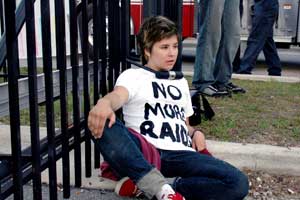
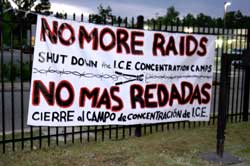
Just after dawn on June 4, two young Houston activists shut down the Immigration and Customs Enforcement detention center in Houston for three hours. They chained and locked themselves to the only two gates that allow vehicles into and out of the jail.

Ashley Turner, shown here, and Ben Browning
U-locked themselves to the gates of the
detention center in solidarity with immigrants.
Photos: Houston Indymedia

Ashley Turner and Ben Browning used bike locks and chains to attach themselves to the automatic rolling gates in front of the jail, which holds 950 people. Not only could the shift not change, but none of the vans bringing in people rounded up in early morning raids could enter either.

A phalanx of Houston cops joined the ICE cops and finally told the two activists they had five minutes to get off the property. One of the dozens of people joining in the protest and supporting the civil disobedience told the cops they had five minutes to release all the people in the detention center. The standoff began.

It took three fire trucks and dozens of police and firefighters over two hours to figure out how to get the bike locks off. Turner and Browning were led to the cop cars as their supporters cheered. They were bonded out and now face a misdemeanor charge of trespassing and a felony charge of possession of a criminal instrument.

A newly formed group, Houston Sin Fronteras, which Turner and Browning are working with, has called for another demonstration in front of the ICE Detention Center on the Fourth of July at 8 a.m. to show solidarity with all those incarcerated while U.S. authorities profess to celebrate freedom and independence.

A statement released by participants after the arrests linked this action to others happening around the world during the G8 summit:

“This week the leaders of the richest and most powerful eight countries in the world are meeting in Germany for the Group of 8 (G8) conference. During the G8 gathering these leaders will continue to strategize and promote the economic and political policy of neoliberal ‘globalization.’ These eight nations, which compose 65 percent of the global economy, have pushed for an economic system which impacts the whole world, making the rich richer, and impoverishing millions.

“Today, June 4th, the Dissent! Network in Europe has called for a Global Day of Action for freedom of movement and equal rights for all!

“We here in Houston, Texas, USA, have heard this call to action and share the same concerns as our brothers and sisters in Europe and all over the world who are taking action today in solidarity with migrants and refugees of the global economy.”

For updates, see www.houston.indymedia.org.


Articles copyright 1995-2007 Workers World. Verbatim copying and distribution of this entire article is permitted in any medium without royalty provided this notice is preserved.

Workers World, 55 W. 17 St., NY, NY 10011
Email: ww@workers.org
Subscribe wwnews-subscribe@workersworld.net
Support independent news http://www.workers.org/orders/donate.php
Page printed from:
http://www.workers.org/2007/us/ice-0705/

Police beat, arrest civil rights attorneys

Published Jun 28, 2007 9:40 PM

A long-time civil rights and people’s attorney, Michael Tarif Warren, and his partner Evelyn Warren, also a lawyer, were beaten and arrested by police on June 21 in Brooklyn, N.Y. The Warrens, who are both Black, were held for several hours at the 77th Precinct before being released.

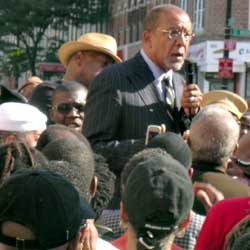
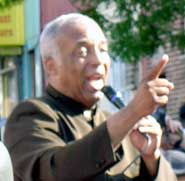
Michael Tarif Warren addresses crowd
outside Brooklyn’s 77th Precint
at June 23 protest rally.
WW photos: Arturo J. Pérez-Saad

Their statement to the press on being released later that evening, following a long ordeal and after both having been attacked by a cop, was: “What we experienced tonight happens every day in our communities. What happened to me was the result of doing what is right—speaking out against wrongdoing.”

The doing “what is right” was to observe and try to offer assistance to a young Black man who had been chased by cops. After having caught the young man, they began kicking him while he had his hands behind his back and was on the ground.

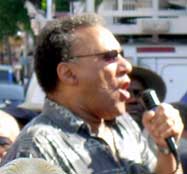
Larry Holmes
at June 23 protest.

The following are excerpts from an article entitled “NYPD Brutalize Human Rights Attorney” written by Amadi Ajamu, an organizer with the December 12th Movement:

“Warren, a high profile attorney who has been practicing law for 28 years, said, ‘We saw a young kid being chased by a horde of policemen across a McDonald’s parking lot. They tackled him and immediately put handcuffs on him. Then Sergeant Talvy, who appeared to be in charge, began kicking him in the head and ribs, and stomping him on the neck.’ The other police officers followed suit. ‘They literally gave this kid a beating which was unconscionable.’

Charles Barron
at June 23 protest.

“‘Not only as people of conscience and moral decency, but as lawyers, we said this is outrageous.’ They arrived and stood ‘more than 10 feet away,’ he said. Mr. Warren told Sergeant Talvy they were lawyers, and told him to stop and just take the young man to the precinct. In response, he said, ‘Talvy shouted, ‘I don’t give a f**k who you are, get the f**k back in your car!’

“They returned to their car, and Mr. Warren began to write down the license plate numbers of the police vehicles as they watched them put the bleeding young man in a car. ‘Then Talvy comes to my car and viciously attacks me, repeatedly punching me through the window. Shouting, “Get out of the car!” he dragged me out of the car, ripping my shirt and pants. My wife, very upset, asked him, “Why are you doing this?” He then punched her in the face.’ Both were arrested and taken to the 77th precinct charged with obstruction, disorderly conduct, and resisting arrest.

“Michael Tarif Warren has handled many police misconduct cases in the black community, including the shocking police murder of graffiti artist Michael Stewart, and Yvonne Smallwood, who was beaten to death by police in the Bronx. He also handled the case exonerating the five young black teenagers falsely convicted of raping the white bank executive ‘Central Park Jogger.’”

Arrests outrage community

Perhaps the cops didn’t know who they were attacking, maybe they did. It is entirely possible, though, that the cops thought the two were a “regular” Black couple and that, like countless other times that play out in every city around this country, they would simply get away with it.

The community might hear or read of the incident, and then again, they might not. There could be a press conference, a few rallies, outrage, marches calling for justice, but at the end of the day, just as many times before, the police chief, mayor and the corporate media outlets would speak of the difficulty of police work.

There would be no suspension, no dock in pay, no firings and cops still celebrated as heroes in popular media.

This time, though, the cops picked on two Freedom Fighters, two well-known heroes and supporters of liberation struggles around the world. This time the cops attacked people who not only have the know-how and determination to fight back, but also the popular support that comes with having been in the struggle for years and with being loved for their work, compassion and humble demeanor.

There is no greater evidence of those assets than what happened the night of their detainment.

It undoubtedly goes without utterance or written word that no cop at the 77th Precinct expected that there would be a minor rebellion, albeit a peaceful one. But that is what happened in the late evening of June 21.

As soon as word got out about the Warrens’ arrests, the call was sent out by e-mail, WBAI-FM public radio and by phone to gather at the 77th Precinct where they were being held. In just a couple of hours, the precinct was packed with political and community leaders and activists, including this writer.

Those who immediately came to the precinct were Brooklyn-based city council member Charles Barron; the Malcolm X Grassroots Movement; the December 12th Movement; FIERCE!; CAAAV; WBAI, which broadcast the incident on the airwaves; the Jericho Movement; the Safiya/Nuh Foundation; CEMOTAP, the Free Mumia Abu-Jamal Coalition; representatives from the Muslim and Haitian communities; the International Action Center; Workers World Party; and other organizations and concerned individuals.

There was barely room to move and still more people waited in the stairwell and outside in the rain. When one cop asked if the people could make room, someone in the crowd retorted, “As soon as you let Michael and Evelyn go, we’ll give you all the room you want.”

Because of the mass of people, there was nothing the cops could do, not even when the cop who attacked Michael Tarif and Evelyn Warren was pointed out, and not even when shouts of “Michael Warren/Freedom Fighter,” resounded.

Those gathered along with the leadership, from Viola Plummer of the December 12th Movement to Charles Barron, had already decided that the night could not end without the freedom of Michael and Evelyn.

Darkness would have passed into day as nature goes unimpeded, but the masses gathered seemed to have made up their mind.

Eventually, after the summoning of the borough chief and deputy chief, before midnight, Michael and Evelyn walked out of the precinct, surrounded by throngs of supporters who chanted loudly.

Michael Warren’s clothes were torn and both had scrapes and looked tired, but were surprised and glad to see so many admirers. After giving a statement, they got in their vehicle, flanked by supporters, and drove away. From there the people marched and chanted. The cops looked on, helpless. People from the neighborhood looked out their windows, seeming to revel in the victory, though maybe not even aware of what transpired.

Another anti-police-brutality rally took place at the precinct on June 24.

This battle is not yet over, however. Michael Tarif Warren and Evelyn Warren have a court date on July 25 in Brooklyn to respond to desk appearance tickets. Supporters are asking that the courtroom be packed to show the city that justice is demanded, that the charges be dropped and once again, the cops have to be put on trial for their brutality.


Articles copyright 1995-2007 Workers World. Verbatim copying and distribution of this entire article is permitted in any medium without royalty provided this notice is preserved.

Workers World, 55 W. 17 St., NY, NY 10011
Email: ww@workers.org
Subscribe wwnews-subscribe@workersworld.net
Support independent news http://www.workers.org/orders/donate.php site promotion
Page printed from:
http://www.workers.org/2007/us/warren-0705/