Saturday, December 16, 2006

THE 2006 ELECTION: ANOTHER NAIL IN OUR DEMOCRACY'S COFFIN?

By Danny Schechter

New York, New York, November 28: After every election, there are post-mortems and then, after that, come the studies to confirm the presence of many institutional and deep seated flaws in our ritualized electoral-democracy.

Annually, journalists acknowledge their own limits and mistakes. The honest ones admit there was a uniformity of outlook in which the horse race is over-covered and the issues under covered.

They concede that there was a focus on polls without explaining their limits adequately or how polls in turn are affected by the volume and slant of media coverage. There are criticisms of how negative ads and entertainment values infiltrated election coverage, what Time magazine calls "electotainment." They bemoan the fact that there was more spin and opinionizing than reporting along with less investigative reporting.

And then they do it all over again.

It happened again this year, as if the media industry and the press corps never learns from its own mistakes and is doomed to repeat them. Why? Phil Troustine former political editor of the San Jose Mercury News, told Nieman Reports, "too many reporters are cynics, not just skeptics. This leads to the sense that they are hard bitten realists when they are simplistic and often biased." They also work for corporate media outlets who design the coverage and assign the journalists. Mostly, they are not free or independent agents.

A 2006 survey by the Committee of Concerned Journalists of their own members revealed that many journalists think the news media is failing voters by not adequately covering this past year's campaigns.

"Only 3% give the press an A grade, while another 27% give the news media a B. At the same time, 42% give the coverage a C and 27% say D or F.

The poll surveyed 499 CCJ members between October 8 and October 15th. The Committee is a national consortium of journalists and journalism educators in various media."

The Mediaocracy blog, inspired by a book I wrote of the same name asks. "What are the particular concerns these journalists have? By large majorities they feel the news media has become sidetracked by trivial issues, has been too reactive and has focused too much on the inside baseball that doesn't really matter to voters, according to the survey.

In other words, most of the campaign reporting does not deliver what journalists think the public wants or needs. This is in line with other general surveys of reporters regarding the current state of their profession. A Pew Research Center report in 2000 showed that less than 40% of journalists surveyed said the media was fulfilling its public responsibilities."

THE LATEST STUDY

The Project on Excellence in Journalism has just assessed this past year's election after extensive on day research "On Nov. 7, a team of researchers from the Project for Excellence in Journalism monitored the coverage of 32 news outlets-18 web sites, six blogs, four broadcast networks, three cable channels, and NPR as the results rolled in and Congress changed hands. This report, "Election Night 2006": An Evening in the Life of the American Media," breaks down that performance by media platform and contains an evaluation of each individual outlet.

What did they find?

"l. The two most valuable things the news media offers on these fast-moving election nights now is a quick summary of key results for those wanting the headlines and deep veins of data that users can mine on their own. That may explain why TV Web sites fared well.

2. In contrast, rich narrative story telling and snap punditry, the long suit of the morning newspaper and the TV telecast, may be less valuable-at least as the numbers are rolling in on the first night.

3.Most news organizations are still finding their way in this new multi-media environment. Often they are trying to do too many things and lack the resources and flexibility to adjust to the speed of the news. They need to make clearer choices.

4. The Exit Poll may be more important today, not less, since users are probing that information directly, functioning as their own editors--going state by state, looking for demographic information, late deciders, and more. This is not just the purview of experts and academicians anymore."

5. When the system works-voting occurs without widespread problems and the media establishment isn't faltering-citizen sentinels, bloggers, and other observers, while potentially important watchdogs, have a more restricted role."

Sorry to disagree. The system is NOT working well. On November 26, three weeks AFTER the election, the NY Times discovered that voting machines in Florida swallowed 18,000 votes and worry that without a verified paper trail, results will be compromised. Their editorial was titled "Déjà vu" in Florida." The Times seemed shocked in concluding that electronic voting "could end up undermining democracy…"

"COULD?"

Now I am the one who is shocked. How is it that so many of our mainstream media outlets IGNORED this problem, and did not demand that it be fixed BEFORE the election. For years now, an election integrity movement has been crusading on this issue but they have been brushed aside, and are rarely in the news. There is no shortage of information on the subject.

BURYING THE LEAD

Years ago, Jim Naureckas of FAIR wrote: "In journalism, it's called 'burying the lead.' A story starts off with what everyone already knows, while the real news - the most surprising, significant or never-been-told-before information - gets pushed down where people are less likely to see it...."

Why? What accounts for media organizations looking away and covering elections the same way each year as if they are following routines?

Responds Naurekas: "many journalists are instinctively protective of the legitimacy of the institutions they cover." He then adds, "but the job of a journalist is not to promote but to question. The theory behind the First Amendment is that the system will be strengthened by an unflinching look at the system's flaws."

Too many journalists fail to separate the election outcomes from the self-interested financial interests that influence them or the way incumbents manipulate the system to their advantage. Elections are often determined by what's called the "Air War"-TV commercials, many negative attacks ads that do more misrepresenting than presenting, more selling than telling. The cost of these political ads on television, the third highest source of ad revenues for the industry, has more than quadrupled since 1982.

Today, commercial media has gone AWOL on this most obvious responsibility. "Pre-election news coverage of the candidates has in many cases all but disappeared," says Paul Taylor, chairman of the Alliance for Better Campaigns -- a MediaChannel Affiliate that advocates free airtime for candidates. "What little candidate coverage that remains is devoted to incumbents, by a margin of nearly five to one, over challengers."

In a study of media coverage, MediaChannel affiliate Norman Lear Center revealed that the amount of election-centered discourse provided by the typical local station during the height of the 2000 presidential primary season was just 39 seconds a night - far short of the five-minute standard advocated by a 1998 presidential advisory commission headed by then Vice President Al Gore.

Another MediaChannel affiliate, the Center for Media and Public Affairs, found that the total minutes of coverage of the 2002 midterm election on the national network news programs had declined by 78 percent over the coverage those networks devoted to the 1998 midterm election.

POLITICAL DEVOLUTION

All of this got worse in 2006. The media is failing us along with the political system it allegedly covers. There is a devolution underway, not reform and change.

Years ago in a book called "Hail to the Thief" on the outcome of the 2000 election, I wrote:

"The media is no longer, if it ever did stand apart from politics as a neutral--much less objective--watchdog operating outside the political system to strengthen democracy. In an age of corporate mergers and unprecedented media concentration, the media have in effect, merged with politics and now function as a key component of a system that Norman Mailer sees, with a whiff of the Mafia theory of Organization, as a "family."

"The American political body has evolved," he wrote in an essay in his l998 anthology The Time of Our Time" into a highly controlled and powerfully manipulated democracy overseen by a new species of aristocracy formed at the junction of four Royal Families--the ten thousand dollar suits of the mega-corporations, the titans of the media, the high ogres of Congress and the upper lords of the White House."

In 2006, years after all the hand-wringing over the fiasco in Florida, and the debacle in Ohio, I see no reason to revise this judgment.

News Dissector and filmmaker Danny Schechter is the "blogger-in-chief for Mediachannel.org. His latest film is InDebtWeTrust.(InDebtWeTrust.com) Comments to dissector@mediachannel.org

Raleigh, N.C., city workers’ victories help build union


When we stand up and fight for our rights, when we build solidarity and resolve and take it to sympathetic, alternative media (corporate media is a lost cause, being owned by the same companies who are firing workers for "disrupting commerce"), the capitalist, bizarro-world economic model can be righted to better reflect the true balance of power in the workplace. Still a long way to go to even catch up with 30's-era unionization, though. Don't mourn, organize! --Pete

Published Dec 14, 2006 7:25 PM

Under pressure, Raleigh City Council members voted six to two on Dec. 5 to authorize payroll deduction for the Raleigh City Workers Union-UE Local 150. This vote reflects the power being gained by city workers, first exercised in their mid-September strike.

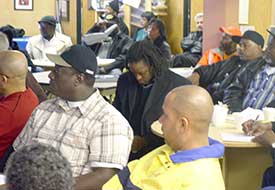
City workers’ summit, Raleigh, N.C.

City workers’ summit, Raleigh, N.C.
Photo: Andrew Dinkelaker

Pushed even further by the workers’ power, the council also voted five to three to waive the $1,000 administrative fee to process the union membership forms.

The Raleigh City Workers Union now has both payroll deduction and meet-and-confer status. It has also won a number of other significant gains through unity and struggle. These include all overtime being paid at time and a half—previously workers were only getting compensatory time and often getting nothing; 15 percent to 20 percent pay increases for entry-level positions citywide; reduced forced overtime; temporary workers made permanent citywide; sick leave policy improvements; some of the worst management forced out and unfair suspensions reversed.

In addition to sanitation department workers, other city workers in Raleigh—from the parks and recreation department, public works and public utilities—are beginning to join the union and attend Raleigh City Workers Union meetings.

Beyond Raleigh, the momentum from these tremendous gains is being felt across the entire state of North Carolina.

More than 60 workers from nine cities across North Carolina attended the Dec. 9 Statewide City Workers Summit. UE Local 150 has established City Worker chapters in Durham, Charlotte, Chapel Hill and Rocky Mount. Recently UE began reaching out to city workers in Wilson, Greenville, Goldsboro and Greensboro, whose leadership attended the summit. At the summit workers spoke out and received important training to build the union.

Durham city workers also staged a several hour work stoppage the morning of Nov. 27 to bring attention to their issues.

The struggle in the South—and North Carolina in particular—is intensifying as workers across the state continue to walk out of their jobs in organized resistance.

From the Fayetteville Goodyear workers striking with the Steel Workers union, from the Smithfield Hog Plant with mostly immigrant workers striking, to all job actions carried out by city workers, the atmosphere is changing.

As Saladin Muhammad, organizer with UE Local 150 and chair of Black Workers for Justice, explains in “Raleigh City Workers Exercise Power and Build Their Union,” his recently released pamphlet: “The anti-union Taft Hartley Act enacted in 1947 during the period of legal segregation established a section (14 b.), allowing states to establish additional laws to complement their racist state laws. The racist oppression of African Americans in the South and the division of Black and white workers was and continues to be the basis for dividing the Southern and larger U.S. working class and maintaining the South as a region of cheap labor.”

Workers are organizing against the brutal anti-worker, anti-woman, racist laws, and a movement has been developing to repeal N.C. General Statute 95-98, which prohibits public-sector collective bargaining.

It is a challenge to the left as a whole to support the demands of Raleigh and other city workers as they struggle for justice.


Copyright © 1995-2006 Workers World. Verbatim copying and distribution of this entire article is permitted in any medium without royalty provided this notice is preserved.

Workers World, 55 W. 17 St., NY, NY 10011
Email: ww@workers.org
Subscribe wwnews-subscribe@workersworld.net
Support independent news http://www.workers.org/orders/donate.php
site promotion

Page printed from:
http://www.workers.org/2006/us/raleigh-1221/

Wednesday, December 13, 2006

Inquiry Sought Over Evangelical Video

Defense Department Asked to Examine Officers' Acts Supporting Christian Group

By Alan Cooperman
Washington Post Staff Writer
Monday, December 11, 2006

WaPo Article

A military watchdog group is asking the Defense Department to investigate whether seven Army and Air Force officers violated regulations by appearing in uniform in a promotional video for an evangelical Christian organization.

In the video, much of which was filmed inside the Pentagon, four generals and three colonels praise the Christian Embassy, a group that evangelizes among military leaders, politicians and diplomats in Washington. Some of the officers describe their efforts to spread their faith within the military.

"I found a wonderful opportunity as a director on the joint staff, as I meet the people that come into my directorate," Air Force Maj. Gen. Jack J. Catton Jr. says in the video. "And I tell them right up front who Jack Catton is, and I start with the fact that I'm an old-fashioned American, and my first priority is my faith in God, then my family and then country. I share my faith because it describes who I am."

Pete Geren, a former acting secretary of the Air Force who oversaw the service's response in 2005 to accusations that evangelical Christians were pressuring cadets at the Air Force Academy, also appears in the video. The Christian Embassy "has been a rock that I can rely on, been an organization that helped me in my walk with Christ, and I'm just thankful for the service they give," he says.

The 10-minute video is on the group's Web site, Christianembassy.com. The organization was founded nearly 30 years ago by the late Bill Bright, who also founded Campus Crusade for Christ. The Christian Embassy Web site says the group holds prayer breakfasts each Wednesday in the Pentagon's executive dining room and organizes small groups to help military leaders "bridge the gap between faith and work."

Army Brig. Gen. Bob Casen refers in the video to the Christian Embassy's special efforts to reach admirals and generals through Flag Fellowship groups. Whenever he sees another fellowship member, he says, "I immediately feel like I am being held accountable, because we are the aroma of Jesus Christ."

The Military Religious Freedom Foundation, a watchdog group led by retired Air Force lawyer Michael L. "Mikey" Weinstein, is requesting an investigation in a letter to the Defense Department's inspector general.

Weinstein, a White House lawyer in the Reagan administration, cites Defense Department regulations barring personnel from appearing in uniform in "speeches, interviews, picket lines, marches, rallies or any public demonstration . . . which may imply Service sanction of the cause for which the demonstration or activity is conducted."

All the officers are identified in the video by their Defense Department positions, "yet the video failed to include any disclaimers indicating that the views expressed were not those of the Department of Defense," the letter says.

It asks whether the officers received permission to promote the Christian Embassy and whether any other religious or secular organizations have been allowed to use Pentagon facilities and uniformed personnel in promotional videos.

Catton said yesterday that he does not remember whether he sought approval to appear in the video, which he said was made in 2005. "If someone asked me today to do it, I for sure would ask permission," said the general, who sparked controversy this year by raising money from fellow officers for a congressional candidate.

Christian Embassy officials in Washington did not return phone messages left at their homes and offices over the weekend.

Air Force Lt. Col. Todd Vician, a Pentagon spokesman, said yesterday that "it is impossible for me or the department to comment on a letter we haven't received yet." Once the letter is in hand, he added, "I'm confident that the inspector general will take the appropriate action."

In 2003, Army Lt. Gen. William G. "Jerry" Boykin drew criticism for appearing in uniform before church groups and saying, in remarks captured on video, that President Bush was "appointed by God," that the United States is "a Christian nation" and that Muslims worship "an idol." The inspector general's office determined that Boykin had not violated any rules, and he remained in a top intelligence post.

This year, Navy chaplain Gordon J. Klingenschmitt was court-martialed for appearing in uniform at a political protest in front of the White House, though he maintained that all he did was lead a prayer.

Weinstein noted that his son and daughter-in-law, who are serving as first lieutenants in the Air Force, received written permission in July to appear in a documentary based on the book "Constantine's Sword," a history of Christian anti-Semitism.

"They may appear on camera for this documentary, but as they will be speaking for themselves, as private citizens, not for the Air Force, they cannot appear in uniform," says the order, a copy of which Weinstein provided to The Washington Post.

Make It Happen: Health Care For All

Jacob S. Hacker
http://www.tompaine.com/articles/2006/12/13/make_it_happen_health_care_for_all.php

December 13, 2006

Jacob S. Hacker is a political science professor at Yale University and fellow at the New America Foundation. His latest book, The Great Risk Shift, analyzes the destruction of America’s economic safety net and offers ways to restore opportunity and security to working-class people. He spoke about his book Tuesday at a discussion sponsored by the Campaign for America’s Future.

In recent years, a “perfect storm” of rapidly rising medical costs, declining median wages, and mounting business desperation about health benefits have produced a dramatic deterioration in the scope and generosity of American health insurance. Meanwhile, runaway health costs have become an increasingly grave threat—not just to family finances, but to corporate America’s bottom line. A decade ago, insistent voices proclaimed that the system was healing itself, that managed care and business vigilance would finally rein in costs, reversing the long-term slide in coverage. No one can believe that today. A system that was barely treading water is now sinking fast.

Americans want this to change. The 2006 midterm was more than a repudiation of the current course in Iraq. It was also an affirmation of the need for government to address the pressing economic concerns of the middle class: above all, the pervasive sense of insecurity that working Americans feel despite the overall growth of the economy. Among nearly every demographic and political group—whites, blacks, women, men, older voters, younger voters, working-class earners, middle-class earners, Democratic and swing voters, and even some reliable Republican voters—there is overwhelming support for providing affordable health care to all Americans. Although Americans like much about U.S. health insurance, dissatisfaction with how present arrangements affect family finances and security is broad, deep, and growing.

These trends are pushing comprehensive reform of U.S. health finance back onto the agenda of American politics, after more than a decade of reluctance to tackle the issue. And yet, nothing guarantees that this looming debate will end differently from past debates. Again and again in the 20th century—most recently, in the early 1990s—efforts to make health insurance an integral piece of the American social fabric have been stymied. The stakes are too high to allow them to be stymied again.

Now is the time, therefore, for advocates of reform to map out their strategies and develop their ideas for providing affordable, quality health care to all Americans. The central goal should be simple, ambitious, and direct—health security for all. The means should be straightforward, too. Rather than coming up with complex “compromise” schemes that try to please everyone (à la the Clinton health plan of 1993) or seeking to turn the entire framework of American health financing upside down overnight, reformers need to think about how they can build on the positive example set by America’s largest, most popular, and most successful health insurance program, Medicare, to provide health security to all Americans without secure workplace coverage.

It would, of course, be more difficult to make the case for change if our antiquated financing structure delivered huge competitive benefits to American business. But who can believe that today? Corporations may have multiple and conflicting views about what should be done, but none is satisfied with the status quo. Most believe that the present system hurts the international competitiveness of multinational companies and creates an unfair competitive playing field at home. Far from hurting business, a proposal for true health security would immensely benefit corporate America, and especially those elements of corporate American most committed to the welfare of their employees. A new social contract laying out the roles of employers, government, and workers is clearly and desperately needed.

This contract must ensure that all workers have access to health insurance, even if their employers decide not to offer it. But it need not eliminate the employer role in health financing altogether. The biggest problem with American health financing is not that employers sponsor coverage. It is that employers decide whether workers get coverage at all. So why not give employers the option of providing low-cost coverage to their workers through a new public program modeled after Medicare? If employers want to provide comparable private coverage, they can. But if they do not provide basic insurance, their workers should be automatically enrolled in the new Medicare-like program, with employers required to make a modest contribution toward its cost. (The self-employed would have the option of purchasing coverage through the program as well—on the same terms as other employers.)

A few years ago, I developed a proposal along these broad lines, and it has been extensively analyzed by the Lewin Group, the leading private firm that does cost and coverage estimates for groups developing reform plans. (Currently, I am developing a revised version of the proposal for the Economic Policy Institute in Washington.) The estimates show that if employers were allowed to purchase public coverage for their workers by paying a modest wage-related premium, roughly half of Americans younger than 65 would be in the new Medicare-like plan and the other half would remain in private insurance. All Americans with direct or family ties to the work force would be guaranteed affordable coverage, at a cost (in 2002 dollars) of around $110 per person in increased health spending.

Expanding public insurance in this way would not eliminate private employment-based insurance. It would simply give employers a new option (while requiring that they make at least a minimal commitment to financing coverage for their workers). In higher-wage firms and unionized industries, companies would still see it as in their interest to provide broad coverage—although some might decide it was better to supplement the new Healthy America program than provide coverage directly. Yet the new framework would ensure that everyone who works has secure health insurance with at least a standard package of benefits, that many more workers have a choice of health plan (including a plan with free choice of doctors and specialists), and that firms that now struggle to provide health benefits, or cannot provide them at all, have an attractive, low-cost option for doing so. Because the public insurance pool would cover nearly half of nonelderly Americans, moreover, it would have strong leverage to bargain for low prices on behalf of covered Americans and their employers.

Labor unions are increasingly attracted to a public-private partnership of this sort. Business groups are another matter, but the idea that they might warm to it is not so far-fetched. After all, this proposal lets employers continue to provide coverage if they want to, preserves a substantial role for private insurance, and saves many companies serious money. At the same time, it ensures that all workers have good, affordable coverage in the public or private sector. That’s the kind of bargain that could give compromise a good name.

Snapshots from School

By Cynthia Peters
http://www.zmag.org/sustainers/content/2006-12/12peters.cfm

"Don't go to the Parent-Teacher Council meeting," advised my daughter, who is a 9th-grader at a large urban high school. "They'll only try to scare you."

I shouldn't have been too surprised at how accurately she summed up at least one salient aspect of the culture at her school. After two days at the orientation for new students, she commented on the school's basic M.O., "I've figured out that they use fear a lot."

We wondered what she meant. Wasn't the school using the orientation as an opportunity to help the kids get to know each other, get acquainted with the school, and gain a measure of comfort before entering the big, scary secondary grades? No, apparently not. What were they doing?

"Well, they explained how we would get an F. And that if we got an F, we would get expelled. But if we got an F+, we could go to summer school to make it up."

The next day, they handed out candies to kids (keep in mind that these are 9th graders) who finished their math worksheets. And so the flip side of punishment made itself apparent, that is, reward.

I suppose it should not be too surprising that a traditional, inner-city school operating on low resources would have too much in its motivator tool box beyond the usual carrot and stick. The accepted mentality about learning, working, or doing just about anything besides watching TV is that it's a bitter pill that must be swallowed. The idea that kids (and adults) might find joy in learning or feel inherent gratification in their work seems to have been beaten out of us by a society that holds out consumption as the main source of satisfaction. A popular radio station in Boston plays music "to help your work day fly by." And that about sums it up. The workday and the school day are something that have to be tolerated, gotten through, survived.

My family has taken an unusual approach to schooling in the past (both of our kids have homeschooled for most of their lives), and so we are naive in this new environment. This commentary is personal and anecdotal -- a reflection on schooling from a family that is new at it.

At back-to-school night, held soon after classes started, we learned something about the way fear and stress operate in schools. Not only were mundane stress-causing devices in place (the mis-firing bell ringing at arbitrary times, which teachers simply talk over; the public broadcasting system mistakenly airing some angry conversation; the limited time between classes -- three minutes in a school that is the size of a very large city block), but the teachers and administrators took every opportunity to raise the specter of failure.

The range of ways you could fail was enormous -- from failing to fill out the proper paperwork to failing to secure a scholarship. Inducing anxiety about the mundane along with the potentially life-changing results in pure anxiety about everything. It's hard to keep perspective about what matters and what doesn't. The school uses back-to-school night to ask parents to ally themselves with teachers against the child.

One guidance counselor, who acted like she was reporting from a subdivision of the police force, held up a piece of paper. "Do you see this?" she asked all the now (and formerly) petrified parents. "This is your paycheck." We stared back blankly. "This is the report card schedule. It will tell you how much you're getting paid. Your child's report card, you see, is the return you'll be getting on your investment. You've invested a lot in your children, and now it's pay-back time!"

She waved the report card schedule with a flourish while the parents waited obediently to try to make sense of what she was saying. I, for one, kept trying to reconcile everything-my-daughter-means-to-me with the idea that the flimsy letter grades that will some day be coming home on a flimsy piece of paper are somehow a form of compensation -- something she owes me.

Years ago, Paulo Freire criticized the banking model of education, whereby teachers treat students like a passive vault that holds knowledge. Teachers put the knowledge in and then get it back out in the form of tests or homework. But the guidance counselor on back-to-school night brought the banking model of education to a whole new level. "You'll be getting a good return on your investment," she said, "if your child brings home As and Bs. But if your child is bringing home Cs," and here, I swear, she wagged her finger at us, "you are not getting the paycheck you deserve."

I don't even believe in grades, and I'm not too fond of traditional schooling, but this lady was scaring me. All the ways I know my kid and feel confidence in her were getting crowded out by fear. People are judged by letter grades, after all, and what if hers aren't good? What if she doesn't get into college? What if she doesn't get a scholarship? What if she fails? What if we fail her by not instilling enough fear in her about her potential failure? What will we do? What will we do? When we got home, I asked to see her notebooks. "The teachers all say we're supposed to be checking your notebooks once a week to ensure you're not getting behind in anything."

She indicated her backpack loaded with binders and 10-pound textbooks. "Feel free," she said nonchalantly, but I could tell she was surprised. We had never checked her work before. We just trusted she was doing her best and would ask if she needed help. This system was working fine. It didn't feel good to change gears and perform this policing function. Nor did I relish the fact that in subsequent weeks, I was starting to ask, "So, how'd you do on that test? How's your grade in biology?" No wonder she didn't want me to go to the Parent-Teacher Council meeting. She could see I was not immune to their fear-inspiring tactics. After years of homeschooling and being outside of traditional, fear-based schooling, her armature against these tactics was perhaps in better condition than mine.

When you participate in an institution, you start traveling down the pathways that the institution offers you. You speak the language because otherwise you won't be understood. The institution of school prepares you for the institution of work and passive citizenship -- key ingredients to maintaining the current power structure. Fear limits your creativity; swinging back and forth between punishment and reward keeps you oriented toward external motivators; arbitrary authority acclimates you to subservience; severe boredom dulls your mind, lowers your expectations, and teaches you how to tolerate life rather than be an agent in it.

Many of the kids graduating from this school will end up in jobs -- either white-collar or blue, where they carry out orders. Perhaps a few will be in positions of power where they make important decisions and give orders. But all will have been trained to think that there is no other way it could be. They will learn, too, that the parameters of the institution allow for occasional random acts of kindness (the next generation's selfless teachers) at one end and extreme acts of evil at the other (the next generation's abusive cops). Systemic evils (war, profiteering, racism, sexism, etc.) will go largely unnoticed because they are the roads we walk, the language we speak, the walls we live inside of everyday. That's what schools teach: the parameters are set. You must operate within them. There's no point in contesting them. Get used to it.

When my daughter failed to note her section number in the designated spot on her art project, she received an F, and the teacher threw the piece away. I emailed the teacher, expressing respect for the challenges of having so many students, but also registering our concern about how demoralizing his tactics were. He did not write back, but he told Zoe the next day that he would give her partial credit for her work. "What does partial credit mean?" I found myself asking her as if that is what mattered. It's not what matters, but there's no other way to engage with her teacher, and so you use the language that is best understood -- that of grades and credit, rather than what matters much more, i.e., creativity, expression, critical thinking, collective engagement, and effort.

And it's not the teacher's fault either. He has about 150 students -- Boston public high schools having a 31-student-per-class maximum. And he functions in the same overly stressed environment with insufficient resources. On the same day he slammed my kid with the F, he had been yelling at the class for wasting paint. Maybe he had hit the wall himself, dealing with the contradictions of being an art teacher in an overcrowded school with not enough money for paint and the asinine job of assigning grades to students' work.

Everyone, then, is required to function according to the norms of the institution. Teachers, too, deal with arbitrary authority (from administrators, state and city budget decisions, work rules, and standardized tests). Then they turn around and dish it out. More examples: Zoe's A in Latin got significantly reduced when the teacher discovered her binder was not properly organized. She almost got a zero on an English test because she had left one question blank. Why? Because she didn't understand the question. But then she heard the teacher announce that leaving any blanks would result in a zero, so she went back to her desk and made up something that she thought would fit. She received full credit, thus learning an important lesson in bullshitting.

Maybe it's not so bad to learn how to bullshit. And maybe we could all use some experience dealing with arbitrary authority and rigid institutional requirements. They are key survival skills. But as parents we should watch out for the ways we help do the school's dirty work. One parent I know got upset because her kid's biology teacher was not keeping up with the assigned pace for moving through the textbook. How would her child do on the mandatory citywide biology test at the end of the year if the teacher didn't keep up? What gets the parent's attention is the teacher's failure to stick to norms. But is anyone asking if the norms make sense?

I find myself feeling appalled at the content in her textbooks. And then I feel appalled that the schools are so underfunded that they don't have enough of them. How contradictory is that? "These textbooks suck, and you should get more of them."

How many other parents, are out there pushing schools to live up to their norms without questioning those norms in the first place?

How many parents are abiding by the terms set by the school system and agreeing to play enforcer at home?

The only teacher I really learned anything from in high school was my AP U.S. history teacher who never made it past the Rosenbergs. He got stuck there because it was a powerful moment in history and it really mattered. I remember how he challenged us to think and how I could tell that that mattered to him more than anything else did. Students were upset with him for failing to put them through their paces. Their AP scores would surely suffer. But I remember -- even at the time -- feeling grateful that he expected me to think. And to think hard.

There is pleasure in thinking hard and using your mind to solve problems you are interested in. That's what I want for my kid -- and for every kid. Not just for its liberatory aspects, but because the survival of the planet probably depends on it.

My daughter is no doubt getting something positive from her school. Many of her teachers genuinely care about the kids and their ability to learn. But the requirements of the institution include the fundamental lessons: Do what you're told. Don't ask why. Accept arbitrary punishment and reward. Reduce your expectations. Nobody said life was fair or fun. You can hold on until the weekend, the next holiday, graduation, a week's vacation from your job, and finally retirement. We all know what happens after that. You die. And the best you can hope for is that it all flew by, like the radio station promises?

Tuesday, December 12, 2006

STATE & FEDERAL PROGRAMS FORCING CHRISTIAN RIGHT ON PRISONERS

NY TIMES - Life was different in Unit E at the state prison outside Newton, Iowa. The toilets and sinks white porcelain ones, like at home were in a separate bathroom with partitions for privacy. In many Iowa prisons, metal toilet-and-sink combinations squat beside the bunks, to be used without privacy, a few feet from cellmates.

The cells in Unit E had real wooden doors and doorknobs, with locks. More books and computers were available, and inmates were kept busy with classes, chores, music practice and discussions. There were occasional movies and events with live bands and real-world food, like pizza or sandwiches from Subway. Best of all, there were opportunities to see loved ones in an environment quieter and more intimate than the typical visiting rooms.

But the only way an inmate could qualify for this kinder mutation of prison life was to enter an intensely religious rehabilitation program and satisfy the evangelical Christians running it that he was making acceptable spiritual progress. The program which grew from a project started in 1997 at a Texas prison with the support of George W. Bush, who was governor at the time says on its Web site that it seeks to cure prisoners by identifying sin as the root of their problems and showing inmates how God can heal them permanently, if they turn from their sinful past. . .

For Robert W. Pratt, chief judge of the federal courts in the Southern District of Iowa, this all added up to an unconstitutional use of taxpayer money for religious indoctrination, as he ruled in June in a lawsuit challenging the arrangement.

The Iowa prison program is not unique. Since 2000, courts have cited more than a dozen programs for having unconstitutionally used taxpayer money to pay for religious activities or evangelism aimed at prisoners, recovering addicts, job seekers, teenagers and children.

Nevertheless, the programs are proliferating. For example, the Corrections Corporation of America, the nation s largest prison management company, with 65 facilities and 71,000 inmates under its control, is substantially expanding its religion-based curriculum and now has 22 institutions offering residential programs similar to the one in Iowa. And the federal Bureau of Prisons, which runs at least five multi-faith programs at its facilities, is preparing to seek bids for a single-faith prison program as well.

Government agencies have been repeatedly cited by judges and government auditors for not doing enough to guard against taxpayer-financed evangelism. But some constitutional lawyers say new federal rules may bar the government from imposing any special requirements for how faith-based programs are audited.

New York Times Article (requires registration)

Another evangelical minister resigns over homosexuality

As far as I'm concerned, this is a non-issue.
These self-loathing men, with their obsessive condemnations of all things homosexual, have made this a hot-button, front-page leader.
They burn in fires of their own making.--Pete

By Melissa McEwan
Posted on December 12, 2006, Printed on December 12, 2006
http://www.alternet.org/bloggers/mcewan/45408/
Here we go again:
In a tearful videotaped message Sunday to his congregation, the senior pastor of a thriving evangelical megachurch in south metro Denver confessed to sexual relations with other men and announced he had voluntarily resigned his pulpit.
A month ago, the Rev. Paul Barnes of Grace Chapel in Doug las County preached to his 2,100-member congregation about integrity and grace in the aftermath of the Ted Haggard drugs-and-gay-sex scandal.

But that didn't stop him from hiding that he's gay until someone called the church claiming to have "overheard a conversation in which someone mentioned 'blowing the whistle' on evangelical preachers engaged in homosexuality, including Barnes." Barnes was confronted and then confessed to "sexual infidelity" before resigning.

I love this response from the associate pastor at Barnes' former church when asked if this situation would "expose the evangelical community to further charges of hypocrisy":

"The criticism is valid if you look at perfection being the mark, because the next person who stands at our pulpit is going to be guilty of not being perfect as well," he said. "Does that mean we have to change what we say about the word of God? We can't do that."

Well, actually, you can. There was a time when the word of God supposedly justified slavery, for instance -- and I bet you're not preaching that these days. But aside from that, it's not what you say that's the problem -- it's more the fact that you're pursuing/supporting discriminatory legislation based on your beliefs, which is predicated on judgment, condemnation, and punishment, all of which are meant to be left up to the Almighty according to the same book you cite as justification for hating on the gays. Just keep your damn noses out of other people's business, and I think you'll find that a lot fewer people give a crap what you say about the word of God from your own pulpit.

Michael Stickings grouses that we'll see the same scenario we always seem to see in these situations: "He'll get away with it. Just like Haggard will. He'll say all the right things. He'll talk of his life-long struggle against sin, of fallen man. He will repent and find redemption, and he will be forgiven, because those in his church cannot bring themselves to admit that homosexuality not only is not a sin but is natural and normal." He'll be "cured," and the church will pretend nothing ever happened and busily get back to trying to ruin the lives of gay people brave enough to live an honest life.

Rinse. Repeat.

(The Reaction)

Melissa McEwan writes and edits the blog Shakespeare's Sister.

© 2006 Independent Media Institute. All rights reserved.
View this story online at: http://www.alternet.org/bloggers/mcewan/45408/

Waxman opens fire on Blackwater …

By Joshua Holland
Posted on December 12, 2006, Printed on December 12, 2006
http://www.alternet.org/bloggers/joshua/45413/

A few months ago I wrote:

If you were to gather together the finest, most creative minds and ask them to come up with a plan to outsource the reconstruction of Iraq that would guarantee shoddy work, overcharges, unfinished projects and overt graft, they would probably devise a system very similar to what U.S. taxpayers have enjoyed -- to the tune of about $30 billion -- for the past three years.

Enter Henry Waxman, incoming chair of the House Government Reform Committee, with a perfect example. He wants to know "why Blackwater USA" -- a premier modern mercenary firm -- "was paid so much for security work in Iraq -- and why, in fact, the North Carolina company was paid at all."

Taxpayers paid exorbitant prices for Blackwater's services, U.S. Rep. Henry Waxman wrote in a letter to outgoing Defense Secretary Donald Rumsfeld…
The California congressman said that Blackwater's services were not just pricey, but prohibited, because the Army never authorized Blackwater or any other Halliburton subcontractors to guard convoys or carry weapons. Houston-based Halliburton has been paid at least $16 billion to provide food, lodging and other support for troops in Iraq, and $2.4 billion to work on Iraqi oil infrastructure.
Waxman demanded "whether and how the Army intends to recover taxpayer funds paid to Halliburton and Blackwater for services prohibited under [Halliburton's] contract." [ht: FireDogLake]

In this instance, Blackwater was a sub-sub-contractor for Halliburton. The way many of these reconstruction deals are structured -- as massive, "bundled," cost-plus contracts -- no firm on the planet has the staff and resources to do the job itself. So instead of awarding dozens of contracts on a competitive basis to firms that specialize in, say, road construction or building sewage treatment plants or convoy security -- an approach that would give smaller, hungrier companies a shot at some of the action -- you take dozens of different jobs and lump them all together in one megaproject.

Then the prime contractor effectively takes over the government's oversight role. And while anti-government types claim that they have a profit motive to ensure efficient service from their sub-contractors, the opposite is true: cost-plus contracts -- contracts that deliver a specified profit margin on top of what the firms pay out to whoever does the actual work -- give the prime contractor a motive to ignore waste and fraud. Consider the case at hand:

At the lowest level, Blackwater security guards were paid $600 a day. Blackwater added a 36 percent markup, plus overhead costs, and sent the bill to a Kuwaiti company that ordinarily runs hotels, according to the contract.
That company, Regency Hotel, tacked on costs and profit and sent an invoice to ESS. The food company added its costs and profit and sent its bill to Kellogg Brown & Root, a division of Halliburton, which added overhead and profit and presented the final bill to the Pentagon.

Got that? The taxpayers shell out hundreds of thousands of dollars to train a soldier. That soldier goes to Blackwater to earn $600 a day working beside (unhappy) grunts making $50. Blackwater adds a chunk and bills a hotel in Kuwait, which adds a chunk and bills a food services company, which in turn adds a chunk and bills Halliburton subsidiary KBR. The taxpayers' have been had coming and going.

And it gets worse…

Tina Ballard, an undersecretary of the Army, testified in September that the Army had never authorized Halliburton or its subcontractors to carry weapons or guard convoys. Ballard testified that Blackwater provided no services for Halliburton or its subcontractors.
Waxman said ESS had sent him a memo saying the food company had hired Blackwater to provide security services under the Halliburton contract.
"If the ESS memo is accurate, it appears that Halliburton entered into a subcontracting arrangement that is expressly prohibited by the contract itself," Waxman wrote. "After more than two years, we still do not know how much ESS and Halliburton charged for these security services."
At a hearing in June, Blackwater vice president Chris Taylor testified that Blackwater's 36 percent markup included all the company's costs. Rep. Christopher Shays, a Connecticut Republican, interrupted, reminded Taylor he was under oath and ordered Blackwater to provide the documents to back up his testimony. Blackwater has not provided any of the contracts and other documents requested by the committee.
In Thursday's letter, Waxman said Taylor's testimony was wrong: Blackwater's contracts posted on The [News and Observer's] Web site showed that Blackwater billed separately for insurance, room and board, travel, weapons, ammunition, vehicles and office space, as The N&O article reported.

But, hey, I hear they've painted some schools.

Joshua Holland is a staff writer at Alternet and a regular contributor to The Gadflyer.

© 2006 Independent Media Institute. All rights reserved.
View this story online at: http://www.alternet.org/bloggers/joshua/45413/

Monday, December 11, 2006

New income figures: richest get even richer


Published Dec 8, 2006 11:03 PM

The old Marxist aphorism is being proven yet again. The rich are getting richer while the poor are getting poorer. In fact, the richest of the rich in the United States are getting wealthier faster than just the merely rich, while people in the bottom 90 percent have basically seen their incomes stagnate over the past 15 years, moving up and down with the economic tides.

The most detailed technical analysis of the income gap comes from two academic economists, Thomas Piketty and Emmanuel Saez, who rely on data released by the IRS. These figures have a two-year lag, but the authors point out that press reports and anecdotal data show the trends established between 1990 and 2004 have if anything intensified over the past two years. (elsa.berkeley.edu/~saez/pikettyqje.pdf)

There was a deep chasm in 2004 between the very wealthy, the people in the top 1 percent whose family incomes averaged $326,270, and the rest of this country. The median family income that year was $43,389, meaning half the population earned less than that, and generally reflected the earnings of two or more people working in the household.

In constant dollars adjusted for inflation, the mean income has actually declined slightly since 1990, even as the incomes of the wealthy have vastly expanded. (wikipedia.org)

From 1990 to 2004, according to Piketty and Saez, the average family income of the top 1 percent of the population grew by 53 percent, while the bottom 90 percent saw their total incomes increase by just 2 percent. But the richer people were, the more their incomes increased. So the top one-tenth of 1 percent—with average family incomes of $2,018,910—enjoyed an increase of 85 percent over the same time period. And, dividing even further, the top one-tenth of that group wallowed in a jump of 112 percent. These top of the top have an average family income of $12,775,016.

This data is very broad and doesn’t catch income disparities based on gender. It doesn’t reflect what has happened to Black people in the United States, who average about 73 percent the income of their white counterparts, according to the Urban League.

It doesn’t distinguish between wage income of workers and the income of capitalists, who get their wealth mostly through various forms of profits. Wages alone put very few people into the top 1 percent. And it is not just income, but ownership of the means of production, that defines who become part of the ruling class.

These figures also don’t reflect the increased costs of housing, health care and education that are leaving so many workers deep in debt.

What the figures do show, however, is that income disparity in the U.S. in recent years has become greater than at any time since 1929—the year the bubble burst and the Great Depression began.

That disaster laid the basis for a huge working class struggle that spurred the formation of industrial unions and eventually won government social programs to alleviate poverty—like welfare, unemployment insurance, the minimum wage and Social Security. While these programs helped workers survive and get a living wage, they did not change the underlying tendency of capitalism to create poles of extreme wealth and extreme poverty, which will continue until another great working class struggle erupts.

E-mail: gdunkel@workers.org


Copyright © 1995-2006 Workers World. Verbatim copying and distribution of this entire article is permitted in any medium without royalty provided this notice is preserved.

Workers World, 55 W. 17 St., NY, NY 10011
Email: ww@workers.org
Subscribe wwnews-subscribe@workersworld.net
Support independent news http://www.workers.org/orders/donate.php

Page printed from:
http://www.workers.org/2006/us/rich-richer-1214/

‘Enhanced’ temporary workers launch ‘enhanced’ fight


Fired & fed up at Illinois Chrysler plant
Published Dec 8, 2006 11:06 PM

Imagine being one of 10,000 people applying for 1,000 jobs. Imagine passing a five-hour written test, an eight-hour manual dexterity and physical ability test, a background check, a medical exam and a grueling interview. Imagine abruptly quitting your current job because the DaimlerChrysler Corporation has informed you that you must report for work immediately—you are one of “the chosen few.”

This was the scenario earlier this year for hundreds of workers in Belvidere, Ill., buoyant at the good fortune of getting a job in auto. Their exhilaration was tempered, to say the least, the day of their orientation. There they were informed that they were being hired as “Enhanced Temporary Employees” (ETEs).

An ETE is paid two-thirds the wage of a permanent hourly production worker. An ETE gets no raises, has no dental or vision coverage, no pension credits and no sick pay. There is no health insurance for eight months, and then it is not the same as that of a permanent, UAW-represented employee.

When ETEs are laid off, they cannot receive supplemental unemployment benefits or be placed in the jobs bank; they have no recall rights; if they work fewer than 40 hours they do not receive short work pay. They have no seniority rights and almost no access to the grievance procedure—and they can be fired for the slightest infraction.

Sexual harassment is rampant; women who complain have been fired. Injuries are commonplace, but injured workers have not been able to collect workers’ compensation, nor can they collect unemployment because they are unable to work. Workers have literally collapsed while working the lines.

The most logical conclusion would be, “They ought to form a union.” Sadly, they are already in a union. They were trapped in a web of deception spun by the DaimlerChrysler Corporation (DCX) with the cooperation of the governor of Illinois and the leadership of the United Auto Workers.

Much media fanfare accompanied the 2005 announcement by DCX that they would be adding 1,000 jobs at the Belvidere assembly plant, with the launch of the Dodge Caliber.

The launch had a hefty price tag—$416 million to retool Belvidere Assembly for the new model. The cost to DCX was reduced by nearly 25 percent with close to $100 million in state “opportunity returns grants.” For 11 months the well-kept secret, never disclosed to future workers nor publicized in the media, was that the burden of further cost reductions would be borne by “the chosen few.”

“Nothing in the contract applies to us,” Kathy Hungness—one of the 800 or so who were actually hired as ETEs—told Workers World. Hired in June and kept in the dark about her temporary status until the last minute, she was terminated in October.

She’s not alone. Some 250 workers have been terminated so far, recently 50 in just one week. They can apply for unemployment, but so far none have seen a check, and they cannot apply for emergency public assistance until their status with unemployment is clarified. They cannot go back to the jobs they gave up, and jobs are hard to find. “We have families to feed,” stated Hungness. “They’re throwing us away.”

Hungness is not just fired, however. She’s fired up and has organized rank-and-file ETEs into the group Enhanced Fight.

Now 150 have joined Hungness in a class-action lawsuit against DCX and the UAW, and more are joining every day. The first organizing meeting of Enhanced Fight was a huge success, with many volunteering for fundraising, membership, phone tree and community-action committees. They hope to have a public protest sometime in the future.

Hungness had a message for this writer, who is a 19-year DCX employee in Twinsburg, Ohio: “If we don’t stand up for our rights that were broken here, this will come to you. Enough of concessions, enough, enough!”

Messages of support for Enhanced Fight can be sent to Sister Hungness at kpsd1968@yahoo.com.


Copyright © 1995-2006 Workers World. Verbatim copying and distribution of this entire article is permitted in any medium without royalty provided this notice is preserved.

Workers World, 55 W. 17 St., NY, NY 10011
Email: ww@workers.org
Subscribe wwnews-subscribe@workersworld.net
Support independent news http://www.workers.org/orders/donate.php

Page printed from:
http://www.workers.org/2006/us/chrysler-1214/

"Let's Impeach The President", by Neil Young

This Modern World's Highly Subjective "Year In Review"


Click On Image For Larger Pic

Friday, December 08, 2006

No relief from the Iraq Study Group


Turmoil in Baghdad and Washington
Published Dec 7, 2006 1:40 AM

The Iraqi resistance continues handing setbacks to U.S. occupation and Iraqi puppet forces. With 10 GIs reported killed on Dec. 3, including deaths from a helicopter crash the Pentagon claims was “mechanical,” official U.S. troop deaths are over 2,900. Car bombings leave Baghdad in turmoil. U.S. forces in Anbar Province once again are striking residential areas with bombs, rockets and artillery, killing children and other civilians although they allege their targets are fighters.

U.S. aggression in Iraq has led to disaster. Most of all, disaster for the Iraqi people. How bad it is was hinted at by outgoing United Nations Secretary General Kofi Annan, who broke a taboo by telling the BBC on Dec. 4 that it is worse now for ordinary Iraqis than under Saddam Hussein. Annan added that U.N. inspectors sent to Iraq could have avoided the war “if they had more time,” that is, if the Bush administration had not been hell-bent to carry out a criminal invasion.

But it is also a disaster for the Bush administration’s original scheme to conquer an entire region, monopolize its resources and use it as a base of expansion. Instead, the invasion and occupation have exposed U.S. political and military weaknesses to the world, in what former President Jimmy Carter calls “one of the greatest blunders that [U.S.] American presidents have ever made.”

Washington has its own kind of turmoil these days as ruling circles there battle over how to cut U.S. losses. Attention is now focused on the upcoming Dec. 6 report from the Iraq Study Group, set up by Congress last March to study ways to change U.S. fortunes in Baghdad.

Led by former Secretary of State James Baker, who is now an adviser to former President George H.W. Bush, and made up of five Republicans and five Democrats, the ISG has become a point of reference for all Washington. According to leaks—which have been frequent in Washington lately—the ISG will offer some compromise programs that add up to a gradual drawback of U.S. combat forces from Iraq, replacing them with U.S. military advisers to the Iraqi puppet troops.

These programs include the possibility of negotiating with Iran and Syria, but also allow U.S. military commanders flexibility to keep U.S. troops in Iraq, as determined by conditions there. It is also unclear how the ISG will impose its program on the administration. But already the news from Iraq is that more U.S. advisers—even though they are not specially trained for the job—are now attached to Iraqi units. (New York Times, Dec. 5)

Iraq out of U.S. control

Revealing U.S. weaknesses are recent statements by U.S. diplomats and officials regarding the bleak prospects that ISG “solutions” will lead anywhere. One of the harshest critiques came from Richard C. Holbrooke, the former U.S. ambassador to the United Nations. Holbrooke is a hard-nosed imperialist diplomat. In 1995 he brokered the Dayton Accords by using threats of continued NATO bombing to force the Yugoslav government to make serious concessions to Washington’s ongoing attempt to break up that country.

Of Iraq, Holbrooke said: “For all the excitement in Washington, this will be decided on the ground in Baghdad. The United States has lost its capacity to shape the events on the ground, regardless of what’s recommended by the commission, regardless of what’s done by the U.S. military and the president.” (Washington Post, Dec. 1)

Strangely enough, one of the warlords who finally realized his Iraq policy had ended in shambles is recently fired Defense Secretary Donald Rumsfeld. In a classified memo written to the White House on Nov. 6, two days before he was dismissed—this one leaked to the New York Times—Rumsfeld noted: “In my view it is time for a major adjustment. Clearly, what U.S. forces are currently doing in Iraq is not working well enough or fast enough.”

Rumsfeld’s memo is a list of often contradictory proposals that create an illusion that he was being flexible, but also indicate how desperate the U.S. position is. Some of the media report that Rumsfeld’s memo was growing closer to the Democratic Party position.

Even Bush had to pay lip service to his problems in Iraq in his Dec. 2 Saturday radio address. “I recognize that the recent violence in Iraq has been unsettling,” he said. “Many people in our country are wondering about the way forward.”

But while Bush talks of more flexibility, his stance is to keep stalling. His public position is that as long as the U.S. has the will to stay, it can “win” in Iraq.

Rep. John P. Murtha (D-Pa.), an ex-Marine officer with close ties to the Pentagon who first raised objections to the Iraq occupation a year ago, called the Iraq Study Group’s plan “unacceptable to me” because it would not begin to withdraw troops immediately. “If it depends on circumstances on the ground, it’s not a lot different than what President Bush is saying,” he told CNN on Nov. 30.

Murtha, who earlier asked the U.S. to pull its forces out of Iraq and into neighboring countries from where it can use air power, is one of the few Democrats in Congress to criticize the ISG. Now in control of Congress, most Democratic Party leaders have avoided taking a strong stand. They deny even thinking about withholding funds from the military—their only lever of power—or of demanding anything more than a lengthy timetable for pulling out troops.

No one can expect quick relief for Iraqis or even for U.S. troops to come from a decision by the Bush administration. The debates playing out in Washington are among forces that are all representatives of U.S. imperialist interests. They can’t find any tactical measures that can be guaranteed to protect those interests, which points to a continuation of the occupation. Only the exhaustion of U.S. forces or a popular upheaval at home against the war can hasten its end.

E-mail: jcat@workers.org


Copyright © 1995-2006 Workers World. Verbatim copying and distribution of this entire article is permitted in any medium without royalty provided this notice is preserved.

Workers World, 55 W. 17 St., NY, NY 10011
Email: ww@workers.org
Subscribe wwnews-subscribe@workersworld.net
Support independent news http://www.workers.org/orders/donate.php

Page printed from:
http://www.workers.org/2006/world/iraq-1214/

Thursday, December 07, 2006

It Had To Happen...

MEANWHILE, OBAMA has blown his cover. The NY Daily News reports his assessment of what happened when cops fired 50 bullets at an innocent man. Using the weasel wording beloved by the Washington establishment, Obama said it "strikes me as excessive."

No one asked him how many bullets into an innocent victim the police should be allowed to shoot, but added that the police operate with restraint 99 percent of the time.

And this is a guy from Chicago.

Wednesday, December 06, 2006

Hugo Chávez beats the spread

By Joshua Holland
Posted on December 4, 2006
http://www.alternet.org/bloggers/joshua/45097/

It looks like Evan beat me to the punch here (I'm apartment hunting and have a bad internet connection), but let me add a couple of points.

Two weeks ago, the Washington Post was managing expectations leading up to yesterday's presidential elections in Venezuela. "Setbacks" for Venezuelan president Hugo Chávez, the WaPo's Juan Forero told us, were emboldening the opposition. While Chávez led most polls by at least 15-20 points, "there [were] signs the government is anxious about a strong showing by the opposition." The implication was that a win by, say, ten percentage points would have represented a rebuke of Chávez' policies.

It was a variation on a familiar theme about What Elections In Latin America Really Mean, and it goes like this: everything in Latin American politics is a reflection on Hugo Chávez' style. There are no issues that move voters from Mexico to Brazil except for Chávez' populism and ideological clashes with the United States. Whenever a candidate to the left of Pinochet loses -- anywhere -- it's because the people have renounced Hugo's divisive brand of neo-socialism. At the same time, any win for a candidate on the left only resulted because he or she distanced him or herself from Chávez. So, while an American president who takes 51 percent of the vote has a mandate -- elections matter, we're told -- a Chávez victory in anything less than a landslide is actually a defeat for his Bolivarian revolution. Ho hum.

Anyway, it looks like Chávez beat the spread; with 78 percent of the votes counted, electoral authorities announced last night that Chávez had won 61.3 percent of the vote to 38.4 percent for his opponent Manuel Rosales. That's slightly higher than Chávez last win, but within the same 60 percent range that he's gotten in 1998, 2000 and 2004.

Rosales, who ran a tough campaign and got in some good shots on Chávez where he was weakest -- on Venezuela's high level of violent crime and on the charge that Hugo is too concerned with foreign policy -- conceded to Chávez without charging fraud, an unusual move for the Venezuelan opposition (this election was watched by hundreds of independent monitors from the U.S., Latin America and Europe).

There are isolated reports of opposition gangs attacking celebrating Chavistas, but overall the opposition looks as if its handling its loss reasonably well. That's important, as some observers warned (scroll down to November 21 entry) that a coup might immediately follow a Chávez win. Crucial to the plans that were allegedly hatched by some members of the opposition -- with Washington's backing -- would be the emergence of widespread allegations of fraud, leading to massive street protests culminating in an "Orange Revolution" scenario. But with Chávez' margin of victory over 20 points, the losing candidate stopping short of declaring fraud and election monitors reporting few significant problems, that dog is unlikely to hunt.

As in previous elections, yesterday's vote will leave Chávez in a stronger position, and he's promised to redouble his efforts to redistribute Venezuela's impressive wealth. We'll hear a lot about why the opposition lost -- they weren't organized, or they came together too late or the government spent tons of money on Chávez' campaign. The truth is that Chávez won because the Venezuelan people are more hopeful than they've been in past elections, the economy is booming, the private sector is adding jobs at a breakneck rate, poverty has fallen dramatically and the opposition' promises apparently were not credible for six out of ten Venezuelan voters.

In the coming weeks, we'll likely hear quite a bit about Chávez' talk of changing the Venezuelan Constitution to allow him to seek re-election in 2013. It's just talk so far, and a change would require a national referendum on a new Constitution. I oppose it in principle -- 15 years is plenty of time in office for any one individual -- but if it were to come about with the consent of the majority of the Venezuelan people in a free and fair vote, well, that's just democracy.

Joshua Holland is a staff writer at Alternet and a regular contributor to The Gadflyer.

© 2006 Independent Media Institute. All rights reserved.
View this story online at: http://www.alternet.org/bloggers/joshua/45097/

Dispatch From BushCo's Police State

As Economic Crisis Grows
Published Dec 5, 2006 10:37 PM

The Nov. 25 police shootings of three unarmed young African-American men in Queens, N.Y., continue to evoke deep-seated feelings of righteous anger and distrust towards the New York Police Department and the city administration.

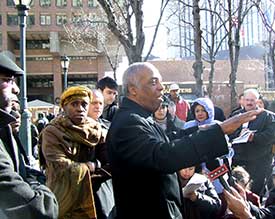
Charles Barron speaks to the media Dec. 4
on rampant police brutality in NYC.
Viola Plummer is to his left.
WW photo: Monica Moorehead

Several undercover police officers emptied 50 bullets into a moving car at 4 a.m., resulting in the death of 23-year-old Sean Bell and the wounding of two of his friends: Joseph Guzman, shot 11 times, and Trent Benefield, shot three times. The three men were leaving a bachelor party for Bell, who was scheduled to be married later that same day, when they were confronted by plain-clothes police.

Guzman and Benefield were reportedly handcuffed to their hospital beds before they were operated on for their wounds.

These tragic shootings are the latest in a long list of deadly police shootings of Black, Latin@ and Asian people in New York over several decades. Similar to many other urban areas, the police in this city are viewed as a repressive, occupying force that follows up racial profiling with terror, especially in the working-class communities of color.

Police who carry out acts of brutality against people of color are very seldom brought up on felony charges, much less indicted. District attorneys put enormous pressure on grand juries to find some excuse to let the police off the hook.

Since the police are central to the criminal justice system, the laws are written to protect them and not the people victimized by them. In the case of the Nov. 25 shootings, the police involved have been put on administrative leave but are still on the payroll.

Black activists call for citywide protest

On Dec. 4, leaders of the Brooklyn-based December 12 Movement along with City Councilperson Charles Barron held a press conference at One Police Plaza, the headquarters of the NYPD. The main purpose of this event was to announce the first in a series of protests to “Resist Fascism and the Rise of the American Police State,” to be held Dec. 6 at One Police Plaza.

Attorney Roger Wareham from D12 stated that the protest had been planned for a month in response to increased complaints of police abuse. He characterized Bell’s death as an “execution.” The protest will demand the firing of Police Commissioner Raymond Kelly and Assistant Police Chief Anthony J. Izzo, head of the NYPD’s Organized Crime Control Bureau.

Councilperson Barron spoke on how the city is running out of chances to stop an angry explosion of Black people, who are fed up with police brutality. Barron recalled the many Black people who have been killed by the cops but never received any kind of justice—that is, no police were sent to jail—including Eleanor Bumpurs, Malcolm Ferguson, Timothy Stansbury Jr., Amadou Diallo and Patrick Dorismond.

Barron answered critics who stated that the shootings of Bell, Guzman and Benefield were not racially motivated because two of the cops involved were also Black. “The victims’ having Black skin makes the shootings racist. Race is alive and well in New York City,” he said.

He went on to say that just because certain Black people hold high positions, like U.S. Supreme Court Justice Clarence Thomas or former NYPD Police Commissioner Benjamin Ward, doesn’t mean that institutionalized racism is over. Barron called for all grand juries that focus on police killings to be made public.

Viola Plummer, a leader of D12 and a former political prisoner, stated, “Unless the people take over the reins of power on a federal, state and local level, the fascistic nature of the state will not abate.” She also talked about how the so-called war on terror was just another excuse to target Muslims, Arabs and South Asians along with Black, Latin@, poor and working people.

Police repression and economic crisis

The Nov. 25 shootings not only impacted the lives of Bell, Guzman and Benefield and their families and friends but the larger Black community throughout every borough in New York.

Gentrification is deepening in Harlem and Brooklyn, driving out the poor to make room for the wealthy and affluent; unemployment and underemployment are intensifying poverty and despair, especially for young people, with the unemployment rate for young Black men in New York close to 50 percent; students of color are dropping out of school at astronomical rates while the police treat them like criminals; hospitals and clinics are closing their doors, especially in the poorest areas. It is no coincidence that police brutality and occupation have become even more omnipresent.

These deplorable conditions are part of the overall assault on workers’ rights, including low wages, disappearing pensions, little to no health care, speed-ups, layoffs, the demonizing of immigrant workers and much more.

The police exist as an armed force separate and apart from the people to keep order on behalf of the wealthy owners of industry, banking and commerce. Maintaining “order” means using all kinds of repressive measures to keep the masses down and divided.

Poverty, racism and suffering have sown the seeds of rebellion, as history has shown. The police and the class interests they protect fear the rebellions that are sure to come—whether they are in the oppressed communities or during a strike. This makes it even more important for working people and progressive movements to come out in solidarity with the oppressed communities to fight against police brutality wherever it rears its ugly head.

E-mail: mmoorehead@workers.org


Copyright © 1995-2006 Workers World. Verbatim copying and distribution of this entire article is permitted in any medium without royalty provided this notice is preserved.

Workers World, 55 W. 17 St., NY, NY 10011
Email: ww@workers.org
Subscribe wwnews-subscribe@workersworld.net
Support independent news http://www.workers.org/orders/donate.php


Page printed from:
http://www.workers.org/2006/us/police-brutality-1214/

Tuesday, December 05, 2006

Despite protests, bear hunt still set for Friday, Saturday

You'll notice that AP didn't feel the need to reveal that the "hunt" would be taking place on a national wildlife refuge until the end of the piece.--Pete

By the Associated Press SUFFOLK, Va. -- A black bear hunt in 21,000 acres of the Great Dismal Swamp will proceed as planned Friday and Saturday, despite opposition from animal rights groups, officials said.

In Defense of Animals and the Animal Welfare Institute have sought to cancel the hunt with a letter-writing drive and online petition.

The two groups sent a 14-page letter, along with the American Environment Foundation, on Tuesday to the U.S. Department of Fish and Wildlife. In it, they wrote that the U.S. Department of Fish and Wildlife "failed to comply with proper procedures and has ignored its duties under federal law to evaluate the environmental impacts of the hunt."

John Stasko, a refuge supervisor for the U.S. Fish and Wildlife Service, said the department will review the letter but go forward with the hunt. He said the department followed federal law and has provided information to the groups regarding its environmental assessment studies.

Stasko also said the groups had an opportunity over the last three years to raise objections but launched a final-week attempt to stop the hunt.

Suzanne Baird, the manager for the Great Dismal Swamp National Wildlife Refuge, has said the refuge worked with biologists and concluded that the hunt "won't be a significant impact to the population" of black bears.

One-hundred hunters were selected through a lottery for the right to kill 20 bears. The hunt does not extend to the North Carolina portion of the refuge.

Monday, December 04, 2006

Fishin' For Nazis!

Via Alternet

http://www.alternet.org/blogs/video/45079/

In the wake of this latest episode of cowardly behavior by American bigots, liberal DC talk show host Jerry Klein ripped the proverbial sheet off a number of heads with his on-air modest proposal to force Muslims to wear crescent armbands or to simply tattoo them.

Listeners, unable to comprehend their own Nazi sympathies, piled on. From Rock Strongo:

"Not only do you tattoo them in the middle of their forehead but you ship them out of this country ... they are here to kill us."
Another said that tattoos, armbands and other identifying markers such as crescent marks on driver's licenses, passports and birth certificates did not go far enough. "What good is identifying them?" he asked. "You have to set up encampments like during World War Two with the Japanese and Germans."

Then, after listening to earnest statements like this for 30 minutes, not to mention at least one caller outraged by the prospect, Klein came clean (I've condensed the show to a 7-minute segment you can listen to or download below the video above. It contains the proposal, a caller, and the revelation...):

"I can't believe any of you are sick enough to have agreed for one second with anything I said. For me to suggest to tattoo marks on people's bodies, have them wear armbands, put a crescent moon on their driver's license on their passport or birth certificate is disgusting. It's beyond disgusting.
Because basically what you just did was show me how the German people allowed what happened to the Jews to happen ... We need to separate them, we need to tattoo their arms, we need to make them wear the yellow Star of David, we need to put them in concentration camps, we basically just need to kill them all because they are dangerous."

Sunday, December 03, 2006

Stop the bloodbaths!

By Nikos Raptis, ZNet
http://www.zmag.org/sustainers/content/2006-11/24raptis.cfm

The (latest and current) bloodbaths are: 9/11, Afghanistan, Iraq, Palestine, Madrid bombing, London bombings, Lebanon, Gaza (again), ...

The killing of Americans, British, Spaniards, and other Westerners by non-Americans is called "terrorism".

The killing of non-Americans by Americans, British, and other Westerners is called "war on terror".

Bush (the Second) stated that the non-Americans (mostly the Arab Muslims) started the bloodbaths because they hate the Americans for being free, democratic, etc.

Assuming that humans are rational, there is no doubt that they wish that the bloodbaths should stop. Also, being rational, they wish to stop the killing without using violence.

George W. Bush (and his collaborators) claim that the only way to stop the bloodbaths perpetrated by the "terrorists" is through violence (even preemptive violence).

The "terrorists" claim that as long as the American Government (et al) are murdering their children they are obliged to retaliate by kill ordinary Americans (and their "willing" collaborators).

But, does the American Government kill Arab children, etc? And, if it does, are the ordinary Americans aware of these killings. An effort to answer both questions was made in previous (ZNet) Commentaries starting with the one of December 13, 2001. The answer to both questions, then, was that: Yes! They are aware. The results of the US congressional elections confirm that this claim is correct. The US elites and their collaborators (Israelis, British, Australians, etc) kill innocent people and the ordinary Americans are aware of it.

So, how do we (all the peoples of the World) put an end to the bloodbaths?

Let us start with the (ordinary) Americans: "If there was ever a time for [the US] to look closely at itself in the mirror, now is the time... Shame on us if we don't have a very aggressive debate about what we should be... We need to take responsibility as a people..." Who uttered these words is irrelevant. If an individual states that 2 plus 3 equals 5 the truth of the statement supercedes the education, the profession, etc of the individual.

The above quoted statement, after replacing [the US] with the correct original word "Louisiana", belongs to Mitch Landrieu, the lieutenant governor of Louisiana and the occasion was a meeting funded by the United Engineering Foundation and organized and hosted by the American Society of Civil Engineers, the Georgia Institute of Technology, and several other universities in the region to discuss the rebuilding of New Orleans.

What would the ordinary Americans see in the mirror, if they were to decide to look in it? They would see a people that did not react MASSIVELY:

- When Madeleine Albright, after killing half a million Iraqi infants (through Clinton's embargo), said: "We think it was worth it."

- When Barbara Bush, mother of George W. Bush, said that the New Orleans blacks were lucky to be in the luxury of the "Louisiana Superdome", after Katrina drove them away from their miserable homes.

- When the son of Barbara said that only 35,000 Iraqi civilians were killed (obviously, an insignificant number) and that the number of 650,000 of Johns Hopkins University was inaccurate.

One could argue that the ordinary Americans did react massively with their votes on November 7. Or, even, that Johns Hopkins is an American university that had the moral power to come up with the above number. The answer to this is that the reaction of the ordinary Americans has to be deep. Very deep! Not the rather shallow (if not irrelevant) "traditional" electoral process, no matter how praiseworthy the Johns Hopkins report.

But let us now turn to the other side, the (so-called) "terrorists". There are two kinds of them. To the first kind belong those that hit towers, bomb subways, etc. To the second kind belong those that resist a foreign force that invades and occupies their country. Therefore, the term "terrorists" does not apply to them. For example, in (the brutal) reality of Iraq they should be considered Resistance Fighters (comparable to the Resistance Fighters against he Nazis during the Second World War).

Historically it has been proven that the first kind, who indiscriminately kill civilians, etc, are nothing but "assistants" to the murderous dominant powers. If there was no 9/11, Bush (the second) would have been non-existent, Ashcroft would not have released his religiously psychotic "patriotisms", Rumsfeld would have impressed with his virile postures no one but the ladies of his local Christian congregation, Rove, etc, etc.

So, if the first kind of reaction (through indiscriminant killing) is not only immoral but also helps the murderous dominant powers, then what can those harmed by them do? The only answer is found in the overwhelming power that resides in the number (the massive number) of the women and the men of the world.

The ordinary Americans have this power and they have the moral duty to use it in order to bring about a deep, a very deep, change. This duty becomes even more imperative due to the fact that they are free to exercise it. A freedom that in reality does not exist in other "democracies".

This very deep change will be accomplished by bringing to justice the war criminals: Bush, Blair, Cheney, Rumsfeld, Wolfowitz, Rove, Rice, and the rest of the murderous individuals who were responsible for the killing, raping, and torturing of hundreds of thousands of humans.

What is important is not which will be the tribunal that will judge them, or how this is going to be accomplished, or if there are legal "tools" available. What is of paramount importance is that the American women and men should make known to the war criminals that they DEMAND their punishment. The use of terms as the International Criminal Court (of Rome), the Geneva Accords, etc only weaken the effort. There is a single word that describes in the most powerful and most accurate way the (moral) intentions of the women and men not only of America but of the entire word. The word is: NUREMBERG! This should be the motto for all of us. Nuremberg for all the war criminals and their minions.

The first step has already been taken!

A few days ago (on November 14, 2006), German and American lawyers "asked a German prosecutor to investigate Secretary of Defense Donald Rumsfeld on allegations of war crimes..." [International Herald Tribune, Nov. 15, '06]. It is up to ALL of us to elevate this moral struggle to a higher level and not let it become only "a lingering irritant" for Rumsfeld, "who is soon to lose the legal protection of his cabinet post...should he decide to travel overseas as a private citizen..." [IHT, page 8]

However, this effort should aim even higher than Nuremberg. The American people and the rest of the world should find the moral courage to face the fundamental problem between them:

- The American people should apologize to the world for the grave crimes that the American Governments have been committing against the peoples of the world (at least) for the last 60 years, in the name of the American people.

- The peoples of he world who have been harmed by the American Governments should accept this apology and should declare that they will stop exercising active Resistance by violent means against the Americans and their collaborators.

Thus, without "terrorism" as a weapon in the hands of Bush (and any future Bush) to terrorize the ordinary Americans this could become a more peaceful and moral world. [Note 1: To be really successful, an effort to stop the bloodshed should take into account the following tragic and unbelievable fact: "By the beginning of the 1990s the income of those in the top 20 percent worldwide was almost 60 times as much as the income of those in the bottom 20 percent". (This according to the Worldwatch Institute). However, I am told that the correct number is close to 600 or 700 times!]

[Note 2: The Katrina case of New Orleans is equally instructive as the numbers in the above Note 1. An estimated 460,000 pre-Katrina residents have not returned. "Nearly 79,000 families have applied to the $7.5 million program to rebuild Louisiana. Only 1,721 have been told how much grant money they will receive. And just 22 have received access to the cash, which was provided by federal taxpayers..." (New York Times, Nov. 11, '06). Meanwhile, $ 32.5 million were spent to restore the Louisiana Superdome (of Barbara Bush fame). Finally, it is reasonable to wonder if, as an adult, Rumsfeld has ever thought how much human misery could have been eliminated with the money he spends for a single week in Iraq? End of Notes.]

Hatred of Muslims Runs High in U.S.

REUTERS - When radio host Jerry Klein suggested that all Muslims in the United States should be identified with a crescent-shape tattoo or a distinctive arm band, the phone lines jammed instantly. The first caller to the station in Washington said that Klein must be "off his rocker." The second congratulated him and added: "Not only do you tattoo them in the middle of their forehead but you ship them out of this country ... they are here to kill us."

Another said that tattoos, armbands and other identifying markers such as crescent marks on driver's licenses, passports and birth certificates did not go far enough. "What good is identifying them?" he asked. "You have to set up encampments like during World War Two with the Japanese and Germans."

At the end of the one-hour show, rich with arguments on why visual identification of "the threat in our midst" would alleviate the public's fears, Klein revealed that he had staged a hoax. . . "I can't believe any of you are sick enough to have agreed for one second with anything I said," he told his audience on the AM station 630 WMAL, which covers Washington, Northern Virginia and Maryland

"For me to suggest to tattoo marks on people's bodies, have them wear armbands, put a crescent moon on their driver's license on their passport or birth certificate is disgusting. It's beyond disgusting. Because basically what you just did was show me how the German people allowed what happened to the Jews to happen ... We need to separate them, we need to tattoo their arms, we need to make them wear the yellow Star of David, we need to put them in concentration camps, we basically just need to kill them all because they are dangerous.". . .

A Gallup poll this summer of more than 1,000 Americans showed that 39 percent were in favor of requiring Muslims in the United States, including American citizens, to carry special identification. Roughly a quarter of those polled said they would not want to live next door to a Muslim and a third thought that Muslims in the United States sympathized with al Qaeda, the extremist group behind the September 11, 2001, attacks on New York and Washington.