In the battle for fairness, the Federal Marriage Amendment suffered a resounding defeat this morning in the U.S. Senate.
Not only did not a single Senator from the compromised left buckle to pressure and advertising campaigns from right-wing groups to switch their vote, but we gained two Senators, Senators Gregg (R-NH) and Specter (R-PA), who voted the other way in 2004.
President Bush and the Republican leadership gambled their dwindling political capital on a discriminatory amendment and came up empty.
To read the coverage in the press, visit http://www.hrc.org/voteno/headlines.htm.
Thursday, June 08, 2006


Wednesday, June 07, 2006
Sunday, June 04, 2006
Tomdispatch Interview: Ehrenreich, The Prey and the Predators
A Guided Tour of Class in America
A Tomdispatch Interview with Barbara Ehrenreich
You turn into a middle-class, suburban housing project on the periphery of Charlottesville, Virginia, and at a row of attached homes, you pull up in front of the one with the yellow "for sale" sign on the tiny patch of grass. Ushered inside, you take in an interior of paint cans, a mop and pail, and cleaning liquids. On the small porch that overlooks a communal backyard, workmen are painting the weathered wood railings a nice, clean white. Later, when they're gone, we step out for a minute, on a balmy late spring afternoon, and she says, "You know what I need out here? Flowers!" And it's true, the nearest neighbor's small porch is a riot of red, orange, and purple blooms, while hanging from her railing are three plant holders with only dirt and the scraps of dead vegetation in them.
Not surprising really. Barbara Ehrenreich, our foremost journalist of, and dissector of class is regularly not here. Practically a household name since she entered the low-wage working class disguised as herself and, in her already classic account, Nickel and Dimed, reported back on just how difficult it is for so many hard-working Americans to get by. Then, a few years later, she repeated the process with the middle class, only to find herself not in the workforce but among the desperately unemployed who had fallen out of an ever meaner corporate world. Her most recent book, Bait and Switch, The (Futile) Pursuit of the American Dream, was the result. Now, she spends much time traveling the country talking to audiences about her -- and their -- experiences. She has become a blogger, is involved in launching a new group to help organize the middle-class unemployed, and in her spare time she's even finished a new book.
Now, after four years in Virginia (at least some of the time), she's about to head north. She gestures at the bookshelves. "There are a lot fewer books this week than last. I'm giving them to the Virginia Organizing Project." And it's true, the place is clearly being stripped down for sale. But you have the feeling, looking around, that it was a no-frills life to begin with, as Ehrenreich herself, in her short hair, jeans, T-shirt, and sneakers, presents a distinctly no-frills look. (Suddenly, imagining her with an image make-over advisor in Bait and Switch trying to give herself that perfect corporate look of employability seems amusing.)
Her mind is wide-ranging and daring indeed. Some years back, in a book entitled Blood Rites, she even managed to turn traditional ideas about the origins of war on their head. She is a thoroughly no-nonsense national resource.
Looking forward to a trip to the local gym followed by a visit with her two grandchildren (the daughters of her daughter Rosa Brooks, a law professor and columnist for the Los Angeles Times), we sit down at a paper-and-book cluttered dining-room table, which shows no evidence of having held a meal in some time, and -- eye on the clock, no fooling around -- begin.
Tomdispatch: You were at a graduation ceremony recently where the students were bouncing beach balls in the stands. The college president leaned over and whispered, "This is the problem with having the commencement in the afternoon. Some of these people have been partying for hours." In response, you wrote: "There are reasons, whether the graduates know them or not, to want to greet one's entrance into the work world with an excess of Bud." Could you start by explaining why an excess of Bud might be an appropriate response to leaving college today?
Barbara Ehrenreich: Well, a lot of graduates are simply not going to find jobs appropriate to their credentials. They're going to be wait staff. They're going to be call-center operators. Their twenties could be spent like that. I recently got Jared Bernstein of the Economic Policy Institute to do some research on this. It's still tentative, but he found that 17% of people in jobs that do not require college degrees have them. Those are very often people in their twenties who can't get professional-type employment, or people in their fifties who have been through one too many lay-off and are no longer employable because they're quote too old. So I was thinking of that, and then I was thinking that for a lot of those who do get jobs, you know, the fun is over. They're going to be sitting in cubicles and they won't be able to bounce balls around when they're in boring meetings with their bosses.
TD: The real earnings of college graduates fell by 5% between 2000 and 2004, so they also have that to look forward to.
Ehrenreich: There still is a real big earnings gap between college and non-college graduates, but it's begun to shrink. Jared tells me that the reason it was growing so fast in the nineties was not that college graduates were doing so well, but that low-wage people, blue-collar people, were doing so poorly. Their wages were being held down -- and that remains true.
TD: In 1989, you published a book about the middle class, or the professional-managerial class as you call them, entitled Fear of Falling. The book was way ahead of its time. If you were titling a work on the subject today you might just call it, Falling.
Ehrenreich: What I was thinking about then was the fear of intergenerational falling, the fear a lot of upper-middle class people have that their children will not get into the same class, because you can't just bequeath your class status to them. They can't inherit. They have to go through this whole education thing. Now, it could be Free Fall, though it isn't quite that bad… yet.
TD: In Bait and Switch, the book where, as an investigative reporter, you sought a corporate job and found yourself in the world of the middle-class unemployed or anxiously employed, you wrote, "On many fronts, the American middle class is under attack as never before." What happened to the middle class between then and now?
Ehrenreich: In Fear of Falling, I was concerned with the distance between the professional managerial class and the traditional working class. I thought I saw a new class developing. The strict Marxist idea is: You've got the bourgeoisie. Everybody else is a wage earner and they're not that different, whether they're accountants or laborers. And I was saying, no, there's a real difference here. The white-collar worker who sits at a desk is telling other people what to do in one way or another. Such workers are in positions of authority when compared to blue and pink-collar people.
Back then, I was emphasizing the differences. Today, in Bait and Switch, what I'm emphasizing is the lack of difference, that the security the professional-managerial class thought it had is gone. The safest part of that class, when I was writing in the eighties, seemed to be the professionals and managers with corporate positions. Then something happened in the nineties. Companies began to look at even those people as expenses to be eliminated rather than assets to be nurtured. What I was seeing in the late eighties was this pretty tight middle class where, really, the only problem was to get your kids into it, too.
Much More here...
A Tomdispatch Interview with Barbara Ehrenreich
You turn into a middle-class, suburban housing project on the periphery of Charlottesville, Virginia, and at a row of attached homes, you pull up in front of the one with the yellow "for sale" sign on the tiny patch of grass. Ushered inside, you take in an interior of paint cans, a mop and pail, and cleaning liquids. On the small porch that overlooks a communal backyard, workmen are painting the weathered wood railings a nice, clean white. Later, when they're gone, we step out for a minute, on a balmy late spring afternoon, and she says, "You know what I need out here? Flowers!" And it's true, the nearest neighbor's small porch is a riot of red, orange, and purple blooms, while hanging from her railing are three plant holders with only dirt and the scraps of dead vegetation in them.
Not surprising really. Barbara Ehrenreich, our foremost journalist of, and dissector of class is regularly not here. Practically a household name since she entered the low-wage working class disguised as herself and, in her already classic account, Nickel and Dimed, reported back on just how difficult it is for so many hard-working Americans to get by. Then, a few years later, she repeated the process with the middle class, only to find herself not in the workforce but among the desperately unemployed who had fallen out of an ever meaner corporate world. Her most recent book, Bait and Switch, The (Futile) Pursuit of the American Dream, was the result. Now, she spends much time traveling the country talking to audiences about her -- and their -- experiences. She has become a blogger, is involved in launching a new group to help organize the middle-class unemployed, and in her spare time she's even finished a new book.
Now, after four years in Virginia (at least some of the time), she's about to head north. She gestures at the bookshelves. "There are a lot fewer books this week than last. I'm giving them to the Virginia Organizing Project." And it's true, the place is clearly being stripped down for sale. But you have the feeling, looking around, that it was a no-frills life to begin with, as Ehrenreich herself, in her short hair, jeans, T-shirt, and sneakers, presents a distinctly no-frills look. (Suddenly, imagining her with an image make-over advisor in Bait and Switch trying to give herself that perfect corporate look of employability seems amusing.)
Her mind is wide-ranging and daring indeed. Some years back, in a book entitled Blood Rites, she even managed to turn traditional ideas about the origins of war on their head. She is a thoroughly no-nonsense national resource.
Looking forward to a trip to the local gym followed by a visit with her two grandchildren (the daughters of her daughter Rosa Brooks, a law professor and columnist for the Los Angeles Times), we sit down at a paper-and-book cluttered dining-room table, which shows no evidence of having held a meal in some time, and -- eye on the clock, no fooling around -- begin.
Tomdispatch: You were at a graduation ceremony recently where the students were bouncing beach balls in the stands. The college president leaned over and whispered, "This is the problem with having the commencement in the afternoon. Some of these people have been partying for hours." In response, you wrote: "There are reasons, whether the graduates know them or not, to want to greet one's entrance into the work world with an excess of Bud." Could you start by explaining why an excess of Bud might be an appropriate response to leaving college today?
Barbara Ehrenreich: Well, a lot of graduates are simply not going to find jobs appropriate to their credentials. They're going to be wait staff. They're going to be call-center operators. Their twenties could be spent like that. I recently got Jared Bernstein of the Economic Policy Institute to do some research on this. It's still tentative, but he found that 17% of people in jobs that do not require college degrees have them. Those are very often people in their twenties who can't get professional-type employment, or people in their fifties who have been through one too many lay-off and are no longer employable because they're quote too old. So I was thinking of that, and then I was thinking that for a lot of those who do get jobs, you know, the fun is over. They're going to be sitting in cubicles and they won't be able to bounce balls around when they're in boring meetings with their bosses.
TD: The real earnings of college graduates fell by 5% between 2000 and 2004, so they also have that to look forward to.
Ehrenreich: There still is a real big earnings gap between college and non-college graduates, but it's begun to shrink. Jared tells me that the reason it was growing so fast in the nineties was not that college graduates were doing so well, but that low-wage people, blue-collar people, were doing so poorly. Their wages were being held down -- and that remains true.
TD: In 1989, you published a book about the middle class, or the professional-managerial class as you call them, entitled Fear of Falling. The book was way ahead of its time. If you were titling a work on the subject today you might just call it, Falling.
Ehrenreich: What I was thinking about then was the fear of intergenerational falling, the fear a lot of upper-middle class people have that their children will not get into the same class, because you can't just bequeath your class status to them. They can't inherit. They have to go through this whole education thing. Now, it could be Free Fall, though it isn't quite that bad… yet.
TD: In Bait and Switch, the book where, as an investigative reporter, you sought a corporate job and found yourself in the world of the middle-class unemployed or anxiously employed, you wrote, "On many fronts, the American middle class is under attack as never before." What happened to the middle class between then and now?
Ehrenreich: In Fear of Falling, I was concerned with the distance between the professional managerial class and the traditional working class. I thought I saw a new class developing. The strict Marxist idea is: You've got the bourgeoisie. Everybody else is a wage earner and they're not that different, whether they're accountants or laborers. And I was saying, no, there's a real difference here. The white-collar worker who sits at a desk is telling other people what to do in one way or another. Such workers are in positions of authority when compared to blue and pink-collar people.
Back then, I was emphasizing the differences. Today, in Bait and Switch, what I'm emphasizing is the lack of difference, that the security the professional-managerial class thought it had is gone. The safest part of that class, when I was writing in the eighties, seemed to be the professionals and managers with corporate positions. Then something happened in the nineties. Companies began to look at even those people as expenses to be eliminated rather than assets to be nurtured. What I was seeing in the late eighties was this pretty tight middle class where, really, the only problem was to get your kids into it, too.
Much More here...
Saturday, June 03, 2006
Today's Quote
"Enough details have emerged from survivors and military personnel to conclude that in the town of Haditha last November, members of the 3rd Battalion, 1st Marine Regiment perpetrated a massacre. The killings may have been in retaliation for the death of a Marine lance corporal, but this was not the work of soldiers gone berserk. The targets (children from 3 to 14, an old man in a wheelchair, taxi passengers), the hours-long duration of killings, the number of Marines involved, the careful mop-up--all amount to willful, targeted brutality designed to send a message to Iraqis. As Representative John Murtha has pointed out, the patently false story floated afterward, blaming the killings on roadside bombs, and Marine payoffs to survivors imply a cover-up that may extend far up the chain of command."
~~ The Nation Editors, Why Haditha Matters
CNN's White Supremacist Sourcing
By Evan Derkacz
Posted on May 24, 2006
http://www.alternet.org/bloggers/evan/36625/
The thin, thin line between Lou Dobbs' punitive conservative views on immigration and unabashed bigotry was crossed, erased and spat upon yesterday.
Bill Scher writes:

The above map that accompanied the report was provided by the white supremacist Council of Conservative Citizens classified as a hate group by the ADL.
Dave Neiwert explains the fundamental misunderstanding in hysterical reporting and rightwing gumflapping on the "reconquista" issue:
Silly Dave. This is called nuance and rationality, two qualities melting away from the public discourse like polar ice caps in a quaint belief system once known as "science." (LiberalOasis, Orcinus)
--Evan Derkacz is a New York-based writer and contributor to AlterNet.
View this story online at: http://www.alternet.org/bloggers/evan/36625/
Posted on May 24, 2006
http://www.alternet.org/bloggers/evan/36625/
The thin, thin line between Lou Dobbs' punitive conservative views on immigration and unabashed bigotry was crossed, erased and spat upon yesterday.
Bill Scher writes:
During a piece about illegal immigrants in Utah, reporter Casey Wian said, "Utah is also part of the territory some militant Latino activists refer to as Aztlan, the portion of the southwest United States they claim rightfully belongs to Mexico."

The above map that accompanied the report was provided by the white supremacist Council of Conservative Citizens classified as a hate group by the ADL.
Dave Neiwert explains the fundamental misunderstanding in hysterical reporting and rightwing gumflapping on the "reconquista" issue:
The belief that the Southwest is part of their historical homeland is a legitimate belief for most Latinos, and the marchers [the Washington Times] cite[s] seem to be expressing that point. They're also expressing the belief that this historical claim overrides the latter-day borders that would deny them their heritage. What's utterly absent is any claim that they intend to retake the Southwest for Mexico, which is what the reconquista theory is all about. On the contrary, they seem intent on becoming American -- but they also are claiming they have a right, by virtue of their heritage, to become one.
Silly Dave. This is called nuance and rationality, two qualities melting away from the public discourse like polar ice caps in a quaint belief system once known as "science." (LiberalOasis, Orcinus)
--Evan Derkacz is a New York-based writer and contributor to AlterNet.
View this story online at: http://www.alternet.org/bloggers/evan/36625/
From the "Wha', Where?" File...
During an interview with the Early Show concerning BushCo's new bid for isolationism in the U.S. while rampant corporate globalization is shoved down the throat of "developing" nations, one can actually see immigrants jumping the "most technologically advanced" border barrier ever.
http://www.youtube.com/watch?v=9BqDtHOE5zs
Priceless!
Thanks to Jack Spellman (and Bryan, whoever you are)
http://www.youtube.com/watch?v=9BqDtHOE5zs
Priceless!
Thanks to Jack Spellman (and Bryan, whoever you are)
Friday, June 02, 2006
Kennedy: 2004 Election was rigged
Via Alternet
http://www.alternet.org/blogs/peek/36993/
Robert F. Kennedy Jr. writes, in Rolling Stone:
On Exit Polls:
On Ohio:
There's more. Much more.
http://www.alternet.org/blogs/peek/36993/
Robert F. Kennedy Jr. writes, in Rolling Stone:
...what is most anomalous about the irregularities in 2004 was their decidedly partisan bent: Almost without exception they hurt John Kerry and benefited George Bush. After carefully examining the evidence, I've become convinced that the president's party mounted a massive, coordinated campaign to subvert the will of the people in 2004. Across the country, Republican election officials and party stalwarts employed a wide range of illegal and unethical tactics to fix the election.
On Exit Polls:
On the evening of the vote, reporters at each of the major networks were briefed by pollsters at 7:54 p.m. Kerry, they were informed, had an insurmountable lead and would win by a rout: at least 309 electoral votes to Bush’s 174, with fifty-five too close to call. In London, Prime Minister Tony Blair went to bed contemplating his relationship with President-elect Kerry.
As the last polling stations closed on the West Coast, exit polls showed Kerry ahead in ten of eleven battleground states – including commanding leads in Ohio and Florida – and winning by a million and a half votes nationally. The exit polls even showed Kerry breathing down Bush’s neck in supposed GOP strongholds Virginia and North Carolina. Against these numbers, the statistical likelihood of Bush winning was less than one in 450,000.
On Ohio:
[Ohio Sec of State Kenneth Blackwell] has openly denounced Kerry as ''an unapologetic liberal Democrat,''(50) and during the 2004 election he used his official powers to disenfranchise hundreds of thousands of Ohio citizens in Democratic strongholds. In a ruling issued two weeks before the election, a federal judge rebuked Blackwell for seeking to ''accomplish the same result in Ohio in 2004 that occurred in Florida in 2000.''
There's more. Much more.
Thursday, June 01, 2006
If Free Borders Are Good Enough For Corporations, Then Why Not For People, Too?
JONATHAN ROWE - There is an egregious disconnect in the case for the global economy, corporate version. We are told that the world should be without borders, for corporations and stuff. Borders are clogs in the celestial mechanism of the market. They are protectionism, which is darkness to the market's light.
But when the discussion turns to people, somehow the argument flips. Then it's troops, fences, regulations up the kazoo. Corporations get magic visas; cars and video games get them too. But when an actual human being tries to cross the border - well, call out the National Guard.
To which one has to say, "Wait a minute." If the world should be borderless for artificial persons called corporations, then why not for real people? If Ford can go to Mexico to find cheaper labor, then why should not Mexican workers be able to come to the U.S. to find higher-paying jobs - or jobs period? The proponents of global corporatism think that real people should be content with second-class status. I don't think so.
http://onthecommons.org/node/904
But when the discussion turns to people, somehow the argument flips. Then it's troops, fences, regulations up the kazoo. Corporations get magic visas; cars and video games get them too. But when an actual human being tries to cross the border - well, call out the National Guard.
To which one has to say, "Wait a minute." If the world should be borderless for artificial persons called corporations, then why not for real people? If Ford can go to Mexico to find cheaper labor, then why should not Mexican workers be able to come to the U.S. to find higher-paying jobs - or jobs period? The proponents of global corporatism think that real people should be content with second-class status. I don't think so.
http://onthecommons.org/node/904
Morning Line
Courtesy of Sam Smith, The Progressive Review
WE'RE SURPRISED by how many are dismissing the FBI raid on Capitol Hill as permissible law enforcement. The danger is not just the threat of blackmail, but the broader intimidation of Congress by the executive branch. As former House solicitor Charles Tiefer pointed out, "The framers, who were familiar with King George III's disdain for their colonial legislatures, would turn over in their graves." . . .
Now details of the raid suggest the FBI was up to far more than an ordinary search. They were in the office for 18 hours without any legal representation from the Congress and they downloaded all of Rep. Jefferson's computer files.
Let's say, to be kind, that 5% of the material related to bribery or other malfeasance. That means 95% of what the FBI was up to was spying on Congress' constitutional operations and documents that it had no business viewing. Not to mention the possibility that Jefferson's files contain memos outlining Democratic strategy for the next election and, as Tiefer notes, the personal business of "countless innocent constituents."
This is far worse than the Valerie Plame affair. This involves executive branch thuggery designed to intimidate Congress now and perhaps blackmail some of its members later.
Let's impeach the motherfucker already! --Pete
WE'RE SURPRISED by how many are dismissing the FBI raid on Capitol Hill as permissible law enforcement. The danger is not just the threat of blackmail, but the broader intimidation of Congress by the executive branch. As former House solicitor Charles Tiefer pointed out, "The framers, who were familiar with King George III's disdain for their colonial legislatures, would turn over in their graves." . . .
Now details of the raid suggest the FBI was up to far more than an ordinary search. They were in the office for 18 hours without any legal representation from the Congress and they downloaded all of Rep. Jefferson's computer files.
Let's say, to be kind, that 5% of the material related to bribery or other malfeasance. That means 95% of what the FBI was up to was spying on Congress' constitutional operations and documents that it had no business viewing. Not to mention the possibility that Jefferson's files contain memos outlining Democratic strategy for the next election and, as Tiefer notes, the personal business of "countless innocent constituents."
This is far worse than the Valerie Plame affair. This involves executive branch thuggery designed to intimidate Congress now and perhaps blackmail some of its members later.
Let's impeach the motherfucker already! --Pete
Santorum's Harpies
Santorum: The frothy mix of lube and fecal matter that is sometimes the result of anal sex. (http://www.spreadingsantorum.com/)--Pete
By Lindsay Beyerstein
Posted on June 1
http://www.alternet.org/bloggers/lindsay/36957/
Will Bunch reports that the five "angry young women" who were ejected from Rick Santorum's book signing last August have filed suit. Hat tip to Crooks and Liars.
In other Santorum-related news, AMERICAblog reports that Santorum is 23% behind Bob Casey in PA Senate race.
[Attytood, Crooks and Liars, AMERICAblog]
Lindsay Beyerstein a New York writer blogging at Majikthise.
By Lindsay Beyerstein
Posted on June 1
http://www.alternet.org/bloggers/lindsay/36957/
Will Bunch reports that the five "angry young women" who were ejected from Rick Santorum's book signing last August have filed suit. Hat tip to Crooks and Liars.
In other Santorum-related news, AMERICAblog reports that Santorum is 23% behind Bob Casey in PA Senate race.
[Attytood, Crooks and Liars, AMERICAblog]
Lindsay Beyerstein a New York writer blogging at Majikthise.
America's Shame
Pittsburgh Post-Gazette Editorial
Jun 1, 2006
The United States being hauled up before the U.N. Committee Against Torture in Geneva last month was a sharp reminder of how America's reputation as a beacon of human rights has sagged in recent years.
There was a time when the United States could go on the offensive in international forums against countries that were human rights violators. It could do that since its position was solidly based on a strong record of respect of civil rights and deeply entrenched rule of law at home.
That base now no longer exists, and American professions of indignation at other countries' violations of human rights have a tinny ring in the light of what has happened to the United States in that regard. It isn't so much that the United States has taken strong measures at home and abroad in response to the 9/11 attacks and to seek to preclude other such events. That was normal. It is rather the degree to which the United States has violated its own previous standards of justice, in the name of 9/11, in the name of what is sold to the American public as defense of U.S. national security.
What it appears took place at U.S. military detention facilities that include Abu Ghraib prison in Baghdad, Bagram Air Force Base in Afghanistan, Guantanamo Bay in Cuba and in the CIA's secret prisons in Europe, plus the practice of U.S. captors turning prisoners over to countries where torture is openly practiced, are a shame to America.
At home, the Bush administration's disregard of law in designating American citizens as enemy combatants, thus putting them outside of normal, traditional U.S. due process of law; its disregard of the legal requirement that a court approve wiretaps; and the hundreds of times that President Bush has followed signature of a law passed by Congress with a statement that he might, or he might not, carry out that law as Congress passed it are simply some of the ways in which this U.S. government has riddled governance by law in the United States over the past five years with holes like a rural highway sign that has stopped a shotgun blast.
And so the United States gets hauled up before a U.N. human rights tribunal. There is almost always an element of dishonesty in such U.N. institutions, given that their membership frequently includes countries whose own records on such subjects are morally degenerate _ the Zimbabwes, Sudans and Myanmars of this world.
All the worse that the U.S. record in that regard is now so bad that America, the land of the free, ends up in the dock, for torture.
Jun 1, 2006
The United States being hauled up before the U.N. Committee Against Torture in Geneva last month was a sharp reminder of how America's reputation as a beacon of human rights has sagged in recent years.
There was a time when the United States could go on the offensive in international forums against countries that were human rights violators. It could do that since its position was solidly based on a strong record of respect of civil rights and deeply entrenched rule of law at home.
That base now no longer exists, and American professions of indignation at other countries' violations of human rights have a tinny ring in the light of what has happened to the United States in that regard. It isn't so much that the United States has taken strong measures at home and abroad in response to the 9/11 attacks and to seek to preclude other such events. That was normal. It is rather the degree to which the United States has violated its own previous standards of justice, in the name of 9/11, in the name of what is sold to the American public as defense of U.S. national security.
What it appears took place at U.S. military detention facilities that include Abu Ghraib prison in Baghdad, Bagram Air Force Base in Afghanistan, Guantanamo Bay in Cuba and in the CIA's secret prisons in Europe, plus the practice of U.S. captors turning prisoners over to countries where torture is openly practiced, are a shame to America.
At home, the Bush administration's disregard of law in designating American citizens as enemy combatants, thus putting them outside of normal, traditional U.S. due process of law; its disregard of the legal requirement that a court approve wiretaps; and the hundreds of times that President Bush has followed signature of a law passed by Congress with a statement that he might, or he might not, carry out that law as Congress passed it are simply some of the ways in which this U.S. government has riddled governance by law in the United States over the past five years with holes like a rural highway sign that has stopped a shotgun blast.
And so the United States gets hauled up before a U.N. human rights tribunal. There is almost always an element of dishonesty in such U.N. institutions, given that their membership frequently includes countries whose own records on such subjects are morally degenerate _ the Zimbabwes, Sudans and Myanmars of this world.
All the worse that the U.S. record in that regard is now so bad that America, the land of the free, ends up in the dock, for torture.
Wednesday, May 31, 2006
True Patriotism Emerges
By Sean Gonsalves, AlterNet
Posted on May 30, 2006
http://www.alternet.org/story/36875/
Most dictionaries define a patriot as a person who loves, supports and defends his or her country.
But, according to Ambrose Bierce's "Devil's Dictionary," a patriot is "one to whom the interests of a part seem superior to those of the whole. The dupe of statesmen and the tool of conquerors." Cynical as it is, the truth of Bierce's definition is plain, especially in light of the my-country-right-or- wrong mentality that has blossomed under President Bush.
Immediately following 9/11, it was hard to tell the difference between jingoistic "patriotism," which puts feelings of trust above truth, and the true patriotism that is emerging at this moment, triggered by the Bush administration's disregard for the Constitution.
It's not news to any reader of this column that I've never been a Bush supporter. I have a laundry list of reasons why, but what's far more interesting and important than my own sense of historical and spiritual consciousness is the burgeoning constitutional consciousness of ordinary citizens who once counted themselves among Bush supporters.
Glenn Greenwald is just such a citizen. A constitutional lawyer who lived and worked in Manhattan on Sept. 11, 2001, Greenwald speaks for many in the preface of his new book "How Would A Patriot Act?" Like many Americans, Greenwald felt like the Constitution prevented any serious abuses of power from either party and that since both parties had their share of extremists, "I was never sufficiently moved to become engaged in the electoral process."
Over the past five years, "all that has changed." Greenwald sees extremism shredding the Constitution, which once served to keep him from becoming politically engaged.
"This extremism is neither conservative or liberal in nature, but is instead driven by theories of presidential power wholly alien, and antithetical, to the core political values that have governed this country since its founding," Greenwald writes.
He goes on to talk about his initial faith, even admiration, in Bush's leadership, which crystallized when the president wrapped his arm around a firefighter on top of a pile of Ground Zero rubble.
What first began to shake his "faith" was the Jose Padilla case, in which the Bush administration claimed it could hold a U.S. citizen indefinitely without issuing a charge or providing access to counsel. The Iraq WMD farce really threw Greenwald for a loop. Then came Abu Ghraib.
In October 2005, Greenwald started the "Unclaimed Territory" blog as a way to uphold "the supremacy of our constitutional principles and the corresponding duty of every American citizen to defend these liberties when they are under assault."
Greenwald's analysis, particularly of the NSA wiretapping debacle, is something that should be pondered by all those whose reaction to the NSA program is: "If you're doing nothing wrong, you have nothing to worry about."
Greenwald walks the reader through how the Bush administration successfully urged Congress to broaden presidential powers with the Patriot Act, including the expansion of eavesdropping powers under the Foreign Intelligence Surveillance Act.
After it was passed, the president said he had all the tools he needed to fight the war on terror. So when Bush admitted that he authorized the NSA eavesdropping program without going to the FISA court, he did so "in violation of the very act he had just signed into law," Greenwald said.
"When George Bush ordered the secret NSA program," he continues, "it was not the first time an American president had acted illegally. But what is so astounding, and so profoundly alarming, about the president's behavior is not that he just violated the law deliberately but that he did so repeatedly over the course of many years, and when he was caught he defiantly insisted he had the right to do so."
Though exploring that one fact alone makes Greenwald's 144-page book worth reading, his argument doesn't rest solely on the NSA example. Rather, by analyzing the plethora of constitutional violations committed by the Bush administration over the past five years,
Greenwald's book is important because it raises a fundamental question about patriotism: Loyalty to Bush or to the Constitution?
Sean Gonsalves is a Cape Cod Times staff reporter and a syndicated columnist.
© 2006 Independent Media Institute. All rights reserved.
View this story online at: http://www.alternet.org/story/36875/
Posted on May 30, 2006
http://www.alternet.org/story/36875/
Most dictionaries define a patriot as a person who loves, supports and defends his or her country.
But, according to Ambrose Bierce's "Devil's Dictionary," a patriot is "one to whom the interests of a part seem superior to those of the whole. The dupe of statesmen and the tool of conquerors." Cynical as it is, the truth of Bierce's definition is plain, especially in light of the my-country-right-or- wrong mentality that has blossomed under President Bush.
Immediately following 9/11, it was hard to tell the difference between jingoistic "patriotism," which puts feelings of trust above truth, and the true patriotism that is emerging at this moment, triggered by the Bush administration's disregard for the Constitution.
It's not news to any reader of this column that I've never been a Bush supporter. I have a laundry list of reasons why, but what's far more interesting and important than my own sense of historical and spiritual consciousness is the burgeoning constitutional consciousness of ordinary citizens who once counted themselves among Bush supporters.
Glenn Greenwald is just such a citizen. A constitutional lawyer who lived and worked in Manhattan on Sept. 11, 2001, Greenwald speaks for many in the preface of his new book "How Would A Patriot Act?" Like many Americans, Greenwald felt like the Constitution prevented any serious abuses of power from either party and that since both parties had their share of extremists, "I was never sufficiently moved to become engaged in the electoral process."
Over the past five years, "all that has changed." Greenwald sees extremism shredding the Constitution, which once served to keep him from becoming politically engaged.
"This extremism is neither conservative or liberal in nature, but is instead driven by theories of presidential power wholly alien, and antithetical, to the core political values that have governed this country since its founding," Greenwald writes.
He goes on to talk about his initial faith, even admiration, in Bush's leadership, which crystallized when the president wrapped his arm around a firefighter on top of a pile of Ground Zero rubble.
What first began to shake his "faith" was the Jose Padilla case, in which the Bush administration claimed it could hold a U.S. citizen indefinitely without issuing a charge or providing access to counsel. The Iraq WMD farce really threw Greenwald for a loop. Then came Abu Ghraib.
In October 2005, Greenwald started the "Unclaimed Territory" blog as a way to uphold "the supremacy of our constitutional principles and the corresponding duty of every American citizen to defend these liberties when they are under assault."
Greenwald's analysis, particularly of the NSA wiretapping debacle, is something that should be pondered by all those whose reaction to the NSA program is: "If you're doing nothing wrong, you have nothing to worry about."
Greenwald walks the reader through how the Bush administration successfully urged Congress to broaden presidential powers with the Patriot Act, including the expansion of eavesdropping powers under the Foreign Intelligence Surveillance Act.
After it was passed, the president said he had all the tools he needed to fight the war on terror. So when Bush admitted that he authorized the NSA eavesdropping program without going to the FISA court, he did so "in violation of the very act he had just signed into law," Greenwald said.
"When George Bush ordered the secret NSA program," he continues, "it was not the first time an American president had acted illegally. But what is so astounding, and so profoundly alarming, about the president's behavior is not that he just violated the law deliberately but that he did so repeatedly over the course of many years, and when he was caught he defiantly insisted he had the right to do so."
Though exploring that one fact alone makes Greenwald's 144-page book worth reading, his argument doesn't rest solely on the NSA example. Rather, by analyzing the plethora of constitutional violations committed by the Bush administration over the past five years,
Greenwald's book is important because it raises a fundamental question about patriotism: Loyalty to Bush or to the Constitution?
Sean Gonsalves is a Cape Cod Times staff reporter and a syndicated columnist.
© 2006 Independent Media Institute. All rights reserved.
View this story online at: http://www.alternet.org/story/36875/
Sunday, May 28, 2006
Probe Finds Marines Killed Unarmed Iraqi Civilians
By Tony Perry
LA Times Staff Writer
May 26, 2006
SAN DIEGO — Marines from Camp Pendleton wantonly killed unarmed Iraqi civilians, including women and children, and then tried to cover up the slayings in the insurgent stronghold of Haditha, military investigations have found.
Officials who have seen the findings of the investigations said the filing of criminal charges, including some murder counts, was expected, which would make the Nov. 19 incident the most serious case of alleged U.S. war crimes in Iraq.
An administrative inquiry overseen by Army Maj. Gen. Eldon Bargewell found that several infantry Marines fatally shot as many as 24 Iraqis and that other Marines either failed to stop them or filed misleading or blatantly false reports.
The report concludes that a dozen Marines acted improperly after a roadside bomb explosion killed a fellow Marine, Lance Cpl. Miguel Terrazas.
Looking for insurgents, the Marines entered several homes and began firing their weapons, according to the report.
In its initial statement to the media, the Marine Corps said the Iraqi civilians were killed either by an insurgent bomb or by crossfire between Marines and insurgents.
But after Time magazine obtained pictures showing dead women and children and quoted Iraqis who said the attack was unprovoked, the Marine Corps backtracked on its explanation and called for an investigation.
The Marines, many of whom were on their third deployment to Iraq, are part of the 3rd Battalion, 1st Regiment of the 1st Marine Division.
The battalion commander and two company commanders were relieved of duty last month because, a spokesman said, Maj. Gen. Richard Natonski, commanding general of the division, had lost confidence in their leadership.
The Naval Criminal Investigative Service, which conducted a separate investigation, is expected to call for criminal charges, including murder, negligent homicide, dereliction of duty and filing a false report.
After the roadside bomb killed Terrazas, the Marines conducted a sweep of the area, a common military tactic. But instead of following the Geneva Convention rules about identifying combatants, the Marines killed Iraqis in homes and five sitting in a vehicle, reportedly without provocation, the investigation found.
Bargewell's report is to be given soon to Army Lt. Gen. Peter Chiarelli, the top operational commander in Baghdad. Chiarelli will make recommendations involving leadership, training and filing reports. Compensation has already been paid to families of some of the slain Iraqis.
Marine officials also confirmed Thursday that an investigation had been opened into an April 26 incident in which troops allegedly killed a civilian in the town of Hamandiya, west of Baghdad.
Marine Commandant Gen. Michael Hagee flew to Iraq on Thursday to talk to Marines and remind them of long-standing orders to protect Iraqi civilians and follow the Geneva Convention.
Hagee is emphasizing "the importance of our core values" and reminding troops about the laws of war, a Marine Corps statement said.
The Marine commandant planned to read to officers and enlisted personnel a statement reminding them: "We must regulate force and violence, we only damage property that must be damaged, and we protect the noncombatants we find on the battlefield."
Hagee last week briefed key congressional leaders on the upcoming report. One of those, Rep. John P. Murtha (D-Pa.), a retired Marine colonel, said later that Marines "killed innocent civilians in cold blood."
Rep. Duncan Hunter (R-El Cajon), chairman of the House Armed Services Committee, held a news conference last Friday to plead with reporters, politicians and the public not to judge U.S. troops by the action "of one squad, in one city, on one morning."
The Marines have had more than 700 personnel killed in Iraq.
In his statement, Hagee said that Marines should overcome the tendency "of becoming indifferent to the loss of a human life" in their dealings with Iraqi civilians.
Article...
LA Times Staff Writer
May 26, 2006
SAN DIEGO — Marines from Camp Pendleton wantonly killed unarmed Iraqi civilians, including women and children, and then tried to cover up the slayings in the insurgent stronghold of Haditha, military investigations have found.
Officials who have seen the findings of the investigations said the filing of criminal charges, including some murder counts, was expected, which would make the Nov. 19 incident the most serious case of alleged U.S. war crimes in Iraq.
An administrative inquiry overseen by Army Maj. Gen. Eldon Bargewell found that several infantry Marines fatally shot as many as 24 Iraqis and that other Marines either failed to stop them or filed misleading or blatantly false reports.
The report concludes that a dozen Marines acted improperly after a roadside bomb explosion killed a fellow Marine, Lance Cpl. Miguel Terrazas.
Looking for insurgents, the Marines entered several homes and began firing their weapons, according to the report.
In its initial statement to the media, the Marine Corps said the Iraqi civilians were killed either by an insurgent bomb or by crossfire between Marines and insurgents.
But after Time magazine obtained pictures showing dead women and children and quoted Iraqis who said the attack was unprovoked, the Marine Corps backtracked on its explanation and called for an investigation.
The Marines, many of whom were on their third deployment to Iraq, are part of the 3rd Battalion, 1st Regiment of the 1st Marine Division.
The battalion commander and two company commanders were relieved of duty last month because, a spokesman said, Maj. Gen. Richard Natonski, commanding general of the division, had lost confidence in their leadership.
The Naval Criminal Investigative Service, which conducted a separate investigation, is expected to call for criminal charges, including murder, negligent homicide, dereliction of duty and filing a false report.
After the roadside bomb killed Terrazas, the Marines conducted a sweep of the area, a common military tactic. But instead of following the Geneva Convention rules about identifying combatants, the Marines killed Iraqis in homes and five sitting in a vehicle, reportedly without provocation, the investigation found.
Bargewell's report is to be given soon to Army Lt. Gen. Peter Chiarelli, the top operational commander in Baghdad. Chiarelli will make recommendations involving leadership, training and filing reports. Compensation has already been paid to families of some of the slain Iraqis.
Marine officials also confirmed Thursday that an investigation had been opened into an April 26 incident in which troops allegedly killed a civilian in the town of Hamandiya, west of Baghdad.
Marine Commandant Gen. Michael Hagee flew to Iraq on Thursday to talk to Marines and remind them of long-standing orders to protect Iraqi civilians and follow the Geneva Convention.
Hagee is emphasizing "the importance of our core values" and reminding troops about the laws of war, a Marine Corps statement said.
The Marine commandant planned to read to officers and enlisted personnel a statement reminding them: "We must regulate force and violence, we only damage property that must be damaged, and we protect the noncombatants we find on the battlefield."
Hagee last week briefed key congressional leaders on the upcoming report. One of those, Rep. John P. Murtha (D-Pa.), a retired Marine colonel, said later that Marines "killed innocent civilians in cold blood."
Rep. Duncan Hunter (R-El Cajon), chairman of the House Armed Services Committee, held a news conference last Friday to plead with reporters, politicians and the public not to judge U.S. troops by the action "of one squad, in one city, on one morning."
The Marines have had more than 700 personnel killed in Iraq.
In his statement, Hagee said that Marines should overcome the tendency "of becoming indifferent to the loss of a human life" in their dealings with Iraqi civilians.
Article...

STUDY FINDS POT DOES NOT INCREASE RISK OF CANCER
HEATHER BURKE BLOOMBERG NEWS - People who smoke marijuana may be at less risk of developing lung cancer than tobacco smokers, according to a new study. The study of 2,200 people in Los Angeles found that even heavy marijuana smokers were no more likely to develop lung, head or neck cancer than non-users, in contrast with tobacco users, whose risk increases the more they smoke.
The findings are a surprise because marijuana smoke has some of the same cancer-causing substances as tobacco smoke, often in higher concentrations, said the senior researcher, Donald Tashkin, a professor at the David Geffen School of Medicine at the University of California-Los Angeles.
One possible explanation is that THC, a key ingredient in marijuana not present in tobacco, may inhibit tumor growth, he said in an interview. .
.
About 1,200 adults under age 60 with cancer of the lung, tongue, mouth, throat or esophagus, took part in the study, as well as about 1,000 without cancer, between 1999 and 2003.
http://seattlepi.nwsource.com/health/271359_marijuana24.html
The findings are a surprise because marijuana smoke has some of the same cancer-causing substances as tobacco smoke, often in higher concentrations, said the senior researcher, Donald Tashkin, a professor at the David Geffen School of Medicine at the University of California-Los Angeles.
One possible explanation is that THC, a key ingredient in marijuana not present in tobacco, may inhibit tumor growth, he said in an interview. .
.
About 1,200 adults under age 60 with cancer of the lung, tongue, mouth, throat or esophagus, took part in the study, as well as about 1,000 without cancer, between 1999 and 2003.
http://seattlepi.nwsource.com/health/271359_marijuana24.html
Wednesday, May 24, 2006

Sunday, May 21, 2006
ANTI-UNION SMEAR CAMPAIGN LAUNCHED
PR WATCH - The new industry-funded front group from lobbyist Rick Berman, the Center for Union Facts, has launched its first TV ad campaign. The 30-second spot, running on Fox News and local markets, has "actors posing as workers" saying "sarcastically what they 'love' about unions," like paying dues, union leaders' "fat-cat lifestyles," and discrimination against minorities. The ad campaign cost $3 million, which was raised "from companies, foundations and individuals that Mr. Berman won't identify." Another TV ad will be filmed in June. Labor and economics professor Harley Shaiken said the effort "to create an anti-union atmosphere" more generally, as opposed to business-funded ads against a particular union organizing drive or strike, "is a new wrinkle."
http://www.prwatch.org/node/4817
http://www.prwatch.org/node/4817
Ward Sutton and Sutton Impact: The Case of the Capitulating Corporate Media
 Click pic for larger image
Friday, May 19, 2006
Irony alert: Bush asks people to pray for peace
From Alternet
http://www.alternet.org/blogs/peek/36399/
From our you've-gotta-be-kidding-me file, George W. Bush on Tuesday issued a formal presidential proclamation designating May 29 -- Memorial Day -- as "a day of prayer for permanent peace."
"Those who lost their lives in the defense of freedom helped protect our citizens and lay the foundation of peace for people everywhere," reads the proclamation, signed by Bush on May 16. "On Memorial Day, a grateful Nation pays tribute to their personal courage, love of country, and dedication to duty."
In conjunction with a joint resolution of Congress issued in 1950 that compels the president to issue such a proclamation each year, Bush designated "…the hour beginning in each locality at 11:00 a.m. of that day as a time to unite in prayer." The proclamation also requests that all Americans observe a National Moment of Remembrance on Memorial Day at 3:00 PM local time.
As a Veteran, I observe Memorial Day in a private and personal way and, while I understand Bush's responsibility for issuing this proclamation, I don’t think it's any secret why this received almost zero mention in the media. Nobody wants to breach the dignity of Memorial Day and George W. Bush declaring any day a time to wish for peace is just dripping with too much sick irony to acknowledge.
Isn’t this just a bit like Charles Manson declaring a mental-health day or Rush Limbaugh proclaiming a certain date as a time to renounce recreational Oxycontin? How seriously are we suppose to take a pray-for-peace proclamation from a man who lied us into a pointless war and who has the blood of tens of thousands of human beings on his hands?
But I don’t think Bush has anything to worry about as most of the country has been praying for peace on a daily basis ever since he took office. In that way, May 29 will just be another day.
http://www.alternet.org/blogs/peek/36399/
From our you've-gotta-be-kidding-me file, George W. Bush on Tuesday issued a formal presidential proclamation designating May 29 -- Memorial Day -- as "a day of prayer for permanent peace."
"Those who lost their lives in the defense of freedom helped protect our citizens and lay the foundation of peace for people everywhere," reads the proclamation, signed by Bush on May 16. "On Memorial Day, a grateful Nation pays tribute to their personal courage, love of country, and dedication to duty."
In conjunction with a joint resolution of Congress issued in 1950 that compels the president to issue such a proclamation each year, Bush designated "…the hour beginning in each locality at 11:00 a.m. of that day as a time to unite in prayer." The proclamation also requests that all Americans observe a National Moment of Remembrance on Memorial Day at 3:00 PM local time.
As a Veteran, I observe Memorial Day in a private and personal way and, while I understand Bush's responsibility for issuing this proclamation, I don’t think it's any secret why this received almost zero mention in the media. Nobody wants to breach the dignity of Memorial Day and George W. Bush declaring any day a time to wish for peace is just dripping with too much sick irony to acknowledge.
Isn’t this just a bit like Charles Manson declaring a mental-health day or Rush Limbaugh proclaiming a certain date as a time to renounce recreational Oxycontin? How seriously are we suppose to take a pray-for-peace proclamation from a man who lied us into a pointless war and who has the blood of tens of thousands of human beings on his hands?
But I don’t think Bush has anything to worry about as most of the country has been praying for peace on a daily basis ever since he took office. In that way, May 29 will just be another day.
Thursday, May 18, 2006
Al Gore On SNL!
President Elect In Exile Gore made an unexpected appearance on corporate television recently in an attempt to lampoon the status quo. This seems to be a progressive trend, brought to the fore by Stephan Colbert, who woke us from our collective trance.
Check dis shit out here...
Video
Check dis shit out here...
Video
Tuesday, May 16, 2006
After The Thaw
ZNet Commentary
After The Thaw May 16, 2006
By John Hepburn
http://www.zmag.org/sustainers/content/2006-05/15hepburn.cfm
Great events in human history are captured in our memories like fish in ice at the sudden onset of winter. Frozen in time, to be thawed and trawled out in generations to come by curious grandchildren. What were you doing when it happened? Where were you? Who were you with? How did you feel?
Most of these defining moments are shared. The event happens. News flashes around the globe. For a moment we are transfixed, shocked, in awe. JFK has been assassinated…the Berlin Wall came down… the planes hit the twin towers… bonds are created as we share in the tragedy or the elation of the moment.
I recently experienced the defining moment of my generation - the event to dwarf all others. But strangely, I had it all to myself, staring at an email on my computer screen as I struggled to comprehend… humans are changing the climate.
My great grandchildren are unlikely to care about September 11, or about John Howard, or who won the world cup in 2006. They're going to want to know how, in the space of only 4 generations, we created a mass wave of extinctions by triggering a climatic shift so dramatic that evolution was left flailing in it's wake. And they're going to want to know why my generation didn't do anything when we knew it was happening.
Scientists revealed that the Siberian permafrost is melting. Researchers found that an area of permafrost spanning a million square kilometres - the size of France and Germany combined - has started to melt for the first time since it formed 11,000 years ago.
The area in question, covering the entire sub-Arctic region of western Siberia, is the world's largest frozen peat bog and scientists fear that, as it thaws, it will release billions of tonnes of methane, a greenhouse gas 20 times more potent than carbon dioxide, into the atmosphere.
It is yet another example of a scenario climate scientists have feared since first identifying "tipping points" - delicate thresholds where a slight rise in the Earth's temperature can cause a dramatic change in the environment that itself triggers a far greater increase in global temperatures. The news managed to climb to the dizzy heights of story number 6 on the radio news. The lead story has already slipped from memory.
Much like the thaw of the permafrost or the dawn sweeping across the landscape, the realization that climate change is real and catastrophic spreads slowly. While I've had an intellectual understanding of climate change for many years and have followed the scientific developments with increasing concern, at some deeper level it just hadn't sunk in. Now it has. And it's not the loss of skiing holidays that is most concerning - it's the loss of life.
A 2004 study published in Nature magazine examined the extinction risk from climate change in six biodiversity-rich regions, representing one fifth of the Earth's land area. The researchers concluded that from 15 to 37% of all the species in the regions studied could be driven to extinction by the climate changes likely between now and 2050. Climate change and the impacts of industrialization and over-consumption are driving a mass wave of extinction that is leading many scientists, like world famous paleoanthropologist, Dr. Richard Leakey, to predict that up to 50% of all species will be extinct within the next 100 years.
Article...
After The Thaw May 16, 2006
By John Hepburn
http://www.zmag.org/sustainers/content/2006-05/15hepburn.cfm
Great events in human history are captured in our memories like fish in ice at the sudden onset of winter. Frozen in time, to be thawed and trawled out in generations to come by curious grandchildren. What were you doing when it happened? Where were you? Who were you with? How did you feel?
Most of these defining moments are shared. The event happens. News flashes around the globe. For a moment we are transfixed, shocked, in awe. JFK has been assassinated…the Berlin Wall came down… the planes hit the twin towers… bonds are created as we share in the tragedy or the elation of the moment.
I recently experienced the defining moment of my generation - the event to dwarf all others. But strangely, I had it all to myself, staring at an email on my computer screen as I struggled to comprehend… humans are changing the climate.
My great grandchildren are unlikely to care about September 11, or about John Howard, or who won the world cup in 2006. They're going to want to know how, in the space of only 4 generations, we created a mass wave of extinctions by triggering a climatic shift so dramatic that evolution was left flailing in it's wake. And they're going to want to know why my generation didn't do anything when we knew it was happening.
Scientists revealed that the Siberian permafrost is melting. Researchers found that an area of permafrost spanning a million square kilometres - the size of France and Germany combined - has started to melt for the first time since it formed 11,000 years ago.
The area in question, covering the entire sub-Arctic region of western Siberia, is the world's largest frozen peat bog and scientists fear that, as it thaws, it will release billions of tonnes of methane, a greenhouse gas 20 times more potent than carbon dioxide, into the atmosphere.
It is yet another example of a scenario climate scientists have feared since first identifying "tipping points" - delicate thresholds where a slight rise in the Earth's temperature can cause a dramatic change in the environment that itself triggers a far greater increase in global temperatures. The news managed to climb to the dizzy heights of story number 6 on the radio news. The lead story has already slipped from memory.
Much like the thaw of the permafrost or the dawn sweeping across the landscape, the realization that climate change is real and catastrophic spreads slowly. While I've had an intellectual understanding of climate change for many years and have followed the scientific developments with increasing concern, at some deeper level it just hadn't sunk in. Now it has. And it's not the loss of skiing holidays that is most concerning - it's the loss of life.
A 2004 study published in Nature magazine examined the extinction risk from climate change in six biodiversity-rich regions, representing one fifth of the Earth's land area. The researchers concluded that from 15 to 37% of all the species in the regions studied could be driven to extinction by the climate changes likely between now and 2050. Climate change and the impacts of industrialization and over-consumption are driving a mass wave of extinction that is leading many scientists, like world famous paleoanthropologist, Dr. Richard Leakey, to predict that up to 50% of all species will be extinct within the next 100 years.
Article...
WORKING ASSETS -- Tell The Telecoms Where They Can Get Off!
http://www.workingassets.com/
In light of new revelations about the big telecommunications carriers' handing over domestic calling records to the National Security Agency, you should know where Working Assets stands on the NSA's increasingly alarming activities.
Working Assets believes that the warrantless monitoring of phone conversations ordered by the Bush administration is illegal and unacceptable. We also unequivocally oppose the disclosure of domestic calling records to the NSA by our nation's telecommunications providers. As reported yesterday in USA Today,1 AT&T, Bell South and Verizon sold customer call records to the NSA. Working Assets would never, under any circumstances, give (let alone sell) records to the Bush administration without a warrant or a court order.
In fact, as Working Assets' president, I recently signed on to an amicus brief supporting the ACLU's law suit against the National Security Agency. We are the only telephone company participating in this law suit.
Working Assets has never been approached by any government agency seeking our help in illegally accessing the content of conversations by our customers, and we would refuse any such request. Similarly, we would not, under any circumstances, turn over customer call records to the government without a warrant. We are actively engaged in opposing warrantless monitoring, in pushing for full disclosure by the government regarding the scope of the monitoring, and in protecting citizens from intrusive and illegal exercises of governmental power. Additionally, we are fighting Bush's nomination of General Michael V. Hayden, the architect of the NSA's illegal wiretapping program, to head the CIA. . .
Working Assets' underlying carrier for both wireless and long distance is Sprint. After the news broke that AT&T, Verizon, and BellSouth were helping the NSA to compile a massive database of call records for domestic spying purposes, we contacted Sprint. Sprint has reassured us that they did not participate in this database. However, we continue to push for additional confirmation.
An important element of our relationship with Sprint is that while we utilize Sprint's underlying network on behalf of our customers, we do not give Sprint any of our customer information, including name, address, billing info.
http://www.workingassets.com/nsadatabase
In light of new revelations about the big telecommunications carriers' handing over domestic calling records to the National Security Agency, you should know where Working Assets stands on the NSA's increasingly alarming activities.
Working Assets believes that the warrantless monitoring of phone conversations ordered by the Bush administration is illegal and unacceptable. We also unequivocally oppose the disclosure of domestic calling records to the NSA by our nation's telecommunications providers. As reported yesterday in USA Today,1 AT&T, Bell South and Verizon sold customer call records to the NSA. Working Assets would never, under any circumstances, give (let alone sell) records to the Bush administration without a warrant or a court order.
In fact, as Working Assets' president, I recently signed on to an amicus brief supporting the ACLU's law suit against the National Security Agency. We are the only telephone company participating in this law suit.
Working Assets has never been approached by any government agency seeking our help in illegally accessing the content of conversations by our customers, and we would refuse any such request. Similarly, we would not, under any circumstances, turn over customer call records to the government without a warrant. We are actively engaged in opposing warrantless monitoring, in pushing for full disclosure by the government regarding the scope of the monitoring, and in protecting citizens from intrusive and illegal exercises of governmental power. Additionally, we are fighting Bush's nomination of General Michael V. Hayden, the architect of the NSA's illegal wiretapping program, to head the CIA. . .
Working Assets' underlying carrier for both wireless and long distance is Sprint. After the news broke that AT&T, Verizon, and BellSouth were helping the NSA to compile a massive database of call records for domestic spying purposes, we contacted Sprint. Sprint has reassured us that they did not participate in this database. However, we continue to push for additional confirmation.
An important element of our relationship with Sprint is that while we utilize Sprint's underlying network on behalf of our customers, we do not give Sprint any of our customer information, including name, address, billing info.
http://www.workingassets.com/nsadatabase
Saturday, May 13, 2006
Can't Happen Here...?
What happened was the gradual habituation of the people, little by little, to be governed by surprise, to receiving decisions deliberated in secret; to believe that the situation was so complicated that the government had to act on information which the people could not understand, or so dangerous that, even if people could understand it, it could not be released because of national security. . .
To live in the process is absolutely not to notice it -- please try to believe me -- unless one has a much greater degree of political awareness, acuity, than most of us ever had occasion to develop.
Each step was so small, so inconsequential, so well explained or, on occasion, 'regretted.' . . . Believe me this is true. Each act, each occasion is worse than the last, but only a little worse. You wait for the next and the next. You wait for one shocking occasion, thinking that others, when such a shock comes, will join you in resisting somehow. . .
Suddenly it all comes down, all at once. . . You remember everything now, and your heart breaks. Too late. You are compromised beyond repair.
--German professor describing arrival of Nazism to journalist Milton Mayer
Friday, May 05, 2006
Expunged Wiretap Report Here!
From The Memory Hole
http://www.thememoryhole.org/policestate/wiretaps_2005.htm
Each April, the Director of the Administrative Office of the United States Courts is required by federal law to submit to Congress a report detailing the number of federal and state wiretaps approved or authorized during the previous calendar year. On 01 May 2006, the Office posted this report here: www.uscourts.gov/wiretap05/contents.html (It has been removed)
One PDF file contained the main body of the report, and multiple separate PDFs contained the 9 text tables and 4 appendix tables.
A press release about the report is here.
On the evening of 03 May, a librarian reported on an email discussion list that all the files had been deleted from the US Courts website. A copy was not in Google's cache, although the cache did show a page with a deleted link to the 2005 report.
I contacted several journalists who had written about the report to see if they still had a copy of it on their hard drives. They didn't, but on 04 May, one of the reporters called the US Courts' press officer, who said that the report had been yanked because it contained information that is still under judicial seal. A sanitized version of the report is expected to be posted soon.
Soon after I contacted Marc Rotenberg of the Electronic Privacy Information Center about this, Sherwin Siy of EPIC kindly emailed the body of the original, uncensored report, which he had downloaded and saved. It is posted below.
PDF Report: 11 Pages, 125K
http://www.thememoryhole.org/policestate/wiretaps_2005.htm
Each April, the Director of the Administrative Office of the United States Courts is required by federal law to submit to Congress a report detailing the number of federal and state wiretaps approved or authorized during the previous calendar year. On 01 May 2006, the Office posted this report here: www.uscourts.gov/wiretap05/contents.html (It has been removed)
One PDF file contained the main body of the report, and multiple separate PDFs contained the 9 text tables and 4 appendix tables.
A press release about the report is here.
On the evening of 03 May, a librarian reported on an email discussion list that all the files had been deleted from the US Courts website. A copy was not in Google's cache, although the cache did show a page with a deleted link to the 2005 report.
I contacted several journalists who had written about the report to see if they still had a copy of it on their hard drives. They didn't, but on 04 May, one of the reporters called the US Courts' press officer, who said that the report had been yanked because it contained information that is still under judicial seal. A sanitized version of the report is expected to be posted soon.
Soon after I contacted Marc Rotenberg of the Electronic Privacy Information Center about this, Sherwin Siy of EPIC kindly emailed the body of the original, uncensored report, which he had downloaded and saved. It is posted below.
PDF Report: 11 Pages, 125K
Thursday, May 04, 2006
BIGGEST U.S. GENERAL STRIKE IN MORE THAN 70 YEARS
Proud to say that Vicki, Suzanne and I marched in Northern Cali's largest demonstration--Pete
MICHAEL CONLON, REUTERS - Chipotle Mexican Grill Inc. said 29 of its more than 500 eateries were closed Monday because employees didn't show up but it was largely "business as usual" across the chain.
At the headquarters of American Apparel in Los Angeles, the largest garment factory in the United States, sewing machines fell silent when managers shut down to allow all 3,000 workers a chance to join the protests. . .
In Florida, about of half the state's farm workers stayed away from the fields, according to the Florida Fruit and Vegetable Association and many workers abandoned construction sites, according to contracting officials.
In New York City, demonstrators formed "human chains" at several points around the city. Hundreds, including school children, lined the streets in Queens waving U.S. and Latin American flags and banners saying, "We are Americans" and "Full Rights for All Immigrants."
The Catholic Church has come down strongly on the side of the immigrants in the debate, and priests at the parish level helped organize many of the protests. Cardinal Roger Mahony in Los Angeles has suggested he would order his priests to disregard any law against assisting undocumented immigrants.
Article...
MICHAEL CONLON, REUTERS - Chipotle Mexican Grill Inc. said 29 of its more than 500 eateries were closed Monday because employees didn't show up but it was largely "business as usual" across the chain.
At the headquarters of American Apparel in Los Angeles, the largest garment factory in the United States, sewing machines fell silent when managers shut down to allow all 3,000 workers a chance to join the protests. . .
In Florida, about of half the state's farm workers stayed away from the fields, according to the Florida Fruit and Vegetable Association and many workers abandoned construction sites, according to contracting officials.
In New York City, demonstrators formed "human chains" at several points around the city. Hundreds, including school children, lined the streets in Queens waving U.S. and Latin American flags and banners saying, "We are Americans" and "Full Rights for All Immigrants."
The Catholic Church has come down strongly on the side of the immigrants in the debate, and priests at the parish level helped organize many of the protests. Cardinal Roger Mahony in Los Angeles has suggested he would order his priests to disregard any law against assisting undocumented immigrants.
Article...
Mr. Colbert has certainly struck a nerve, 'twould seem
A "Thank You" site, dedicated to recording the gratitude of viewers worldwide.
http://thankyoustephencolbert.org/wordpress/archives/3
http://thankyoustephencolbert.org/wordpress/archives/3
Maryland's Steny Hoyer is apparently quite the idiot...
From Alternet
http://www.alternet.org/blogs/peek/35781/
This is just heartbreakingly stupid suck-up-ness on the part of Maryland's Steny Hoyer. John Aravosis writes: "Sure, George Bush is plumetting in the polls. So what does Steny Hoyer do? The Hill newspaper reports that he takes a cheap shot at someone who's out there defending the party and taking the president on."
Bad taste?! Bad taste?! Are you fucking kidding me? If anyone came to me, as a nationally recognized figure, and asked with the camera and lights on whether I thought Stephen Colbert's speech was in "bad taste" I would try to avoid the drool accumulating in the corners of my mouth and say:
So I paraphrase Heathers the next time someone asks why the Dems don't win elections:
http://www.alternet.org/blogs/peek/35781/
This is just heartbreakingly stupid suck-up-ness on the part of Maryland's Steny Hoyer. John Aravosis writes: "Sure, George Bush is plumetting in the polls. So what does Steny Hoyer do? The Hill newspaper reports that he takes a cheap shot at someone who's out there defending the party and taking the president on."
"I thought some of it was funny, but I think it got a little rough," Hoyer said. "He is the president of the United States, and he deserves some respect."
"I’m certainly not a defender of the administration," Hoyer reassured stunned observers, but Colbert “crossed the line” with many jokes that were "in bad taste." [VIDEO.]
Bad taste?! Bad taste?! Are you fucking kidding me? If anyone came to me, as a nationally recognized figure, and asked with the camera and lights on whether I thought Stephen Colbert's speech was in "bad taste" I would try to avoid the drool accumulating in the corners of my mouth and say:
You know what's in bad taste? Trampling on the Constitution, sending people to other countries to be tortured, starting a war on false pretenses that has taken the lives of over 2000 soldiers and untold Iraqis, many of whom were women and children, sending people, without trial, in the most un-American fashion to a black hole off the coast where they sit and rot without hope of release, tortured because the president has played with the law to make it difficult to prosecute, spying on Americans illegally and claiming he can do it like some kind of a monarch.
And you wanna talk about a comedian's jokes being in bad taste? Shame on you.
So I paraphrase Heathers the next time someone asks why the Dems don't win elections:
Because you're an idiot, Dad.
Tuesday, May 02, 2006
THE LIST
Where Hamas' government learned their stuff
[From the Washington Post]
Abdul Rahman Zeidan
Minister of Transportation
BA, civil engineering, University of Alabama
Sameer Abu Eisheh
Minister of Planning
Civil engineering, Pennsylvania State University
Aziz Duwaik
Speaker, Palestinian Legislative Council
MA, geography, State University of New York at Binghamton
PhD, regional science, University of Pennsylvania
Wasfi Kabaha
Minister of Prisoners and Released Prisoners' Affairs
BS, civil engineering, University of Detroit
Omar Abdel Razek
Minister of Finance
BA, with majors in mathematics, economics and computer science, Coe College, Cedar Rapids, Iowa)
PhD, economics, Iowa State University
Naser al-Shaer, Deputy Prime Minister and Minister of Education
Institute Fellow, Multinational Institute of American Studies, New York University
Mousa Abu Marzook, Deputy chief of Hamas political bureau
MA, industrial science, Colorado State University
Studied engineering, Louisiana Tech University
WaPo Article...
[From the Washington Post]
Abdul Rahman Zeidan
Minister of Transportation
BA, civil engineering, University of Alabama
Sameer Abu Eisheh
Minister of Planning
Civil engineering, Pennsylvania State University
Aziz Duwaik
Speaker, Palestinian Legislative Council
MA, geography, State University of New York at Binghamton
PhD, regional science, University of Pennsylvania
Wasfi Kabaha
Minister of Prisoners and Released Prisoners' Affairs
BS, civil engineering, University of Detroit
Omar Abdel Razek
Minister of Finance
BA, with majors in mathematics, economics and computer science, Coe College, Cedar Rapids, Iowa)
PhD, economics, Iowa State University
Naser al-Shaer, Deputy Prime Minister and Minister of Education
Institute Fellow, Multinational Institute of American Studies, New York University
Mousa Abu Marzook, Deputy chief of Hamas political bureau
MA, industrial science, Colorado State University
Studied engineering, Louisiana Tech University
WaPo Article...
Monday, May 01, 2006
Stephan Colbert Skewers BushCo!
At the White House correspondents dinner - usually bootlicker journalist central - Stephan Colbert goes full tilt on the president, with GWB just feet away.
Bravo, Stephan!
Part 1
http://www.youtube.com/watch?v=lcIRXur61II
Part 2
http://www.youtube.com/watch?v=HN0INDOkFuo
Part 3
http://www.youtube.com/watch?v=rJvar7BKwvQ
Bravo, Stephan!
Part 1
http://www.youtube.com/watch?v=lcIRXur61II
Part 2
http://www.youtube.com/watch?v=HN0INDOkFuo
Part 3
http://www.youtube.com/watch?v=rJvar7BKwvQ
Sunday, April 30, 2006
Support Builds for Immigration Protests, Boycott
As May 1 action looms, undocumented workers discuss their power, solidarity
by Kari Lydersen, NewStandard
While the corporate-sponsored media report alleged splits in the immigrant-rights movement and dwindling support for a boycott and general strike, TNS found that solidarity and commitment are growing.
Chicago; Apr. 28 – In the 2004 independent film A Day Without a Mexican, Californians woke up and all the Mexicans had disappeared. Lawns went untended, hotel rooms sat uncleaned, and countless other jobs performed by low-paid immigrants were left undone.
Immigrant-rights groups have frequently mentioned this film and the larger concept behind it during the past six weeks of massive pro-immigrant marches. In Chicago, where the first of the large demonstrations took place, a central theme has been waking the American public up to the economic importance of immigrants. Organizers say they want to show how much immigrants, including close to 12 million undocumented ones, contribute with their labor and with their buying power.
At the March 10 Chicago demonstration, during which more than 100,000 immigrants and their supporters hit the streets, a group handed out flyers for a hastily organized boycott of Miller beer. Demonstrators targeted Miller Brewing Co. because the company's PAC had donated $2,000 to Wisconsin Republican Congressman F. James Sensenbrenner Jr., sponsor of the harshly anti-immigrant bill that passed the House of Representatives last year.
Merchants on 26th Street, Chicago's main Mexican commercial drag in the Little Village neighborhood, said that by evening customers were refusing to buy Miller. The message reached beer distributors quickly, and by the following week officials from the company's Milwaukee headquarters had met with coalition organizers and put out a statement opposing the House's legislation.
"A lot of immigrants are not eligible to vote, but we have the purchasing power," said Salvador Cervantes, a member of the Chicago organizing coalition.
The idea amplified on April 10, when immigrant marchers in scores of cities and towns across the country pledged to refrain from shopping, working or going to school, wearing white T-shirts to symbolize their unity in creating a "day without immigrants."
A boycott on May Day has likewise been called in many cities across the country as part of pro-immigrant demonstrations. Called a paro in Spanish, the term is generally understood to mean both refusing to buy and refusing to work or go to school.
But the plan for a paro is not universally endorsed by all immigrant-rights groups. In Chicago, the organizing coalition known as the Movimiento 10 de Marzo, or the March 10 Movement, decided not to call for a boycott or general strike in the city, largely because of the involvement of labor unions that said they could not legally endorse such an action because their contracts prohibit them.
The question of whether to participate in nationwide calls for a May 1 boycott was hashed out at a contentious April 22 meeting, where the local coalition decided to support calls for boycotts in other cities, but refrain from a boycott in Chicago.
"We consider it a matter of wording," said Jorge Mujica, Illinois secretary general for the Democratic Revolution Party (PRD), a Mexican political party and one of the central coalition organizers. "If people are marching all day, they're not working, buying things or going to school. But since we have the unions, we can't call a boycott or a strike. We'd rather have labor on our side than call for a boycott. As for the national and international boycott, we think it's beautiful."
But some organizers described this as caving in to unions and politicians that were pushing for a more moderate stance.
"I wish the unions had stayed out of it and let people celebrate May Day the way they wanted," said Rafael Cervantes, an activist from Monterrey, Mexico who has lived in Chicago for decades. "The boycott was a symbol for people, an icon, a way to say we matter, we are an important cog in this machine, we produce and we consume. It's ironic that the unions are saying they could not support it because it would be illegal, but the whole reason we're marching is that people are here 'illegally.'"
Tom Hansen, founder and director of the Mexico Solidarity Network, a grassroots organization working for social change on both sides of the US-Mexico border, said the boycott is only one example of the larger ideological battle that is going on in the immigrant-rights movement. "The reformists want to 'manage' the movement with a lot of US flags and a discourse about family values, et cetera," Hansen told The NewStandard. "The more progressive elements want to move the discussion to one about exploitation, labor rights and the meaning of citizenship."
On April 24 union leaders held a press conference supporting the march and framing it as not only about immigration but about rights for all workers. They said a boycott was beside the point for the labor issues they wanted to highlight.
"We're not even putting it into the equation," said Moises Zavala, a Chicago organizer for the United Food and Commercial Workers (UFCW). "This is the day to recognize our labor history and bring it full circle. In Chicago we're not endorsing a boycott; we're out to march to show our numbers and recognize the importance of May Day."
Teamsters organizers said that rather than discussing a strike or boycott, they were trying to get employers on workers' side; helping employees petition their employers for time off or paid holidays to attend the demonstrations.
In Los Angeles, where other mass protests are planned, some groups will be carrying out work stoppages and boycotts and attending a daytime downtown march. Others who plan to go to work and school will attend a separate demonstration in the late afternoon.
Thousands of truck drivers working out of the Port of Los Angeles and cab drivers who serve Los Angeles International Airport are expected to strike for the day or possibly the week.
"If truckers aren't trucking, the port isn't working," said Los Angeles attorney and organizer Jim DeMaegt. "If cab drivers don't drive, LAX will be shut down. Nobody knows precisely what will happen, but there is a lot of support."
DeMaegt thinks a massive strike would force policy change faster than some other types of actions. "We say a day without shopping is good; going to speeches, going marches is good," he told TNS. "But stopping work – a day without workers will close the country. A day without goods going in and out of the ports and airports of the US, and we'll have a policy change within a week."
The truckers and cab drivers are organized but are not members of official labor unions, giving them the freedom to strike without worrying about legal issues binding unions.
The truckers and cab drivers are protesting against rising fuel prices and low pay, along with calling for immigration reform.
DeMaegt said local Teamsters officials are not supporting a work stoppage but support the overall mobilization.
Aquilina Soriano-Versoza, executive director of the Pilipino Workers' Center, noted that many of their members are home-healthcare workers, so they don't want to endanger their clients by skipping work; but they will support the mobilization nonetheless.
"They can't leave their patients, but they're in solidarity," Soriano-Versoza said. "There are a whole range of ways people can participate."
She noted that many employers, particularly in the Koreatown garment industry, have given their workers the day off thanks to organizing by community groups and employees.
Alexis Lanza, an activist with the Chicago group La Voz de los de Abajo (The Voice of Those Below) and an immigrant from Honduras, said he supported the call for a one-day boycott. "I think it would have been good if the US united on that," he said. "But there are lots of interests, unions and different groups, and it's not easy to balance those things."
Lanza would prefer long-term boycotts of products from companies that donate to anti-immigrant politicians or promote policies that hurt Latin Americans through international trade or employment policies. The Chicago committee discussed proposals for a long-term boycott of Coca-Cola, with its notorious human-rights record, and a local Mexican cheese company that buys from Rep. Sensenbrenner's state, Wisconsin. But those proposals were not adopted.
"Calling a boycott for just one day strategically doesn't have that big an impact; it's symbolic," said Lanza. "The next day you'll be buying the same products again."
Lanza thinks even without an official boycott, the demonstrations will make immigrants' economic power clear. "If you're calling on people to close their businesses during the march, that's like a boycott, except you're not calling it that," Lanza said.
Some groups in other cities have not endorsed the boycott out of fear there will be a backlash against immigrants or that workers will lose their jobs for skipping work. But in Chicago, where many workers fired for participating in the March 10 demonstrations were reinstated after immigrant organizers threatened to protest workplaces, advocates say they are not that worried.
"I really feel this time around nobody is going to get fired," said Mujica. "We have prepared this so well with the letters for employees to give to their employers." He noted the group is distributing letters in several languages for workers to download and use to explain their cause while formally requesting time off.
In Arizona, the coalition that organized a 100,000-strong protest on April 10 in Phoenix waffled about supporting a boycott. Last week, the Somos America (We are America) coalition announced it was supporting demonstrations and other forms of protest, but not endorsing the boycott due to fear of a backlash and concern for immigrants' job security.
But, according to the group's chairman, Roberto Reveles, who spoke to the Arizona Republic, the recent arrests of 1,187 undocumented immigrants in federal raids on pallet maker IFCO Systems locations in 26 states including Arizona, spurred the group to change its mind.
Reveles told the Republic that his group wanted "to make a statement against the latest raids," which came "at a time when they should be working toward immigration reform rather than instilling additional fear in the lives of undocumented workers and their families."
The success of the boycott, according to Hansen of the Mexico Solidarity Network, will depend "on how many people participate, what the impacts are and, most importantly, the kind of political consciousness that accompanies the tactic."
"The idea is to change hearts and minds," he said, "and to give immigrants a sense of their power. This is particularly important for a group that has been repressed and exploited for so long, on both sides of the border. A change in the collective appreciation of what is possible is the real goal of the boycott."
by Kari Lydersen, NewStandard
While the corporate-sponsored media report alleged splits in the immigrant-rights movement and dwindling support for a boycott and general strike, TNS found that solidarity and commitment are growing.
Chicago; Apr. 28 – In the 2004 independent film A Day Without a Mexican, Californians woke up and all the Mexicans had disappeared. Lawns went untended, hotel rooms sat uncleaned, and countless other jobs performed by low-paid immigrants were left undone.
Immigrant-rights groups have frequently mentioned this film and the larger concept behind it during the past six weeks of massive pro-immigrant marches. In Chicago, where the first of the large demonstrations took place, a central theme has been waking the American public up to the economic importance of immigrants. Organizers say they want to show how much immigrants, including close to 12 million undocumented ones, contribute with their labor and with their buying power.
At the March 10 Chicago demonstration, during which more than 100,000 immigrants and their supporters hit the streets, a group handed out flyers for a hastily organized boycott of Miller beer. Demonstrators targeted Miller Brewing Co. because the company's PAC had donated $2,000 to Wisconsin Republican Congressman F. James Sensenbrenner Jr., sponsor of the harshly anti-immigrant bill that passed the House of Representatives last year.
Merchants on 26th Street, Chicago's main Mexican commercial drag in the Little Village neighborhood, said that by evening customers were refusing to buy Miller. The message reached beer distributors quickly, and by the following week officials from the company's Milwaukee headquarters had met with coalition organizers and put out a statement opposing the House's legislation.
"A lot of immigrants are not eligible to vote, but we have the purchasing power," said Salvador Cervantes, a member of the Chicago organizing coalition.
The idea amplified on April 10, when immigrant marchers in scores of cities and towns across the country pledged to refrain from shopping, working or going to school, wearing white T-shirts to symbolize their unity in creating a "day without immigrants."
A boycott on May Day has likewise been called in many cities across the country as part of pro-immigrant demonstrations. Called a paro in Spanish, the term is generally understood to mean both refusing to buy and refusing to work or go to school.
But the plan for a paro is not universally endorsed by all immigrant-rights groups. In Chicago, the organizing coalition known as the Movimiento 10 de Marzo, or the March 10 Movement, decided not to call for a boycott or general strike in the city, largely because of the involvement of labor unions that said they could not legally endorse such an action because their contracts prohibit them.
The question of whether to participate in nationwide calls for a May 1 boycott was hashed out at a contentious April 22 meeting, where the local coalition decided to support calls for boycotts in other cities, but refrain from a boycott in Chicago.
"We consider it a matter of wording," said Jorge Mujica, Illinois secretary general for the Democratic Revolution Party (PRD), a Mexican political party and one of the central coalition organizers. "If people are marching all day, they're not working, buying things or going to school. But since we have the unions, we can't call a boycott or a strike. We'd rather have labor on our side than call for a boycott. As for the national and international boycott, we think it's beautiful."
But some organizers described this as caving in to unions and politicians that were pushing for a more moderate stance.
"I wish the unions had stayed out of it and let people celebrate May Day the way they wanted," said Rafael Cervantes, an activist from Monterrey, Mexico who has lived in Chicago for decades. "The boycott was a symbol for people, an icon, a way to say we matter, we are an important cog in this machine, we produce and we consume. It's ironic that the unions are saying they could not support it because it would be illegal, but the whole reason we're marching is that people are here 'illegally.'"
Tom Hansen, founder and director of the Mexico Solidarity Network, a grassroots organization working for social change on both sides of the US-Mexico border, said the boycott is only one example of the larger ideological battle that is going on in the immigrant-rights movement. "The reformists want to 'manage' the movement with a lot of US flags and a discourse about family values, et cetera," Hansen told The NewStandard. "The more progressive elements want to move the discussion to one about exploitation, labor rights and the meaning of citizenship."
On April 24 union leaders held a press conference supporting the march and framing it as not only about immigration but about rights for all workers. They said a boycott was beside the point for the labor issues they wanted to highlight.
"We're not even putting it into the equation," said Moises Zavala, a Chicago organizer for the United Food and Commercial Workers (UFCW). "This is the day to recognize our labor history and bring it full circle. In Chicago we're not endorsing a boycott; we're out to march to show our numbers and recognize the importance of May Day."
Teamsters organizers said that rather than discussing a strike or boycott, they were trying to get employers on workers' side; helping employees petition their employers for time off or paid holidays to attend the demonstrations.
In Los Angeles, where other mass protests are planned, some groups will be carrying out work stoppages and boycotts and attending a daytime downtown march. Others who plan to go to work and school will attend a separate demonstration in the late afternoon.
Thousands of truck drivers working out of the Port of Los Angeles and cab drivers who serve Los Angeles International Airport are expected to strike for the day or possibly the week.
"If truckers aren't trucking, the port isn't working," said Los Angeles attorney and organizer Jim DeMaegt. "If cab drivers don't drive, LAX will be shut down. Nobody knows precisely what will happen, but there is a lot of support."
DeMaegt thinks a massive strike would force policy change faster than some other types of actions. "We say a day without shopping is good; going to speeches, going marches is good," he told TNS. "But stopping work – a day without workers will close the country. A day without goods going in and out of the ports and airports of the US, and we'll have a policy change within a week."
The truckers and cab drivers are organized but are not members of official labor unions, giving them the freedom to strike without worrying about legal issues binding unions.
The truckers and cab drivers are protesting against rising fuel prices and low pay, along with calling for immigration reform.
DeMaegt said local Teamsters officials are not supporting a work stoppage but support the overall mobilization.
Aquilina Soriano-Versoza, executive director of the Pilipino Workers' Center, noted that many of their members are home-healthcare workers, so they don't want to endanger their clients by skipping work; but they will support the mobilization nonetheless.
"They can't leave their patients, but they're in solidarity," Soriano-Versoza said. "There are a whole range of ways people can participate."
She noted that many employers, particularly in the Koreatown garment industry, have given their workers the day off thanks to organizing by community groups and employees.
Alexis Lanza, an activist with the Chicago group La Voz de los de Abajo (The Voice of Those Below) and an immigrant from Honduras, said he supported the call for a one-day boycott. "I think it would have been good if the US united on that," he said. "But there are lots of interests, unions and different groups, and it's not easy to balance those things."
Lanza would prefer long-term boycotts of products from companies that donate to anti-immigrant politicians or promote policies that hurt Latin Americans through international trade or employment policies. The Chicago committee discussed proposals for a long-term boycott of Coca-Cola, with its notorious human-rights record, and a local Mexican cheese company that buys from Rep. Sensenbrenner's state, Wisconsin. But those proposals were not adopted.
"Calling a boycott for just one day strategically doesn't have that big an impact; it's symbolic," said Lanza. "The next day you'll be buying the same products again."
Lanza thinks even without an official boycott, the demonstrations will make immigrants' economic power clear. "If you're calling on people to close their businesses during the march, that's like a boycott, except you're not calling it that," Lanza said.
Some groups in other cities have not endorsed the boycott out of fear there will be a backlash against immigrants or that workers will lose their jobs for skipping work. But in Chicago, where many workers fired for participating in the March 10 demonstrations were reinstated after immigrant organizers threatened to protest workplaces, advocates say they are not that worried.
"I really feel this time around nobody is going to get fired," said Mujica. "We have prepared this so well with the letters for employees to give to their employers." He noted the group is distributing letters in several languages for workers to download and use to explain their cause while formally requesting time off.
In Arizona, the coalition that organized a 100,000-strong protest on April 10 in Phoenix waffled about supporting a boycott. Last week, the Somos America (We are America) coalition announced it was supporting demonstrations and other forms of protest, but not endorsing the boycott due to fear of a backlash and concern for immigrants' job security.
But, according to the group's chairman, Roberto Reveles, who spoke to the Arizona Republic, the recent arrests of 1,187 undocumented immigrants in federal raids on pallet maker IFCO Systems locations in 26 states including Arizona, spurred the group to change its mind.
Reveles told the Republic that his group wanted "to make a statement against the latest raids," which came "at a time when they should be working toward immigration reform rather than instilling additional fear in the lives of undocumented workers and their families."
The success of the boycott, according to Hansen of the Mexico Solidarity Network, will depend "on how many people participate, what the impacts are and, most importantly, the kind of political consciousness that accompanies the tactic."
"The idea is to change hearts and minds," he said, "and to give immigrants a sense of their power. This is particularly important for a group that has been repressed and exploited for so long, on both sides of the border. A change in the collective appreciation of what is possible is the real goal of the boycott."
Friday, April 28, 2006
Moderate Earners Increasingly Lack Health Coverage
By Nick Timiraos
LA Times Staff Writer
April 26, 2006
WASHINGTON — The number of uninsured adults who earn between $20,000 and $40,000 annually is rising, according to a study released today — suggesting that fewer employers are providing healthcare coverage.
That study, along with one that says the uninsured are likely to seek treatment only when they become seriously ill, coincides with a national campaign, Cover the Uninsured, to make healthcare coverage a top legislative priority.
Research by the Commonwealth Fund, a nonpartisan New York-based foundation that examines healthcare issues, found that the percentage of moderate-income Americans who were without insurance for at least part of the year had jumped sharply over four years — from 28% in 2001 to 41% in 2005.
"It's a cause for concern that this problem is obviously spreading into more moderate-income households," said Sara Collins, the study's lead author. "It's reflective of the fact that more employers are not offering coverage."
The study estimates that 48 million Americans lack health insurance. Of those, two-thirds are in families in which at least one person works full time, the study says.
"What those numbers do is cry out for public policymakers to take this challenge very seriously," said Gail Shearer, health policy director at Consumers Union.
Dr. Fernando Guerra, who directs the public health department in San Antonio, described the costs incurred by a lack of insurance. In an interview, he told of treating a staph infection in a 4-month-old whose mother had postponed treatment because she had no insurance.
"If the mother had been able to bring the child for treatment, it could have been resolved very quickly" for about $150, he said. Instead, surgery to drain the infant's thigh cost nearly five times as much.
The study found that 60% of uninsured adults with chronic illnesses, such as heart disease, forgo medication to save money and that 20% of working adults are paying off medical debt, often exceeding $2,000.
The study surveyed 4,350 adults by telephone between August 2005 and January 2006.
A similar report released today warned that uninsured Americans were four times more likely than those with insurance to avoid seeing a doctor when they needed treatment.
The study by the Robert Wood Johnson Foundation, a Princeton, N.J., philanthropy specializing in healthcare issues, found that 23% of uninsured adults said their health was "fair" or "poor," compared with 12% of those with insurance.
LA Times Staff Writer
April 26, 2006
WASHINGTON — The number of uninsured adults who earn between $20,000 and $40,000 annually is rising, according to a study released today — suggesting that fewer employers are providing healthcare coverage.
That study, along with one that says the uninsured are likely to seek treatment only when they become seriously ill, coincides with a national campaign, Cover the Uninsured, to make healthcare coverage a top legislative priority.
Research by the Commonwealth Fund, a nonpartisan New York-based foundation that examines healthcare issues, found that the percentage of moderate-income Americans who were without insurance for at least part of the year had jumped sharply over four years — from 28% in 2001 to 41% in 2005.
"It's a cause for concern that this problem is obviously spreading into more moderate-income households," said Sara Collins, the study's lead author. "It's reflective of the fact that more employers are not offering coverage."
The study estimates that 48 million Americans lack health insurance. Of those, two-thirds are in families in which at least one person works full time, the study says.
"What those numbers do is cry out for public policymakers to take this challenge very seriously," said Gail Shearer, health policy director at Consumers Union.
Dr. Fernando Guerra, who directs the public health department in San Antonio, described the costs incurred by a lack of insurance. In an interview, he told of treating a staph infection in a 4-month-old whose mother had postponed treatment because she had no insurance.
"If the mother had been able to bring the child for treatment, it could have been resolved very quickly" for about $150, he said. Instead, surgery to drain the infant's thigh cost nearly five times as much.
The study found that 60% of uninsured adults with chronic illnesses, such as heart disease, forgo medication to save money and that 20% of working adults are paying off medical debt, often exceeding $2,000.
The study surveyed 4,350 adults by telephone between August 2005 and January 2006.
A similar report released today warned that uninsured Americans were four times more likely than those with insurance to avoid seeing a doctor when they needed treatment.
The study by the Robert Wood Johnson Foundation, a Princeton, N.J., philanthropy specializing in healthcare issues, found that 23% of uninsured adults said their health was "fair" or "poor," compared with 12% of those with insurance.
Monday, April 24, 2006
Study Finds Oil Co. Profits Driving Increased Fuel Costs, Not Crude Prices
CONSUMER WATCHDOG - The Foundation for Taxpayer and Consumer Rights released a new study today of rising gasoline prices in California that found corporate markups and profiteering are responsible for spring price spikes, not rising crude costs or the national switchover to higher-cost ethanol, as the oil industry claims.
Independent petroleum consultant Tim Hamilton analyzed gasoline price increases from January to April to find that:
Increases in the "spot" market price of crude oil -- which is the highest price a major oil company would pay for crude oil -- accounted for only 12 cents per gallon. California's percentage sales tax increased fuel prices by another four cents per gallon. More than 40 cents of the 60-cent increase in gasoline prices over 3 1/2 months is attributable to increased refinery and marketing profit margins for the oil companies; Neither the MTBE phaseout nor the substitution of ethanol is a serious part of the increase. . .
The profit increase of 42 cents, on top of record profits last year, means California gasoline will cost consumers approximately $546 million more in April 2006 than in April of last year. . . Oil companies are opportunistically using the rising world price for crude oil as an excuse to excessively raise gasoline prices and pump up their profits, even though the spot market price for crude has gone up far more slowly than gasoline prices," said FTCR President Jamie Court. "In addition, the spot price is higher than most oil companies pay, since they either harvest their own crude or pay more stable and often much lower contract prices.
http://www.consumerwatchdog.org/energy/pr/?postId=6133
Independent petroleum consultant Tim Hamilton analyzed gasoline price increases from January to April to find that:
Increases in the "spot" market price of crude oil -- which is the highest price a major oil company would pay for crude oil -- accounted for only 12 cents per gallon. California's percentage sales tax increased fuel prices by another four cents per gallon. More than 40 cents of the 60-cent increase in gasoline prices over 3 1/2 months is attributable to increased refinery and marketing profit margins for the oil companies; Neither the MTBE phaseout nor the substitution of ethanol is a serious part of the increase. . .
The profit increase of 42 cents, on top of record profits last year, means California gasoline will cost consumers approximately $546 million more in April 2006 than in April of last year. . . Oil companies are opportunistically using the rising world price for crude oil as an excuse to excessively raise gasoline prices and pump up their profits, even though the spot market price for crude has gone up far more slowly than gasoline prices," said FTCR President Jamie Court. "In addition, the spot price is higher than most oil companies pay, since they either harvest their own crude or pay more stable and often much lower contract prices.
http://www.consumerwatchdog.org/energy/pr/?postId=6133
Sunday, April 23, 2006
KATIE COURIC VERSUS AMY GOODMAN
By Russell Mokhiber and Robert Weissman
We haven't done the poll, but our guess is that most Americans recognize the name Katie Couric.
And they wouldn't know Amy Goodman from a hole in the wall.
NBC Today Show co-anchor Katie Couric said this morning that she is leaving the show to become the anchor for the CBS Evening News.
Amy Goodman is the anchor of the award winning one-hour television and radio news program, Democracy Now.
Couric gets more ink than Goodman in the mainstream press.
That's because Couric plays by the rules of the game.
Goodman doesn't.
Couric has been with the Today Show for 15 years.
She has also been a contributing anchor for Dateline NBC.
For most of her professional life, Couric has been a celebrity interviewer and stenographer to power.
According to the Today Show web site, she has interviewed "a panoply of world leaders, national political figures, writers, actors and pop culture icons."
Some of her groundbreaking political interviews have been fawning sycophantic things with:
George Bush Sr., George Bush Jr., Barbara Bush, Laura Bush, Hillary Clinton, Bill Clinton, Kofi Annan, Tony Blair, Jennifer Wilbanks ("whose disappearance just before her wedding day created a nationwide sensation, earning her the moniker "runaway bride"), Tricia Meili -- the Central Park Jogger, John F. Kennedy, Jr. John and Patsy Ramsey about the death of their daughter, JonBenet,
Amy Goodman has reported more substantive news in one year that Couric has reported on in a lifetime.
Just last week, Democracy Now ran a two part interview with Noam Chomsky about his new book, Failed States: The Abuse of Power and the Assault on Democracy.
Would Couric run a debate on the Israeli/Palestinian issue between Noam Chomsky and Alan Dershowitz, as Goodman did earlier this year?
Would Couric interview Norman Finkelstein on the same?
Would she know who Norman Finkelstein is?
Would Couric know Al Lewis as anything more than Grandpa on the Munsters?
Or would she dare interview him on his radical political philosophy, as Goodman did before Grandpa Al died earlier this year?
Would Couric know about the 1991 massacre of 271 peaceful protesters in Dili, East Timor by Indonesia forces?
Goodman was there with the protesters, was beaten, but survived.
If Katie Couric were interviewing Vanessa Redgrave, would the conversation be dominated by the death by Israeli bulldozer of peace activist Rachel Corrie -- as was Goodman's interview last month of Redgrave?
Would Couric dare interview the now untouchable Harry Belafonte -- after he called the war criminal a war criminal?
Would Couric travel to Nigeria -- as Goodman did -- to document Chevron's complicity with the Nigerian military in putting down an indigenous revolt?
Couric is going to CBS News, the old stomping ground of Edward R. Murrow.
The recently released movie of Murrow -- Good Night and Good Luck -- purports to be how Murrow stood up to Senator Joseph McCarthy and his communist witch hunts.
But the movie is actually about the sacrifice of television news at the altar of corporate commercialism.
Murrow had slim hopes for television.
He could see the writing on the wall.
As movie reviewer John Powers put it, the movie's real theme is "the inherent debasement of mass news in a commercial culture, a process so powerful that even brave individuals can't stop it."
"You see, news is a product that must be able to pay for itself," Powers said on NPR's Fresh Air. "In practice, that means getting ratings, finding corporate sponsors and newsmen becoming purveyors of fluff, and that's precisely what we see happening in the film. Murrow's show 'See It Now' has to fret about alienating its sponsor, Alcoa, when it goes after McCarthy, and Murrow himself must placate CBS by hosting the celebrity interview show 'Person to Person.'"
Powers says that "like it or not, the age of infotainment was in the cards from the very beginning."
"And for all his highfalutin speeches about how television can educate, illuminate and inspire, Murrow could do nothing to slow it down," Power said. "Seeing it now, his famed anti-McCarthy broadcast looks less like the flowering of a golden age than a blip on the radar of packaged commercial news, rather like Shepard Smith and Anderson Cooper unexpectedly exploding with anger during Hurricane Katrina before returning to their usual sleek selves."
Amy Goodman and Democracy Now are what Edward Murrow professed television could become.
Katie Couric and the CBS Evening News represent what he feared it would become.
Good night.
Good luck to Amy Goodman and Democracy Now.
Russell Mokhiber is editor of the Washington, D.C.-based Corporate Crime Reporter, <http://www.corporatecrimereporter.com>. Robert Weissman is editor of the Washington, D.C.-based Multinational Monitor, <http://www.multinationalmonitor.org>. Mokhiber and Weissman are co-authors of On the Rampage: Corporate Predators and the Destruction of Democracy (Monroe, Maine: Common Courage Press).
We haven't done the poll, but our guess is that most Americans recognize the name Katie Couric.
And they wouldn't know Amy Goodman from a hole in the wall.
NBC Today Show co-anchor Katie Couric said this morning that she is leaving the show to become the anchor for the CBS Evening News.
Amy Goodman is the anchor of the award winning one-hour television and radio news program, Democracy Now.
Couric gets more ink than Goodman in the mainstream press.
That's because Couric plays by the rules of the game.
Goodman doesn't.
Couric has been with the Today Show for 15 years.
She has also been a contributing anchor for Dateline NBC.
For most of her professional life, Couric has been a celebrity interviewer and stenographer to power.
According to the Today Show web site, she has interviewed "a panoply of world leaders, national political figures, writers, actors and pop culture icons."
Some of her groundbreaking political interviews have been fawning sycophantic things with:
George Bush Sr., George Bush Jr., Barbara Bush, Laura Bush, Hillary Clinton, Bill Clinton, Kofi Annan, Tony Blair, Jennifer Wilbanks ("whose disappearance just before her wedding day created a nationwide sensation, earning her the moniker "runaway bride"), Tricia Meili -- the Central Park Jogger, John F. Kennedy, Jr. John and Patsy Ramsey about the death of their daughter, JonBenet,
Amy Goodman has reported more substantive news in one year that Couric has reported on in a lifetime.
Just last week, Democracy Now ran a two part interview with Noam Chomsky about his new book, Failed States: The Abuse of Power and the Assault on Democracy.
Would Couric run a debate on the Israeli/Palestinian issue between Noam Chomsky and Alan Dershowitz, as Goodman did earlier this year?
Would Couric interview Norman Finkelstein on the same?
Would she know who Norman Finkelstein is?
Would Couric know Al Lewis as anything more than Grandpa on the Munsters?
Or would she dare interview him on his radical political philosophy, as Goodman did before Grandpa Al died earlier this year?
Would Couric know about the 1991 massacre of 271 peaceful protesters in Dili, East Timor by Indonesia forces?
Goodman was there with the protesters, was beaten, but survived.
If Katie Couric were interviewing Vanessa Redgrave, would the conversation be dominated by the death by Israeli bulldozer of peace activist Rachel Corrie -- as was Goodman's interview last month of Redgrave?
Would Couric dare interview the now untouchable Harry Belafonte -- after he called the war criminal a war criminal?
Would Couric travel to Nigeria -- as Goodman did -- to document Chevron's complicity with the Nigerian military in putting down an indigenous revolt?
Couric is going to CBS News, the old stomping ground of Edward R. Murrow.
The recently released movie of Murrow -- Good Night and Good Luck -- purports to be how Murrow stood up to Senator Joseph McCarthy and his communist witch hunts.
But the movie is actually about the sacrifice of television news at the altar of corporate commercialism.
Murrow had slim hopes for television.
He could see the writing on the wall.
As movie reviewer John Powers put it, the movie's real theme is "the inherent debasement of mass news in a commercial culture, a process so powerful that even brave individuals can't stop it."
"You see, news is a product that must be able to pay for itself," Powers said on NPR's Fresh Air. "In practice, that means getting ratings, finding corporate sponsors and newsmen becoming purveyors of fluff, and that's precisely what we see happening in the film. Murrow's show 'See It Now' has to fret about alienating its sponsor, Alcoa, when it goes after McCarthy, and Murrow himself must placate CBS by hosting the celebrity interview show 'Person to Person.'"
Powers says that "like it or not, the age of infotainment was in the cards from the very beginning."
"And for all his highfalutin speeches about how television can educate, illuminate and inspire, Murrow could do nothing to slow it down," Power said. "Seeing it now, his famed anti-McCarthy broadcast looks less like the flowering of a golden age than a blip on the radar of packaged commercial news, rather like Shepard Smith and Anderson Cooper unexpectedly exploding with anger during Hurricane Katrina before returning to their usual sleek selves."
Amy Goodman and Democracy Now are what Edward Murrow professed television could become.
Katie Couric and the CBS Evening News represent what he feared it would become.
Good night.
Good luck to Amy Goodman and Democracy Now.
Russell Mokhiber is editor of the Washington, D.C.-based Corporate Crime Reporter, <http://www.corporatecrimereporter.com>. Robert Weissman is editor of the Washington, D.C.-based Multinational Monitor, <http://www.multinationalmonitor.org>. Mokhiber and Weissman are co-authors of On the Rampage: Corporate Predators and the Destruction of Democracy (Monroe, Maine: Common Courage Press).
Wednesday, April 19, 2006
Breaking News: Scott McClellan is history
Posted by Evan Derkacz at 7:03 AM on April 19, 2006.
Replaced by a Fox host?
White House Press Secretary (Ari Fleischer's replacement) Scott McClellan is history. No more on this yet... except to say that this is roughly the equivalent of bleaching the teeth of a cancer patient. Which is to say: no dice, what ails you, ails you still.
Update: Judd Legum writes: "The White House is considering replacing him with Fox News anchor Tony Snow."
Oh, come on... like you're surprised.
Here's Media Matters' Tony Snow page:
(ThinkProgress, MediaMatters)
Replaced by a Fox host?
White House Press Secretary (Ari Fleischer's replacement) Scott McClellan is history. No more on this yet... except to say that this is roughly the equivalent of bleaching the teeth of a cancer patient. Which is to say: no dice, what ails you, ails you still.
Update: Judd Legum writes: "The White House is considering replacing him with Fox News anchor Tony Snow."
Oh, come on... like you're surprised.
Here's Media Matters' Tony Snow page:
* Fox's Snow falsely claimed that Wilson said Plame was not covert
* Tony Snow's evolutionary falsehoods
* Conservatives falsify record on Ruth Bader Ginsburg
* FOX pundits wrong: undecideds do break for challenger
* Conservative hosts echoed RNC claim that Kerry blamed troops for missing explosives
* "Nuisance" echo: Media conservatives embraced GOP distortion of Kerry interview
* Media largely ignored LA Times report of Bush administration plans to delay major Iraq combat until after presidential election
* Contrary to conservatives' claims, Bush has not been forthcoming in release of military service records
(ThinkProgress, MediaMatters)
Feckless Leader
Posted by Melissa McEwan, Alternet
Bush still can't answer important questions; life's just a big old joke.
Yesterday, during at appearance at Johns Hopkins School of International Studies, Bush opened it up to some unscripted Q&A, which is always a disastrous idea under the best of circumstances, but things took a terrible turn when a first-year student in South Asia studies asked him about the law governing the actions of private military contractors in Iraq.
Three years into the war, that the president still has no idea how to answer questions like this (sobbing) is just a dreadful embarrassment (blushing), not only for him, who must now be used to the shame of his own idiocy (crawling into the fetal position), but also for us, who probably ought to be used to it (sobbing), which is perhaps the most pathetic commentary of all (uncontrollable wailing).
The intrepid Crooks and Liars has the video. Be prepared to cringe in agony as you witness Dear Leader do his manic tapdance under the excruciating misapprehension that the crowd is laughing with him rather than at him.
(Crooks and Liars)
Bush still can't answer important questions; life's just a big old joke.
Yesterday, during at appearance at Johns Hopkins School of International Studies, Bush opened it up to some unscripted Q&A, which is always a disastrous idea under the best of circumstances, but things took a terrible turn when a first-year student in South Asia studies asked him about the law governing the actions of private military contractors in Iraq.
Q …My question is in regards to private military contractors. Uniform Code of Military Justice does not apply to these contractors in Iraq. I asked your Secretary of Defense a couple months ago what law governs their actions.
THE PRESIDENT: I was going to ask him. Go ahead. (Laughter.) Help. (Laughter.)
Q I was hoping your answer might be a little more specific. (Laughter.) Mr. Rumsfeld answered that Iraq has its own domestic laws which he assumed applied to those private military contractors. However, Iraq is clearly not currently capable of enforcing its laws, much less against -- over our American military contractors. I would submit to you that in this case, this is one case that privatization is not a solution. And, Mr. President, how do you propose to bring private military contractors under a system of law?
THE PRESIDENT: I appreciate that very much. I wasn’t kidding -- (laughter.) I was going to -- I pick up the phone and say, Mr. Secretary, I've got an interesting question. (Laughter.) This is what delegation -- I don't mean to be dodging the question, although it’s kind of convenient in this case, but never -- (laughter.) I really will – I’m going to call the Secretary and say you brought up a very valid question, and what are we doing about it? That’s how I work. I'm -- thanks. (Laughter.)
Three years into the war, that the president still has no idea how to answer questions like this (sobbing) is just a dreadful embarrassment (blushing), not only for him, who must now be used to the shame of his own idiocy (crawling into the fetal position), but also for us, who probably ought to be used to it (sobbing), which is perhaps the most pathetic commentary of all (uncontrollable wailing).
The intrepid Crooks and Liars has the video. Be prepared to cringe in agony as you witness Dear Leader do his manic tapdance under the excruciating misapprehension that the crowd is laughing with him rather than at him.
(Crooks and Liars)
Thursday, April 13, 2006
The people, united, will never be defeated!
CHIRAC CAVES ON YOUTH LAW
http://direland.typepad.com/direland/2006/04/france_why_the_.html
DOUG IRELAND, DIRELAND - This morning in Paris, the conservative government of President Jacques Chirac caved in and announced that the special labor contract for under-26 workers that had sent millions of students and union members into the streets in protest was dead. The "CPE" (Contrat Premier Embauche or first-job contract) will be "replaced" by a new plan to provide subsidies to employers to encourage the hiring of young people in a country where youth unemployment is at 24% (and even higher -- upwards of 50% -- in the ghettos.). . .
As usual, the U.S. press understood little about the conflict. Over and over again, one heard the students referred to by TV's bubbleheads (from CBS to CNN) as "reactionaries" because they opposed the new law. But what the CPE law had done was to eliminate for under-26 workers the rights previously guaranteed to all French workers not to be fired without cause. Under the CPE, younger workers could be canned at any moment from the moment of their hiring up the two years' duration of these youth employment contracts without the employers' being required to justify the firing, if the fired worker chose to haul the employer before labor tribunals. . .
http://direland.typepad.com/direland/2006/04/france_why_the_.html
DOUG IRELAND, DIRELAND - This morning in Paris, the conservative government of President Jacques Chirac caved in and announced that the special labor contract for under-26 workers that had sent millions of students and union members into the streets in protest was dead. The "CPE" (Contrat Premier Embauche or first-job contract) will be "replaced" by a new plan to provide subsidies to employers to encourage the hiring of young people in a country where youth unemployment is at 24% (and even higher -- upwards of 50% -- in the ghettos.). . .
As usual, the U.S. press understood little about the conflict. Over and over again, one heard the students referred to by TV's bubbleheads (from CBS to CNN) as "reactionaries" because they opposed the new law. But what the CPE law had done was to eliminate for under-26 workers the rights previously guaranteed to all French workers not to be fired without cause. Under the CPE, younger workers could be canned at any moment from the moment of their hiring up the two years' duration of these youth employment contracts without the employers' being required to justify the firing, if the fired worker chose to haul the employer before labor tribunals. . .
Critics Blow Holes in Mass. ‘Universal’ Health Plan
by Megan Tady
http://newstandardnews.net/content/index.cfm/items/3050
Massachusetts; Apr. 12 – While Massachusetts's new "universal" bill meets with a nationwide round of applause as a possible solution to the growing healthcare crisis, physicians and public advocates point to a long list of faults with a plan they consider a universal facade.
Many opponents say the bill, which was passed by the Massachusetts House and the Senate last Tuesday and is awaiting Governor Mitt Romney's signature, hurts low- and middle-income residents while bolstering profits for private insurance companies. According to a Boston Globe analysis, private insurers paid $7.5 million to lobbyists fighting for the bill.
Although the bill is designed to provide health coverage for Massachusetts's poorest residents and offers a sliding-scale subsidy for residents who earn up to three times the poverty level, some critics say low-income residents should be prepared for disappointment, because lawmakers have drastically under-funded the bill.
"The bill raises almost no new funds but promises to cover hundreds of thousands of new people," noted Benjamin Day, executive director of Mass-Care, a coalition of organizations working toward a single-payer healthcare system for Massachusetts. Day's group estimates that the $170 million allotted to subsidize lower-income residents will only cover about 45,000 of them.
That's less than a tenth of the state's uninsured residents, according to the most conservative official estimate of 523,000 uninsured people in the state. Lawmakers have based that estimate on data from a 2004 state survey that only counted people who were uninsured at the time of the survey and was conducted only in English or Spanish. When people who lacked coverage at any point in the year prior to the survey were added, the number of uninsured rose by 170,000.
"We don't think it was an accurate survey to make accurate policies," said Steffie Woolhandler, a physician at Cambridge Hospital, who also co-founded Physicians for a National Health Program, a nonprofit organization working toward a comprehensive national healthcare program.
What has thrown Massachusetts into the spotlight, however, is not the plan's pitfalls. Massachusetts is the first state to devise a healthcare plan that forces people to obtain health insurance. Those who exceed the income-eligibility threshold for subsidies are required to purchase their own health insurance or face tax penalties and fines. For example, an individual who makes $29,000 a year and whose employer does not provide health benefits must purchase health insurance through a private company.
Under the bill, uninsured individuals who don't purchase health insurance by July 1, 2007 will lose their personal income-tax exemption; by 2008, they will have to pay a penalty equal to half the cost of the insurance plan they could have purchased. Individual coverage typically costs a minimum of $4,000 annually in Massachusetts, and family plans cost as much as $11,000 a year.
Proponents of the bill say it will make insurance universally accessible through as-yet-undefined "market reforms" aimed at holding down costs.
Many organizations were immediately enthusiastic about the bill. "We were big smiles all around [when the bill passed]," said Brian Rosman, policy director of Health Care for All, a healthcare advocacy organization that pushed for the bill. "It's certainly not all that we'd hoped for, and there are some things that are not yet worked out or don't meet what our ideal bill is. But in terms of the legislative process, we're very pleased."
Others, however, see the bill as little more than a scheme to enforce payments to private companies.
"The poorest people did get some benefits from this bill, but the majority of the uninsured in Massachusetts are going to get precious little help," said Woolhandler. "So we don't think this plan is going to give us universal health care. But what it will do is force a lot of middle-income people – who are already struggling to make it in this expensive state – to pay thousands of dollars to private insurance companies."
According to the Massachusetts Department of Health and Human Services, 56 percent of the uninsured in Massachusetts live in households with incomes above twice the poverty level, or $37,700 per year for a family of four.
Defending the plan, Romney has compared the bill with requiring drivers to buy automobile liability insurance. But critics point out that insuring a car against accidents is not exactly akin to insuring one's health.
"Romney has this notion that health insurance should work like auto insurance, but people can choose not to buy a car," said Matt Singer, communications director of the Progressive Legislation Action Network, an organization that supports progressive legislation on the state level. "People can't choose not to have a body."
The bill would also impose a tax on some businesses that do not provide health insurance. But in contrast to the heavy penalties that individuals could face for not complying with the mandate by 2008, businesses employing more than ten people will only face a tax of up to $295 annually for every employee not covered by a company plan.
Although proponents of the bill say it would encourage employers and employees to share responsibility for providing broad health coverage, others see it as an anti-worker tactic.
"This is a rejection of the fundamental healthcare system in America, which is employer-based," Singer said. Traditionally, she explained, people have relied on the bulk-purchasing power of their employers to provide insurance for workers. "But this bill is taking that away and saying, 'Well, actually, we're going to put the burden on the individual, to the extent that we're going to penalize individuals who don't have health insurance.'"
Equally disturbing, said Singer, is the prospect that some residents who simply can't afford health insurance will end up paying the tax rather than buy a plan. "That's not a solution to America's healthcare crisis," he said.
While the bill states that "affordable" health care will be offered to residents, lawmakers were vague about the details of the cost of plans. In addition, officials have so far not indicated what exact incentives they intend to provide insurers to push them to offer low-cost healthcare plans. Critics expect the sheer cost of even basic health insurance will force many to buy low-cost plans that offer watered-down coverage compounded by high fees.
"Comprehensive, affordable policies don't exist," Woolhandler said. "Many people will be forced to pay thousands of dollars for a policy that is only a piece of paper. If someone actually does get sick, the policy will be so full of gaps – like large co-pays – that they could go bankrupt. They'll be facing the worst of both worlds: [being] forced to hand over thousands of dollars to the private health-insurance companies, and finding that they're not actually covered when they get sick."
© 2006 The NewStandard.
http://newstandardnews.net/content/index.cfm/items/3050
Massachusetts; Apr. 12 – While Massachusetts's new "universal" bill meets with a nationwide round of applause as a possible solution to the growing healthcare crisis, physicians and public advocates point to a long list of faults with a plan they consider a universal facade.
Many opponents say the bill, which was passed by the Massachusetts House and the Senate last Tuesday and is awaiting Governor Mitt Romney's signature, hurts low- and middle-income residents while bolstering profits for private insurance companies. According to a Boston Globe analysis, private insurers paid $7.5 million to lobbyists fighting for the bill.
Although the bill is designed to provide health coverage for Massachusetts's poorest residents and offers a sliding-scale subsidy for residents who earn up to three times the poverty level, some critics say low-income residents should be prepared for disappointment, because lawmakers have drastically under-funded the bill.
"The bill raises almost no new funds but promises to cover hundreds of thousands of new people," noted Benjamin Day, executive director of Mass-Care, a coalition of organizations working toward a single-payer healthcare system for Massachusetts. Day's group estimates that the $170 million allotted to subsidize lower-income residents will only cover about 45,000 of them.
That's less than a tenth of the state's uninsured residents, according to the most conservative official estimate of 523,000 uninsured people in the state. Lawmakers have based that estimate on data from a 2004 state survey that only counted people who were uninsured at the time of the survey and was conducted only in English or Spanish. When people who lacked coverage at any point in the year prior to the survey were added, the number of uninsured rose by 170,000.
"We don't think it was an accurate survey to make accurate policies," said Steffie Woolhandler, a physician at Cambridge Hospital, who also co-founded Physicians for a National Health Program, a nonprofit organization working toward a comprehensive national healthcare program.
What has thrown Massachusetts into the spotlight, however, is not the plan's pitfalls. Massachusetts is the first state to devise a healthcare plan that forces people to obtain health insurance. Those who exceed the income-eligibility threshold for subsidies are required to purchase their own health insurance or face tax penalties and fines. For example, an individual who makes $29,000 a year and whose employer does not provide health benefits must purchase health insurance through a private company.
Under the bill, uninsured individuals who don't purchase health insurance by July 1, 2007 will lose their personal income-tax exemption; by 2008, they will have to pay a penalty equal to half the cost of the insurance plan they could have purchased. Individual coverage typically costs a minimum of $4,000 annually in Massachusetts, and family plans cost as much as $11,000 a year.
Proponents of the bill say it will make insurance universally accessible through as-yet-undefined "market reforms" aimed at holding down costs.
Many organizations were immediately enthusiastic about the bill. "We were big smiles all around [when the bill passed]," said Brian Rosman, policy director of Health Care for All, a healthcare advocacy organization that pushed for the bill. "It's certainly not all that we'd hoped for, and there are some things that are not yet worked out or don't meet what our ideal bill is. But in terms of the legislative process, we're very pleased."
Others, however, see the bill as little more than a scheme to enforce payments to private companies.
"The poorest people did get some benefits from this bill, but the majority of the uninsured in Massachusetts are going to get precious little help," said Woolhandler. "So we don't think this plan is going to give us universal health care. But what it will do is force a lot of middle-income people – who are already struggling to make it in this expensive state – to pay thousands of dollars to private insurance companies."
According to the Massachusetts Department of Health and Human Services, 56 percent of the uninsured in Massachusetts live in households with incomes above twice the poverty level, or $37,700 per year for a family of four.
Defending the plan, Romney has compared the bill with requiring drivers to buy automobile liability insurance. But critics point out that insuring a car against accidents is not exactly akin to insuring one's health.
"Romney has this notion that health insurance should work like auto insurance, but people can choose not to buy a car," said Matt Singer, communications director of the Progressive Legislation Action Network, an organization that supports progressive legislation on the state level. "People can't choose not to have a body."
The bill would also impose a tax on some businesses that do not provide health insurance. But in contrast to the heavy penalties that individuals could face for not complying with the mandate by 2008, businesses employing more than ten people will only face a tax of up to $295 annually for every employee not covered by a company plan.
Although proponents of the bill say it would encourage employers and employees to share responsibility for providing broad health coverage, others see it as an anti-worker tactic.
"This is a rejection of the fundamental healthcare system in America, which is employer-based," Singer said. Traditionally, she explained, people have relied on the bulk-purchasing power of their employers to provide insurance for workers. "But this bill is taking that away and saying, 'Well, actually, we're going to put the burden on the individual, to the extent that we're going to penalize individuals who don't have health insurance.'"
Equally disturbing, said Singer, is the prospect that some residents who simply can't afford health insurance will end up paying the tax rather than buy a plan. "That's not a solution to America's healthcare crisis," he said.
While the bill states that "affordable" health care will be offered to residents, lawmakers were vague about the details of the cost of plans. In addition, officials have so far not indicated what exact incentives they intend to provide insurers to push them to offer low-cost healthcare plans. Critics expect the sheer cost of even basic health insurance will force many to buy low-cost plans that offer watered-down coverage compounded by high fees.
"Comprehensive, affordable policies don't exist," Woolhandler said. "Many people will be forced to pay thousands of dollars for a policy that is only a piece of paper. If someone actually does get sick, the policy will be so full of gaps – like large co-pays – that they could go bankrupt. They'll be facing the worst of both worlds: [being] forced to hand over thousands of dollars to the private health-insurance companies, and finding that they're not actually covered when they get sick."
© 2006 The NewStandard.
Tuesday, April 11, 2006
UPDATED: Bush planning Iran attack
By Evan Derkacz
Posted on April 10, 2006
http://www.alternet.org/bloggers/evan/34741/
Seymour Hersh drops another bomb -- pun very much intended -- in the latest New Yorker alleging that the Bush administration has "operational plans" for regime change in Iran. That's "n" not "q." Iran.
Not only have they "increased clandestine activities inside Iran and intensified planning for a possible major air attack," according to Hersh, but the plans may well, in the name of destroying Iran's nuclear capability, involve the utilization of ours: "The lack of reliable intelligence leaves military planners, given the goal of totally destroying the [potential nuclear weapon development] sites, little choice but to consider the use of tactical nuclear weapons."
This, despite the fact that, according to Scott Ritter [VIDEO], there's no reason to believe that Iran has the capability, nor that they're actually do anything to violate the nonproliferation treaty at this point.
Not only that, but former UN weapons inspector Hans Blix said last week that "Iran is a least five years away from developing a nuclear bomb, leaving time to peacefully negotiate a settlement... 'We have time on our side in this case. Iran can't have a bomb ready in the next five years.'"
Hersh contends that Bush's reasoning for these radical plans is largely "messianic."
Hersh quotes a former defense official with close ties to the administration as responding to Bush's plans with this technical jargon: "What are they smoking?"
UPDATE: Exasperated commenters have inspired me to include this bright spot from the Hersh piece. According to a Penatagon adviser, not only are "some senior officers and officials... considering resigning over the issue [the use of nuclear weapons, not necessarily a pre-emptive war]," but the Joint Chiefs have "agreed to give President Bush a formal recommendation stating that they are strongly opposed to considering the nuclear option for Iran."
One final note of potential irony. Larisa Alexandrovna writes:
In other words, Bush's outing of Valerie Plame for political gain may well have played a role in bringing about these apocalyptic and heartbreakingly stupid plans. (C&L, DailyKos, RawStory)
Posted on April 10, 2006
http://www.alternet.org/bloggers/evan/34741/
Seymour Hersh drops another bomb -- pun very much intended -- in the latest New Yorker alleging that the Bush administration has "operational plans" for regime change in Iran. That's "n" not "q." Iran.
Not only have they "increased clandestine activities inside Iran and intensified planning for a possible major air attack," according to Hersh, but the plans may well, in the name of destroying Iran's nuclear capability, involve the utilization of ours: "The lack of reliable intelligence leaves military planners, given the goal of totally destroying the [potential nuclear weapon development] sites, little choice but to consider the use of tactical nuclear weapons."
This, despite the fact that, according to Scott Ritter [VIDEO], there's no reason to believe that Iran has the capability, nor that they're actually do anything to violate the nonproliferation treaty at this point.
Not only that, but former UN weapons inspector Hans Blix said last week that "Iran is a least five years away from developing a nuclear bomb, leaving time to peacefully negotiate a settlement... 'We have time on our side in this case. Iran can't have a bomb ready in the next five years.'"
Hersh contends that Bush's reasoning for these radical plans is largely "messianic."
A government consultant with close ties to the civilian leadership in the Pentagon said that Bush was "absolutely convinced that Iran is going to get the bomb" if it is not stopped. He said that the President believes that he must do "what no Democrat or Republican, if elected in the future, would have the courage to do," and "that saving Iran is going to be his legacy."
Hersh quotes a former defense official with close ties to the administration as responding to Bush's plans with this technical jargon: "What are they smoking?"
UPDATE: Exasperated commenters have inspired me to include this bright spot from the Hersh piece. According to a Penatagon adviser, not only are "some senior officers and officials... considering resigning over the issue [the use of nuclear weapons, not necessarily a pre-emptive war]," but the Joint Chiefs have "agreed to give President Bush a formal recommendation stating that they are strongly opposed to considering the nuclear option for Iran."
One final note of potential irony. Larisa Alexandrovna writes:
According to current and former intelligence officials, Plame Wilson, who worked on the clandestine side of the CIA in the Directorate of Operations as a non-official cover (NOC) officer, was part of an operation tracking distribution and acquisition of weapons of mass destruction technology to and from Iran.
In other words, Bush's outing of Valerie Plame for political gain may well have played a role in bringing about these apocalyptic and heartbreakingly stupid plans. (C&L, DailyKos, RawStory)
Tuesday, April 04, 2006
Massachusetts Sets Health Plan for Nearly All
April 5, 2006
PAM BELLUCK
New York Times
BOSTON, April 4 — Massachusetts is poised to become the first state to provide nearly universal health care coverage with a bill passed overwhelmingly by the legislature Tuesday that Gov. Mitt Romney says he will sign.
The bill does what health experts say no other state has been able to do: provide a mechanism for all of its citizens to obtain health insurance. It accomplishes that in a way that experts say combines several methods and proposals from across the political spectrum, apportioning the cost among businesses, individuals and the government.
"This is probably about as close as you can get to universal," said Paul B. Ginsburg, president of the nonpartisan Center for Studying Health System Change in Washington. "It's definitely going to be inspiring to other states about how there was this compromise. They found a way to get to a major expansion of coverage that people could agree on. For a conservative Republican, this is individual responsibility. For a Democrat, this is government helping those that need help."
The bill, after the product of months of wrangling between legislators and the governor, requires all Massachusetts residents to obtain health coverage by July 1, 2007.
Individuals who can afford private insurance will be penalized on their state income taxes if they do not purchase it. Government subsidies to private insurance plans will allow more of the working poor to buy insurance and will expand the number of children who are eligible for free coverage. Businesses with more than 10 workers that do not provide insurance will be assessed up to $295 per employee per year.
All told, the plan is expected to cover 515,000 uninsured people within three years, about 95 percent of the state's uninsured population, legislators said, leaving less than 1 percent of the population unprotected.
"It is not a typical Massachusetts-Taxachusetts, oh-just-crazy-liberal plan," said Stuart H. Altman, a professor of health policy at Brandeis University. "It isn't that at all. It is a pretty moderate approach, and that's what's impressive about it. It tried to borrow and blend a lot of different pieces."
Many states, including Massachusetts, have been wrestling for years with how to cover the uninsured, and several states have come close, according to the National Conference of State Legislatures. Hawaii passed a universal access law in 1974 requiring employers to offer health care coverage for employees working 20 hours or more a week, but nearly 10 percent of people remain uncovered. Efforts to cover all citizens in Minnesota and Vermont in 1992 and in Massachusetts in 1988 fell flat in the mid-1990s when the language in the bills concerning universal coverage was repealed.
In 2003, Maine enacted a law that significantly broadened insurance coverage and combined employer payments with expanded government programs. That year, California enacted a law that required employer contributions, but it was repealed in a referendum in 2004. Massachusetts would be the first state to require its citizens to have health insurance.
The Massachusetts bill creates a sliding scale of affordability ranging from people who can afford insurance outright to those who cannot afford it at all. About 215,000 people will be covered by allowing individuals and businesses with 50 or fewer employees to buy insurance with pretax dollars, and by giving insurance companies incentives to offer stripped-down plans at lower cost. Lower-cost basic plans will be available to people ages 19 to 26.
Article...
PAM BELLUCK
New York Times
BOSTON, April 4 — Massachusetts is poised to become the first state to provide nearly universal health care coverage with a bill passed overwhelmingly by the legislature Tuesday that Gov. Mitt Romney says he will sign.
The bill does what health experts say no other state has been able to do: provide a mechanism for all of its citizens to obtain health insurance. It accomplishes that in a way that experts say combines several methods and proposals from across the political spectrum, apportioning the cost among businesses, individuals and the government.
"This is probably about as close as you can get to universal," said Paul B. Ginsburg, president of the nonpartisan Center for Studying Health System Change in Washington. "It's definitely going to be inspiring to other states about how there was this compromise. They found a way to get to a major expansion of coverage that people could agree on. For a conservative Republican, this is individual responsibility. For a Democrat, this is government helping those that need help."
The bill, after the product of months of wrangling between legislators and the governor, requires all Massachusetts residents to obtain health coverage by July 1, 2007.
Individuals who can afford private insurance will be penalized on their state income taxes if they do not purchase it. Government subsidies to private insurance plans will allow more of the working poor to buy insurance and will expand the number of children who are eligible for free coverage. Businesses with more than 10 workers that do not provide insurance will be assessed up to $295 per employee per year.
All told, the plan is expected to cover 515,000 uninsured people within three years, about 95 percent of the state's uninsured population, legislators said, leaving less than 1 percent of the population unprotected.
"It is not a typical Massachusetts-Taxachusetts, oh-just-crazy-liberal plan," said Stuart H. Altman, a professor of health policy at Brandeis University. "It isn't that at all. It is a pretty moderate approach, and that's what's impressive about it. It tried to borrow and blend a lot of different pieces."
Many states, including Massachusetts, have been wrestling for years with how to cover the uninsured, and several states have come close, according to the National Conference of State Legislatures. Hawaii passed a universal access law in 1974 requiring employers to offer health care coverage for employees working 20 hours or more a week, but nearly 10 percent of people remain uncovered. Efforts to cover all citizens in Minnesota and Vermont in 1992 and in Massachusetts in 1988 fell flat in the mid-1990s when the language in the bills concerning universal coverage was repealed.
In 2003, Maine enacted a law that significantly broadened insurance coverage and combined employer payments with expanded government programs. That year, California enacted a law that required employer contributions, but it was repealed in a referendum in 2004. Massachusetts would be the first state to require its citizens to have health insurance.
The Massachusetts bill creates a sliding scale of affordability ranging from people who can afford insurance outright to those who cannot afford it at all. About 215,000 people will be covered by allowing individuals and businesses with 50 or fewer employees to buy insurance with pretax dollars, and by giving insurance companies incentives to offer stripped-down plans at lower cost. Lower-cost basic plans will be available to people ages 19 to 26.
Article...
Wednesday, March 29, 2006
BIGGEST PROTEST IN LOS ANGELES HISTORY AS IMMIGRANTS SHOW THEY KNOW WHAT AMERICA IS SUPPOSED TO BE ABOUT
PETER PRENGAMAN ASSOCIATED PRESS - Thousands of immigration advocates marched though downtown Los Angeles in one of the largest demonstrations for any cause in recent U.S. history. More than 500,000 protesters - demanding that Congress abandon attempts to make illegal immigration a felony and to build more walls along the border - surprised police who estimated the crowd size using aerial photographs and other techniques, police Cmdr. Louis Gray Jr. said. . . In Denver, more than 50,000 people protested downtown Saturday, according to police who had expected only a few thousand. Phoenix was similarly surprised Friday when an estimated 20,000 people gathered for one of the biggest demonstrations in city history, and more than 10,000 marched in Milwaukee on Thursday.
Article...
Article...
Tuesday, March 28, 2006
Troops Think They're Fighting to Avenge US for Saddam's "Role" in September, 2001 Attacks
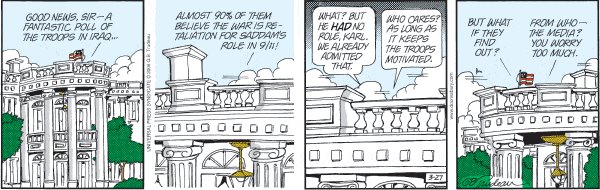
Click pic for larger image
Scalia: Guantanamo inmates have "no rights"
By Rachel Neumann
Posted on March 27, 2006
http://www.alternet.org/bloggers/rachel/34107/
Starting this week, the Supreme Court is supposed to be objectively and impartially hearing arguments in the case of Hamdan v. Rumsfeld, on the legality of the U.S.'s military tribunals for Guantanamo detainees. These detainees, who have been held for years without charges or access to lawyers, are not given access to full representation and jury trials.
One Justice, Antonin Scalia, has apparently already made up his mind about the detainees. In an unpublicized talk to a Swiss audience, documented by Newsweek, Scalia called their claims "crazy" and said detainees have no rights either under the U.S. Constitution or under international law.
Although only 5 percent of the Guantnamo detainees were captured by U.S. forces, for Scalia, this time it's personal:
If Scalia doesn't recuse himself, his vote will be considered suspect. Much comfort that will give Hamdan and the other detainees who believed in U.S. justice enough to hope for a fair hearing.
Posted on March 27, 2006
http://www.alternet.org/bloggers/rachel/34107/
Starting this week, the Supreme Court is supposed to be objectively and impartially hearing arguments in the case of Hamdan v. Rumsfeld, on the legality of the U.S.'s military tribunals for Guantanamo detainees. These detainees, who have been held for years without charges or access to lawyers, are not given access to full representation and jury trials.
One Justice, Antonin Scalia, has apparently already made up his mind about the detainees. In an unpublicized talk to a Swiss audience, documented by Newsweek, Scalia called their claims "crazy" and said detainees have no rights either under the U.S. Constitution or under international law.
Although only 5 percent of the Guantnamo detainees were captured by U.S. forces, for Scalia, this time it's personal:
If he was captured by my army on a battlefield, that is where he belongs. I had a son on that battlefield and they were shooting at my son and I'm not about to give this man who was captured in a war a full jury trial. I mean it's crazy.
If Scalia doesn't recuse himself, his vote will be considered suspect. Much comfort that will give Hamdan and the other detainees who believed in U.S. justice enough to hope for a fair hearing.
Wednesday, March 22, 2006
Remember, God Kills A Kitten...
As far as I'm concerned, this works with the Democrats as well - the other "choice" in our faux, corporate whore democracy.

Click on image for larger pic...

Click on image for larger pic...
Monday, March 20, 2006
Feds Okay Plan to Deny Remote Polling for Katrina Refugees
by Jessica Azulay, NewStandard
Mar. 20 – What was good enough for mostly well-to-do, pro-Western Iraqi expatriates living in the United States is apparently too good for the mostly black and poor New Orleanians displaced by Hurricane Katrina.
On Thursday, the US Justice Department authorized state and local plans for carrying out the New Orleans primaries on April 22. In votes postponed from February 4, the city will vote on mayoral, city council and other local primary races. Though the plans include setting up polling stations throughout Louisiana, remote balloting will not be available in other states with high concentrations of hurricane survivors.
In effect, displaced New Orleanians will not enjoy the same level of polling access that the federal government provided last year to Iraqi expatriates, who cast ballots for the Iraqi legislative elections in five cities across the United States.
By contrast, even Southern cities like Atlanta and Houston, which host high numbers of Katrina refugees, will not host polling stations for storm-affected New Orleanians outside of Louisiana.
Civil rights groups had been urging the Justice Department to overrule the plans, saying they will disenfranchise thousands of voters.
"The current elections plan is a formula for problems and disaster," National Urban League President Marc Morial told the Associated Press.
Under the voting plan, displaced New Orleanians scattered in other states would still be able to send in absentee ballots. But opponents of the plan say absentee ballots are unfairly cumbersome. Would-be voters must request a ballot ahead of time, fill it out correctly, sign it in front of a notary or witnesses, and send it back before April 21. Voting-rights advocates say they fear the complexity of the process will lead to the disqualification of many absentee ballots.
They also worry that candidates will not have an opportunity to present their platforms to constituents without reliable lists of addresses for registered voters. The Urban League is urging the Federal Emergency Management Agency (FEMA) to make its comprehensive lists of hurricane survivors addresses available to registered candidates.
In a statement last Friday, the NAACP urged Louisiana Governor Kathleen Blanco to put off next month's election by executive order ''until clear and measurable procedures are put in place to ensure all New Orleans voters, regardless of demographical location, will be able to fully and freely exercise their constitutional right to vote."
NAACP President Bruce S. Gordon wrote to the governor: "Historically, the extension of voting rights to black citizens in Louisiana has been strongly resisted, whether through literacy tests, poll taxes or other formal and informal practices combined to keep black voting rates in the state low. The impact of Hurricane Katrina now threatens Louisiana's African-American citizens' voting right in equally devastating ways."
Article...
Mar. 20 – What was good enough for mostly well-to-do, pro-Western Iraqi expatriates living in the United States is apparently too good for the mostly black and poor New Orleanians displaced by Hurricane Katrina.
On Thursday, the US Justice Department authorized state and local plans for carrying out the New Orleans primaries on April 22. In votes postponed from February 4, the city will vote on mayoral, city council and other local primary races. Though the plans include setting up polling stations throughout Louisiana, remote balloting will not be available in other states with high concentrations of hurricane survivors.
In effect, displaced New Orleanians will not enjoy the same level of polling access that the federal government provided last year to Iraqi expatriates, who cast ballots for the Iraqi legislative elections in five cities across the United States.
By contrast, even Southern cities like Atlanta and Houston, which host high numbers of Katrina refugees, will not host polling stations for storm-affected New Orleanians outside of Louisiana.
Civil rights groups had been urging the Justice Department to overrule the plans, saying they will disenfranchise thousands of voters.
"The current elections plan is a formula for problems and disaster," National Urban League President Marc Morial told the Associated Press.
Under the voting plan, displaced New Orleanians scattered in other states would still be able to send in absentee ballots. But opponents of the plan say absentee ballots are unfairly cumbersome. Would-be voters must request a ballot ahead of time, fill it out correctly, sign it in front of a notary or witnesses, and send it back before April 21. Voting-rights advocates say they fear the complexity of the process will lead to the disqualification of many absentee ballots.
They also worry that candidates will not have an opportunity to present their platforms to constituents without reliable lists of addresses for registered voters. The Urban League is urging the Federal Emergency Management Agency (FEMA) to make its comprehensive lists of hurricane survivors addresses available to registered candidates.
In a statement last Friday, the NAACP urged Louisiana Governor Kathleen Blanco to put off next month's election by executive order ''until clear and measurable procedures are put in place to ensure all New Orleans voters, regardless of demographical location, will be able to fully and freely exercise their constitutional right to vote."
NAACP President Bruce S. Gordon wrote to the governor: "Historically, the extension of voting rights to black citizens in Louisiana has been strongly resisted, whether through literacy tests, poll taxes or other formal and informal practices combined to keep black voting rates in the state low. The impact of Hurricane Katrina now threatens Louisiana's African-American citizens' voting right in equally devastating ways."
Article...
Subscribe to:
Posts (Atom)