As May 1 action looms, undocumented workers discuss their power, solidarity
by Kari Lydersen, NewStandard
While the corporate-sponsored media report alleged splits in the immigrant-rights movement and dwindling support for a boycott and general strike, TNS found that solidarity and commitment are growing.
Chicago; Apr. 28 – In the 2004 independent film A Day Without a Mexican, Californians woke up and all the Mexicans had disappeared. Lawns went untended, hotel rooms sat uncleaned, and countless other jobs performed by low-paid immigrants were left undone.
Immigrant-rights groups have frequently mentioned this film and the larger concept behind it during the past six weeks of massive pro-immigrant marches. In Chicago, where the first of the large demonstrations took place, a central theme has been waking the American public up to the economic importance of immigrants. Organizers say they want to show how much immigrants, including close to 12 million undocumented ones, contribute with their labor and with their buying power.
At the March 10 Chicago demonstration, during which more than 100,000 immigrants and their supporters hit the streets, a group handed out flyers for a hastily organized boycott of Miller beer. Demonstrators targeted Miller Brewing Co. because the company's PAC had donated $2,000 to Wisconsin Republican Congressman F. James Sensenbrenner Jr., sponsor of the harshly anti-immigrant bill that passed the House of Representatives last year.
Merchants on 26th Street, Chicago's main Mexican commercial drag in the Little Village neighborhood, said that by evening customers were refusing to buy Miller. The message reached beer distributors quickly, and by the following week officials from the company's Milwaukee headquarters had met with coalition organizers and put out a statement opposing the House's legislation.
"A lot of immigrants are not eligible to vote, but we have the purchasing power," said Salvador Cervantes, a member of the Chicago organizing coalition.
The idea amplified on April 10, when immigrant marchers in scores of cities and towns across the country pledged to refrain from shopping, working or going to school, wearing white T-shirts to symbolize their unity in creating a "day without immigrants."
A boycott on May Day has likewise been called in many cities across the country as part of pro-immigrant demonstrations. Called a paro in Spanish, the term is generally understood to mean both refusing to buy and refusing to work or go to school.
But the plan for a paro is not universally endorsed by all immigrant-rights groups. In Chicago, the organizing coalition known as the Movimiento 10 de Marzo, or the March 10 Movement, decided not to call for a boycott or general strike in the city, largely because of the involvement of labor unions that said they could not legally endorse such an action because their contracts prohibit them.
The question of whether to participate in nationwide calls for a May 1 boycott was hashed out at a contentious April 22 meeting, where the local coalition decided to support calls for boycotts in other cities, but refrain from a boycott in Chicago.
"We consider it a matter of wording," said Jorge Mujica, Illinois secretary general for the Democratic Revolution Party (PRD), a Mexican political party and one of the central coalition organizers. "If people are marching all day, they're not working, buying things or going to school. But since we have the unions, we can't call a boycott or a strike. We'd rather have labor on our side than call for a boycott. As for the national and international boycott, we think it's beautiful."
But some organizers described this as caving in to unions and politicians that were pushing for a more moderate stance.
"I wish the unions had stayed out of it and let people celebrate May Day the way they wanted," said Rafael Cervantes, an activist from Monterrey, Mexico who has lived in Chicago for decades. "The boycott was a symbol for people, an icon, a way to say we matter, we are an important cog in this machine, we produce and we consume. It's ironic that the unions are saying they could not support it because it would be illegal, but the whole reason we're marching is that people are here 'illegally.'"
Tom Hansen, founder and director of the Mexico Solidarity Network, a grassroots organization working for social change on both sides of the US-Mexico border, said the boycott is only one example of the larger ideological battle that is going on in the immigrant-rights movement. "The reformists want to 'manage' the movement with a lot of US flags and a discourse about family values, et cetera," Hansen told The NewStandard. "The more progressive elements want to move the discussion to one about exploitation, labor rights and the meaning of citizenship."
On April 24 union leaders held a press conference supporting the march and framing it as not only about immigration but about rights for all workers. They said a boycott was beside the point for the labor issues they wanted to highlight.
"We're not even putting it into the equation," said Moises Zavala, a Chicago organizer for the United Food and Commercial Workers (UFCW). "This is the day to recognize our labor history and bring it full circle. In Chicago we're not endorsing a boycott; we're out to march to show our numbers and recognize the importance of May Day."
Teamsters organizers said that rather than discussing a strike or boycott, they were trying to get employers on workers' side; helping employees petition their employers for time off or paid holidays to attend the demonstrations.
In Los Angeles, where other mass protests are planned, some groups will be carrying out work stoppages and boycotts and attending a daytime downtown march. Others who plan to go to work and school will attend a separate demonstration in the late afternoon.
Thousands of truck drivers working out of the Port of Los Angeles and cab drivers who serve Los Angeles International Airport are expected to strike for the day or possibly the week.
"If truckers aren't trucking, the port isn't working," said Los Angeles attorney and organizer Jim DeMaegt. "If cab drivers don't drive, LAX will be shut down. Nobody knows precisely what will happen, but there is a lot of support."
DeMaegt thinks a massive strike would force policy change faster than some other types of actions. "We say a day without shopping is good; going to speeches, going marches is good," he told TNS. "But stopping work – a day without workers will close the country. A day without goods going in and out of the ports and airports of the US, and we'll have a policy change within a week."
The truckers and cab drivers are organized but are not members of official labor unions, giving them the freedom to strike without worrying about legal issues binding unions.
The truckers and cab drivers are protesting against rising fuel prices and low pay, along with calling for immigration reform.
DeMaegt said local Teamsters officials are not supporting a work stoppage but support the overall mobilization.
Aquilina Soriano-Versoza, executive director of the Pilipino Workers' Center, noted that many of their members are home-healthcare workers, so they don't want to endanger their clients by skipping work; but they will support the mobilization nonetheless.
"They can't leave their patients, but they're in solidarity," Soriano-Versoza said. "There are a whole range of ways people can participate."
She noted that many employers, particularly in the Koreatown garment industry, have given their workers the day off thanks to organizing by community groups and employees.
Alexis Lanza, an activist with the Chicago group La Voz de los de Abajo (The Voice of Those Below) and an immigrant from Honduras, said he supported the call for a one-day boycott. "I think it would have been good if the US united on that," he said. "But there are lots of interests, unions and different groups, and it's not easy to balance those things."
Lanza would prefer long-term boycotts of products from companies that donate to anti-immigrant politicians or promote policies that hurt Latin Americans through international trade or employment policies. The Chicago committee discussed proposals for a long-term boycott of Coca-Cola, with its notorious human-rights record, and a local Mexican cheese company that buys from Rep. Sensenbrenner's state, Wisconsin. But those proposals were not adopted.
"Calling a boycott for just one day strategically doesn't have that big an impact; it's symbolic," said Lanza. "The next day you'll be buying the same products again."
Lanza thinks even without an official boycott, the demonstrations will make immigrants' economic power clear. "If you're calling on people to close their businesses during the march, that's like a boycott, except you're not calling it that," Lanza said.
Some groups in other cities have not endorsed the boycott out of fear there will be a backlash against immigrants or that workers will lose their jobs for skipping work. But in Chicago, where many workers fired for participating in the March 10 demonstrations were reinstated after immigrant organizers threatened to protest workplaces, advocates say they are not that worried.
"I really feel this time around nobody is going to get fired," said Mujica. "We have prepared this so well with the letters for employees to give to their employers." He noted the group is distributing letters in several languages for workers to download and use to explain their cause while formally requesting time off.
In Arizona, the coalition that organized a 100,000-strong protest on April 10 in Phoenix waffled about supporting a boycott. Last week, the Somos America (We are America) coalition announced it was supporting demonstrations and other forms of protest, but not endorsing the boycott due to fear of a backlash and concern for immigrants' job security.
But, according to the group's chairman, Roberto Reveles, who spoke to the Arizona Republic, the recent arrests of 1,187 undocumented immigrants in federal raids on pallet maker IFCO Systems locations in 26 states including Arizona, spurred the group to change its mind.
Reveles told the Republic that his group wanted "to make a statement against the latest raids," which came "at a time when they should be working toward immigration reform rather than instilling additional fear in the lives of undocumented workers and their families."
The success of the boycott, according to Hansen of the Mexico Solidarity Network, will depend "on how many people participate, what the impacts are and, most importantly, the kind of political consciousness that accompanies the tactic."
"The idea is to change hearts and minds," he said, "and to give immigrants a sense of their power. This is particularly important for a group that has been repressed and exploited for so long, on both sides of the border. A change in the collective appreciation of what is possible is the real goal of the boycott."
Sunday, April 30, 2006


Friday, April 28, 2006
Moderate Earners Increasingly Lack Health Coverage
By Nick Timiraos
LA Times Staff Writer
April 26, 2006
WASHINGTON — The number of uninsured adults who earn between $20,000 and $40,000 annually is rising, according to a study released today — suggesting that fewer employers are providing healthcare coverage.
That study, along with one that says the uninsured are likely to seek treatment only when they become seriously ill, coincides with a national campaign, Cover the Uninsured, to make healthcare coverage a top legislative priority.
Research by the Commonwealth Fund, a nonpartisan New York-based foundation that examines healthcare issues, found that the percentage of moderate-income Americans who were without insurance for at least part of the year had jumped sharply over four years — from 28% in 2001 to 41% in 2005.
"It's a cause for concern that this problem is obviously spreading into more moderate-income households," said Sara Collins, the study's lead author. "It's reflective of the fact that more employers are not offering coverage."
The study estimates that 48 million Americans lack health insurance. Of those, two-thirds are in families in which at least one person works full time, the study says.
"What those numbers do is cry out for public policymakers to take this challenge very seriously," said Gail Shearer, health policy director at Consumers Union.
Dr. Fernando Guerra, who directs the public health department in San Antonio, described the costs incurred by a lack of insurance. In an interview, he told of treating a staph infection in a 4-month-old whose mother had postponed treatment because she had no insurance.
"If the mother had been able to bring the child for treatment, it could have been resolved very quickly" for about $150, he said. Instead, surgery to drain the infant's thigh cost nearly five times as much.
The study found that 60% of uninsured adults with chronic illnesses, such as heart disease, forgo medication to save money and that 20% of working adults are paying off medical debt, often exceeding $2,000.
The study surveyed 4,350 adults by telephone between August 2005 and January 2006.
A similar report released today warned that uninsured Americans were four times more likely than those with insurance to avoid seeing a doctor when they needed treatment.
The study by the Robert Wood Johnson Foundation, a Princeton, N.J., philanthropy specializing in healthcare issues, found that 23% of uninsured adults said their health was "fair" or "poor," compared with 12% of those with insurance.
LA Times Staff Writer
April 26, 2006
WASHINGTON — The number of uninsured adults who earn between $20,000 and $40,000 annually is rising, according to a study released today — suggesting that fewer employers are providing healthcare coverage.
That study, along with one that says the uninsured are likely to seek treatment only when they become seriously ill, coincides with a national campaign, Cover the Uninsured, to make healthcare coverage a top legislative priority.
Research by the Commonwealth Fund, a nonpartisan New York-based foundation that examines healthcare issues, found that the percentage of moderate-income Americans who were without insurance for at least part of the year had jumped sharply over four years — from 28% in 2001 to 41% in 2005.
"It's a cause for concern that this problem is obviously spreading into more moderate-income households," said Sara Collins, the study's lead author. "It's reflective of the fact that more employers are not offering coverage."
The study estimates that 48 million Americans lack health insurance. Of those, two-thirds are in families in which at least one person works full time, the study says.
"What those numbers do is cry out for public policymakers to take this challenge very seriously," said Gail Shearer, health policy director at Consumers Union.
Dr. Fernando Guerra, who directs the public health department in San Antonio, described the costs incurred by a lack of insurance. In an interview, he told of treating a staph infection in a 4-month-old whose mother had postponed treatment because she had no insurance.
"If the mother had been able to bring the child for treatment, it could have been resolved very quickly" for about $150, he said. Instead, surgery to drain the infant's thigh cost nearly five times as much.
The study found that 60% of uninsured adults with chronic illnesses, such as heart disease, forgo medication to save money and that 20% of working adults are paying off medical debt, often exceeding $2,000.
The study surveyed 4,350 adults by telephone between August 2005 and January 2006.
A similar report released today warned that uninsured Americans were four times more likely than those with insurance to avoid seeing a doctor when they needed treatment.
The study by the Robert Wood Johnson Foundation, a Princeton, N.J., philanthropy specializing in healthcare issues, found that 23% of uninsured adults said their health was "fair" or "poor," compared with 12% of those with insurance.
Monday, April 24, 2006
Study Finds Oil Co. Profits Driving Increased Fuel Costs, Not Crude Prices
CONSUMER WATCHDOG - The Foundation for Taxpayer and Consumer Rights released a new study today of rising gasoline prices in California that found corporate markups and profiteering are responsible for spring price spikes, not rising crude costs or the national switchover to higher-cost ethanol, as the oil industry claims.
Independent petroleum consultant Tim Hamilton analyzed gasoline price increases from January to April to find that:
Increases in the "spot" market price of crude oil -- which is the highest price a major oil company would pay for crude oil -- accounted for only 12 cents per gallon. California's percentage sales tax increased fuel prices by another four cents per gallon. More than 40 cents of the 60-cent increase in gasoline prices over 3 1/2 months is attributable to increased refinery and marketing profit margins for the oil companies; Neither the MTBE phaseout nor the substitution of ethanol is a serious part of the increase. . .
The profit increase of 42 cents, on top of record profits last year, means California gasoline will cost consumers approximately $546 million more in April 2006 than in April of last year. . . Oil companies are opportunistically using the rising world price for crude oil as an excuse to excessively raise gasoline prices and pump up their profits, even though the spot market price for crude has gone up far more slowly than gasoline prices," said FTCR President Jamie Court. "In addition, the spot price is higher than most oil companies pay, since they either harvest their own crude or pay more stable and often much lower contract prices.
http://www.consumerwatchdog.org/energy/pr/?postId=6133
Independent petroleum consultant Tim Hamilton analyzed gasoline price increases from January to April to find that:
Increases in the "spot" market price of crude oil -- which is the highest price a major oil company would pay for crude oil -- accounted for only 12 cents per gallon. California's percentage sales tax increased fuel prices by another four cents per gallon. More than 40 cents of the 60-cent increase in gasoline prices over 3 1/2 months is attributable to increased refinery and marketing profit margins for the oil companies; Neither the MTBE phaseout nor the substitution of ethanol is a serious part of the increase. . .
The profit increase of 42 cents, on top of record profits last year, means California gasoline will cost consumers approximately $546 million more in April 2006 than in April of last year. . . Oil companies are opportunistically using the rising world price for crude oil as an excuse to excessively raise gasoline prices and pump up their profits, even though the spot market price for crude has gone up far more slowly than gasoline prices," said FTCR President Jamie Court. "In addition, the spot price is higher than most oil companies pay, since they either harvest their own crude or pay more stable and often much lower contract prices.
http://www.consumerwatchdog.org/energy/pr/?postId=6133
Sunday, April 23, 2006
KATIE COURIC VERSUS AMY GOODMAN
By Russell Mokhiber and Robert Weissman
We haven't done the poll, but our guess is that most Americans recognize the name Katie Couric.
And they wouldn't know Amy Goodman from a hole in the wall.
NBC Today Show co-anchor Katie Couric said this morning that she is leaving the show to become the anchor for the CBS Evening News.
Amy Goodman is the anchor of the award winning one-hour television and radio news program, Democracy Now.
Couric gets more ink than Goodman in the mainstream press.
That's because Couric plays by the rules of the game.
Goodman doesn't.
Couric has been with the Today Show for 15 years.
She has also been a contributing anchor for Dateline NBC.
For most of her professional life, Couric has been a celebrity interviewer and stenographer to power.
According to the Today Show web site, she has interviewed "a panoply of world leaders, national political figures, writers, actors and pop culture icons."
Some of her groundbreaking political interviews have been fawning sycophantic things with:
George Bush Sr., George Bush Jr., Barbara Bush, Laura Bush, Hillary Clinton, Bill Clinton, Kofi Annan, Tony Blair, Jennifer Wilbanks ("whose disappearance just before her wedding day created a nationwide sensation, earning her the moniker "runaway bride"), Tricia Meili -- the Central Park Jogger, John F. Kennedy, Jr. John and Patsy Ramsey about the death of their daughter, JonBenet,
Amy Goodman has reported more substantive news in one year that Couric has reported on in a lifetime.
Just last week, Democracy Now ran a two part interview with Noam Chomsky about his new book, Failed States: The Abuse of Power and the Assault on Democracy.
Would Couric run a debate on the Israeli/Palestinian issue between Noam Chomsky and Alan Dershowitz, as Goodman did earlier this year?
Would Couric interview Norman Finkelstein on the same?
Would she know who Norman Finkelstein is?
Would Couric know Al Lewis as anything more than Grandpa on the Munsters?
Or would she dare interview him on his radical political philosophy, as Goodman did before Grandpa Al died earlier this year?
Would Couric know about the 1991 massacre of 271 peaceful protesters in Dili, East Timor by Indonesia forces?
Goodman was there with the protesters, was beaten, but survived.
If Katie Couric were interviewing Vanessa Redgrave, would the conversation be dominated by the death by Israeli bulldozer of peace activist Rachel Corrie -- as was Goodman's interview last month of Redgrave?
Would Couric dare interview the now untouchable Harry Belafonte -- after he called the war criminal a war criminal?
Would Couric travel to Nigeria -- as Goodman did -- to document Chevron's complicity with the Nigerian military in putting down an indigenous revolt?
Couric is going to CBS News, the old stomping ground of Edward R. Murrow.
The recently released movie of Murrow -- Good Night and Good Luck -- purports to be how Murrow stood up to Senator Joseph McCarthy and his communist witch hunts.
But the movie is actually about the sacrifice of television news at the altar of corporate commercialism.
Murrow had slim hopes for television.
He could see the writing on the wall.
As movie reviewer John Powers put it, the movie's real theme is "the inherent debasement of mass news in a commercial culture, a process so powerful that even brave individuals can't stop it."
"You see, news is a product that must be able to pay for itself," Powers said on NPR's Fresh Air. "In practice, that means getting ratings, finding corporate sponsors and newsmen becoming purveyors of fluff, and that's precisely what we see happening in the film. Murrow's show 'See It Now' has to fret about alienating its sponsor, Alcoa, when it goes after McCarthy, and Murrow himself must placate CBS by hosting the celebrity interview show 'Person to Person.'"
Powers says that "like it or not, the age of infotainment was in the cards from the very beginning."
"And for all his highfalutin speeches about how television can educate, illuminate and inspire, Murrow could do nothing to slow it down," Power said. "Seeing it now, his famed anti-McCarthy broadcast looks less like the flowering of a golden age than a blip on the radar of packaged commercial news, rather like Shepard Smith and Anderson Cooper unexpectedly exploding with anger during Hurricane Katrina before returning to their usual sleek selves."
Amy Goodman and Democracy Now are what Edward Murrow professed television could become.
Katie Couric and the CBS Evening News represent what he feared it would become.
Good night.
Good luck to Amy Goodman and Democracy Now.
Russell Mokhiber is editor of the Washington, D.C.-based Corporate Crime Reporter, <http://www.corporatecrimereporter.com>. Robert Weissman is editor of the Washington, D.C.-based Multinational Monitor, <http://www.multinationalmonitor.org>. Mokhiber and Weissman are co-authors of On the Rampage: Corporate Predators and the Destruction of Democracy (Monroe, Maine: Common Courage Press).
We haven't done the poll, but our guess is that most Americans recognize the name Katie Couric.
And they wouldn't know Amy Goodman from a hole in the wall.
NBC Today Show co-anchor Katie Couric said this morning that she is leaving the show to become the anchor for the CBS Evening News.
Amy Goodman is the anchor of the award winning one-hour television and radio news program, Democracy Now.
Couric gets more ink than Goodman in the mainstream press.
That's because Couric plays by the rules of the game.
Goodman doesn't.
Couric has been with the Today Show for 15 years.
She has also been a contributing anchor for Dateline NBC.
For most of her professional life, Couric has been a celebrity interviewer and stenographer to power.
According to the Today Show web site, she has interviewed "a panoply of world leaders, national political figures, writers, actors and pop culture icons."
Some of her groundbreaking political interviews have been fawning sycophantic things with:
George Bush Sr., George Bush Jr., Barbara Bush, Laura Bush, Hillary Clinton, Bill Clinton, Kofi Annan, Tony Blair, Jennifer Wilbanks ("whose disappearance just before her wedding day created a nationwide sensation, earning her the moniker "runaway bride"), Tricia Meili -- the Central Park Jogger, John F. Kennedy, Jr. John and Patsy Ramsey about the death of their daughter, JonBenet,
Amy Goodman has reported more substantive news in one year that Couric has reported on in a lifetime.
Just last week, Democracy Now ran a two part interview with Noam Chomsky about his new book, Failed States: The Abuse of Power and the Assault on Democracy.
Would Couric run a debate on the Israeli/Palestinian issue between Noam Chomsky and Alan Dershowitz, as Goodman did earlier this year?
Would Couric interview Norman Finkelstein on the same?
Would she know who Norman Finkelstein is?
Would Couric know Al Lewis as anything more than Grandpa on the Munsters?
Or would she dare interview him on his radical political philosophy, as Goodman did before Grandpa Al died earlier this year?
Would Couric know about the 1991 massacre of 271 peaceful protesters in Dili, East Timor by Indonesia forces?
Goodman was there with the protesters, was beaten, but survived.
If Katie Couric were interviewing Vanessa Redgrave, would the conversation be dominated by the death by Israeli bulldozer of peace activist Rachel Corrie -- as was Goodman's interview last month of Redgrave?
Would Couric dare interview the now untouchable Harry Belafonte -- after he called the war criminal a war criminal?
Would Couric travel to Nigeria -- as Goodman did -- to document Chevron's complicity with the Nigerian military in putting down an indigenous revolt?
Couric is going to CBS News, the old stomping ground of Edward R. Murrow.
The recently released movie of Murrow -- Good Night and Good Luck -- purports to be how Murrow stood up to Senator Joseph McCarthy and his communist witch hunts.
But the movie is actually about the sacrifice of television news at the altar of corporate commercialism.
Murrow had slim hopes for television.
He could see the writing on the wall.
As movie reviewer John Powers put it, the movie's real theme is "the inherent debasement of mass news in a commercial culture, a process so powerful that even brave individuals can't stop it."
"You see, news is a product that must be able to pay for itself," Powers said on NPR's Fresh Air. "In practice, that means getting ratings, finding corporate sponsors and newsmen becoming purveyors of fluff, and that's precisely what we see happening in the film. Murrow's show 'See It Now' has to fret about alienating its sponsor, Alcoa, when it goes after McCarthy, and Murrow himself must placate CBS by hosting the celebrity interview show 'Person to Person.'"
Powers says that "like it or not, the age of infotainment was in the cards from the very beginning."
"And for all his highfalutin speeches about how television can educate, illuminate and inspire, Murrow could do nothing to slow it down," Power said. "Seeing it now, his famed anti-McCarthy broadcast looks less like the flowering of a golden age than a blip on the radar of packaged commercial news, rather like Shepard Smith and Anderson Cooper unexpectedly exploding with anger during Hurricane Katrina before returning to their usual sleek selves."
Amy Goodman and Democracy Now are what Edward Murrow professed television could become.
Katie Couric and the CBS Evening News represent what he feared it would become.
Good night.
Good luck to Amy Goodman and Democracy Now.
Russell Mokhiber is editor of the Washington, D.C.-based Corporate Crime Reporter, <http://www.corporatecrimereporter.com>. Robert Weissman is editor of the Washington, D.C.-based Multinational Monitor, <http://www.multinationalmonitor.org>. Mokhiber and Weissman are co-authors of On the Rampage: Corporate Predators and the Destruction of Democracy (Monroe, Maine: Common Courage Press).
Wednesday, April 19, 2006
Breaking News: Scott McClellan is history
Posted by Evan Derkacz at 7:03 AM on April 19, 2006.
Replaced by a Fox host?
White House Press Secretary (Ari Fleischer's replacement) Scott McClellan is history. No more on this yet... except to say that this is roughly the equivalent of bleaching the teeth of a cancer patient. Which is to say: no dice, what ails you, ails you still.
Update: Judd Legum writes: "The White House is considering replacing him with Fox News anchor Tony Snow."
Oh, come on... like you're surprised.
Here's Media Matters' Tony Snow page:
(ThinkProgress, MediaMatters)
Replaced by a Fox host?
White House Press Secretary (Ari Fleischer's replacement) Scott McClellan is history. No more on this yet... except to say that this is roughly the equivalent of bleaching the teeth of a cancer patient. Which is to say: no dice, what ails you, ails you still.
Update: Judd Legum writes: "The White House is considering replacing him with Fox News anchor Tony Snow."
Oh, come on... like you're surprised.
Here's Media Matters' Tony Snow page:
* Fox's Snow falsely claimed that Wilson said Plame was not covert
* Tony Snow's evolutionary falsehoods
* Conservatives falsify record on Ruth Bader Ginsburg
* FOX pundits wrong: undecideds do break for challenger
* Conservative hosts echoed RNC claim that Kerry blamed troops for missing explosives
* "Nuisance" echo: Media conservatives embraced GOP distortion of Kerry interview
* Media largely ignored LA Times report of Bush administration plans to delay major Iraq combat until after presidential election
* Contrary to conservatives' claims, Bush has not been forthcoming in release of military service records
(ThinkProgress, MediaMatters)
Feckless Leader
Posted by Melissa McEwan, Alternet
Bush still can't answer important questions; life's just a big old joke.
Yesterday, during at appearance at Johns Hopkins School of International Studies, Bush opened it up to some unscripted Q&A, which is always a disastrous idea under the best of circumstances, but things took a terrible turn when a first-year student in South Asia studies asked him about the law governing the actions of private military contractors in Iraq.
Three years into the war, that the president still has no idea how to answer questions like this (sobbing) is just a dreadful embarrassment (blushing), not only for him, who must now be used to the shame of his own idiocy (crawling into the fetal position), but also for us, who probably ought to be used to it (sobbing), which is perhaps the most pathetic commentary of all (uncontrollable wailing).
The intrepid Crooks and Liars has the video. Be prepared to cringe in agony as you witness Dear Leader do his manic tapdance under the excruciating misapprehension that the crowd is laughing with him rather than at him.
(Crooks and Liars)
Bush still can't answer important questions; life's just a big old joke.
Yesterday, during at appearance at Johns Hopkins School of International Studies, Bush opened it up to some unscripted Q&A, which is always a disastrous idea under the best of circumstances, but things took a terrible turn when a first-year student in South Asia studies asked him about the law governing the actions of private military contractors in Iraq.
Q …My question is in regards to private military contractors. Uniform Code of Military Justice does not apply to these contractors in Iraq. I asked your Secretary of Defense a couple months ago what law governs their actions.
THE PRESIDENT: I was going to ask him. Go ahead. (Laughter.) Help. (Laughter.)
Q I was hoping your answer might be a little more specific. (Laughter.) Mr. Rumsfeld answered that Iraq has its own domestic laws which he assumed applied to those private military contractors. However, Iraq is clearly not currently capable of enforcing its laws, much less against -- over our American military contractors. I would submit to you that in this case, this is one case that privatization is not a solution. And, Mr. President, how do you propose to bring private military contractors under a system of law?
THE PRESIDENT: I appreciate that very much. I wasn’t kidding -- (laughter.) I was going to -- I pick up the phone and say, Mr. Secretary, I've got an interesting question. (Laughter.) This is what delegation -- I don't mean to be dodging the question, although it’s kind of convenient in this case, but never -- (laughter.) I really will – I’m going to call the Secretary and say you brought up a very valid question, and what are we doing about it? That’s how I work. I'm -- thanks. (Laughter.)
Three years into the war, that the president still has no idea how to answer questions like this (sobbing) is just a dreadful embarrassment (blushing), not only for him, who must now be used to the shame of his own idiocy (crawling into the fetal position), but also for us, who probably ought to be used to it (sobbing), which is perhaps the most pathetic commentary of all (uncontrollable wailing).
The intrepid Crooks and Liars has the video. Be prepared to cringe in agony as you witness Dear Leader do his manic tapdance under the excruciating misapprehension that the crowd is laughing with him rather than at him.
(Crooks and Liars)
Thursday, April 13, 2006
The people, united, will never be defeated!
CHIRAC CAVES ON YOUTH LAW
http://direland.typepad.com/direland/2006/04/france_why_the_.html
DOUG IRELAND, DIRELAND - This morning in Paris, the conservative government of President Jacques Chirac caved in and announced that the special labor contract for under-26 workers that had sent millions of students and union members into the streets in protest was dead. The "CPE" (Contrat Premier Embauche or first-job contract) will be "replaced" by a new plan to provide subsidies to employers to encourage the hiring of young people in a country where youth unemployment is at 24% (and even higher -- upwards of 50% -- in the ghettos.). . .
As usual, the U.S. press understood little about the conflict. Over and over again, one heard the students referred to by TV's bubbleheads (from CBS to CNN) as "reactionaries" because they opposed the new law. But what the CPE law had done was to eliminate for under-26 workers the rights previously guaranteed to all French workers not to be fired without cause. Under the CPE, younger workers could be canned at any moment from the moment of their hiring up the two years' duration of these youth employment contracts without the employers' being required to justify the firing, if the fired worker chose to haul the employer before labor tribunals. . .
http://direland.typepad.com/direland/2006/04/france_why_the_.html
DOUG IRELAND, DIRELAND - This morning in Paris, the conservative government of President Jacques Chirac caved in and announced that the special labor contract for under-26 workers that had sent millions of students and union members into the streets in protest was dead. The "CPE" (Contrat Premier Embauche or first-job contract) will be "replaced" by a new plan to provide subsidies to employers to encourage the hiring of young people in a country where youth unemployment is at 24% (and even higher -- upwards of 50% -- in the ghettos.). . .
As usual, the U.S. press understood little about the conflict. Over and over again, one heard the students referred to by TV's bubbleheads (from CBS to CNN) as "reactionaries" because they opposed the new law. But what the CPE law had done was to eliminate for under-26 workers the rights previously guaranteed to all French workers not to be fired without cause. Under the CPE, younger workers could be canned at any moment from the moment of their hiring up the two years' duration of these youth employment contracts without the employers' being required to justify the firing, if the fired worker chose to haul the employer before labor tribunals. . .
Critics Blow Holes in Mass. ‘Universal’ Health Plan
by Megan Tady
http://newstandardnews.net/content/index.cfm/items/3050
Massachusetts; Apr. 12 – While Massachusetts's new "universal" bill meets with a nationwide round of applause as a possible solution to the growing healthcare crisis, physicians and public advocates point to a long list of faults with a plan they consider a universal facade.
Many opponents say the bill, which was passed by the Massachusetts House and the Senate last Tuesday and is awaiting Governor Mitt Romney's signature, hurts low- and middle-income residents while bolstering profits for private insurance companies. According to a Boston Globe analysis, private insurers paid $7.5 million to lobbyists fighting for the bill.
Although the bill is designed to provide health coverage for Massachusetts's poorest residents and offers a sliding-scale subsidy for residents who earn up to three times the poverty level, some critics say low-income residents should be prepared for disappointment, because lawmakers have drastically under-funded the bill.
"The bill raises almost no new funds but promises to cover hundreds of thousands of new people," noted Benjamin Day, executive director of Mass-Care, a coalition of organizations working toward a single-payer healthcare system for Massachusetts. Day's group estimates that the $170 million allotted to subsidize lower-income residents will only cover about 45,000 of them.
That's less than a tenth of the state's uninsured residents, according to the most conservative official estimate of 523,000 uninsured people in the state. Lawmakers have based that estimate on data from a 2004 state survey that only counted people who were uninsured at the time of the survey and was conducted only in English or Spanish. When people who lacked coverage at any point in the year prior to the survey were added, the number of uninsured rose by 170,000.
"We don't think it was an accurate survey to make accurate policies," said Steffie Woolhandler, a physician at Cambridge Hospital, who also co-founded Physicians for a National Health Program, a nonprofit organization working toward a comprehensive national healthcare program.
What has thrown Massachusetts into the spotlight, however, is not the plan's pitfalls. Massachusetts is the first state to devise a healthcare plan that forces people to obtain health insurance. Those who exceed the income-eligibility threshold for subsidies are required to purchase their own health insurance or face tax penalties and fines. For example, an individual who makes $29,000 a year and whose employer does not provide health benefits must purchase health insurance through a private company.
Under the bill, uninsured individuals who don't purchase health insurance by July 1, 2007 will lose their personal income-tax exemption; by 2008, they will have to pay a penalty equal to half the cost of the insurance plan they could have purchased. Individual coverage typically costs a minimum of $4,000 annually in Massachusetts, and family plans cost as much as $11,000 a year.
Proponents of the bill say it will make insurance universally accessible through as-yet-undefined "market reforms" aimed at holding down costs.
Many organizations were immediately enthusiastic about the bill. "We were big smiles all around [when the bill passed]," said Brian Rosman, policy director of Health Care for All, a healthcare advocacy organization that pushed for the bill. "It's certainly not all that we'd hoped for, and there are some things that are not yet worked out or don't meet what our ideal bill is. But in terms of the legislative process, we're very pleased."
Others, however, see the bill as little more than a scheme to enforce payments to private companies.
"The poorest people did get some benefits from this bill, but the majority of the uninsured in Massachusetts are going to get precious little help," said Woolhandler. "So we don't think this plan is going to give us universal health care. But what it will do is force a lot of middle-income people – who are already struggling to make it in this expensive state – to pay thousands of dollars to private insurance companies."
According to the Massachusetts Department of Health and Human Services, 56 percent of the uninsured in Massachusetts live in households with incomes above twice the poverty level, or $37,700 per year for a family of four.
Defending the plan, Romney has compared the bill with requiring drivers to buy automobile liability insurance. But critics point out that insuring a car against accidents is not exactly akin to insuring one's health.
"Romney has this notion that health insurance should work like auto insurance, but people can choose not to buy a car," said Matt Singer, communications director of the Progressive Legislation Action Network, an organization that supports progressive legislation on the state level. "People can't choose not to have a body."
The bill would also impose a tax on some businesses that do not provide health insurance. But in contrast to the heavy penalties that individuals could face for not complying with the mandate by 2008, businesses employing more than ten people will only face a tax of up to $295 annually for every employee not covered by a company plan.
Although proponents of the bill say it would encourage employers and employees to share responsibility for providing broad health coverage, others see it as an anti-worker tactic.
"This is a rejection of the fundamental healthcare system in America, which is employer-based," Singer said. Traditionally, she explained, people have relied on the bulk-purchasing power of their employers to provide insurance for workers. "But this bill is taking that away and saying, 'Well, actually, we're going to put the burden on the individual, to the extent that we're going to penalize individuals who don't have health insurance.'"
Equally disturbing, said Singer, is the prospect that some residents who simply can't afford health insurance will end up paying the tax rather than buy a plan. "That's not a solution to America's healthcare crisis," he said.
While the bill states that "affordable" health care will be offered to residents, lawmakers were vague about the details of the cost of plans. In addition, officials have so far not indicated what exact incentives they intend to provide insurers to push them to offer low-cost healthcare plans. Critics expect the sheer cost of even basic health insurance will force many to buy low-cost plans that offer watered-down coverage compounded by high fees.
"Comprehensive, affordable policies don't exist," Woolhandler said. "Many people will be forced to pay thousands of dollars for a policy that is only a piece of paper. If someone actually does get sick, the policy will be so full of gaps – like large co-pays – that they could go bankrupt. They'll be facing the worst of both worlds: [being] forced to hand over thousands of dollars to the private health-insurance companies, and finding that they're not actually covered when they get sick."
© 2006 The NewStandard.
http://newstandardnews.net/content/index.cfm/items/3050
Massachusetts; Apr. 12 – While Massachusetts's new "universal" bill meets with a nationwide round of applause as a possible solution to the growing healthcare crisis, physicians and public advocates point to a long list of faults with a plan they consider a universal facade.
Many opponents say the bill, which was passed by the Massachusetts House and the Senate last Tuesday and is awaiting Governor Mitt Romney's signature, hurts low- and middle-income residents while bolstering profits for private insurance companies. According to a Boston Globe analysis, private insurers paid $7.5 million to lobbyists fighting for the bill.
Although the bill is designed to provide health coverage for Massachusetts's poorest residents and offers a sliding-scale subsidy for residents who earn up to three times the poverty level, some critics say low-income residents should be prepared for disappointment, because lawmakers have drastically under-funded the bill.
"The bill raises almost no new funds but promises to cover hundreds of thousands of new people," noted Benjamin Day, executive director of Mass-Care, a coalition of organizations working toward a single-payer healthcare system for Massachusetts. Day's group estimates that the $170 million allotted to subsidize lower-income residents will only cover about 45,000 of them.
That's less than a tenth of the state's uninsured residents, according to the most conservative official estimate of 523,000 uninsured people in the state. Lawmakers have based that estimate on data from a 2004 state survey that only counted people who were uninsured at the time of the survey and was conducted only in English or Spanish. When people who lacked coverage at any point in the year prior to the survey were added, the number of uninsured rose by 170,000.
"We don't think it was an accurate survey to make accurate policies," said Steffie Woolhandler, a physician at Cambridge Hospital, who also co-founded Physicians for a National Health Program, a nonprofit organization working toward a comprehensive national healthcare program.
What has thrown Massachusetts into the spotlight, however, is not the plan's pitfalls. Massachusetts is the first state to devise a healthcare plan that forces people to obtain health insurance. Those who exceed the income-eligibility threshold for subsidies are required to purchase their own health insurance or face tax penalties and fines. For example, an individual who makes $29,000 a year and whose employer does not provide health benefits must purchase health insurance through a private company.
Under the bill, uninsured individuals who don't purchase health insurance by July 1, 2007 will lose their personal income-tax exemption; by 2008, they will have to pay a penalty equal to half the cost of the insurance plan they could have purchased. Individual coverage typically costs a minimum of $4,000 annually in Massachusetts, and family plans cost as much as $11,000 a year.
Proponents of the bill say it will make insurance universally accessible through as-yet-undefined "market reforms" aimed at holding down costs.
Many organizations were immediately enthusiastic about the bill. "We were big smiles all around [when the bill passed]," said Brian Rosman, policy director of Health Care for All, a healthcare advocacy organization that pushed for the bill. "It's certainly not all that we'd hoped for, and there are some things that are not yet worked out or don't meet what our ideal bill is. But in terms of the legislative process, we're very pleased."
Others, however, see the bill as little more than a scheme to enforce payments to private companies.
"The poorest people did get some benefits from this bill, but the majority of the uninsured in Massachusetts are going to get precious little help," said Woolhandler. "So we don't think this plan is going to give us universal health care. But what it will do is force a lot of middle-income people – who are already struggling to make it in this expensive state – to pay thousands of dollars to private insurance companies."
According to the Massachusetts Department of Health and Human Services, 56 percent of the uninsured in Massachusetts live in households with incomes above twice the poverty level, or $37,700 per year for a family of four.
Defending the plan, Romney has compared the bill with requiring drivers to buy automobile liability insurance. But critics point out that insuring a car against accidents is not exactly akin to insuring one's health.
"Romney has this notion that health insurance should work like auto insurance, but people can choose not to buy a car," said Matt Singer, communications director of the Progressive Legislation Action Network, an organization that supports progressive legislation on the state level. "People can't choose not to have a body."
The bill would also impose a tax on some businesses that do not provide health insurance. But in contrast to the heavy penalties that individuals could face for not complying with the mandate by 2008, businesses employing more than ten people will only face a tax of up to $295 annually for every employee not covered by a company plan.
Although proponents of the bill say it would encourage employers and employees to share responsibility for providing broad health coverage, others see it as an anti-worker tactic.
"This is a rejection of the fundamental healthcare system in America, which is employer-based," Singer said. Traditionally, she explained, people have relied on the bulk-purchasing power of their employers to provide insurance for workers. "But this bill is taking that away and saying, 'Well, actually, we're going to put the burden on the individual, to the extent that we're going to penalize individuals who don't have health insurance.'"
Equally disturbing, said Singer, is the prospect that some residents who simply can't afford health insurance will end up paying the tax rather than buy a plan. "That's not a solution to America's healthcare crisis," he said.
While the bill states that "affordable" health care will be offered to residents, lawmakers were vague about the details of the cost of plans. In addition, officials have so far not indicated what exact incentives they intend to provide insurers to push them to offer low-cost healthcare plans. Critics expect the sheer cost of even basic health insurance will force many to buy low-cost plans that offer watered-down coverage compounded by high fees.
"Comprehensive, affordable policies don't exist," Woolhandler said. "Many people will be forced to pay thousands of dollars for a policy that is only a piece of paper. If someone actually does get sick, the policy will be so full of gaps – like large co-pays – that they could go bankrupt. They'll be facing the worst of both worlds: [being] forced to hand over thousands of dollars to the private health-insurance companies, and finding that they're not actually covered when they get sick."
© 2006 The NewStandard.
Tuesday, April 11, 2006
UPDATED: Bush planning Iran attack
By Evan Derkacz
Posted on April 10, 2006
http://www.alternet.org/bloggers/evan/34741/
Seymour Hersh drops another bomb -- pun very much intended -- in the latest New Yorker alleging that the Bush administration has "operational plans" for regime change in Iran. That's "n" not "q." Iran.
Not only have they "increased clandestine activities inside Iran and intensified planning for a possible major air attack," according to Hersh, but the plans may well, in the name of destroying Iran's nuclear capability, involve the utilization of ours: "The lack of reliable intelligence leaves military planners, given the goal of totally destroying the [potential nuclear weapon development] sites, little choice but to consider the use of tactical nuclear weapons."
This, despite the fact that, according to Scott Ritter [VIDEO], there's no reason to believe that Iran has the capability, nor that they're actually do anything to violate the nonproliferation treaty at this point.
Not only that, but former UN weapons inspector Hans Blix said last week that "Iran is a least five years away from developing a nuclear bomb, leaving time to peacefully negotiate a settlement... 'We have time on our side in this case. Iran can't have a bomb ready in the next five years.'"
Hersh contends that Bush's reasoning for these radical plans is largely "messianic."
Hersh quotes a former defense official with close ties to the administration as responding to Bush's plans with this technical jargon: "What are they smoking?"
UPDATE: Exasperated commenters have inspired me to include this bright spot from the Hersh piece. According to a Penatagon adviser, not only are "some senior officers and officials... considering resigning over the issue [the use of nuclear weapons, not necessarily a pre-emptive war]," but the Joint Chiefs have "agreed to give President Bush a formal recommendation stating that they are strongly opposed to considering the nuclear option for Iran."
One final note of potential irony. Larisa Alexandrovna writes:
In other words, Bush's outing of Valerie Plame for political gain may well have played a role in bringing about these apocalyptic and heartbreakingly stupid plans. (C&L, DailyKos, RawStory)
Posted on April 10, 2006
http://www.alternet.org/bloggers/evan/34741/
Seymour Hersh drops another bomb -- pun very much intended -- in the latest New Yorker alleging that the Bush administration has "operational plans" for regime change in Iran. That's "n" not "q." Iran.
Not only have they "increased clandestine activities inside Iran and intensified planning for a possible major air attack," according to Hersh, but the plans may well, in the name of destroying Iran's nuclear capability, involve the utilization of ours: "The lack of reliable intelligence leaves military planners, given the goal of totally destroying the [potential nuclear weapon development] sites, little choice but to consider the use of tactical nuclear weapons."
This, despite the fact that, according to Scott Ritter [VIDEO], there's no reason to believe that Iran has the capability, nor that they're actually do anything to violate the nonproliferation treaty at this point.
Not only that, but former UN weapons inspector Hans Blix said last week that "Iran is a least five years away from developing a nuclear bomb, leaving time to peacefully negotiate a settlement... 'We have time on our side in this case. Iran can't have a bomb ready in the next five years.'"
Hersh contends that Bush's reasoning for these radical plans is largely "messianic."
A government consultant with close ties to the civilian leadership in the Pentagon said that Bush was "absolutely convinced that Iran is going to get the bomb" if it is not stopped. He said that the President believes that he must do "what no Democrat or Republican, if elected in the future, would have the courage to do," and "that saving Iran is going to be his legacy."
Hersh quotes a former defense official with close ties to the administration as responding to Bush's plans with this technical jargon: "What are they smoking?"
UPDATE: Exasperated commenters have inspired me to include this bright spot from the Hersh piece. According to a Penatagon adviser, not only are "some senior officers and officials... considering resigning over the issue [the use of nuclear weapons, not necessarily a pre-emptive war]," but the Joint Chiefs have "agreed to give President Bush a formal recommendation stating that they are strongly opposed to considering the nuclear option for Iran."
One final note of potential irony. Larisa Alexandrovna writes:
According to current and former intelligence officials, Plame Wilson, who worked on the clandestine side of the CIA in the Directorate of Operations as a non-official cover (NOC) officer, was part of an operation tracking distribution and acquisition of weapons of mass destruction technology to and from Iran.
In other words, Bush's outing of Valerie Plame for political gain may well have played a role in bringing about these apocalyptic and heartbreakingly stupid plans. (C&L, DailyKos, RawStory)
Tuesday, April 04, 2006
Massachusetts Sets Health Plan for Nearly All
April 5, 2006
PAM BELLUCK
New York Times
BOSTON, April 4 — Massachusetts is poised to become the first state to provide nearly universal health care coverage with a bill passed overwhelmingly by the legislature Tuesday that Gov. Mitt Romney says he will sign.
The bill does what health experts say no other state has been able to do: provide a mechanism for all of its citizens to obtain health insurance. It accomplishes that in a way that experts say combines several methods and proposals from across the political spectrum, apportioning the cost among businesses, individuals and the government.
"This is probably about as close as you can get to universal," said Paul B. Ginsburg, president of the nonpartisan Center for Studying Health System Change in Washington. "It's definitely going to be inspiring to other states about how there was this compromise. They found a way to get to a major expansion of coverage that people could agree on. For a conservative Republican, this is individual responsibility. For a Democrat, this is government helping those that need help."
The bill, after the product of months of wrangling between legislators and the governor, requires all Massachusetts residents to obtain health coverage by July 1, 2007.
Individuals who can afford private insurance will be penalized on their state income taxes if they do not purchase it. Government subsidies to private insurance plans will allow more of the working poor to buy insurance and will expand the number of children who are eligible for free coverage. Businesses with more than 10 workers that do not provide insurance will be assessed up to $295 per employee per year.
All told, the plan is expected to cover 515,000 uninsured people within three years, about 95 percent of the state's uninsured population, legislators said, leaving less than 1 percent of the population unprotected.
"It is not a typical Massachusetts-Taxachusetts, oh-just-crazy-liberal plan," said Stuart H. Altman, a professor of health policy at Brandeis University. "It isn't that at all. It is a pretty moderate approach, and that's what's impressive about it. It tried to borrow and blend a lot of different pieces."
Many states, including Massachusetts, have been wrestling for years with how to cover the uninsured, and several states have come close, according to the National Conference of State Legislatures. Hawaii passed a universal access law in 1974 requiring employers to offer health care coverage for employees working 20 hours or more a week, but nearly 10 percent of people remain uncovered. Efforts to cover all citizens in Minnesota and Vermont in 1992 and in Massachusetts in 1988 fell flat in the mid-1990s when the language in the bills concerning universal coverage was repealed.
In 2003, Maine enacted a law that significantly broadened insurance coverage and combined employer payments with expanded government programs. That year, California enacted a law that required employer contributions, but it was repealed in a referendum in 2004. Massachusetts would be the first state to require its citizens to have health insurance.
The Massachusetts bill creates a sliding scale of affordability ranging from people who can afford insurance outright to those who cannot afford it at all. About 215,000 people will be covered by allowing individuals and businesses with 50 or fewer employees to buy insurance with pretax dollars, and by giving insurance companies incentives to offer stripped-down plans at lower cost. Lower-cost basic plans will be available to people ages 19 to 26.
Article...
PAM BELLUCK
New York Times
BOSTON, April 4 — Massachusetts is poised to become the first state to provide nearly universal health care coverage with a bill passed overwhelmingly by the legislature Tuesday that Gov. Mitt Romney says he will sign.
The bill does what health experts say no other state has been able to do: provide a mechanism for all of its citizens to obtain health insurance. It accomplishes that in a way that experts say combines several methods and proposals from across the political spectrum, apportioning the cost among businesses, individuals and the government.
"This is probably about as close as you can get to universal," said Paul B. Ginsburg, president of the nonpartisan Center for Studying Health System Change in Washington. "It's definitely going to be inspiring to other states about how there was this compromise. They found a way to get to a major expansion of coverage that people could agree on. For a conservative Republican, this is individual responsibility. For a Democrat, this is government helping those that need help."
The bill, after the product of months of wrangling between legislators and the governor, requires all Massachusetts residents to obtain health coverage by July 1, 2007.
Individuals who can afford private insurance will be penalized on their state income taxes if they do not purchase it. Government subsidies to private insurance plans will allow more of the working poor to buy insurance and will expand the number of children who are eligible for free coverage. Businesses with more than 10 workers that do not provide insurance will be assessed up to $295 per employee per year.
All told, the plan is expected to cover 515,000 uninsured people within three years, about 95 percent of the state's uninsured population, legislators said, leaving less than 1 percent of the population unprotected.
"It is not a typical Massachusetts-Taxachusetts, oh-just-crazy-liberal plan," said Stuart H. Altman, a professor of health policy at Brandeis University. "It isn't that at all. It is a pretty moderate approach, and that's what's impressive about it. It tried to borrow and blend a lot of different pieces."
Many states, including Massachusetts, have been wrestling for years with how to cover the uninsured, and several states have come close, according to the National Conference of State Legislatures. Hawaii passed a universal access law in 1974 requiring employers to offer health care coverage for employees working 20 hours or more a week, but nearly 10 percent of people remain uncovered. Efforts to cover all citizens in Minnesota and Vermont in 1992 and in Massachusetts in 1988 fell flat in the mid-1990s when the language in the bills concerning universal coverage was repealed.
In 2003, Maine enacted a law that significantly broadened insurance coverage and combined employer payments with expanded government programs. That year, California enacted a law that required employer contributions, but it was repealed in a referendum in 2004. Massachusetts would be the first state to require its citizens to have health insurance.
The Massachusetts bill creates a sliding scale of affordability ranging from people who can afford insurance outright to those who cannot afford it at all. About 215,000 people will be covered by allowing individuals and businesses with 50 or fewer employees to buy insurance with pretax dollars, and by giving insurance companies incentives to offer stripped-down plans at lower cost. Lower-cost basic plans will be available to people ages 19 to 26.
Article...
Wednesday, March 29, 2006
BIGGEST PROTEST IN LOS ANGELES HISTORY AS IMMIGRANTS SHOW THEY KNOW WHAT AMERICA IS SUPPOSED TO BE ABOUT
PETER PRENGAMAN ASSOCIATED PRESS - Thousands of immigration advocates marched though downtown Los Angeles in one of the largest demonstrations for any cause in recent U.S. history. More than 500,000 protesters - demanding that Congress abandon attempts to make illegal immigration a felony and to build more walls along the border - surprised police who estimated the crowd size using aerial photographs and other techniques, police Cmdr. Louis Gray Jr. said. . . In Denver, more than 50,000 people protested downtown Saturday, according to police who had expected only a few thousand. Phoenix was similarly surprised Friday when an estimated 20,000 people gathered for one of the biggest demonstrations in city history, and more than 10,000 marched in Milwaukee on Thursday.
Article...
Article...
Tuesday, March 28, 2006
Troops Think They're Fighting to Avenge US for Saddam's "Role" in September, 2001 Attacks
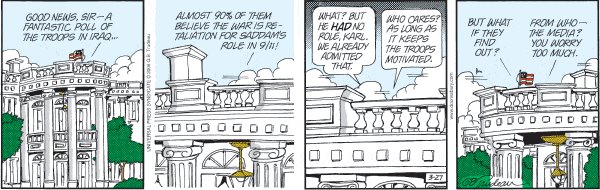
Click pic for larger image
Scalia: Guantanamo inmates have "no rights"
By Rachel Neumann
Posted on March 27, 2006
http://www.alternet.org/bloggers/rachel/34107/
Starting this week, the Supreme Court is supposed to be objectively and impartially hearing arguments in the case of Hamdan v. Rumsfeld, on the legality of the U.S.'s military tribunals for Guantanamo detainees. These detainees, who have been held for years without charges or access to lawyers, are not given access to full representation and jury trials.
One Justice, Antonin Scalia, has apparently already made up his mind about the detainees. In an unpublicized talk to a Swiss audience, documented by Newsweek, Scalia called their claims "crazy" and said detainees have no rights either under the U.S. Constitution or under international law.
Although only 5 percent of the Guantnamo detainees were captured by U.S. forces, for Scalia, this time it's personal:
If Scalia doesn't recuse himself, his vote will be considered suspect. Much comfort that will give Hamdan and the other detainees who believed in U.S. justice enough to hope for a fair hearing.
Posted on March 27, 2006
http://www.alternet.org/bloggers/rachel/34107/
Starting this week, the Supreme Court is supposed to be objectively and impartially hearing arguments in the case of Hamdan v. Rumsfeld, on the legality of the U.S.'s military tribunals for Guantanamo detainees. These detainees, who have been held for years without charges or access to lawyers, are not given access to full representation and jury trials.
One Justice, Antonin Scalia, has apparently already made up his mind about the detainees. In an unpublicized talk to a Swiss audience, documented by Newsweek, Scalia called their claims "crazy" and said detainees have no rights either under the U.S. Constitution or under international law.
Although only 5 percent of the Guantnamo detainees were captured by U.S. forces, for Scalia, this time it's personal:
If he was captured by my army on a battlefield, that is where he belongs. I had a son on that battlefield and they were shooting at my son and I'm not about to give this man who was captured in a war a full jury trial. I mean it's crazy.
If Scalia doesn't recuse himself, his vote will be considered suspect. Much comfort that will give Hamdan and the other detainees who believed in U.S. justice enough to hope for a fair hearing.
Wednesday, March 22, 2006
Remember, God Kills A Kitten...
As far as I'm concerned, this works with the Democrats as well - the other "choice" in our faux, corporate whore democracy.

Click on image for larger pic...

Click on image for larger pic...
Monday, March 20, 2006
Feds Okay Plan to Deny Remote Polling for Katrina Refugees
by Jessica Azulay, NewStandard
Mar. 20 – What was good enough for mostly well-to-do, pro-Western Iraqi expatriates living in the United States is apparently too good for the mostly black and poor New Orleanians displaced by Hurricane Katrina.
On Thursday, the US Justice Department authorized state and local plans for carrying out the New Orleans primaries on April 22. In votes postponed from February 4, the city will vote on mayoral, city council and other local primary races. Though the plans include setting up polling stations throughout Louisiana, remote balloting will not be available in other states with high concentrations of hurricane survivors.
In effect, displaced New Orleanians will not enjoy the same level of polling access that the federal government provided last year to Iraqi expatriates, who cast ballots for the Iraqi legislative elections in five cities across the United States.
By contrast, even Southern cities like Atlanta and Houston, which host high numbers of Katrina refugees, will not host polling stations for storm-affected New Orleanians outside of Louisiana.
Civil rights groups had been urging the Justice Department to overrule the plans, saying they will disenfranchise thousands of voters.
"The current elections plan is a formula for problems and disaster," National Urban League President Marc Morial told the Associated Press.
Under the voting plan, displaced New Orleanians scattered in other states would still be able to send in absentee ballots. But opponents of the plan say absentee ballots are unfairly cumbersome. Would-be voters must request a ballot ahead of time, fill it out correctly, sign it in front of a notary or witnesses, and send it back before April 21. Voting-rights advocates say they fear the complexity of the process will lead to the disqualification of many absentee ballots.
They also worry that candidates will not have an opportunity to present their platforms to constituents without reliable lists of addresses for registered voters. The Urban League is urging the Federal Emergency Management Agency (FEMA) to make its comprehensive lists of hurricane survivors addresses available to registered candidates.
In a statement last Friday, the NAACP urged Louisiana Governor Kathleen Blanco to put off next month's election by executive order ''until clear and measurable procedures are put in place to ensure all New Orleans voters, regardless of demographical location, will be able to fully and freely exercise their constitutional right to vote."
NAACP President Bruce S. Gordon wrote to the governor: "Historically, the extension of voting rights to black citizens in Louisiana has been strongly resisted, whether through literacy tests, poll taxes or other formal and informal practices combined to keep black voting rates in the state low. The impact of Hurricane Katrina now threatens Louisiana's African-American citizens' voting right in equally devastating ways."
Article...
Mar. 20 – What was good enough for mostly well-to-do, pro-Western Iraqi expatriates living in the United States is apparently too good for the mostly black and poor New Orleanians displaced by Hurricane Katrina.
On Thursday, the US Justice Department authorized state and local plans for carrying out the New Orleans primaries on April 22. In votes postponed from February 4, the city will vote on mayoral, city council and other local primary races. Though the plans include setting up polling stations throughout Louisiana, remote balloting will not be available in other states with high concentrations of hurricane survivors.
In effect, displaced New Orleanians will not enjoy the same level of polling access that the federal government provided last year to Iraqi expatriates, who cast ballots for the Iraqi legislative elections in five cities across the United States.
By contrast, even Southern cities like Atlanta and Houston, which host high numbers of Katrina refugees, will not host polling stations for storm-affected New Orleanians outside of Louisiana.
Civil rights groups had been urging the Justice Department to overrule the plans, saying they will disenfranchise thousands of voters.
"The current elections plan is a formula for problems and disaster," National Urban League President Marc Morial told the Associated Press.
Under the voting plan, displaced New Orleanians scattered in other states would still be able to send in absentee ballots. But opponents of the plan say absentee ballots are unfairly cumbersome. Would-be voters must request a ballot ahead of time, fill it out correctly, sign it in front of a notary or witnesses, and send it back before April 21. Voting-rights advocates say they fear the complexity of the process will lead to the disqualification of many absentee ballots.
They also worry that candidates will not have an opportunity to present their platforms to constituents without reliable lists of addresses for registered voters. The Urban League is urging the Federal Emergency Management Agency (FEMA) to make its comprehensive lists of hurricane survivors addresses available to registered candidates.
In a statement last Friday, the NAACP urged Louisiana Governor Kathleen Blanco to put off next month's election by executive order ''until clear and measurable procedures are put in place to ensure all New Orleans voters, regardless of demographical location, will be able to fully and freely exercise their constitutional right to vote."
NAACP President Bruce S. Gordon wrote to the governor: "Historically, the extension of voting rights to black citizens in Louisiana has been strongly resisted, whether through literacy tests, poll taxes or other formal and informal practices combined to keep black voting rates in the state low. The impact of Hurricane Katrina now threatens Louisiana's African-American citizens' voting right in equally devastating ways."
Article...
Sunday, March 19, 2006
Does Anyone Give a Damn?
ZNet Commentary
By Saul Landau
Commentaries are a premium sent to Sustainer Donors of Z/ZNet. To learn more folks can consult ZNet at http://www.zmag.org
"We gave him [Saddam Hussein] a chance to allow the inspectors in, and he wouldn't let them in."
Bush Press Conference, 7/14/2003
Fact: On September 21, 2002, Saddam said the UN inspectors could return to Iraq to search for possible weapons violations. They searched from December 2002 to March 2003 and found nothing.
"Any time you hear the United States government talking about wiretap, it requires --a wiretap requires a court order. Nothing has changed, by the way. When we're talking about chasing down terrorists, we're talking about getting a court order before we do so." President Bush, April 20, 2004
Fact: Bush authorized wiretaps without court orders.
So Bush lied! But only about making war and invading citizens' privacy, not about truly important themes. Bush would never have claimed he didn't have "sex with that woman," like his predecessor did. Shame on Bill Clinton for prevaricating on the most important subject in the world!
The Bushies only lie about issues concerning public policy and the extension of executive power. On February 6, as he verbally tried to fib his way out of unseemly behavior he claimed necessary to fight terrorism, Attorney General Alberto Gonzalez looked a tad uncomfortable. On the C-Span camera, before the Senate Judiciary Committee, Gonzalez dissembled with soft spoken language and a smile about Bush's electronic eavesdropping program. Gonzalez made it sound as if nothing serious had happened because of what he portrayed as a very limited wiretapping operation that focused only on international calls involving people with known links to Al Qaeda. He refused to answer Senator Patrick Leahy [D-VT], who asked if Bush had also authorized the opening of citizens' mail.
Gonzalez also did not explain why the Administration circumvented the Foreign Intelligence Surveillance Act (FISA), since the court established by this act would have automatically granted warrants to listen in on anyone even vaguely linked to Al Qaeda.
Indeed, the court has historically granted some 99% of the warrants the government has asked for. Some Senators strongly hinted that the Bush Administration didn't ask for warrants because their targets for snooping involved people with no links to terrorism and whose phone calls were inside the country, if not inside a single city or office building: the personal and political enemies of George W. Bush, family and friends. Senators Chuck Schumer (D-NY) and Richard Durbin (D-IL) stopped just short of such an accusation.
Other Senators referred to a New York Times story that quoted FBI Agents complaining that they had spent endless days investigating NSA intercepts of tens of thousands of calls. These so-called "leads" had led nowhere.
Most serious political analysts would not show surprise that the Bush efforts amounted to massive wheel spinning. The intercepts yielded no warnings about the Madrid or London bombings, for example. They have not helped solve the 2001 anthrax episodes when the lethal powder showed up in Congress and other places and killed US citizens.
The Bush record shows failure and incompetence. Nevertheless, for five plus years, Bush has maintained an aggressive and audacious style that has with some success covered up his failure to forge viable policies.
Incompetence and lack of planning have led to Bush's most devastating failure, the ongoing killing and escalating horror in Iraq. For 2007, Bush proposed $439.3 billion for defense (not counting Iraq and Afghanistan costs), while cutting Medicare and other vital programs. Thus far, we have not heard wild and angry protests from the Democrats.
The US dead count climbs slowly toward 3000; wounded to 20,000. The number of Iraqi dead and wounded, according to reputable journals, has surpassed 100,000. Iraqis have no security, little electricity or water, and not even gasoline for their cars. The daily bomb attacks, kidnappings and firefights amidst shortages of necessities have made life in that "liberated" country a living hell. Those appointed by Bush to manage Iraq had one thing in common: incompetence and loyalty to the President.
No one but a hermit could have failed to see the feeble attempts of the Bush Administration to provide help for those devastated by last year's hurricanes.
After failing to fulfill his promise to privatize social security, Bush did continue to deliver immense tax breaks for those who least needed them. This success for the few helped to skew further the income gap in the country and bring more hardship for the many. The US savings rate has dropped to its lowest point in nearly 13 years.
Early February polls showed that finally the message had filtered through the distracting nets of "I'm protecting you from terrorism" rhetoric and the mesmerizing messages to shop eternally to gain tranquility.
The public now acknowledges that Bush has failed them. Indeed, most Americans would be hard put to identify one successful policy that the Administration has implemented. No child left behind has led many behind. Cheap drugs for seniors has meant confusion for most seniors and the refusal of the FDA to license reduced price generic drugs. Indeed, the FDA bosses represent the pharmaceutical companies far more effectively than they do older America.
Rebuilding New Orleans? Bush doesn't believe in nation-building, even at home. Bush has made enemies among people around the world, depleted the Treasury, furthered the worsening of the environment and alienated even governments that traditionally backed the United States--right or wrong.
Thanks to free trade flummery, Bush's clinging to the notion that US-backed trade policies will deliver prosperity, Latin America's poor have become ever more anti-Yankee. In November 2005, Bush suffered a humiliating rejection at the Mar del Plata Argentina Hemispheric meting where he clung to the very policies that had destroyed the Argentine economy. Indeed, Latin Americans elected several governments on platforms that defy US hegemony in the region (Venezuela, Brazil, Argentina and Bolivia as some examples).
After five years of waging aggressive audacity instead of policy at home and abroad, Bush still faced the nation during his late January speech with not only a look of confidence but claims that had no relation to fact or truth. He wanted to cure the nation's addiction to oil while cutting funds to investigate alternative energy.
Indeed, no viable energy plan has emerged from the Administration, despite Vice President Cheney's adamant refusal to let Congress see documents about his energy discussions with ENRON executives in 2001 that related to forging such a policy.
The Bushies' substitution of chutzpah for policy, however, has its own logic--albeit the logic of banality. As with most Administrations, Bush has gathered various factions, all of whom benefit from his "war on terror." The Karl Rove gang wants to concentrate "power in the executive and pack[ing] the Supreme Court to this effect," wrote former Reagan Assistant Treasury Secretary Paul Craig Roberts. "The neocons are using the war to achieve their agenda of Israeli hegemony in the Middle East.
Police agencies are using the war to remove constraints on their powers and to make themselves less accountable. Republicans are using the war to achieve one-party rule--theirs. The Bush administration is using the war to avoid accountability and evade constraints on executive powers. Arms industries, or what President Eisenhower called the "military-industrial complex," are using the war to fatten profitsThe lack of debate gives carte blanche to these agendas. One certainty prevails. Bush is committing America to a path of violence and coercion, and he is getting away with it." (Counterpunch.org Feb. 6)
While Senate Democrats inexplicably stopped short of confronting Gonzalez as they had shied away from Judge Samuel Alito two weeks before, the Bush Administration continued to pursue its ruthless power game.
Who really felt the invasion of privacy?
Albert Kuydher's phone has not worked properly for four plus years, he has noticed personal letters opened and not carefully resealed and, while vacuuming, he noticed the presence of strange looking metallic objects placed under his furniture.
Mr. Kuydher even noticed people wearing raincoats and dark glasses sitting in parked cars outside of his apartment. Other individuals routinely followed him to work and back and to other places.
Say Al Kuyhder quickly and, well, you know the rest. You can imagine what happened when a police equivalent of former FEMA head Michael Brown got an NSA report on this man.
Yes, it's a joke, but not as cruel a prank as the one Bush has played on the people for five years--one the Democrats don't seem to have the will and stamina to stop. But I keep hoping...
Saul Landau is a fellow at the Institute for Policy Studies.
By Saul Landau
Commentaries are a premium sent to Sustainer Donors of Z/ZNet. To learn more folks can consult ZNet at http://www.zmag.org
"We gave him [Saddam Hussein] a chance to allow the inspectors in, and he wouldn't let them in."
Bush Press Conference, 7/14/2003
Fact: On September 21, 2002, Saddam said the UN inspectors could return to Iraq to search for possible weapons violations. They searched from December 2002 to March 2003 and found nothing.
"Any time you hear the United States government talking about wiretap, it requires --a wiretap requires a court order. Nothing has changed, by the way. When we're talking about chasing down terrorists, we're talking about getting a court order before we do so." President Bush, April 20, 2004
Fact: Bush authorized wiretaps without court orders.
So Bush lied! But only about making war and invading citizens' privacy, not about truly important themes. Bush would never have claimed he didn't have "sex with that woman," like his predecessor did. Shame on Bill Clinton for prevaricating on the most important subject in the world!
The Bushies only lie about issues concerning public policy and the extension of executive power. On February 6, as he verbally tried to fib his way out of unseemly behavior he claimed necessary to fight terrorism, Attorney General Alberto Gonzalez looked a tad uncomfortable. On the C-Span camera, before the Senate Judiciary Committee, Gonzalez dissembled with soft spoken language and a smile about Bush's electronic eavesdropping program. Gonzalez made it sound as if nothing serious had happened because of what he portrayed as a very limited wiretapping operation that focused only on international calls involving people with known links to Al Qaeda. He refused to answer Senator Patrick Leahy [D-VT], who asked if Bush had also authorized the opening of citizens' mail.
Gonzalez also did not explain why the Administration circumvented the Foreign Intelligence Surveillance Act (FISA), since the court established by this act would have automatically granted warrants to listen in on anyone even vaguely linked to Al Qaeda.
Indeed, the court has historically granted some 99% of the warrants the government has asked for. Some Senators strongly hinted that the Bush Administration didn't ask for warrants because their targets for snooping involved people with no links to terrorism and whose phone calls were inside the country, if not inside a single city or office building: the personal and political enemies of George W. Bush, family and friends. Senators Chuck Schumer (D-NY) and Richard Durbin (D-IL) stopped just short of such an accusation.
Other Senators referred to a New York Times story that quoted FBI Agents complaining that they had spent endless days investigating NSA intercepts of tens of thousands of calls. These so-called "leads" had led nowhere.
Most serious political analysts would not show surprise that the Bush efforts amounted to massive wheel spinning. The intercepts yielded no warnings about the Madrid or London bombings, for example. They have not helped solve the 2001 anthrax episodes when the lethal powder showed up in Congress and other places and killed US citizens.
The Bush record shows failure and incompetence. Nevertheless, for five plus years, Bush has maintained an aggressive and audacious style that has with some success covered up his failure to forge viable policies.
Incompetence and lack of planning have led to Bush's most devastating failure, the ongoing killing and escalating horror in Iraq. For 2007, Bush proposed $439.3 billion for defense (not counting Iraq and Afghanistan costs), while cutting Medicare and other vital programs. Thus far, we have not heard wild and angry protests from the Democrats.
The US dead count climbs slowly toward 3000; wounded to 20,000. The number of Iraqi dead and wounded, according to reputable journals, has surpassed 100,000. Iraqis have no security, little electricity or water, and not even gasoline for their cars. The daily bomb attacks, kidnappings and firefights amidst shortages of necessities have made life in that "liberated" country a living hell. Those appointed by Bush to manage Iraq had one thing in common: incompetence and loyalty to the President.
No one but a hermit could have failed to see the feeble attempts of the Bush Administration to provide help for those devastated by last year's hurricanes.
After failing to fulfill his promise to privatize social security, Bush did continue to deliver immense tax breaks for those who least needed them. This success for the few helped to skew further the income gap in the country and bring more hardship for the many. The US savings rate has dropped to its lowest point in nearly 13 years.
Early February polls showed that finally the message had filtered through the distracting nets of "I'm protecting you from terrorism" rhetoric and the mesmerizing messages to shop eternally to gain tranquility.
The public now acknowledges that Bush has failed them. Indeed, most Americans would be hard put to identify one successful policy that the Administration has implemented. No child left behind has led many behind. Cheap drugs for seniors has meant confusion for most seniors and the refusal of the FDA to license reduced price generic drugs. Indeed, the FDA bosses represent the pharmaceutical companies far more effectively than they do older America.
Rebuilding New Orleans? Bush doesn't believe in nation-building, even at home. Bush has made enemies among people around the world, depleted the Treasury, furthered the worsening of the environment and alienated even governments that traditionally backed the United States--right or wrong.
Thanks to free trade flummery, Bush's clinging to the notion that US-backed trade policies will deliver prosperity, Latin America's poor have become ever more anti-Yankee. In November 2005, Bush suffered a humiliating rejection at the Mar del Plata Argentina Hemispheric meting where he clung to the very policies that had destroyed the Argentine economy. Indeed, Latin Americans elected several governments on platforms that defy US hegemony in the region (Venezuela, Brazil, Argentina and Bolivia as some examples).
After five years of waging aggressive audacity instead of policy at home and abroad, Bush still faced the nation during his late January speech with not only a look of confidence but claims that had no relation to fact or truth. He wanted to cure the nation's addiction to oil while cutting funds to investigate alternative energy.
Indeed, no viable energy plan has emerged from the Administration, despite Vice President Cheney's adamant refusal to let Congress see documents about his energy discussions with ENRON executives in 2001 that related to forging such a policy.
The Bushies' substitution of chutzpah for policy, however, has its own logic--albeit the logic of banality. As with most Administrations, Bush has gathered various factions, all of whom benefit from his "war on terror." The Karl Rove gang wants to concentrate "power in the executive and pack[ing] the Supreme Court to this effect," wrote former Reagan Assistant Treasury Secretary Paul Craig Roberts. "The neocons are using the war to achieve their agenda of Israeli hegemony in the Middle East.
Police agencies are using the war to remove constraints on their powers and to make themselves less accountable. Republicans are using the war to achieve one-party rule--theirs. The Bush administration is using the war to avoid accountability and evade constraints on executive powers. Arms industries, or what President Eisenhower called the "military-industrial complex," are using the war to fatten profitsThe lack of debate gives carte blanche to these agendas. One certainty prevails. Bush is committing America to a path of violence and coercion, and he is getting away with it." (Counterpunch.org Feb. 6)
While Senate Democrats inexplicably stopped short of confronting Gonzalez as they had shied away from Judge Samuel Alito two weeks before, the Bush Administration continued to pursue its ruthless power game.
Who really felt the invasion of privacy?
Albert Kuydher's phone has not worked properly for four plus years, he has noticed personal letters opened and not carefully resealed and, while vacuuming, he noticed the presence of strange looking metallic objects placed under his furniture.
Mr. Kuydher even noticed people wearing raincoats and dark glasses sitting in parked cars outside of his apartment. Other individuals routinely followed him to work and back and to other places.
Say Al Kuyhder quickly and, well, you know the rest. You can imagine what happened when a police equivalent of former FEMA head Michael Brown got an NSA report on this man.
Yes, it's a joke, but not as cruel a prank as the one Bush has played on the people for five years--one the Democrats don't seem to have the will and stamina to stop. But I keep hoping...
Saul Landau is a fellow at the Institute for Policy Studies.
Recent Surge In Violence...
This was put together by one of the administrators of the web forum DemocraticUnderground, who noticed that news reports out of Iraq seem to continuously use the phrase "a recent surge of violence" to describe what is happening there. Feast:
2003
Middle East Online, September 3, 2003: "Meanwhile, Chancellor Gerhard Schroeder and French President Jacques Chirac were to meet in Germany on Thursday to discuss ways for the West to respond to the recent surge in violence in Iraq and the Middle East."
UK Telegraph, October 31, 2003: "Ansar is believed to be channeling into Iraq the foreign fighters who are behind a recent surge in violence in the country, officials say."
KNI News, November 3, 2003: "Bush blamed loyalists to ousted Iraqi President Saddam Hussein and foreign terrorists for the recent surge in violence in Iraq."
2004
Reuters, March 4, 2004: "A wave of bomb attacks in Baghdad and Karbala killing at least 171 people earlier this week has highlighted the difficulties in rebuilding the country and restoring peace. But Mr. Blair, speaking after a meeting in Rome with his Italian counterpart, Silvio Berlusconi, said the recent surge in violence in Iraq did not constitute civil war."
Radio Free Europe, April 14, 2004: "US President George W. Bush held a major news conference at the White House on 13 April in the middle of the deadliest month for Americans in Iraq since Baghdad fell a year ago. He spoke of the recent surge in violence there, but urged his countrymen not to lose faith. He also said he would adhere to the 30 June deadline for handing over sovereignty to Iraqis."
US State Department, April 15, 2004: "Pace said the recent surge in violence in Iraq is being driven by 'terrorists' who see the June 30 deadline for turnover of sovereignty approaching rapidly and are petrified by the promise of democracy."
CBS News, April 26, 2004: "Lt. Gen. David Barno, the top American commander in Afghanistan, said Monday that the military has seen a recent surge in violence, but that most attacks were directed against soft targets, such as civilians or isolated Afghan security outposts."
Pew Research Center, May 12, 2004: "Despite the prison abuse scandal and the recent surge in violence in Iraq, a majority of the public (53%) continues to support keeping troops in Iraq until a stable government is established."
China Daily, May 25, 2004: "In his speech to the Army War College here, Bush warned that 'there are difficult days ahead and the way forward may sometimes appear chaotic.' Yet he vowed the handover would take place on schedule and that the US-led coalition would not be defeated by insurgents blamed for the recent surge in violence."
The New Standard, June 24, 2004: "Compelled by the recent surge in violence, US Central Command (CentCom) has informally asked Army planners for as many as 25,000 more troops in Iraq, the Baltimore Sun reports."
The Washington Post, July 22, 2004: "Despite a recent surge in violence, including kidnappings, car bombings and assassinations, senior US and Iraqi officials gave a relatively optimistic assessment on Wednesday of the security situation in Iraq since the transfer of political authority from US to Iraqi authorities June 28."
Progress Magazine, July/August, 2004: "In the short term, ongoing help will be required with the maintenance of security within the country. The response to the recent surge in violence must emphasize political solutions and not be just a simple deployment of military power."
The Washington Post, September 9, 2004: "'The recent surge in violence has been especially surprising because in the weeks after the transfer of power there was a phase that, for Iraq, felt to some almost like a lull.'"
Al Jazeera, September 17, 2004: "The assessments, made before the recent surge in violence in Iraq and the US military death toll there topping 1000, appear to conflict with Bush's upbeat description of the US-led effort to stabilize and democratize Iraq."
The Washington Times, September 22, 2004: "The Iraqi leader also said that despite a recent surge in violence in Iraq, it is 'very important for the people of the world really to know that we are winning, we are making progress in Iraq, we are defeating terrorists.'"
Al Jazeera, December 18, 2004: "Mosul has experienced a recent surge in violence. On Friday, a car carrying Turkish security guards was attacked in the city, in Iraq's far north near the Turkish border, and four people were killed, one of them decapitated."
2005
Radio Free Europe, January 4, 2005: "The incident marks the most senior assassination since the death in May of Governing Council president Abd al-Zahra Uthman Muhammad and should be seen within the context of the recent surge in violence ahead of national and provincial elections slated for 30 January."
CBS Chicago, January 17, 2005: "The area around Kut has seen a recent surge in violence. In a separate attack, two Iraqi provincial government auditors were shot to death late Sunday after armed gunmen stopped their car in Suwaira, about 25 miles southeast of Baghdad, an official at a Kut hospital said."
ABC News, March 2, 2005: "Most of the victims were Shiites, the targets of a recent surge in violence, most notably a series of suicide bombings and other attacks that killed nearly 100 people during the Shiite religious commemoration known as Ashoura."
The BBC, April 27, 2005: "But he added it was too early to say if a recent surge in violence amounted to a concerted campaign, and insisted that US-backed forces were 'winning.'"
The International Herald-Tribune, May 16, 2005: "The insurgents' choice of adversary is unusual. But the recent surge in violence, at least, follows a time-tested pattern."
The Washington Post, May 19, 2005: "A senior US military official told reporters Wednesday that the recent surge in violence in Iraq followed a meeting in Syria last month of associates of the Jordanian insurgent leader Abu Musab Zarqawi."
The Council on Foreign Relations, May 20, 2005: "It's unclear how much of the recent surge in violence stems from tribal leaders, but as Metz points out: 'Local elites recognize that in a secular, modernized Iraq, their power would be challenged.'"
Salon, May 23, 2005: "Even despite the recent surge in violence, in some areas - downtown Mosul, for example - Iraqi forces have begun limited independent operations."
Associated Press, June 17, 2005: "It is also believed to be the main hideout of Abu Musab al-Zarqawi, the Jordanian militant whose al Qaeda-linked group has carried out many of the deadliest attacks in Iraq and who US forces believe is behind a recent surge in violence."
White House press conference, June 20, 2005: "Mr. President, we were told that you planned to sharpen your focus on Iraq. Why did this become necessary? And given the recent surge in violence, do you agree with Vice President Dick Cheney's assessment that the insurgency is in its last throes?"
Iran Focus Online, August 4, 2005: "His comments came as the 15-nation council unanimously adopted a US-drafted resolution condemning a recent surge in violence in Iraq that has killed hundreds ..."
Radio Free Europe, August 12, 2005: "But a recent surge in violence and reports of growing public hostility to the Japanese presence are prompting many to question the prospects for continued humanitarian assistance there."
Associated Press, September 17, 2005: "Abu Musab al-Zarqawi, leader of al Qaeda in Iraq, has reportedly said the recent surge in violence is in retaliation for a coalition offensive against the group's stronghold in the northern city of Tal Afar."
The Washington Times, October 31, 2005: "The fresh US effort to crack down on insurgents followed a recent surge in violence caused by the passing of the new Iraqi constitution in a referendum held earlier this month."
2006
Agence France Presse, January 7, 2006: "US officials have sought to downplay a recent surge in violence that on Thursday alone claimed the lives of more than 115 Iraqis and 11 US servicemen."
The Sidney Morning Herald, January 8, 2006: "The recent surge in violence is "an anomaly" and Iraq is not on the verge of civil war, the top US commander there said yesterday, after one of the country's bloodiest days since the fall of Saddam Hussein."
The American Chronicle, February 1, 2006: "Recently, five other members of Congress and I sat on a C-130 transport plane surrounded by soldiers going from Kuwait to Baghdad. The backdrop is a recent surge in violence."
The Associated Press, February 4, 2006: "Dozens of bodies have been discovered in various parts of Baghdad gagged, bound and shot repeatedly in the past week, amid recent surge in violence, which analysts have repeatedly described as initial stages of an open-ended civil war between Iraq's ethnic groups."
Associated Press, March 1, 2006: "AP reports that he was giving an unusually frank assessment of the stakes in the country's recent surge in violence."
The Baltimore Sun, March 4, 2006: "The top US commander in Iraq said yesterday that he hopes to make an assessment this spring about whether to reduce the number of American troops in Iraq. But Pentagon officials speaking anonymously said a recent surge in violence there has dampened hopes that force levels can be cut anytime soon."
Associated Press, March 6, 2006: "The training at the desert village is especially important for the Marines of the First Battalion, 14th Marine Regiment, 4th Marine Division. The battalion, made up mostly of Marine reservists, is leaving soon for Iraq, where sectarian tensions have brought a recent surge in violence - and growing concerns about civil war."
Reuters, March 10, 2006: "Iraqi forces, not American troops, would deal with a civil war if one erupts in Iraq and US troop cuts remained possible despite a recent surge in violence, Defense Secretary Donald Rumsfeld said on Thursday."
Al Jazeera, March 11, 2006: "Moving to the recent surge in violence that has swept Iraq, Ritter said he wasn't surprised as the only thing holding the three infighting ethnic and religious groups (Kurds, Shia, and Sunnis) together since the end of the Ottoman Empire after World War I was Saddam Hussein's Ba'athist Party."
The New York Times, March 13, 2006: "Despite the recent surge in violence in Iraq, Mr. Reid said he believed that civil war was "neither imminent nor inevitable." He said Iraqi security forces now numbered around 235,000, with 5,000 more volunteering to join every month."
There you have it, folks. There isn't anything to worry about in Iraq. It has only been a "recent surge of violence" we have been hearing about ... every week for the last three years since this whole catastrophe was first undertaken. Have no fear, though. As Army General George Casey states in the January 8, 2006, article above, "This level of violence, I think as we've seen, is an anomaly." George can keep right on admiring his rug.
2003
Middle East Online, September 3, 2003: "Meanwhile, Chancellor Gerhard Schroeder and French President Jacques Chirac were to meet in Germany on Thursday to discuss ways for the West to respond to the recent surge in violence in Iraq and the Middle East."
UK Telegraph, October 31, 2003: "Ansar is believed to be channeling into Iraq the foreign fighters who are behind a recent surge in violence in the country, officials say."
KNI News, November 3, 2003: "Bush blamed loyalists to ousted Iraqi President Saddam Hussein and foreign terrorists for the recent surge in violence in Iraq."
2004
Reuters, March 4, 2004: "A wave of bomb attacks in Baghdad and Karbala killing at least 171 people earlier this week has highlighted the difficulties in rebuilding the country and restoring peace. But Mr. Blair, speaking after a meeting in Rome with his Italian counterpart, Silvio Berlusconi, said the recent surge in violence in Iraq did not constitute civil war."
Radio Free Europe, April 14, 2004: "US President George W. Bush held a major news conference at the White House on 13 April in the middle of the deadliest month for Americans in Iraq since Baghdad fell a year ago. He spoke of the recent surge in violence there, but urged his countrymen not to lose faith. He also said he would adhere to the 30 June deadline for handing over sovereignty to Iraqis."
US State Department, April 15, 2004: "Pace said the recent surge in violence in Iraq is being driven by 'terrorists' who see the June 30 deadline for turnover of sovereignty approaching rapidly and are petrified by the promise of democracy."
CBS News, April 26, 2004: "Lt. Gen. David Barno, the top American commander in Afghanistan, said Monday that the military has seen a recent surge in violence, but that most attacks were directed against soft targets, such as civilians or isolated Afghan security outposts."
Pew Research Center, May 12, 2004: "Despite the prison abuse scandal and the recent surge in violence in Iraq, a majority of the public (53%) continues to support keeping troops in Iraq until a stable government is established."
China Daily, May 25, 2004: "In his speech to the Army War College here, Bush warned that 'there are difficult days ahead and the way forward may sometimes appear chaotic.' Yet he vowed the handover would take place on schedule and that the US-led coalition would not be defeated by insurgents blamed for the recent surge in violence."
The New Standard, June 24, 2004: "Compelled by the recent surge in violence, US Central Command (CentCom) has informally asked Army planners for as many as 25,000 more troops in Iraq, the Baltimore Sun reports."
The Washington Post, July 22, 2004: "Despite a recent surge in violence, including kidnappings, car bombings and assassinations, senior US and Iraqi officials gave a relatively optimistic assessment on Wednesday of the security situation in Iraq since the transfer of political authority from US to Iraqi authorities June 28."
Progress Magazine, July/August, 2004: "In the short term, ongoing help will be required with the maintenance of security within the country. The response to the recent surge in violence must emphasize political solutions and not be just a simple deployment of military power."
The Washington Post, September 9, 2004: "'The recent surge in violence has been especially surprising because in the weeks after the transfer of power there was a phase that, for Iraq, felt to some almost like a lull.'"
Al Jazeera, September 17, 2004: "The assessments, made before the recent surge in violence in Iraq and the US military death toll there topping 1000, appear to conflict with Bush's upbeat description of the US-led effort to stabilize and democratize Iraq."
The Washington Times, September 22, 2004: "The Iraqi leader also said that despite a recent surge in violence in Iraq, it is 'very important for the people of the world really to know that we are winning, we are making progress in Iraq, we are defeating terrorists.'"
Al Jazeera, December 18, 2004: "Mosul has experienced a recent surge in violence. On Friday, a car carrying Turkish security guards was attacked in the city, in Iraq's far north near the Turkish border, and four people were killed, one of them decapitated."
2005
Radio Free Europe, January 4, 2005: "The incident marks the most senior assassination since the death in May of Governing Council president Abd al-Zahra Uthman Muhammad and should be seen within the context of the recent surge in violence ahead of national and provincial elections slated for 30 January."
CBS Chicago, January 17, 2005: "The area around Kut has seen a recent surge in violence. In a separate attack, two Iraqi provincial government auditors were shot to death late Sunday after armed gunmen stopped their car in Suwaira, about 25 miles southeast of Baghdad, an official at a Kut hospital said."
ABC News, March 2, 2005: "Most of the victims were Shiites, the targets of a recent surge in violence, most notably a series of suicide bombings and other attacks that killed nearly 100 people during the Shiite religious commemoration known as Ashoura."
The BBC, April 27, 2005: "But he added it was too early to say if a recent surge in violence amounted to a concerted campaign, and insisted that US-backed forces were 'winning.'"
The International Herald-Tribune, May 16, 2005: "The insurgents' choice of adversary is unusual. But the recent surge in violence, at least, follows a time-tested pattern."
The Washington Post, May 19, 2005: "A senior US military official told reporters Wednesday that the recent surge in violence in Iraq followed a meeting in Syria last month of associates of the Jordanian insurgent leader Abu Musab Zarqawi."
The Council on Foreign Relations, May 20, 2005: "It's unclear how much of the recent surge in violence stems from tribal leaders, but as Metz points out: 'Local elites recognize that in a secular, modernized Iraq, their power would be challenged.'"
Salon, May 23, 2005: "Even despite the recent surge in violence, in some areas - downtown Mosul, for example - Iraqi forces have begun limited independent operations."
Associated Press, June 17, 2005: "It is also believed to be the main hideout of Abu Musab al-Zarqawi, the Jordanian militant whose al Qaeda-linked group has carried out many of the deadliest attacks in Iraq and who US forces believe is behind a recent surge in violence."
White House press conference, June 20, 2005: "Mr. President, we were told that you planned to sharpen your focus on Iraq. Why did this become necessary? And given the recent surge in violence, do you agree with Vice President Dick Cheney's assessment that the insurgency is in its last throes?"
Iran Focus Online, August 4, 2005: "His comments came as the 15-nation council unanimously adopted a US-drafted resolution condemning a recent surge in violence in Iraq that has killed hundreds ..."
Radio Free Europe, August 12, 2005: "But a recent surge in violence and reports of growing public hostility to the Japanese presence are prompting many to question the prospects for continued humanitarian assistance there."
Associated Press, September 17, 2005: "Abu Musab al-Zarqawi, leader of al Qaeda in Iraq, has reportedly said the recent surge in violence is in retaliation for a coalition offensive against the group's stronghold in the northern city of Tal Afar."
The Washington Times, October 31, 2005: "The fresh US effort to crack down on insurgents followed a recent surge in violence caused by the passing of the new Iraqi constitution in a referendum held earlier this month."
2006
Agence France Presse, January 7, 2006: "US officials have sought to downplay a recent surge in violence that on Thursday alone claimed the lives of more than 115 Iraqis and 11 US servicemen."
The Sidney Morning Herald, January 8, 2006: "The recent surge in violence is "an anomaly" and Iraq is not on the verge of civil war, the top US commander there said yesterday, after one of the country's bloodiest days since the fall of Saddam Hussein."
The American Chronicle, February 1, 2006: "Recently, five other members of Congress and I sat on a C-130 transport plane surrounded by soldiers going from Kuwait to Baghdad. The backdrop is a recent surge in violence."
The Associated Press, February 4, 2006: "Dozens of bodies have been discovered in various parts of Baghdad gagged, bound and shot repeatedly in the past week, amid recent surge in violence, which analysts have repeatedly described as initial stages of an open-ended civil war between Iraq's ethnic groups."
Associated Press, March 1, 2006: "AP reports that he was giving an unusually frank assessment of the stakes in the country's recent surge in violence."
The Baltimore Sun, March 4, 2006: "The top US commander in Iraq said yesterday that he hopes to make an assessment this spring about whether to reduce the number of American troops in Iraq. But Pentagon officials speaking anonymously said a recent surge in violence there has dampened hopes that force levels can be cut anytime soon."
Associated Press, March 6, 2006: "The training at the desert village is especially important for the Marines of the First Battalion, 14th Marine Regiment, 4th Marine Division. The battalion, made up mostly of Marine reservists, is leaving soon for Iraq, where sectarian tensions have brought a recent surge in violence - and growing concerns about civil war."
Reuters, March 10, 2006: "Iraqi forces, not American troops, would deal with a civil war if one erupts in Iraq and US troop cuts remained possible despite a recent surge in violence, Defense Secretary Donald Rumsfeld said on Thursday."
Al Jazeera, March 11, 2006: "Moving to the recent surge in violence that has swept Iraq, Ritter said he wasn't surprised as the only thing holding the three infighting ethnic and religious groups (Kurds, Shia, and Sunnis) together since the end of the Ottoman Empire after World War I was Saddam Hussein's Ba'athist Party."
The New York Times, March 13, 2006: "Despite the recent surge in violence in Iraq, Mr. Reid said he believed that civil war was "neither imminent nor inevitable." He said Iraqi security forces now numbered around 235,000, with 5,000 more volunteering to join every month."
There you have it, folks. There isn't anything to worry about in Iraq. It has only been a "recent surge of violence" we have been hearing about ... every week for the last three years since this whole catastrophe was first undertaken. Have no fear, though. As Army General George Casey states in the January 8, 2006, article above, "This level of violence, I think as we've seen, is an anomaly." George can keep right on admiring his rug.
Bush Increasingly Focused On How Revisionist History Will See Him (Satire...duh!)
From The Onion
http://www.theonion.com/content/node/46230
WASHINGTON, DC—With many of his administration's policies facing growing public disapproval, President Bush is reportedly becoming more concerned with how he will be portrayed by future revisionist historians.
"Just last summer, the president never reflected on how apologists would spin his increased lobbying for an unpopular war, or how future far-right generations would justify his failed domestic policy initiatives," presidential scholar Dr. Robert Dallek said. "He reportedly asked an aide if, decades from now, the deluded would see him as great, like Ronald Reagan, or merely as a fully redeemed elder statesman, like Richard Nixon."
Margaret Meehan, a spokesman for the National Board Of Historical Revision, offered no comment on any future portrayal of "America's most beloved and accomplished president."
http://www.theonion.com/content/node/46230
WASHINGTON, DC—With many of his administration's policies facing growing public disapproval, President Bush is reportedly becoming more concerned with how he will be portrayed by future revisionist historians.
"Just last summer, the president never reflected on how apologists would spin his increased lobbying for an unpopular war, or how future far-right generations would justify his failed domestic policy initiatives," presidential scholar Dr. Robert Dallek said. "He reportedly asked an aide if, decades from now, the deluded would see him as great, like Ronald Reagan, or merely as a fully redeemed elder statesman, like Richard Nixon."
Margaret Meehan, a spokesman for the National Board Of Historical Revision, offered no comment on any future portrayal of "America's most beloved and accomplished president."
On Articles of Impeachment (satire)
(from today's Doonesbury)
Section 4 of Article 2 of the Constitution gives lawmakers latitude. How much latitude? Well, consider the case of two presidents.
The first president initiates a bloody, costly, unending war on false premises and approves covert policies of illegal detention, kangaroo courts, extraordinary rendition, torture and warrantless wiretapping of thousands of Americans.
The second president lies about hooking up with an intern.
Question: Which one should be impeached?
Section 4 of Article 2 of the Constitution gives lawmakers latitude. How much latitude? Well, consider the case of two presidents.
The first president initiates a bloody, costly, unending war on false premises and approves covert policies of illegal detention, kangaroo courts, extraordinary rendition, torture and warrantless wiretapping of thousands of Americans.
The second president lies about hooking up with an intern.
Question: Which one should be impeached?
Saturday, March 18, 2006
THE PEOPLE DEFEATED THE ANTI-VENEZUELA MACK RESOLUTION!
Dear friends of Venezuela,
Following a massive outpouring of opposition, H. Con. Res. 328 (the Mack resolution) was withdrawn from the Subcommittee on Western Hemisphere Affairs in the House Committee on International Relations. Due for a vote today, Rep. Mack (R-FL) and his supporters pulled the resolution before a vote could take place. Clearly, they felt that the resolution would now fail.
In recent weeks the A.N.S.W.E.R. Coalition, VoteNoWar.org, the Venezuelan Information Office and others have campaigned against this resolution which paves the way for escalating U.S. intervention against Venezuela's democratic process.
Yesterday more than 10,000 letters were sent to Congress in just a few hours after the last A.N.S.W.E.R./ VoteNoWar.org appeal. Everyone who participated should feel proud. We must intensify our solidarity with the majority of people in Venezuela -- the 80% who live in poverty -- who are mobilizing a many-sided campaign for social, economic and political justice. They face an ever increasing threat from the U.S. government which seeks to maintain the power of the Venezuelan oligarchy and tiny ultra-rich elites who have dominated the country.
This is a congratulations to all for your participation in this campaign.
In solidarity with the people of Venezuela,
Brian Becker, National Coordinator, A.N.S.W.E.R. Coalition
Following a massive outpouring of opposition, H. Con. Res. 328 (the Mack resolution) was withdrawn from the Subcommittee on Western Hemisphere Affairs in the House Committee on International Relations. Due for a vote today, Rep. Mack (R-FL) and his supporters pulled the resolution before a vote could take place. Clearly, they felt that the resolution would now fail.
In recent weeks the A.N.S.W.E.R. Coalition, VoteNoWar.org, the Venezuelan Information Office and others have campaigned against this resolution which paves the way for escalating U.S. intervention against Venezuela's democratic process.
Yesterday more than 10,000 letters were sent to Congress in just a few hours after the last A.N.S.W.E.R./ VoteNoWar.org appeal. Everyone who participated should feel proud. We must intensify our solidarity with the majority of people in Venezuela -- the 80% who live in poverty -- who are mobilizing a many-sided campaign for social, economic and political justice. They face an ever increasing threat from the U.S. government which seeks to maintain the power of the Venezuelan oligarchy and tiny ultra-rich elites who have dominated the country.
This is a congratulations to all for your participation in this campaign.
In solidarity with the people of Venezuela,
Brian Becker, National Coordinator, A.N.S.W.E.R. Coalition
Wednesday, March 15, 2006
Poverty-Stricken Africans Receive Desperately Needed Bibles (Satire, you know...)
March 13, 2006, The Onion
http://www.theonion.com/content/node/46226
MARADI, NIGER—More than 60,000 urgently needed Bibles arrived to allay suffering throughout the famine-stricken nation of Niger Friday, in one of the largest humanitarian-relief operations ever attempted by a Christian ministry.
Africans
"Come rejoice, and feast upon the word of Our Lord, Jesus Christ," said Christina Clarkson, executive director of the Living Light Ministries of Lubbock, TX. "Those who were hungry, hunger no more, for the Word brings life."
An exuberant Clarkson said the Bible drop was the culmination of one of the largest and most aggressive grassroots fundraising drives ever undertaken by the organization, which was able to fund the mission largely through local charitable events, such as bake-offs, barbecues, and pie-eating contests.
"We absolutely would not be here today if it were not for the amazing generosity of the people back home," Clarkson said. "People everywhere opened up their hearts and checkbooks to us and said, 'Dig in.'"
Niger, ranked as the second-poorest nation on Earth, is experiencing its worst famine in more than 20 years, as a brutal drought last year was followed by a plague of crop-destroying locusts. An estimated 3.5 million of Niger's 12 million people are currently at risk of starvation.
"That's why it was so important for this mission to happen right now," said Clarkson. "So many people here are suffering. Disease, starvation, and lack of shelter are day-to-day realities in Niger. But once they hear the Good News of Jesus Christ and accept Him as their Lord and Savior—once they really take Him into their hearts—then they will see what poor comforts are the things of this world."
Due to the tireless efforts of Clarkson and other members of the congregation, the ministry was able to provide the needy with Bibles superior to the ones they use in their own church services.
"Handcrafted, genuine leather—best money can buy," said 61-year-old missionary Don Kostic as he ran his hand along the book's ornately embossed spine. "It's like my wife back home says: Nothing is too good for people who are ready to receive the Living Word of Christ."
Although the fundraising efforts were unprecedented, congregation members said Living Light would never have succeeded had they not obtained the generous support of an array of corporate sponsors, including Applebee's and Church's Fried Chicken.
"We spent so much money just to get here," Kostic continued. "After we had all the Bibles engraved, we still had to charter the plane. When we landed in Niamey, we could barely even afford ground transportation."
Undaunted, the missionaries purchased the best vehicle they could find, which turned out to be a used bread truck. "That old thing!" recalled Kostic, laughing. "We must've scrubbed it down a hundred times. You couldn't get the smell of freshly baked, vitamin-fortified bread out of it if your life depended on it."
Reaction among Niger residents has been mixed.
Moussa Yaouli, a 35-year-old farmer, was particularly interested to learn more about the doctrine of transubstantiation, which Living Light personnel told him involved the eating of wafers. "It is said to be a big wafer. I am sure it will feed many of my children."
Though "spiritually gratified" by their work, many of the missionaries spoke about the difficulties of working in an impoverished country.
"It can be so hard being away from the comfort of our homes and our loving families," Clarkson confided. "I will admit, there have been times when I prayed, 'Lord, just help me get through this mission and get me back to Texas!' But when we rolled into town and people started running after the truck with those big smiles on their faces, I couldn't help but smile back."
Clarkson added: "And when we opened up the back of the truck and they saw that it was full of Bibles... Grown men and women wept in front of their children. That's how moved they were by the Holy Spirit. That's how I know it's all been worth it."
Clarkson said her mission will succeed in bringing the people of Niger "the spiritual sustenance they've been deprived of," despite such obstacles as the nation's 18 percent literacy rate.
"You say you're suffering. I say, let the good Lord do the suffering for you," she said. "You say you're exhibiting the deleterious effects of severe dehydration and chronic malnutrition. And I say that no matter what ails you, the Holy Bible is the best medicine there is."
http://www.theonion.com/content/node/46226
MARADI, NIGER—More than 60,000 urgently needed Bibles arrived to allay suffering throughout the famine-stricken nation of Niger Friday, in one of the largest humanitarian-relief operations ever attempted by a Christian ministry.
Africans
"Come rejoice, and feast upon the word of Our Lord, Jesus Christ," said Christina Clarkson, executive director of the Living Light Ministries of Lubbock, TX. "Those who were hungry, hunger no more, for the Word brings life."
An exuberant Clarkson said the Bible drop was the culmination of one of the largest and most aggressive grassroots fundraising drives ever undertaken by the organization, which was able to fund the mission largely through local charitable events, such as bake-offs, barbecues, and pie-eating contests.
"We absolutely would not be here today if it were not for the amazing generosity of the people back home," Clarkson said. "People everywhere opened up their hearts and checkbooks to us and said, 'Dig in.'"
Niger, ranked as the second-poorest nation on Earth, is experiencing its worst famine in more than 20 years, as a brutal drought last year was followed by a plague of crop-destroying locusts. An estimated 3.5 million of Niger's 12 million people are currently at risk of starvation.
"That's why it was so important for this mission to happen right now," said Clarkson. "So many people here are suffering. Disease, starvation, and lack of shelter are day-to-day realities in Niger. But once they hear the Good News of Jesus Christ and accept Him as their Lord and Savior—once they really take Him into their hearts—then they will see what poor comforts are the things of this world."
Due to the tireless efforts of Clarkson and other members of the congregation, the ministry was able to provide the needy with Bibles superior to the ones they use in their own church services.
"Handcrafted, genuine leather—best money can buy," said 61-year-old missionary Don Kostic as he ran his hand along the book's ornately embossed spine. "It's like my wife back home says: Nothing is too good for people who are ready to receive the Living Word of Christ."
Although the fundraising efforts were unprecedented, congregation members said Living Light would never have succeeded had they not obtained the generous support of an array of corporate sponsors, including Applebee's and Church's Fried Chicken.
"We spent so much money just to get here," Kostic continued. "After we had all the Bibles engraved, we still had to charter the plane. When we landed in Niamey, we could barely even afford ground transportation."
Undaunted, the missionaries purchased the best vehicle they could find, which turned out to be a used bread truck. "That old thing!" recalled Kostic, laughing. "We must've scrubbed it down a hundred times. You couldn't get the smell of freshly baked, vitamin-fortified bread out of it if your life depended on it."
Reaction among Niger residents has been mixed.
Moussa Yaouli, a 35-year-old farmer, was particularly interested to learn more about the doctrine of transubstantiation, which Living Light personnel told him involved the eating of wafers. "It is said to be a big wafer. I am sure it will feed many of my children."
Though "spiritually gratified" by their work, many of the missionaries spoke about the difficulties of working in an impoverished country.
"It can be so hard being away from the comfort of our homes and our loving families," Clarkson confided. "I will admit, there have been times when I prayed, 'Lord, just help me get through this mission and get me back to Texas!' But when we rolled into town and people started running after the truck with those big smiles on their faces, I couldn't help but smile back."
Clarkson added: "And when we opened up the back of the truck and they saw that it was full of Bibles... Grown men and women wept in front of their children. That's how moved they were by the Holy Spirit. That's how I know it's all been worth it."
Clarkson said her mission will succeed in bringing the people of Niger "the spiritual sustenance they've been deprived of," despite such obstacles as the nation's 18 percent literacy rate.
"You say you're suffering. I say, let the good Lord do the suffering for you," she said. "You say you're exhibiting the deleterious effects of severe dehydration and chronic malnutrition. And I say that no matter what ails you, the Holy Bible is the best medicine there is."
"Girl" by Beck
"Girl"
I saw her, yeah I saw her with her black tongue tied
Round the roses
Fist pounding on a vending machine
Toy diamond ring stuck on her finger
With a noose she can hang from the sun
And put it out with her dark sunglasses
Walking crooked down the beach
She spits on the sand where their bones are bleaching
And I know I'm gonna steal her eye
She doesn't even know what's wrong
And I know I'm gonna make her die
Take her where her soul belongs
And I know I'm gonna steal her eye
Nothing that I wouldn't try
Hey, My sun-eyed girl
Hey, My sun-eyed girl
I saw her, yeah I saw her with her hands tied back
And her rags were burning
Crawling out from a landfilled life
Scrawlin her name upon the ceiling
Throw a coin in a fountain of dust
White noise, her ears are ringing
Got a ticket for a midnight hanging
Throw a bullet from a freight train leaving
And I know I'm gonna steal her eye
She doesn't even know what's wrong
And I know I'm gonna make her die
Take her where her soul belongs
And I know I'm gonna steal her eye
Nothing that I would not try
Hey, My sun-eyed girl
I saw her, yeah I saw her with her black tongue tied
Round the roses
Fist pounding on a vending machine
Toy diamond ring stuck on her finger
With a noose she can hang from the sun
And put it out with her dark sunglasses
Walking crooked down the beach
She spits on the sand where their bones are bleaching
And I know I'm gonna steal her eye
She doesn't even know what's wrong
And I know I'm gonna make her die
Take her where her soul belongs
And I know I'm gonna steal her eye
Nothing that I wouldn't try
Hey, My sun-eyed girl
Hey, My sun-eyed girl
I saw her, yeah I saw her with her hands tied back
And her rags were burning
Crawling out from a landfilled life
Scrawlin her name upon the ceiling
Throw a coin in a fountain of dust
White noise, her ears are ringing
Got a ticket for a midnight hanging
Throw a bullet from a freight train leaving
And I know I'm gonna steal her eye
She doesn't even know what's wrong
And I know I'm gonna make her die
Take her where her soul belongs
And I know I'm gonna steal her eye
Nothing that I would not try
Hey, My sun-eyed girl
Monday, March 13, 2006
Online activism is under attack by America Online
AOL has announced plans to charge a corporate "email tax" to guarantee access to user inboxes. Under this pay-to-send system, large emailers can bypass spam filters.
Under this scheme, charities, small businesses, civic organizing groups, and even families with mailing lists will be left with inferior Internet service unless they are willing to pay AOL's fee.
We need to stop AOL and send a message to other email providers -- such as Yahoo!, MSN and Google -- that imposing a similar "email tax" is a mistake.
Please sign the petition to AOL and forward it to your friends
http://action.freepress.net/campaign/dearaol
The petition urges AOL to stop auctioning off preferential access to people's inboxes: "The Internet is a force for free speech, democracy, and economic innovation because it is open and equally accessible to all Internet users. We must keep it a level playing field."
Sign the petition here:
http://action.freepress.net/campaign/dearaol
AOL's proposed pay-to-send system is the first step down a slippery slope that will harm the free flow of ideas and innovations on the Internet.
The "email tax" would actually reward AOL financially for failing to maintain its spam filtering service. This system could disrupt the communications of millions who cannot afford to pay their fees, while setting a dangerous precedent that other large email service providers will follow.
Stop AOL's "email tax" before it spreads.
Thank you,
Timothy Karr
Campaign Director
Free Press
www.freepress.net
P.S. Read the recent San Jose Mercury News editorial opposing AOL's "email tax."
Under this scheme, charities, small businesses, civic organizing groups, and even families with mailing lists will be left with inferior Internet service unless they are willing to pay AOL's fee.
We need to stop AOL and send a message to other email providers -- such as Yahoo!, MSN and Google -- that imposing a similar "email tax" is a mistake.
Please sign the petition to AOL and forward it to your friends
http://action.freepress.net/campaign/dearaol
The petition urges AOL to stop auctioning off preferential access to people's inboxes: "The Internet is a force for free speech, democracy, and economic innovation because it is open and equally accessible to all Internet users. We must keep it a level playing field."
Sign the petition here:
http://action.freepress.net/campaign/dearaol
AOL's proposed pay-to-send system is the first step down a slippery slope that will harm the free flow of ideas and innovations on the Internet.
The "email tax" would actually reward AOL financially for failing to maintain its spam filtering service. This system could disrupt the communications of millions who cannot afford to pay their fees, while setting a dangerous precedent that other large email service providers will follow.
Stop AOL's "email tax" before it spreads.
Thank you,
Timothy Karr
Campaign Director
Free Press
www.freepress.net
P.S. Read the recent San Jose Mercury News editorial opposing AOL's "email tax."
MUSIC & POLITICS
The sound of change;
the power of changes
Sam Smith
[This was the chart used to riff some comments at a performance by the punk rock group Blowback on March 10,2006 at the Club Asylum in DC's Adams Morgan]
WHEN he was 25, Colin Wilson wrote The Outsider, a book about those who see too deep and too much. I suspect some of you are here tonight. Wilson tells of a Jean Paul Sartre character who lives alone in a hotel:
"Of the café patron, he comments:
A few days later he reflects that "the nausea is not inside me; I feel it out there, in the wall . . . everywhere around me."
Here is a metaphor for our own time, living as we do so near to all "these eminent public men, so sure of themselves, so sure that life is theirs and their existence is necessary to it." And finding the nausea out there in a war, an ecological crisis, and the collapse of constitutional government.
I feel it. . . like an exile in my native town, a town partly occupied by guards who demand I prove I am not a terrorist and partly filled with people who seem just to be passing through the place as if it were the world's largest Marriot Hotel lobby.
But then in Sartre's café somebody puts on a record, a woman singing 'Some of These Days'. The nausea disappears and Roquinten says:
Wilson calls it art once again giving order and logic to chaos.
I have been a journalist and I have been a musician and one of the things I have learned is that there are times for words and then there are times when words fail, except the kind that are put to music, a time when music becomes the best politics.
For example, a few decades ago , a young boy named Andras was introduced to rock music while living in Denmark: " I didn't know what the underlying message was and I didn't care. I just thought this was something that I had to embrace."
Then he returned to his native Hungary to live with his aunt and uncle, who were conservative communists. And one night his uncle came in and took away the radio. Andras apologized for playing it so loud but the uncle said, ""The problem was not that it was loud. The problem was that you were listening to a Western radio station. . .
"Still, you had to keep going . . . It kept us sane. . . . As we listened to Radio Luxemburg, we were suddenly out of our bodies and our soul was part of the free world. . .
Someone would find a record in a shop and they would buy it and then make 500 copies. And Andras started a band. As he put it, "there was no way to stop . . . the message of freedom through rock and roll. . .
Andras told that story a few years ago at the Rock and Roll Hall of fame, but no longer as a young man, no longer a rocker but the Hungarian ambassador to the United States.
Similarly, when the Czech leader Vaclav Havel met Lou Reed in 1990 he told him, "Did you know that I am president because of you?" The Velvet Underground's first record had become so popular in Prague it had given the rebellion its name: "the Velvet Revolution."
In short, punk politics.
And then there was Rage Against the Machine: 1993. . . stands naked for 15 minutes without playing a note or singing in a protest against censorship. . . 1997. . . Well before most college students knew about the issue, Tom Morello is arrested during a protest against sweatshop labor. . . 2000: the LA police close down a Rage concert seen as a threat to the Democratic convention.
Or take traditional jazz, my music. During much of the 20th century jazz clubs were among the few places that whites and blacks shared socially. . . My own civil rights involvement had its roots in part in a music I loved. Among my records as a student in an all white high school was a Louis Armstrong song:
Even the mouse
Ran from your house
Laughed at you
And scorned you, too
What did I do
To be so black and blue?
Even earlier I had found a song in a book on my parents' piano:
I dreamt I saw Joe Hill last night
As live as you and me
But Joe, I said, you're ten years dead
I never died said he. I never died said he
The copper bosses shot you Joe,
They killed you Joe said I
What they forgot to kill, said Joe,
Went on to organize.
And years later, holding hands with those I knew only from their souls singing:
Deep in my heart
I do believe
We shall overcome
Some day
Or standing with tens of thousands on the Mall singing:
All we are saying is give peace a chance
Try it yourself. . .
You'll be amazed how much is in the MP3 playlist of your brain that has been guiding and driving you forward.
But there's another side as well. . .
About two weeks ago Itunes downloaded its one billionth song. Its one billionth reason for someone not to notice anything for awhile but to walk indifferently down the streets of our collapsing republic. One billion tunes and things are just getting worse.
It's a reminder that music can be a trap as well as a remedy, another way the system can take our minds off what is happening. Like the café patron, we can become contingent on events and if things stop happening, so do we. The police state can come through sedation as well as suppression.
But you can't stop playing. Billie Holiday could not have foreseen the civil rights revolution when she sang 'Strange Fruit' nor Joe Hill the modern labor movement. The human story gets better when people surrender their telepathic presumptions and simply do the right thing anyway.
In February 1960, four black college students sat down at a white-only Woolworths lunch counter in Greensboro, NC. Within two weeks, there were sit-ins in fifteen cities in five southern states and within two months they had spread to fifty four cities in nine states.
If that response had not occurred, would their sit-in have been without purpose? Or just not blessed?
We can not control the future but we can control how we react to every moment that passes by.
This is the lesson existentialism teaches us. We exist by our actions, our words, our art, and our music, whom and how we love. Existentialism has been called the philosophy that no one can take your shower for you. Or, for that matter, determine how you are going to respond to Iraq, to Bush, to the melting of the Antarctic. It is the philosophy that said that even a condemned man has a choice of how to approach the gallows. It is not a bad philosophy for our times.
Like a hit and run driver, America's elite has left the scene of the accident. They have become like those of whom Fitzgerald wrote in The Great Gatsby:
And through this all -- the unreal, the undemocratic, the cruel, the crowded, the rushed, and the uncritical -- the American outsider walks alone.
But its' always been like that. Behind every great social or political change has been the outsider -- those willing to seek to understand and alter what others just ward off with everything from religious sophistry to pop sophorifics, from IBelieve to ITunes. Those who find inspiration, globes of fire and rings of smoke in music rather than just a way to kill an hour. Those whose existence becomes the event rather than merely contingent upon the event. .
And if enough of us try hard enough and give our support to others who are doing likewise maybe one day we'll have our own Velvet Revolution, maybe we will find an asylum for our souls and our freedoms throughout the land rather than only in a few places like a club on 18th street.
Meanwhile thank those around you for what they have dared to think, thank the band for what it has dared to play, and thank yourself for what you have dared to be.
the power of changes
Sam Smith
[This was the chart used to riff some comments at a performance by the punk rock group Blowback on March 10,2006 at the Club Asylum in DC's Adams Morgan]
WHEN he was 25, Colin Wilson wrote The Outsider, a book about those who see too deep and too much. I suspect some of you are here tonight. Wilson tells of a Jean Paul Sartre character who lives alone in a hotel:
"There is his ordinary life, with its assumptions of meaning, purpose, usefulness. And there are these revelations, or, rather, these attacks of nausea, that knock the bottom out of his ordinary life. The reason is not far to seek. He is too acute and honest an observer. . ."
"Of the café patron, he comments:
'When his place empties, his head empties too.' The lives of these people are contingent on events. If things stopped happening to them, they would stop being. Worse still are the . . . pictures he can look at in the town's art gallery, these eminent public men, so sure of themselves, so sure that life is theirs and their existence is necessary to it. . .
A few days later he reflects that "the nausea is not inside me; I feel it out there, in the wall . . . everywhere around me."
Here is a metaphor for our own time, living as we do so near to all "these eminent public men, so sure of themselves, so sure that life is theirs and their existence is necessary to it." And finding the nausea out there in a war, an ecological crisis, and the collapse of constitutional government.
I feel it. . . like an exile in my native town, a town partly occupied by guards who demand I prove I am not a terrorist and partly filled with people who seem just to be passing through the place as if it were the world's largest Marriot Hotel lobby.
But then in Sartre's café somebody puts on a record, a woman singing 'Some of These Days'. The nausea disappears and Roquinten says:
'When the voice was heard in the silence I felt my body harden and the nausea vanish. . . I am in the music. Globes of fire turn in the mirrors, encircled by rings of smoke.'"
Wilson calls it art once again giving order and logic to chaos.
I have been a journalist and I have been a musician and one of the things I have learned is that there are times for words and then there are times when words fail, except the kind that are put to music, a time when music becomes the best politics.
For example, a few decades ago , a young boy named Andras was introduced to rock music while living in Denmark: " I didn't know what the underlying message was and I didn't care. I just thought this was something that I had to embrace."
Then he returned to his native Hungary to live with his aunt and uncle, who were conservative communists. And one night his uncle came in and took away the radio. Andras apologized for playing it so loud but the uncle said, ""The problem was not that it was loud. The problem was that you were listening to a Western radio station. . .
"Still, you had to keep going . . . It kept us sane. . . . As we listened to Radio Luxemburg, we were suddenly out of our bodies and our soul was part of the free world. . .
Someone would find a record in a shop and they would buy it and then make 500 copies. And Andras started a band. As he put it, "there was no way to stop . . . the message of freedom through rock and roll. . .
Andras told that story a few years ago at the Rock and Roll Hall of fame, but no longer as a young man, no longer a rocker but the Hungarian ambassador to the United States.
Similarly, when the Czech leader Vaclav Havel met Lou Reed in 1990 he told him, "Did you know that I am president because of you?" The Velvet Underground's first record had become so popular in Prague it had given the rebellion its name: "the Velvet Revolution."
In short, punk politics.
And then there was Rage Against the Machine: 1993. . . stands naked for 15 minutes without playing a note or singing in a protest against censorship. . . 1997. . . Well before most college students knew about the issue, Tom Morello is arrested during a protest against sweatshop labor. . . 2000: the LA police close down a Rage concert seen as a threat to the Democratic convention.
Or take traditional jazz, my music. During much of the 20th century jazz clubs were among the few places that whites and blacks shared socially. . . My own civil rights involvement had its roots in part in a music I loved. Among my records as a student in an all white high school was a Louis Armstrong song:
Even the mouse
Ran from your house
Laughed at you
And scorned you, too
What did I do
To be so black and blue?
Even earlier I had found a song in a book on my parents' piano:
I dreamt I saw Joe Hill last night
As live as you and me
But Joe, I said, you're ten years dead
I never died said he. I never died said he
The copper bosses shot you Joe,
They killed you Joe said I
What they forgot to kill, said Joe,
Went on to organize.
And years later, holding hands with those I knew only from their souls singing:
Deep in my heart
I do believe
We shall overcome
Some day
Or standing with tens of thousands on the Mall singing:
All we are saying is give peace a chance
Try it yourself. . .
You'll be amazed how much is in the MP3 playlist of your brain that has been guiding and driving you forward.
But there's another side as well. . .
About two weeks ago Itunes downloaded its one billionth song. Its one billionth reason for someone not to notice anything for awhile but to walk indifferently down the streets of our collapsing republic. One billion tunes and things are just getting worse.
It's a reminder that music can be a trap as well as a remedy, another way the system can take our minds off what is happening. Like the café patron, we can become contingent on events and if things stop happening, so do we. The police state can come through sedation as well as suppression.
But you can't stop playing. Billie Holiday could not have foreseen the civil rights revolution when she sang 'Strange Fruit' nor Joe Hill the modern labor movement. The human story gets better when people surrender their telepathic presumptions and simply do the right thing anyway.
In February 1960, four black college students sat down at a white-only Woolworths lunch counter in Greensboro, NC. Within two weeks, there were sit-ins in fifteen cities in five southern states and within two months they had spread to fifty four cities in nine states.
If that response had not occurred, would their sit-in have been without purpose? Or just not blessed?
We can not control the future but we can control how we react to every moment that passes by.
This is the lesson existentialism teaches us. We exist by our actions, our words, our art, and our music, whom and how we love. Existentialism has been called the philosophy that no one can take your shower for you. Or, for that matter, determine how you are going to respond to Iraq, to Bush, to the melting of the Antarctic. It is the philosophy that said that even a condemned man has a choice of how to approach the gallows. It is not a bad philosophy for our times.
Like a hit and run driver, America's elite has left the scene of the accident. They have become like those of whom Fitzgerald wrote in The Great Gatsby:
"They were careless people -- they smashed up things and creatures and then retreated into their money or their vast carelessness or whatever it was that kept them together. . . and let other people clean up the mess they had made."
And through this all -- the unreal, the undemocratic, the cruel, the crowded, the rushed, and the uncritical -- the American outsider walks alone.
But its' always been like that. Behind every great social or political change has been the outsider -- those willing to seek to understand and alter what others just ward off with everything from religious sophistry to pop sophorifics, from IBelieve to ITunes. Those who find inspiration, globes of fire and rings of smoke in music rather than just a way to kill an hour. Those whose existence becomes the event rather than merely contingent upon the event. .
And if enough of us try hard enough and give our support to others who are doing likewise maybe one day we'll have our own Velvet Revolution, maybe we will find an asylum for our souls and our freedoms throughout the land rather than only in a few places like a club on 18th street.
Meanwhile thank those around you for what they have dared to think, thank the band for what it has dared to play, and thank yourself for what you have dared to be.
GREAT MOMENTS AT HOMELAND SECURITY
AL KAMEN, WASHINGTON POST - President Bush's recess appointment in January of Tracy A. Henke to be assistant secretary of the Office of Grants and Training at the Department of Homeland Security irked Senate Democrats. Henke had caused a ruckus last year when she demanded that a Justice Department report on racial disparities in police treatment of blacks in traffic cases be taken out of a news release. A respected career employee was demoted after protesting the move.
But indications are that Henke's working hard and handling her new post -- an important job to make sure scarce anti-terrorism money is spent effectively across the country -- with appropriate priorities. Take this e-mail she sent to staff members last week:
"Another item I mentioned during the All-Hands meeting was the need to seek suggestions on how we can neatly encapsulate what we do at G&T to help others understand (inside and out of the department)," Henke wrote. She went on to say that when she was at the Justice Department her job included handing out money, being a contact beacon for states and local communities and helping victims of crime. "I used the 'Santa Claus, Batman and Mother Teresa' analogy" to sum up the functions.
But here's the problem. "Mother Teresa won't work for G&T," she wrote. "I requested that you think about and submit suggestions for another analogy to fill in the blank 'Santa Claus, Batman and - - - .' This analogy is not for publication, but to be used in conversation to assist individuals in understanding the great work, activities and possibilities of G&T. Several of you have sent suggestions. Thank you for your interest and great ideas.
"To make certain that everyone has the opportunity to participate and to be involved," she wrote, "I have asked Anne Voigt [an aide] to chair a short-term committee to work on this for me. If you could please e-mail your suggestions to Anne . . . she will assemble the options. I ask that if you are interested in helping her, please e-mail her your name by COB on Tuesday, March 7. She will put the names in a hat (bowl or anything else we can find) and we will pick the other individuals to serve on the short-term committee with her.
"This committee will narrow the options down to no more than three and we will then have an all-hands vote to select the 'Santa Claus, Batman and ?' The individual whose suggestion is selected will be invited to lunch with me," she wrote, "my treat."
Feel safer already, don't you?
But indications are that Henke's working hard and handling her new post -- an important job to make sure scarce anti-terrorism money is spent effectively across the country -- with appropriate priorities. Take this e-mail she sent to staff members last week:
"Another item I mentioned during the All-Hands meeting was the need to seek suggestions on how we can neatly encapsulate what we do at G&T to help others understand (inside and out of the department)," Henke wrote. She went on to say that when she was at the Justice Department her job included handing out money, being a contact beacon for states and local communities and helping victims of crime. "I used the 'Santa Claus, Batman and Mother Teresa' analogy" to sum up the functions.
But here's the problem. "Mother Teresa won't work for G&T," she wrote. "I requested that you think about and submit suggestions for another analogy to fill in the blank 'Santa Claus, Batman and - - - .' This analogy is not for publication, but to be used in conversation to assist individuals in understanding the great work, activities and possibilities of G&T. Several of you have sent suggestions. Thank you for your interest and great ideas.
"To make certain that everyone has the opportunity to participate and to be involved," she wrote, "I have asked Anne Voigt [an aide] to chair a short-term committee to work on this for me. If you could please e-mail your suggestions to Anne . . . she will assemble the options. I ask that if you are interested in helping her, please e-mail her your name by COB on Tuesday, March 7. She will put the names in a hat (bowl or anything else we can find) and we will pick the other individuals to serve on the short-term committee with her.
"This committee will narrow the options down to no more than three and we will then have an all-hands vote to select the 'Santa Claus, Batman and ?' The individual whose suggestion is selected will be invited to lunch with me," she wrote, "my treat."
Feel safer already, don't you?
California's Prop 36 Saves Lives, Taxpayer Money
From DP Alliance
DPA released a report this week documenting the successes of Proposition 36, the California initiative that mandates treatment instead of incarceration for most people convicted of nonviolent drug possession offenses. The report, entitled Proposition 36: Improving Lives, Delivering Results, found that Prop 36 had significant benefits for substance abuse treatment as well as reforms to the state's costly prison system.
In its first four years, Prop 36 diverted over 140,000 Californians from incarceration into treatment. Half were in treatment for the first time. 60,000 Californians will complete substance abuse treatment in the program's first five years, while tens of thousands more will spend substantial amounts of time in treatment and make tangible progress toward recovery.
Treatment access has expanded under Prop 36, with more than 700 new treatment programs licensed after the initiative took effect. Existing programs grew to serve tens of thousands more clients each year.
Meanwhile, the report found that California prisons saw a 32 percent drop in the number of people incarcerated for drug possession after Prop 36 was approved, while drug-related incarceration had risen steadily in the 12 years prior to Prop 36. Thanks largely to Prop 36, a women's prison was closed, and a new men's prison was rendered unnecessary.
Dave Fratello, a co-author of Prop 36, said, "Prop 36 is the most significant sentencing reform since the repeal of alcohol Prohibition. The results show how much good we can do by treating addiction as a public health issue, not a criminal justice issue."
Despite its track record of success, Prop 36 faces funding obstacles. Governor Schwarzenegger has called for the program's funding to be maintained at 1999 levels, which amounts to a cut because of inflation and the expansion of treatment services. Nikos Leverenz, director of the Drug Policy Alliance's capital office in Sacramento, said, "We now have data to show the real impact of Prop 36, as well as the real needs going forward. To keep faith with the voters, legislators must find the money to protect and expand Prop 36. Every new dollar we put in saves lives and money in the long run."
DPA is working in the California legislature as well as in California communities to spread the word about the successes of Prop 36 and boost its funding so it can continue to be effective. The complete report is available here.
Read More...
DPA released a report this week documenting the successes of Proposition 36, the California initiative that mandates treatment instead of incarceration for most people convicted of nonviolent drug possession offenses. The report, entitled Proposition 36: Improving Lives, Delivering Results, found that Prop 36 had significant benefits for substance abuse treatment as well as reforms to the state's costly prison system.
In its first four years, Prop 36 diverted over 140,000 Californians from incarceration into treatment. Half were in treatment for the first time. 60,000 Californians will complete substance abuse treatment in the program's first five years, while tens of thousands more will spend substantial amounts of time in treatment and make tangible progress toward recovery.
Treatment access has expanded under Prop 36, with more than 700 new treatment programs licensed after the initiative took effect. Existing programs grew to serve tens of thousands more clients each year.
Meanwhile, the report found that California prisons saw a 32 percent drop in the number of people incarcerated for drug possession after Prop 36 was approved, while drug-related incarceration had risen steadily in the 12 years prior to Prop 36. Thanks largely to Prop 36, a women's prison was closed, and a new men's prison was rendered unnecessary.
Dave Fratello, a co-author of Prop 36, said, "Prop 36 is the most significant sentencing reform since the repeal of alcohol Prohibition. The results show how much good we can do by treating addiction as a public health issue, not a criminal justice issue."
Despite its track record of success, Prop 36 faces funding obstacles. Governor Schwarzenegger has called for the program's funding to be maintained at 1999 levels, which amounts to a cut because of inflation and the expansion of treatment services. Nikos Leverenz, director of the Drug Policy Alliance's capital office in Sacramento, said, "We now have data to show the real impact of Prop 36, as well as the real needs going forward. To keep faith with the voters, legislators must find the money to protect and expand Prop 36. Every new dollar we put in saves lives and money in the long run."
DPA is working in the California legislature as well as in California communities to spread the word about the successes of Prop 36 and boost its funding so it can continue to be effective. The complete report is available here.
Read More...
GLOBAL DAYS OF ACTION MARCH 18-20
SPRING CALENDAR: TWO MONTHS OF ACTIVISM - GET INVOLVED WITH A.N.S.W.E.R.
Starting next weekend and lasting over the duration of the next two months there will be an intense level of mass anti-war and anti-imperialist organizing and mobilization. We hope everyone will join the A.N.S.W.E.R. Coalition and other anti-war groups in building mass opposition to the government's War for Empire.
Iraq is at the center of many of these mobilizations but so is the threatened aggression and intervention against Iran, Venezuela, Haiti, North Korea, Cuba and the Philippines. In Palestine the U.S. and Israeli authorities are trying to starve the people in retaliation for having democratically voted for candidates that don't meet their approval.
This is a critical juncture for the anti-war movement. The Bush government is discredited. Its approval rating is in the basement because the people have turned against the war and are disgusted with the criminal neglect in the wake of the hurricanes. People are outraged by the administration's attempts to eviscerate civil rights and civil liberties, and its exposed domestic spying operations. Yet the Democrats continue to vote for every allocation to sustain the criminal war in the Middle East, provide no resistance to Bush's attack on the Bill of Rights - including the reauthorization of the repressive Patriot Act. The Democrats are likewise culpable for turning their backs on working class communities in crisis at home.
The hope for the future is to build a new radical peoples movement. That is how we won union rights, civil rights, women's rights -- all the social achievements that are being targeted for destruction. This is the only real road to peace as well.
Thousands of people are active as volunteers and activists, others help by making a donation. Some do both. This is a peoples movement and we are getting stronger but we urge everyone to redouble their commitment and involvement.
Please donate to help support all of these activities. For nearly five years the ANSWER Coalition has been organizing day in and day out against Bush's endless war but we can't do it without your help. Please make as generous donation as you can today by clicking here.
http://www.pephost.org/site/R?i=qvHFZc22xrq6e0G5HQPzuA
As Bush's approval ratings drop to 30%, as the anti-war position has become the majority sentiment, and as the other ruling party, the Democratic party fumbles to be a weak shadow of the Republicans, it is up to the people to forge the political direction of this country.
Starting next weekend and lasting over the duration of the next two months there will be an intense level of mass anti-war and anti-imperialist organizing and mobilization. We hope everyone will join the A.N.S.W.E.R. Coalition and other anti-war groups in building mass opposition to the government's War for Empire.
Iraq is at the center of many of these mobilizations but so is the threatened aggression and intervention against Iran, Venezuela, Haiti, North Korea, Cuba and the Philippines. In Palestine the U.S. and Israeli authorities are trying to starve the people in retaliation for having democratically voted for candidates that don't meet their approval.
This is a critical juncture for the anti-war movement. The Bush government is discredited. Its approval rating is in the basement because the people have turned against the war and are disgusted with the criminal neglect in the wake of the hurricanes. People are outraged by the administration's attempts to eviscerate civil rights and civil liberties, and its exposed domestic spying operations. Yet the Democrats continue to vote for every allocation to sustain the criminal war in the Middle East, provide no resistance to Bush's attack on the Bill of Rights - including the reauthorization of the repressive Patriot Act. The Democrats are likewise culpable for turning their backs on working class communities in crisis at home.
The hope for the future is to build a new radical peoples movement. That is how we won union rights, civil rights, women's rights -- all the social achievements that are being targeted for destruction. This is the only real road to peace as well.
Thousands of people are active as volunteers and activists, others help by making a donation. Some do both. This is a peoples movement and we are getting stronger but we urge everyone to redouble their commitment and involvement.
Please donate to help support all of these activities. For nearly five years the ANSWER Coalition has been organizing day in and day out against Bush's endless war but we can't do it without your help. Please make as generous donation as you can today by clicking here.
http://www.pephost.org/site/R?i=qvHFZc22xrq6e0G5HQPzuA
As Bush's approval ratings drop to 30%, as the anti-war position has become the majority sentiment, and as the other ruling party, the Democratic party fumbles to be a weak shadow of the Republicans, it is up to the people to forge the political direction of this country.
Subscribe to:
Posts (Atom)