Minnesotans who rely on getting medications through over-the-border pharmacies have been getting a letter from the Customs Service instead.
Mark Brunswick, Star Tribune
http://www.startribune.com/462/story/226603.html
Minnesotans buying mail-order prescription drugs from Canada are having medications confiscated by U.S. Customs in escalating numbers, a step that has some worried that life-saving supplies may not reach customers on time.
Scores of participants in mail-order drug programs, including those involved through the state of Minnesota's websites, the Minnesota Senior Federation, and Canadian pharmacies have had their shipments intercepted since the first of the year.
The confiscations are making some people anxious that the government could take legal action against them. Others are concerned that federal authorities are keeping tabs on what medications they take.
Buying prescription drugs from abroad is illegal, but federal officials have allowed individuals to import medications for their own use.
It is unclear why federal authorities have increased confiscations now.
Charlotte Bystrom of Crane Lake, Minn., was expecting a package of six medications in mid-January. Instead, the 69-year-old got a letter from U.S. Customs and Border Protection telling her the $600 shipment had been "intercepted."
The letter gave her two options: She could voluntarily "abandon" the drugs and waive any rights to the property; or she could request that they be sent to the U.S. Food and Drug Administration for testing and disposal. Either way, she wasn't getting her medications back.
It was the first time in the three years she has been participating in a Minnesota Senior Federation drug import program that such a seizure had occurred.
"I thought I would be in jail," Bystrom said. "I could order a dress from Canada or shoes from Canada. I could order nearly everything I wanted from Canada -- except drugs."
"I felt like the drug companies are [calling] the shots here," she added. "They're controlling our government. I felt violated, like something was stolen from me."
Orders can be reshipped
The Minnesota Senior Federation, which operates its own drug importation program, says it has seen a marked increase in drug seizures.
At least 25 people have reported having their medications seized in the past three weeks, compared with five or so a month before that.
The number of recent seizures could be considerably higher, possibly more than 100.
"I'm afraid this is a much bigger program and we're just hearing about a portion of it," said Lee Graczyk, issues director for the federation.
The Canadian pharmacy association that deals with the Minnesota Senior Federation has experienced 2,000 drug seizures in the past three months, representing 6 to 10 percent of its volume.
That is a considerable spike in confiscations, which usually account for about a half of a percent of its volume.
Neither representatives from the Chicago field office of Customs and Border Protection nor officials from the Washington, D.C. office responded to repeated inquiries about the confiscations.
As in Bystrom's case, people receiving the letters are being advised by mail-order programs to contact their Canadian pharmacy, which should re-ship the order at no cost. Bystrom received the new shipment without incident.
"It still makes me angry," she said. "I just am disgusted with the state of affairs in our country right now."
The confiscations have affected programs run by the State of Minnesota as well, but the impact is unclear. State employees who use the program have reported having their medications confiscated in increasing numbers. But state officials say they do not know if there has been a surge in confiscations, because pharmacies alerted them to the increases only near the end of the year.
A posting on the program's website urges affected state workers to contact their Canadian pharmacy to have the order re-shipped. "It's unlikely to be intercepted a second time," the website says.
State program under fire
The confiscations are renewing criticism of the state program, which is beset by concerns about its effectiveness.
In late 2003, when he announced the program would begin, Gov. Tim Pawlenty predicted it could cover nearly 700,000 Minnesotans and save the state "tens of millions of dollars a year."
January sales through the four Canadian mail-order pharmacies in the program were down 17 percent from December. The number of prescriptions ordered last month was the lowest since June 2004, a few months after the program began in January of that year. Sales peaked in January 2005 at $153,130 and, except for one month, have declined since then. Since the program began, 18,400 prescriptions have been ordered.
This week, members of the House DFL caucus may call for an end to the program, citing the threats of confiscation and the low participation.
"This is an initiative that was all flash and no substance," said House Minority Leader Matt Entenza, DFL-St. Paul.
He said the program should be scrapped and the state should focus on using its buying power to reduce prescription prices in Minnesota.
Pawlenty spokesman Brian McClung said the program was never designed to provide services to large numbers, but to people who might have been ordering prescriptions from unknown and potentially unsafe discounters.
"It has been a significant program that has assisted thousands of Minnesotans who are seeking a safe and affordable outlet for their prescriptions," McClung said.
Thursday, February 09, 2006


They came to praise King and bury Bush
Posted at February 8, 2006 01:05 AM in The Rant.
By DOUG THOMPSON
George W. Bush’s pathetic attempt to turn Coretta Scott King’s funeral into a politically-advantageous photo op fell flatter than his State of the Union speech Tuesday – a textbook example of just how out of touch the President has become with the American people.
"This commemorative ceremony this morning and this afternoon is not only to acknowledge the great contributions of Coretta and Martin, but to remind us that the struggle for equal rights is not over," said former President Carter, who remarks brought loud cheers. "We only have to recall the color of the faces of those in Louisiana, Alabama and Mississippi, those who were most devastated by Katrina, to know that there are not yet equal opportunities for all Americans."
Carter’s comments ring true about Bush and his right-wing Republican followers – a group of rabid racists whose tokenism only deepens the racial divide in this country.
But Carter drew even louder cheers when he compared King’s struggles against FBI harassment and surveillance to Bush’s use of the National Security Agency and other government agencies to spy on Americans.
“It was difficult for them personally,” Carter said of both Kings, “with the civil liberties of both husband and wife violated as they became the target of secret government wiretapping, other surveillance, and as you know, harassment from the FBI."
Bush tried his usual plastic smile but his body language clearly showed discomfort as speaker after speaker zeroed in on the hypocrisy of his Presidency – one that talks unity but practices division.
He offered phony applause when the Rev. Joseph Lowery, King protege and longtime critic, who cited Coretta King's opposition to the war in Iraq and scored the administration’s phony commitment to helping the poor.
"She deplored the terror inflicted by our smart bombs on missions way afar," Lowery said. "We know now there were no weapons of mass destruction over there. But Coretta knew and we knew that there are weapons of misdirection right down here. Millions without health insurance. Poverty abounds. For war, billions more, but no more for the poor."
When Bush’s turn came, the audience, for the most part, sat on their hands, offering only muted applause for his seven-minute eulogy. It was a pitiful performance by a President whose legacy is marked all too often by shameless self-promotion.
Longtime political scientist George Harleigh, who worked in both the Nixon and Reagan White House, called the President’s appearance at King’s funeral “the equivalent of a walk-on, a token but-failed attempt to show compassion that does not exist for a cause he does not support.
“George Bush has never been a compassionate man,” says Harleigh, “but lately he looks more detached than normal, like someone going through the motions, marking his time and hoping against hope that his time is not up.”
But Bush, despite his clumsy attempts to put on a strong public face, should realize he is living on borrowed time, not only as a lame duck President but as one who could well face impeachment if enough Democrats win seats in this fall’s House and Senate elections.
“The Bush era is coming to an end – in 2008 or perhaps even sooner,” Harleigh says. “It is an era that will not be remembered fondly.”
There is little doubt that George W. Bush will go down in history as one of the most controversial, morally-challenged, dishonest Presidents to serve at 1600 Pennsylvania Avenue. What remains in doubt is how his Presidency will end and whether or not there will be an America left to put that painful memory behind it.
Article...
By DOUG THOMPSON
George W. Bush’s pathetic attempt to turn Coretta Scott King’s funeral into a politically-advantageous photo op fell flatter than his State of the Union speech Tuesday – a textbook example of just how out of touch the President has become with the American people.
"This commemorative ceremony this morning and this afternoon is not only to acknowledge the great contributions of Coretta and Martin, but to remind us that the struggle for equal rights is not over," said former President Carter, who remarks brought loud cheers. "We only have to recall the color of the faces of those in Louisiana, Alabama and Mississippi, those who were most devastated by Katrina, to know that there are not yet equal opportunities for all Americans."
Carter’s comments ring true about Bush and his right-wing Republican followers – a group of rabid racists whose tokenism only deepens the racial divide in this country.
But Carter drew even louder cheers when he compared King’s struggles against FBI harassment and surveillance to Bush’s use of the National Security Agency and other government agencies to spy on Americans.
“It was difficult for them personally,” Carter said of both Kings, “with the civil liberties of both husband and wife violated as they became the target of secret government wiretapping, other surveillance, and as you know, harassment from the FBI."
Bush tried his usual plastic smile but his body language clearly showed discomfort as speaker after speaker zeroed in on the hypocrisy of his Presidency – one that talks unity but practices division.
He offered phony applause when the Rev. Joseph Lowery, King protege and longtime critic, who cited Coretta King's opposition to the war in Iraq and scored the administration’s phony commitment to helping the poor.
"She deplored the terror inflicted by our smart bombs on missions way afar," Lowery said. "We know now there were no weapons of mass destruction over there. But Coretta knew and we knew that there are weapons of misdirection right down here. Millions without health insurance. Poverty abounds. For war, billions more, but no more for the poor."
When Bush’s turn came, the audience, for the most part, sat on their hands, offering only muted applause for his seven-minute eulogy. It was a pitiful performance by a President whose legacy is marked all too often by shameless self-promotion.
Longtime political scientist George Harleigh, who worked in both the Nixon and Reagan White House, called the President’s appearance at King’s funeral “the equivalent of a walk-on, a token but-failed attempt to show compassion that does not exist for a cause he does not support.
“George Bush has never been a compassionate man,” says Harleigh, “but lately he looks more detached than normal, like someone going through the motions, marking his time and hoping against hope that his time is not up.”
But Bush, despite his clumsy attempts to put on a strong public face, should realize he is living on borrowed time, not only as a lame duck President but as one who could well face impeachment if enough Democrats win seats in this fall’s House and Senate elections.
“The Bush era is coming to an end – in 2008 or perhaps even sooner,” Harleigh says. “It is an era that will not be remembered fondly.”
There is little doubt that George W. Bush will go down in history as one of the most controversial, morally-challenged, dishonest Presidents to serve at 1600 Pennsylvania Avenue. What remains in doubt is how his Presidency will end and whether or not there will be an America left to put that painful memory behind it.
Article...
Wednesday, February 08, 2006
Monday, February 06, 2006
Five Questions for Gonzales
You know, you really should be careful to not read this blog too much or consider its validity.
That's my impressionistic take on a comment from today's congressional hearings on the constitutionality of warrantless spying by Republican Senator Jeff Sessions: "We've gotta be careful that we don't become Congressional-centric." Yeah, because that's really a danger right now.
Just as Alberto Gonzales questions the constitutionality of congress in today's hearings, "Can the Congress question the President's right to protect the Country during wartime?" what better time to post Glenn Greenwald's five questions that should be asked
Question 1
In a September 25, 2001 Memorandum Opinion addressed to the Deputy Counsel to the President, John C. Yoo, then-Deputy Assistant Attorney General in the Office of Legal Counsel, wrote (emphasis added):
In both the War Powers Resolution and the Joint Resolution, Congress has recognized the President's authority to use force in circumstances such as those created by the September 11 incidents. Neither statute, however, can place any limits on the President's determinations as to any terrorist threat, the amount of military force to be used in response, or the method, timing, and nature of the response. These decisions, under our Constitution, are for the President alone to make.
(a) Does this paragraph reflect, or did it ever reflect, the position of the Bush Administration with regard to the President’s powers to respond to "any terrorist threat."
(b) If not, in what way does the Administration’s positions on this issue differ from that paragraph?
(c) What powers does Congress possess, if any, to regulate or limit "the method, timing, and nature" of the President’s response to the threat of terrorism?
(d) What powers does the judiciary possess, if any, to regulate or limit "the method, timing, and nature" of the President’s response to the threat of terrorism?
(e) Are there any limits at all on the President’s power to order actions as a response to threats of terrorism and, if so, what are those limits?
(f) In his Memorandum, Mr. Yoo wrote, quoting the Supreme Court opinion in Youngstown: "As Lincoln aptly said, '[is] it possible to lose the nation and yet preserve the Constitution?'" Does the Administration believe that, as Mr. Yoo suggested, that the threat of terrorism means that we must choose between preserving the Nation or preserving the Constitution?
Question 2
Does Congress have any power whatsoever to regulate or limit the President’s ability to order eavesdropping on either the international or domestic communications of American citizens? If so, what are those limits?
Question 3
Congress has been debating whether to renew all of the provisions of the Patriot Act. Some of the original Patriot Act provisions which are in dispute include those provisions that gave the Administration new surveillance and investigation powers, including those provisions:
(a) allowing the government to obtain secret court orders in domestic intelligence investigations to get all kinds of business records about people, including library records, medical records and various other types of business records whenever the Government certified that the records were "sought for" a terrorism investigation (section 215); and,
(b) expanding the National Security Letter (or "NSL") authority that was contained in Section 505 to enable the FBI to obtain certain types of records using NSLs, with no judicial review.
If Congress decides not to extend these provisions, and the Patriot Act is renewed and signed into law only once these provisions are eliminated, can the President nonetheless exercise those very powers on the ground that he has the authority to unilaterally decide our nation’s response to the terrorism threat regardless of what Congress allows or prohibits?
Question 4
In December of last year, Congress, over the administration’s objections, overwhelmingly passed a Defense Appropriations bill that included the McCain Amendment, which "prohibit[s] cruel, inhuman and degrading treatment of detainees by all U.S. personnel, anywhere in the world":
(a) Does Congress have the legal authority to regulate and limit the treatment of detainees by the United States?
(b) Does the President have the power to order treatment of detainees which is prohibited by the McCain Amendment?
(c) After President Bush signed the McCain Amendment into law, the White House issued a "signing statement" in which the President stated:
The executive branch shall construe Title X in Division A of the Act, relating to detainees, in a manner consistent with the constitutional authority of the President to supervise the unitary executive branch and as Commander in Chief and consistent with the constitutional limitations on the judicial power, which will assist in achieving the shared objective of the Congress and the President, evidenced in Title X, of protecting the American people from further terrorist attacks.
With regard to this paragraph in the signing statement:
(i) What are the "Constitutional limitations on the judicial power" with regard to the McCain Amendment?
(ii) What is "the constitutional authority of the President to supervise the unitary executive branch and as Commander in Chief" with regard to the McCain Amendment?
(iii) Does this mean, or is it the Administration’s position, that the question of how detainees will be treated is for the President alone to decide, and neither Congress nor the courts can limit the President’s power?
(d) Once the signing statement was issued with regard to the McCain Amendment, an article in The Boston Globe reported that a senior administration official made clear that the position of the Administration is that it has the power to violate the McCain Amendment if the President believes it is in the national interest to do so:
A senior administration official, who spoke to a Globe reporter about the statement on condition of anonymity because he is not an official spokesman, said the president intended to reserve the right to use harsher methods in special situations involving national security. . . .
But, the official said, a situation could arise in which Bush may have to waive the law's restrictions to carry out his responsibilities to protect national security. He cited as an example a ''ticking time bomb" scenario, in which a detainee is believed to have information that could prevent a planned terrorist attack.
''Of course the president has the obligation to follow this law, [but] he also has the obligation to defend and protect the country as the commander in chief, and he will have to square those two responsibilities in each case," the official added. ''We are not expecting that those two responsibilities will come into conflict, but it's possible that they will."
With regard to the McCain Amendment, is it the Administration’s position that the President has the power to "waive the law’s restrictions" if the President deems it in the national interest to do so?
Question 5
The Department of Justice ("DoJ") issued a Press Release on January 27 summarizing its legal position with regard to the NSA eavesdropping matter. In support of its position that "[t]he NSA activities described by the President are consistent with FISA," the DoJ identified two arguments:
(i) the AUMF authorized the Administration to eavesdrop without the warrants required by FISA, and
(ii) if FISA is found to restrict the Administration’s power to eavesdrop without warrants, then it is quite likely unconstitutional.
The DoJ issued a lengthier document on January 19, 2006 setting forth its legal defenses of the NSA program, and these same two arguments were the ones invoked in that document to explain why its NSA eavesdropping program did not violate FISA.
(a) Leaving aside any exemption provided by the AUMF, does the Administration acknowledge that the NSA eavesdropping authorized by the President’s Executive Order was the type of eavesdropping which is prohibited by FISA in the absence of judicial oversight and approval?
(b) The DoJ has issued numerous documents, and made multiple statements, setting forth its legal position with regard to this matter. In any of those documents or statements, has the DoJ ever claimed that the type of NSA eavesdropping ordered by the President is not within the scope of FISA?
(Unclaimed Territory, RCFYA)
That's my impressionistic take on a comment from today's congressional hearings on the constitutionality of warrantless spying by Republican Senator Jeff Sessions: "We've gotta be careful that we don't become Congressional-centric." Yeah, because that's really a danger right now.
Just as Alberto Gonzales questions the constitutionality of congress in today's hearings, "Can the Congress question the President's right to protect the Country during wartime?" what better time to post Glenn Greenwald's five questions that should be asked
Question 1
In a September 25, 2001 Memorandum Opinion addressed to the Deputy Counsel to the President, John C. Yoo, then-Deputy Assistant Attorney General in the Office of Legal Counsel, wrote (emphasis added):
In both the War Powers Resolution and the Joint Resolution, Congress has recognized the President's authority to use force in circumstances such as those created by the September 11 incidents. Neither statute, however, can place any limits on the President's determinations as to any terrorist threat, the amount of military force to be used in response, or the method, timing, and nature of the response. These decisions, under our Constitution, are for the President alone to make.
(a) Does this paragraph reflect, or did it ever reflect, the position of the Bush Administration with regard to the President’s powers to respond to "any terrorist threat."
(b) If not, in what way does the Administration’s positions on this issue differ from that paragraph?
(c) What powers does Congress possess, if any, to regulate or limit "the method, timing, and nature" of the President’s response to the threat of terrorism?
(d) What powers does the judiciary possess, if any, to regulate or limit "the method, timing, and nature" of the President’s response to the threat of terrorism?
(e) Are there any limits at all on the President’s power to order actions as a response to threats of terrorism and, if so, what are those limits?
(f) In his Memorandum, Mr. Yoo wrote, quoting the Supreme Court opinion in Youngstown: "As Lincoln aptly said, '[is] it possible to lose the nation and yet preserve the Constitution?'" Does the Administration believe that, as Mr. Yoo suggested, that the threat of terrorism means that we must choose between preserving the Nation or preserving the Constitution?
Question 2
Does Congress have any power whatsoever to regulate or limit the President’s ability to order eavesdropping on either the international or domestic communications of American citizens? If so, what are those limits?
Question 3
Congress has been debating whether to renew all of the provisions of the Patriot Act. Some of the original Patriot Act provisions which are in dispute include those provisions that gave the Administration new surveillance and investigation powers, including those provisions:
(a) allowing the government to obtain secret court orders in domestic intelligence investigations to get all kinds of business records about people, including library records, medical records and various other types of business records whenever the Government certified that the records were "sought for" a terrorism investigation (section 215); and,
(b) expanding the National Security Letter (or "NSL") authority that was contained in Section 505 to enable the FBI to obtain certain types of records using NSLs, with no judicial review.
If Congress decides not to extend these provisions, and the Patriot Act is renewed and signed into law only once these provisions are eliminated, can the President nonetheless exercise those very powers on the ground that he has the authority to unilaterally decide our nation’s response to the terrorism threat regardless of what Congress allows or prohibits?
Question 4
In December of last year, Congress, over the administration’s objections, overwhelmingly passed a Defense Appropriations bill that included the McCain Amendment, which "prohibit[s] cruel, inhuman and degrading treatment of detainees by all U.S. personnel, anywhere in the world":
(a) Does Congress have the legal authority to regulate and limit the treatment of detainees by the United States?
(b) Does the President have the power to order treatment of detainees which is prohibited by the McCain Amendment?
(c) After President Bush signed the McCain Amendment into law, the White House issued a "signing statement" in which the President stated:
The executive branch shall construe Title X in Division A of the Act, relating to detainees, in a manner consistent with the constitutional authority of the President to supervise the unitary executive branch and as Commander in Chief and consistent with the constitutional limitations on the judicial power, which will assist in achieving the shared objective of the Congress and the President, evidenced in Title X, of protecting the American people from further terrorist attacks.
With regard to this paragraph in the signing statement:
(i) What are the "Constitutional limitations on the judicial power" with regard to the McCain Amendment?
(ii) What is "the constitutional authority of the President to supervise the unitary executive branch and as Commander in Chief" with regard to the McCain Amendment?
(iii) Does this mean, or is it the Administration’s position, that the question of how detainees will be treated is for the President alone to decide, and neither Congress nor the courts can limit the President’s power?
(d) Once the signing statement was issued with regard to the McCain Amendment, an article in The Boston Globe reported that a senior administration official made clear that the position of the Administration is that it has the power to violate the McCain Amendment if the President believes it is in the national interest to do so:
A senior administration official, who spoke to a Globe reporter about the statement on condition of anonymity because he is not an official spokesman, said the president intended to reserve the right to use harsher methods in special situations involving national security. . . .
But, the official said, a situation could arise in which Bush may have to waive the law's restrictions to carry out his responsibilities to protect national security. He cited as an example a ''ticking time bomb" scenario, in which a detainee is believed to have information that could prevent a planned terrorist attack.
''Of course the president has the obligation to follow this law, [but] he also has the obligation to defend and protect the country as the commander in chief, and he will have to square those two responsibilities in each case," the official added. ''We are not expecting that those two responsibilities will come into conflict, but it's possible that they will."
With regard to the McCain Amendment, is it the Administration’s position that the President has the power to "waive the law’s restrictions" if the President deems it in the national interest to do so?
Question 5
The Department of Justice ("DoJ") issued a Press Release on January 27 summarizing its legal position with regard to the NSA eavesdropping matter. In support of its position that "[t]he NSA activities described by the President are consistent with FISA," the DoJ identified two arguments:
(i) the AUMF authorized the Administration to eavesdrop without the warrants required by FISA, and
(ii) if FISA is found to restrict the Administration’s power to eavesdrop without warrants, then it is quite likely unconstitutional.
The DoJ issued a lengthier document on January 19, 2006 setting forth its legal defenses of the NSA program, and these same two arguments were the ones invoked in that document to explain why its NSA eavesdropping program did not violate FISA.
(a) Leaving aside any exemption provided by the AUMF, does the Administration acknowledge that the NSA eavesdropping authorized by the President’s Executive Order was the type of eavesdropping which is prohibited by FISA in the absence of judicial oversight and approval?
(b) The DoJ has issued numerous documents, and made multiple statements, setting forth its legal position with regard to this matter. In any of those documents or statements, has the DoJ ever claimed that the type of NSA eavesdropping ordered by the President is not within the scope of FISA?
(Unclaimed Territory, RCFYA)
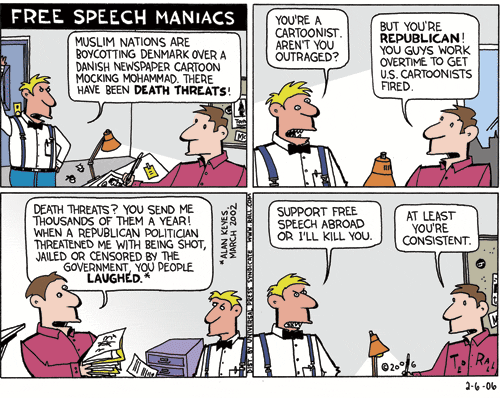
Danish Paper Rejected Drawings Mocking Jesus
Jyllands-Posten, the Danish newspaper that first published the cartoons of the prophet Muhammad that have caused a storm of protest throughout the Islamic world, refused to run drawings lampooning Jesus Christ, it has emerged today. The daily turned down the cartoons of Christ three years ago, on the grounds that they could be offensive to readers and were not funny. "In the Muhammad drawings case, we asked the illustrators to do it. I did not ask for these cartoons. That's the difference," the paper's cartoon editor said.
Article...
Article...
Hypocritical Media Response To Islamic Anger Over Disparaging Editorial Cartoons
Click For Larger Image...
Put The Memo To The Public!
The activist group that helped break mainstream media silence on the original Downing Street Memos needs your help correcting the miserable lack of current coverage of the newest Bush/Blair meeting transcript, which reveals that Bush and Blair agreed on war in January 2003—not March 2003, as they insist. It also reveals they knew there was no legitimate case for war, that Bush was hoping to assassinate Saddam Hussein, and that Bush was so desperate to provoke a war that he even proposed painting U.S. planes to look like U.N. planes and flying them low over Iraq in hopes of getting shot at—which he thought would be grounds for war.
As with the Downing Street Memos, these revelations are considered news in Europe, but not in the U.S.
As with the Downing Street Memos, these revelations are considered news in Europe, but not in the U.S.
Sunday, February 05, 2006
AMAZING POLITICAL FACT OF THE DAY
If the House Republicans had elected their leadership the way the country runs its elections, Rep. Blunt would be majority leader. In fact, however, the GOP used a system somewhat similar to what has been proposed by backers of instant run-off voting. Although not accomplished in one ballot - as in the case of IRV - when the House GOP was unable to decide by majority vote, they dropped the two bottom choices and took another count. It was on this second vote that Rep. Boehner was chosen. Here's how it looked in the first round:
Blunt: 110 votes
Boehner: 79 votes
Shadegg: 40 votes
Ryun: 2 votes
Now according the election law just about everywhere in the U.S. save godless, gay San Francisco and the House GOP caucus, Rep Blunt won the election based on the sacred first-past-the-post principle. But the GOP wanted something more than just a first round winner and so eliminated Shadegg and Ryun and counted again. Second time out:
Boehner: 122
Blunt: 109
In other words, the Republicans were smart for a change. Meanwhile in San Francisco a report by Fair Vote California finds that instant runoff voting (or "ranked choice voting" in San Francisco terminology) increased voter participation in the decisive round of last November's citywide election for assessor-recorder by an estimated 2.7 times. Moreover, six out of 25 neighborhoods in the city had triple the turnout they would have likely had with a traditional runoff; these neighborhoods represent the poorest and most racially diverse in the city, showing how IRV truly is a voting rights issue as well as a good government reform.
Says Fair Vote, nearly every single federal primary runoff has had lower turnout than the first round over the past dozen year, with an average decrease of more than 35%.
http://sfrcv.com/reports/turnout.pdf
Blunt: 110 votes
Boehner: 79 votes
Shadegg: 40 votes
Ryun: 2 votes
Now according the election law just about everywhere in the U.S. save godless, gay San Francisco and the House GOP caucus, Rep Blunt won the election based on the sacred first-past-the-post principle. But the GOP wanted something more than just a first round winner and so eliminated Shadegg and Ryun and counted again. Second time out:
Boehner: 122
Blunt: 109
In other words, the Republicans were smart for a change. Meanwhile in San Francisco a report by Fair Vote California finds that instant runoff voting (or "ranked choice voting" in San Francisco terminology) increased voter participation in the decisive round of last November's citywide election for assessor-recorder by an estimated 2.7 times. Moreover, six out of 25 neighborhoods in the city had triple the turnout they would have likely had with a traditional runoff; these neighborhoods represent the poorest and most racially diverse in the city, showing how IRV truly is a voting rights issue as well as a good government reform.
Says Fair Vote, nearly every single federal primary runoff has had lower turnout than the first round over the past dozen year, with an average decrease of more than 35%.
http://sfrcv.com/reports/turnout.pdf
Saturday, February 04, 2006
Republicans eat their own... votes?
By Evan Derkacz
Posted on February 2, 2006
http://www.alternet.org/bloggers/evan/31750/
Oh, how the irony keeps a bob bob bobbin' along. In the vote to determine just how ethically-challenged Tom DeLay's successor would be, the first tally had to be tossed as there were more votes than members casting them.
It's not that anyone was actually attempting rig the results -- who would be stupid enough to do that in such a small group? [rhetorical, please don't answer that] -- but the symbolism is rich you'll have to admit.
In the end it was Rep John Boehner who won the vote. He'll be succeeding Tom DeLay as House Majority Leader winning by a margin of 122-109. For an explanation of the voting mishap and a look at Boehner's boners, see Josh's excellent analysis [HERE]. (For truly tasteless but funny plays on Boehner's -- pronounced Bay-ner -- name, go HERE).
But that wholly symbolic display of the Republican culture of corruption stands side by side with this news about the "reformer" moseying into town, from Campaign for America's Future:
Posted on February 2, 2006
http://www.alternet.org/bloggers/evan/31750/
Oh, how the irony keeps a bob bob bobbin' along. In the vote to determine just how ethically-challenged Tom DeLay's successor would be, the first tally had to be tossed as there were more votes than members casting them.
It's not that anyone was actually attempting rig the results -- who would be stupid enough to do that in such a small group? [rhetorical, please don't answer that] -- but the symbolism is rich you'll have to admit.
In the end it was Rep John Boehner who won the vote. He'll be succeeding Tom DeLay as House Majority Leader winning by a margin of 122-109. For an explanation of the voting mishap and a look at Boehner's boners, see Josh's excellent analysis [HERE]. (For truly tasteless but funny plays on Boehner's -- pronounced Bay-ner -- name, go HERE).
But that wholly symbolic display of the Republican culture of corruption stands side by side with this news about the "reformer" moseying into town, from Campaign for America's Future:
Rep. John Boehner, R-Ohio, gave nearly $150,000 to colleagues from his leadership political action committee to influence today’s vote for majority leader, according to fundraising records he filed with the Federal Election Commission Tuesday and reported today in a Capitol Hill newspaper.
The Hill today reported that Rep. Boehner gave $150,000 to 30 Republican colleagues on Dec. 15, according to his filing for his leadership committee, the Freedom Project. More than a dozen Republicans receiving money from Rep. Boehner declared their intention to vote for him ahead of today’s vote, including Rep. Gresham Barrett, R-S.C., Rep. Charles Boustany, R-La., Steve Chabot, R-Ohio., Rep. Melissa Hart, R-Pa., Rep. Joe Knollenberg R-Mich., Rep. Steve LaTourette, R-Ohio, Rep. Thaddeus McCotter, R-Mich., Rep. Steve Pearce, R-N.M., Rep. Jon Porter, R-Nev., Rep. Richard Pombo, R-Calif., Rep. Dennis Rehberg, R-Mont., Rep. Jean Schmidt, R-Ohio, and Rep. Lee Terry, R-Neb.
Incest Within The Press
DUNCAN SPENCER, THE HILL - The death-by-negligence of New York Times editor David Rosenbaum [is] a perfect example of the ugly layers of Washington society, and particularly the structure of the high court of the new dukes and duchesses of that society, news reporters. Can one imagine the same case (elderly man clobbered and robbed of his wallet and cards by two thugs) happening in Wards 7 or 8, where the victim would almost surely have been black? The case would never have gotten beyond The Washington Post's "Metro Briefs" and would have ended there.
But several layers of our unexamined and uncriticized social gradation separated Rosenbaum from the Ward 7 and 8 man. Rosenbaum was white. He was sober. He was walking in a Far Northwest neighborhood considered safe (i.e., almost all white). And he was a news reporter. Not only a news reporter but associated with the country's only national daily, the Times.
It was this combination of social factors that triggered a deluge from the press corps (or better, the Press Court) to include high indignation from such luminaries as Maureen Dowd, John Tierney (both NYT), Marc Fisher and Cokie Roberts, to mention only the best known of the indignant. . .
The memorial service on the 13th was little less than a press royal occasion, homage being paid not only by those who knew the decedent but by those who wanted to be known as having known him, as well as by those most public senators, Arlen Specter (R-Pa.), Orrin Hatch (R-Utah), Patrick Leahy (D-Vt.), Edward Kennedy (D-Mass.) and Charles Schumer (D-N.Y.)
Eulogist NYT bureau chief Philip Taubman called the crime "unfathomable, unthinkable, unspeakable." Of course he was referring only to one (his own) social layer - in another part of town . . . such a crime would not only be fathomable, thinkable and speakable but an all-too-frequent experience. But the victim almost certainly would not have been a New York Times reporter. . .
This town's media elite regard themselves as eminently important and amusing, while the public, ever yearning for a new example of that financial, social magic called celebrity, has eagerly embraced regular news columns on the media, the press reporting on itself. Regularly scheduled media columns ensure that stories are not written to report news but are written under the oldest whip in our business - finding something to fill that hole. What's easier than another column about news royalty?. . .
As the press ascends to the level of social godhead, perhaps each scribbler should reread at least once a week Janet Malcolm's shocking confession: "Every journalist who is not too stupid or too full of himself to notice what is going on knows that what he does is morally indefensible. He is a kind of confidence man, preying on people's vanity, ignorance or loneliness, gaining their trust and betraying them without remorse."
Too strong? Then read Washington Examiner writer Karen DeWitt: "I became a reporter like many in my generation, because I wanted to shine a light on wrongs and stand up for the little guy against the powerful." The Press Court is now the powerful. It stands up not for the little guy but for its own.
Article From The Hill... (scroll down to "Hacks favorite subject:themselves")
But several layers of our unexamined and uncriticized social gradation separated Rosenbaum from the Ward 7 and 8 man. Rosenbaum was white. He was sober. He was walking in a Far Northwest neighborhood considered safe (i.e., almost all white). And he was a news reporter. Not only a news reporter but associated with the country's only national daily, the Times.
It was this combination of social factors that triggered a deluge from the press corps (or better, the Press Court) to include high indignation from such luminaries as Maureen Dowd, John Tierney (both NYT), Marc Fisher and Cokie Roberts, to mention only the best known of the indignant. . .
The memorial service on the 13th was little less than a press royal occasion, homage being paid not only by those who knew the decedent but by those who wanted to be known as having known him, as well as by those most public senators, Arlen Specter (R-Pa.), Orrin Hatch (R-Utah), Patrick Leahy (D-Vt.), Edward Kennedy (D-Mass.) and Charles Schumer (D-N.Y.)
Eulogist NYT bureau chief Philip Taubman called the crime "unfathomable, unthinkable, unspeakable." Of course he was referring only to one (his own) social layer - in another part of town . . . such a crime would not only be fathomable, thinkable and speakable but an all-too-frequent experience. But the victim almost certainly would not have been a New York Times reporter. . .
This town's media elite regard themselves as eminently important and amusing, while the public, ever yearning for a new example of that financial, social magic called celebrity, has eagerly embraced regular news columns on the media, the press reporting on itself. Regularly scheduled media columns ensure that stories are not written to report news but are written under the oldest whip in our business - finding something to fill that hole. What's easier than another column about news royalty?. . .
As the press ascends to the level of social godhead, perhaps each scribbler should reread at least once a week Janet Malcolm's shocking confession: "Every journalist who is not too stupid or too full of himself to notice what is going on knows that what he does is morally indefensible. He is a kind of confidence man, preying on people's vanity, ignorance or loneliness, gaining their trust and betraying them without remorse."
Too strong? Then read Washington Examiner writer Karen DeWitt: "I became a reporter like many in my generation, because I wanted to shine a light on wrongs and stand up for the little guy against the powerful." The Press Court is now the powerful. It stands up not for the little guy but for its own.
Article From The Hill... (scroll down to "Hacks favorite subject:themselves")
Bush Crimes Commision Update
February 2, 2006
www.bushcommision.org
BUSH ADMINISTRATION GUILTY OF CRIMES AGAINST HUMANITY SAYS COMMISSION OF INQUIRY; ACTIVIST CONFRONTS RUMSFELD WITH VERDICT, SAYS "STEP DOWN!"
Today the Bush Administration was found guilty of war crimes and crimes against humanity for invading Iraq, instituting torture and indefinite detention, attacking efforts to control global warming and for deliberately failing to prevent devastation and loss of life during Hurricane Katrina.
These findings were released at the National Press Club by the International Commission of Inquiry on Crimes Against Humanity Committed by the Bush Administration. The full text of can be found at www.bushcommission.org.
Shortly after the findings were released, activist Heather Hurwitz confronted Defense Secretary Donald Rumsfeld with the Commission's verdict during his press luncheon. Hurwitz, of World Can't Wait--Drive Out the Bush Regime, declared Rumsfeld and The Bush Administration were guilty of war crimes and crimes against humanity and that thousands were gathering Saturday, February 4th in Washington to demand that they step down. (www.worldcantwait.net)
Ms. Hurwitz was quickly removed by security personnel. After she was led away, Rumsfeld joked, "We'll count her as undecided." When informed of Rumsfeld's comment, Hurwitz said, "war crimes and crimes against humanity are not joking matters. Rumsfeld's attitude typifies this administration's brazen immorality and lawlessness, and this is why it must step down."
Earlier, at the Commission's press conference, Ajamu Sankofa, Executive Director of Physicians for Social Responsibility-NY and one of the panel of jurists, stated "The historical significance of this tribunal is that American citizens, civil society, is demonstrating courage to stand up and speak its definition of the truth against a wholly orchestrated system of deliberate deceptions."
"This commission is attempting to change the level of discourse," said Abdeen Jabara, another panelist and former President of the American-Arab Anti-Discrimination Committee. "We want people to understand Iraq is not simply a war of choice but an actual war of aggression from which flow certain legal consequences. Torture is often reported as 'abuse' rather than torture. So we need to change the way these items are talked about for people to face the fact of what this government is doing."
"The Commission is incredibly important for the future of the United States and really the world, because it's the people of America that are speaking to these very serious indictments," said panel member Ann Wright, a former US diplomat and retired US Army Reserve Colonel. Former CIA analyst Ray McGovern added, "Our German fore-bearers in the 1930s sat around, blamed their rulers, said 'maybe everything's going to be alright.' That is something we cannot do. I do not want my grandchildren asking me years from now, 'why didn't you do something to stop all this?'"
Brig. General Janis Karpinski, former UK Ambassador Craig Murray, and former UN weapons inspector Scott Ritter, were among the 44 witnesses presenting testimony at the Commission's two sessions. The Commission will later issue detailed findings, accompanied by full documentation.
www.bushcommision.org
BUSH ADMINISTRATION GUILTY OF CRIMES AGAINST HUMANITY SAYS COMMISSION OF INQUIRY; ACTIVIST CONFRONTS RUMSFELD WITH VERDICT, SAYS "STEP DOWN!"
Today the Bush Administration was found guilty of war crimes and crimes against humanity for invading Iraq, instituting torture and indefinite detention, attacking efforts to control global warming and for deliberately failing to prevent devastation and loss of life during Hurricane Katrina.
These findings were released at the National Press Club by the International Commission of Inquiry on Crimes Against Humanity Committed by the Bush Administration. The full text of can be found at www.bushcommission.org.
Shortly after the findings were released, activist Heather Hurwitz confronted Defense Secretary Donald Rumsfeld with the Commission's verdict during his press luncheon. Hurwitz, of World Can't Wait--Drive Out the Bush Regime, declared Rumsfeld and The Bush Administration were guilty of war crimes and crimes against humanity and that thousands were gathering Saturday, February 4th in Washington to demand that they step down. (www.worldcantwait.net)
Ms. Hurwitz was quickly removed by security personnel. After she was led away, Rumsfeld joked, "We'll count her as undecided." When informed of Rumsfeld's comment, Hurwitz said, "war crimes and crimes against humanity are not joking matters. Rumsfeld's attitude typifies this administration's brazen immorality and lawlessness, and this is why it must step down."
Earlier, at the Commission's press conference, Ajamu Sankofa, Executive Director of Physicians for Social Responsibility-NY and one of the panel of jurists, stated "The historical significance of this tribunal is that American citizens, civil society, is demonstrating courage to stand up and speak its definition of the truth against a wholly orchestrated system of deliberate deceptions."
"This commission is attempting to change the level of discourse," said Abdeen Jabara, another panelist and former President of the American-Arab Anti-Discrimination Committee. "We want people to understand Iraq is not simply a war of choice but an actual war of aggression from which flow certain legal consequences. Torture is often reported as 'abuse' rather than torture. So we need to change the way these items are talked about for people to face the fact of what this government is doing."
"The Commission is incredibly important for the future of the United States and really the world, because it's the people of America that are speaking to these very serious indictments," said panel member Ann Wright, a former US diplomat and retired US Army Reserve Colonel. Former CIA analyst Ray McGovern added, "Our German fore-bearers in the 1930s sat around, blamed their rulers, said 'maybe everything's going to be alright.' That is something we cannot do. I do not want my grandchildren asking me years from now, 'why didn't you do something to stop all this?'"
Brig. General Janis Karpinski, former UK Ambassador Craig Murray, and former UN weapons inspector Scott Ritter, were among the 44 witnesses presenting testimony at the Commission's two sessions. The Commission will later issue detailed findings, accompanied by full documentation.
Thursday, February 02, 2006
Five Myths About National Healthcare
[Tyler Zimmer, Campus Progress]
Myth #1: It would be too expensive
UHC would actually reduce the cost of health care. The Congressional Budget Office estimated that UHC could save up to $14 billion annually by spreading the risk evenly over the entire population, eliminating deductibles and co-pays and making preventive medicine available to the poor and uninsured. The federal government already subsidizes private health insurance in the form of tax deductions.
Private insurance companies also spend billions on administration and overhead, advertising, and determining and inspecting patient eligibility, all while trying to make a profit. UHC would not be burdened with some of those costs, like advertising, and unlike private business, it could run at a loss and still be viable. . .
Myth #2: It would require a huge, inefficient bureaucracy
The current system is already a huge, inefficient bureaucracy! As previously mentioned, much of the unnecessary overhead and micromanaging in the system now could be eliminated if UHC were implemented. For example, the bureaucracy and paperwork involved in determining patient eligibility would be completely unnecessary if everyone were eligible and covered. Insurance companies spend an estimated 25 cents of every dollar on administration. Canada, which already has a comprehensive UHC in place and still manages to pay 70 percent less per citizen on health care, spends about the equivalent of about 12 cents of every dollar on administration.
Myth #3: It would restrict patient choice
UHC wouldn't directly dictate what doctor you have to see in order to get treatment and would thus enable more choice in selecting a physician than the current system would for many, if not most, Americans.
Myth #4: It would be a socialist seizure of the medical industry
It would be nothing of the sort. Socialized medicine would entail hospitals and doctors becoming employees of the state. UHC only provides funding for people's health care, but doesn't provide the health care itself. . . UHC would be no more socialist than Medicare and arguably less so than public education.
Myth #5: UHC would impede economic growth
An added benefit of UHC would be that private business would no longer have to worry about health-care benefits, and employees wouldn't have to remain in unpleasant jobs just to keep their benefits. Benefits wouldn't interfere with wage increases, and employers would have more financial mobility. . .
http://www.alternet.org/wiretap/31196/
Myth #1: It would be too expensive
UHC would actually reduce the cost of health care. The Congressional Budget Office estimated that UHC could save up to $14 billion annually by spreading the risk evenly over the entire population, eliminating deductibles and co-pays and making preventive medicine available to the poor and uninsured. The federal government already subsidizes private health insurance in the form of tax deductions.
Private insurance companies also spend billions on administration and overhead, advertising, and determining and inspecting patient eligibility, all while trying to make a profit. UHC would not be burdened with some of those costs, like advertising, and unlike private business, it could run at a loss and still be viable. . .
Myth #2: It would require a huge, inefficient bureaucracy
The current system is already a huge, inefficient bureaucracy! As previously mentioned, much of the unnecessary overhead and micromanaging in the system now could be eliminated if UHC were implemented. For example, the bureaucracy and paperwork involved in determining patient eligibility would be completely unnecessary if everyone were eligible and covered. Insurance companies spend an estimated 25 cents of every dollar on administration. Canada, which already has a comprehensive UHC in place and still manages to pay 70 percent less per citizen on health care, spends about the equivalent of about 12 cents of every dollar on administration.
Myth #3: It would restrict patient choice
UHC wouldn't directly dictate what doctor you have to see in order to get treatment and would thus enable more choice in selecting a physician than the current system would for many, if not most, Americans.
Myth #4: It would be a socialist seizure of the medical industry
It would be nothing of the sort. Socialized medicine would entail hospitals and doctors becoming employees of the state. UHC only provides funding for people's health care, but doesn't provide the health care itself. . . UHC would be no more socialist than Medicare and arguably less so than public education.
Myth #5: UHC would impede economic growth
An added benefit of UHC would be that private business would no longer have to worry about health-care benefits, and employees wouldn't have to remain in unpleasant jobs just to keep their benefits. Benefits wouldn't interfere with wage increases, and employers would have more financial mobility. . .
http://www.alternet.org/wiretap/31196/
GOOD WEEK FOR TERRORISTS
AL KAMEN, WASHINTON POST - Been a big week for those on the State Department's terrorist list. Al Qaeda has become a television production company. Hamas has taken over its own sort-of country. And now, it seems the Iranian terrorist group MEK, or Mujaheddin-e Khalq, which opposes the current government, got a positive mention from Secretary of State Condoleezza Rice. Speaking to reporters on her plane yesterday, Rice referred to it as a "dissident" group that helpfully exposed Iran's nuclear perfidy.
Article...(scroll down to "Life On The Terrorist List")
Article...(scroll down to "Life On The Terrorist List")
'Nightline' Investigation: Wounded Soldiers Told They Owe Money to Army
Troops Face Financial Crises After Learning Army Overpaid Them During Hospitalization
By BRIAN ROSS, ABC News
Jan. 31, 2006 — - It was one of the thousands of roadside bombs in Iraq that paralyzed Staff Sgt. Eugene Simpson.
"My first instinct was to jump farther back into the Humvee, you know, for protection," Simpson said. "But in doing that, I opened my back up to all the scrap metal and debris, which hit my spine and severed my spine, paralyzing me."
He was soon on a plane home.
Fast-working, skilled Army doctors saved his life, as they have so many.
Slow, bumbling Army bureaucrats would make his life miserable, as they have so many.
"And the military basically is, like, they turn their back on you, you kind of feel that you've just been used," Simpson said.
No Pay for Four Months
It started with a phone call from his wife, home with their four children. She didn't have enough money to pay the bills.
"And she was like, well, we haven't been paid," Simpson said. "And you know, instantly I was like, I don't know what to do. You know, I'm still in the hospital. I can't actually get up and go around and talk to these different people."
And until "Nightline" inquired at the Pentagon, Simpson said he could not find out what happened.
"Every day is something different," he said. "Well, this person isn't in. I'll have them call you back, give it a couple days. Couple days go by, I call back, well I got somebody else for you to talk to. And days lead to weeks, and weeks lead to months."
It turns out the Army had mistakenly continued to pay Simpson a combat duty bonus while he was in the hospital.
He had been overpaid thousands of dollars, and the Army wanted the money back.
"By law, he's not entitled to the money," said Col. Richard Shrank, "so he must pay it back."
Shrank said although that is the law, soldiers can apply for debt forgiveness if they believe the debt is a mistake. So far, more than 800 soldiers have done so. More than 600 of those requests have been granted, amounting to more than $600,000.
So, the Army said it withheld the paralyzed soldier's pay until it got back the amount he owed -- with no advance notice, Simpson said.
"Four months," he said. "I didn't get paid for four months."
Article...
By BRIAN ROSS, ABC News
Jan. 31, 2006 — - It was one of the thousands of roadside bombs in Iraq that paralyzed Staff Sgt. Eugene Simpson.
"My first instinct was to jump farther back into the Humvee, you know, for protection," Simpson said. "But in doing that, I opened my back up to all the scrap metal and debris, which hit my spine and severed my spine, paralyzing me."
He was soon on a plane home.
Fast-working, skilled Army doctors saved his life, as they have so many.
Slow, bumbling Army bureaucrats would make his life miserable, as they have so many.
"And the military basically is, like, they turn their back on you, you kind of feel that you've just been used," Simpson said.
No Pay for Four Months
It started with a phone call from his wife, home with their four children. She didn't have enough money to pay the bills.
"And she was like, well, we haven't been paid," Simpson said. "And you know, instantly I was like, I don't know what to do. You know, I'm still in the hospital. I can't actually get up and go around and talk to these different people."
And until "Nightline" inquired at the Pentagon, Simpson said he could not find out what happened.
"Every day is something different," he said. "Well, this person isn't in. I'll have them call you back, give it a couple days. Couple days go by, I call back, well I got somebody else for you to talk to. And days lead to weeks, and weeks lead to months."
It turns out the Army had mistakenly continued to pay Simpson a combat duty bonus while he was in the hospital.
He had been overpaid thousands of dollars, and the Army wanted the money back.
"By law, he's not entitled to the money," said Col. Richard Shrank, "so he must pay it back."
Shrank said although that is the law, soldiers can apply for debt forgiveness if they believe the debt is a mistake. So far, more than 800 soldiers have done so. More than 600 of those requests have been granted, amounting to more than $600,000.
So, the Army said it withheld the paralyzed soldier's pay until it got back the amount he owed -- with no advance notice, Simpson said.
"Four months," he said. "I didn't get paid for four months."
Article...
The End of the Internet?
by JEFF CHESTER, The Nation
[posted online on February 1, 2006]
The nation's largest telephone and cable companies are crafting an alarming set of strategies that would transform the free, open and nondiscriminatory Internet of today to a privately run and branded service that would charge a fee for virtually everything we do online.
Verizon, Comcast, Bell South and other communications giants are developing strategies that would track and store information on our every move in cyberspace in a vast data-collection and marketing system, the scope of which could rival the National Security Agency. According to white papers now being circulated in the cable, telephone and telecommunications industries, those with the deepest pockets--corporations, special-interest groups and major advertisers--would get preferred treatment. Content from these providers would have first priority on our computer and television screens, while information seen as undesirable, such as peer-to-peer communications, could be relegated to a slow lane or simply shut out.
Under the plans they are considering, all of us--from content providers to individual users--would pay more to surf online, stream videos or even send e-mail. Industry planners are mulling new subscription plans that would further limit the online experience, establishing "platinum," "gold" and "silver" levels of Internet access that would set limits on the number of downloads, media streams or even e-mail messages that could be sent or received.
Read More...
[posted online on February 1, 2006]
The nation's largest telephone and cable companies are crafting an alarming set of strategies that would transform the free, open and nondiscriminatory Internet of today to a privately run and branded service that would charge a fee for virtually everything we do online.
Verizon, Comcast, Bell South and other communications giants are developing strategies that would track and store information on our every move in cyberspace in a vast data-collection and marketing system, the scope of which could rival the National Security Agency. According to white papers now being circulated in the cable, telephone and telecommunications industries, those with the deepest pockets--corporations, special-interest groups and major advertisers--would get preferred treatment. Content from these providers would have first priority on our computer and television screens, while information seen as undesirable, such as peer-to-peer communications, could be relegated to a slow lane or simply shut out.
Under the plans they are considering, all of us--from content providers to individual users--would pay more to surf online, stream videos or even send e-mail. Industry planners are mulling new subscription plans that would further limit the online experience, establishing "platinum," "gold" and "silver" levels of Internet access that would set limits on the number of downloads, media streams or even e-mail messages that could be sent or received.
Read More...
Pentagon trying to censor top US political cartoonist
by John in DC, from AMERICAblog - 2/01/2006 05:09:00 PM
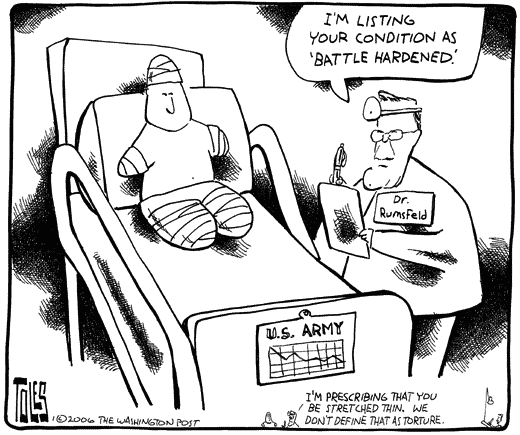
The Joint Chiefs of Staff just sent a menacing letter to the Washington Post over a cartoon. AMERICAblog received a copy of the letter at 10AM this morning, but as its veracity was not yet confirmed, we waited until E&P was able to confirm that is is for real.
Here's the letter the Joint Chiefs of Staff wrote to the Post.
And why not have the Pentagon try to stifle a free media while supposedly promoting freedom in Iraq? The US government just arrested one of President Bush's top political critics for threatening his life with a t-shirt. So why not now threaten a top political cartoonist for drawing a cartoon that the Pentagon doesn't like? Why not use the power of government to try to censor the media, something that's a direct violation of that pesky and quaint 1st Amendment to the US Constitution - you remember, that document the Bush administration doesn't think is relevant.
I have no problem with citizens speaking out about political cartoons they find offensive - hell, we've done it recently with the anti-gay cartoon in the Post. But when the government does it, that's a whole other story that smacks of censorship, especially when that government is the Pentagon threatening you during wartime.
It will be interesting to see if the Post replied to the Pentagon. They sure didn't reply when it was a homophobic cartoon they published.
Hey, here's a thought. Now that the Joint Chiefs have addressed the insidious threat cartoons pose to our troops, perhaps they can move on to less pressing issues like getting them their damn body armor.
Wednesday, February 01, 2006
Bolivia leader halves his own pay
The Bolivian new left-wing President, Evo Morales, has cut his salary by more than a half to a little over $1,800 (£1,012) per month.
The decision means that the salaries of all Bolivian public sector employees will be reviewed, as no official can earn more than the president.
Mr Morales said the money saved would be used to increase the numbers of doctors and teachers.
Mr Morales suggested that members of Congress should cut their salaries too.
During the campaign, Mr Morales had pledged to halve his own pay if elected.
The move announced after his first cabinet went beyond that, with a cut of 57%.
BBC South America correspondent Daniel Schweimler says many voted for Mr Morales believing that he was different from the more conservative politicians who have governed in the past.
The former llama herder and coca leaf farmer was inaugurated last Sunday as Bolivia's first indigenous president.
He has promised to fight corruption, introduce a new tax on the wealthy, and renationalise energy companies.
Story from BBC NEWS:
http://news.bbc.co.uk/go/pr/fr/-/1/hi/world/americas/4652940.stm
The decision means that the salaries of all Bolivian public sector employees will be reviewed, as no official can earn more than the president.
Mr Morales said the money saved would be used to increase the numbers of doctors and teachers.
Mr Morales suggested that members of Congress should cut their salaries too.
During the campaign, Mr Morales had pledged to halve his own pay if elected.
The move announced after his first cabinet went beyond that, with a cut of 57%.
BBC South America correspondent Daniel Schweimler says many voted for Mr Morales believing that he was different from the more conservative politicians who have governed in the past.
The former llama herder and coca leaf farmer was inaugurated last Sunday as Bolivia's first indigenous president.
He has promised to fight corruption, introduce a new tax on the wealthy, and renationalise energy companies.
Story from BBC NEWS:
http://news.bbc.co.uk/go/pr/fr/-/1/hi/world/americas/4652940.stm
Tuesday, January 31, 2006
Protection of its people's lives, liberty and property against lethal attack and occupation...
ALI ABUNIMAH, ELECTRONIC INTIFADA - For Palestinians under occupation, it is not yet clear what Hamas' win will mean. It is now common to speak of a Palestinian "government" being formed out of the election results, as though Palestine were already a sovereign and independent state. But if the first duty of a government is to protect its people's lives, liberty and property, then the Palestinian Authority has never deserved to be called a government. Since its inception, it has not been able to protect Palestinians from lethal daily attacks by the Israeli army in the heart of their towns and refugee camps, or to prevent a single dunum of land being seized for settlements, nor to save a single sapling of the more than one million trees uprooted by Israel in the past ten years. Rather, the Palestinian Authority was supposed to crush Palestinian resistance to make the occupied territories safe for continued Israeli colonization. Hamas will certainly not allow that to continue, but whether it will be able to transform the Authority into an arm of the struggle against Israel is by no means certain. Hamas, which has observed a unilateral truce with Israel for a year, has signaled that it wants to continue this if Israel "reciprocates." The movement clearly believes it can make such an offer from a position of strength and it is to its tactical advantage to leave uncertainty about when and how it might resume full-scale armed resistance.
Elements of the Palestinian Authority security services controlled by Fatah figures may be unwilling to put themselves under the control of a Hamas-led authority, which could lead to the collapse of what is left of the Authority's structure, or even its break-up into personal militias. Israel, and the United States which refuses to accept the outcome of the election may see an interest in encouraging such an internal conflict. Israel is likely to use Hamas' win as a further pretext to tighten repression and accelerate its unilateral imposition of walls and settlements on the West Bank designed to annex the maximum number of land with the minimum not of Palestinians. Such developments increase the risks of a dramatic escalation of Israeli-Palestinian violence. . .
The instant US demand that Hamas "recognize Israel" is like rewinding the clock twenty-five years to when this same demand was the pretext to ignore and exclude the PLO from peace negotiations. But as Hamas has observed, all the PLO's submission to these demands did not lead to any loosening of Israel's grip or any lessening of US support for Israel. Hamas is unlikely to do as the US demands, and even if it did, it would probably only give rise to new resistance groups responding to the worsening conditions on the ground generated by the occupation.
http://electronicintifada.net/v2/article4425.shtml
Elements of the Palestinian Authority security services controlled by Fatah figures may be unwilling to put themselves under the control of a Hamas-led authority, which could lead to the collapse of what is left of the Authority's structure, or even its break-up into personal militias. Israel, and the United States which refuses to accept the outcome of the election may see an interest in encouraging such an internal conflict. Israel is likely to use Hamas' win as a further pretext to tighten repression and accelerate its unilateral imposition of walls and settlements on the West Bank designed to annex the maximum number of land with the minimum not of Palestinians. Such developments increase the risks of a dramatic escalation of Israeli-Palestinian violence. . .
The instant US demand that Hamas "recognize Israel" is like rewinding the clock twenty-five years to when this same demand was the pretext to ignore and exclude the PLO from peace negotiations. But as Hamas has observed, all the PLO's submission to these demands did not lead to any loosening of Israel's grip or any lessening of US support for Israel. Hamas is unlikely to do as the US demands, and even if it did, it would probably only give rise to new resistance groups responding to the worsening conditions on the ground generated by the occupation.
http://electronicintifada.net/v2/article4425.shtml
Monday, January 30, 2006
Sunday, January 29, 2006
Conservative Newspaper Calls For Iraq Pullout
[The funny thing this is that this puts Clinton nemesis Scaife to the
left of Hillary Clinton on the issue--Sam Smith]
GREG MITCHELL, EDITOR & PUBLISHER - As regular readers of this column know, I embarked on a tireless (to some, tiresome) mission more than two years ago, encouraging newspaper editorial writers to endorse a phased U.S. withdrawal from Iraq, or at least kick around the idea. Since virtually no one took me up on it, I've had to repeat it every few months. . . Nearly every major paper continued to ignore or oppose the idea, or even called for sending more troops. The Seattle Times and Minneapolis Star-Tribune were just about the only big-city exceptions.
Last November, after Rep. John Murtha's well-publicized call for a pullout, I tried again. Like most Democrats in Congress, many newspapers found some merit in Murtha's proposal, or at least defended him from those who charged the longtime Marine with being a coward (not exactly a risky choice). But in the end, almost none said: Yeah, let's start to withdraw, and soon. USA Today, for example, called his plea "understandable" but "misguided."
Now, this week, a full and unconditional endorsement of Murtha's notion has come from a completely unexpected source: the notably conservative Tribune-Review, which is based in Greensburg, Pa., but considers itself a full-fledged Pittsburgh newspaper. It's controlled by Richard Mellon Scaife, one of the chief funders of conservative think-thanks and activist causes around the country.
Less than two months ago, the newspaper (daily circulation about 102,000), attacked Murtha's plan. Printed below is the text of the latest editorial, which was published on Tuesday. Perhaps a few other papers would now like to re-visit this subject, with the third anniversary of the start of the war approaching.
||| We didn't agree with Jack Murtha in November when he called for an immediate withdrawal of United States forces from Iraq. The timing was not right. But the times have changed. When the Pennsylvania congressman made his call, critical December parliamentary elections were ahead; cut-and-run talk was inappropriate.
But successful elections have passed. And contrary to what some may say, Iraqis are stepping up to the plate, as evidenced by the number dying in defense of their fledgling republic. Native Iraqi terrorists and those of the al-Qaida brand also are starting to battle each other. There's a growing sense of self-determination, which is a critical trait on the road to democracy.
That said, the world situation has changed dramatically since November. The nuclear saber-rattling of neighboring Iran is heading for a showdown. To meet that threat should diplomacy fail, the United States must begin the six- to nine-month logistical process of drawing down its Iraqi force and repositioning it to respond, if need be, to the Iranian threat.
This is not retreat. This is not cut-and-run. This is a recognition of the reality in Iraq -- one that has evolved into an Iraqi problem that only the Iraqis now can solve -- and that the paramount world security threat now is Iraq.
Article...
left of Hillary Clinton on the issue--Sam Smith]
GREG MITCHELL, EDITOR & PUBLISHER - As regular readers of this column know, I embarked on a tireless (to some, tiresome) mission more than two years ago, encouraging newspaper editorial writers to endorse a phased U.S. withdrawal from Iraq, or at least kick around the idea. Since virtually no one took me up on it, I've had to repeat it every few months. . . Nearly every major paper continued to ignore or oppose the idea, or even called for sending more troops. The Seattle Times and Minneapolis Star-Tribune were just about the only big-city exceptions.
Last November, after Rep. John Murtha's well-publicized call for a pullout, I tried again. Like most Democrats in Congress, many newspapers found some merit in Murtha's proposal, or at least defended him from those who charged the longtime Marine with being a coward (not exactly a risky choice). But in the end, almost none said: Yeah, let's start to withdraw, and soon. USA Today, for example, called his plea "understandable" but "misguided."
Now, this week, a full and unconditional endorsement of Murtha's notion has come from a completely unexpected source: the notably conservative Tribune-Review, which is based in Greensburg, Pa., but considers itself a full-fledged Pittsburgh newspaper. It's controlled by Richard Mellon Scaife, one of the chief funders of conservative think-thanks and activist causes around the country.
Less than two months ago, the newspaper (daily circulation about 102,000), attacked Murtha's plan. Printed below is the text of the latest editorial, which was published on Tuesday. Perhaps a few other papers would now like to re-visit this subject, with the third anniversary of the start of the war approaching.
||| We didn't agree with Jack Murtha in November when he called for an immediate withdrawal of United States forces from Iraq. The timing was not right. But the times have changed. When the Pennsylvania congressman made his call, critical December parliamentary elections were ahead; cut-and-run talk was inappropriate.
But successful elections have passed. And contrary to what some may say, Iraqis are stepping up to the plate, as evidenced by the number dying in defense of their fledgling republic. Native Iraqi terrorists and those of the al-Qaida brand also are starting to battle each other. There's a growing sense of self-determination, which is a critical trait on the road to democracy.
That said, the world situation has changed dramatically since November. The nuclear saber-rattling of neighboring Iran is heading for a showdown. To meet that threat should diplomacy fail, the United States must begin the six- to nine-month logistical process of drawing down its Iraqi force and repositioning it to respond, if need be, to the Iranian threat.
This is not retreat. This is not cut-and-run. This is a recognition of the reality in Iraq -- one that has evolved into an Iraqi problem that only the Iraqis now can solve -- and that the paramount world security threat now is Iraq.
Article...
A Clear and Present Danger to America
By DOUG THOMPSON
Publisher, Capitol Hill Blue
Jan 27, 2006, 05:11
http://www.capitolhillblue.com/artman/publish/article_8065.shtml
George W. Bush, the out-of-control despot who thinks the Presidency of the United States is a license to lie at will, wage war on a whim and break the law without recrimination, put on his “I am in charge” face Thursday and, for all practical purposes, told anyone who thinks his powers should be subject to review or oversight to go screw themselves.
Bush told reporters that he will assert his “presidential prerogatives” any damn way he pleases and will do so without apology, without question and without concern for the law, the Constitution or the rights of Americans.
His press conference was a frightening study of a madman on a tear, an insane, power-mad tyrant who believes he is above the law and cannot be questioned. Sadly, it appears no one has the balls to questions his lunacy.
“I'm going to continue do everything within my authority to protect the American people,” Bush told reporters. That’s Bushspeak for “I’m in charge here you dumb pukes and there ain’t a damn thing you can do about it.”
“We'll continue our terrorist surveillance program against al Qaeda. Congress must reauthorize the Patriot Act so that our law enforcement and intelligence and homeland security officers have the tools they need to route the terrorists -- terrorists who could be planning and plotting within our borders,” he said. Translation: “I’ll spy on Americans, I’ll use the Constitution to wipe my ass and I’ll declare marital law and run this country like the dictator I want so desperately to be.”
On his illegal actions authorizing the National Security Agency to spy on Americans, Bush said “If the attempt to write law …is likely to expose the nature of the program, I'll resist it.” What he is saying is “I’m above the law, goddamnit, and I’ll fight every attempt to make me obey the law.
On the Iraq war, Bush declared: “there is an act passed by Congress in 2001 which said that I must have the power to conduct this war using the incidents of war. In other words, we believe there's a constitutional power granted to Presidents, as well as, this case, a statutory power. And I'm intending to use that power -- Congress says, go ahead and conduct the war, we're not going to tell you how to do it.”
I worked on Capitol Hill for a number of years and wrote more than my share of legislation. I know a thing or two about how the government is designed to work and the checks and balances that are supposed to be built into the system. I’ve also read what Congress passed and nothing in that act or the Constitution gives Bush the authority he claims or the power he abuses. He’s not just a liar. He’s a god-damned liar.
The arrogance surfaced often as he faced the press. His eyes darted from side to side, blinking rapidly – a textbook example of a maniac on the loose. His temper threatened to erupt more than once because a couple of reporters actually had the gall to actually question his motives.
After too many years watching this man destroy what once was a great nation, I can only conclude that Bush is insane and his insanity is protected by a brain-dead populace and a power-mad political party that can’t possibly accept the sad fact that they helped put a madman in charge of our government and have kept him there.
I believe with all my soul that George W. Bush and the Republicans who rubber-stamp his actions represent a clear and present danger to the peace and security of the United States and all must be removed from office immediately if this nation is to survive.
And those are words I never, ever, thought I’d write about a President or other elected officials of this country. And I wish, with all my heart that I did not have to write them now.
But those who love this country and put patriotism above politics must act. America, if it wishes to remain America, must remove the cancer that threatens to destroy it.
Publisher, Capitol Hill Blue
Jan 27, 2006, 05:11
http://www.capitolhillblue.com/artman/publish/article_8065.shtml
George W. Bush, the out-of-control despot who thinks the Presidency of the United States is a license to lie at will, wage war on a whim and break the law without recrimination, put on his “I am in charge” face Thursday and, for all practical purposes, told anyone who thinks his powers should be subject to review or oversight to go screw themselves.
Bush told reporters that he will assert his “presidential prerogatives” any damn way he pleases and will do so without apology, without question and without concern for the law, the Constitution or the rights of Americans.
His press conference was a frightening study of a madman on a tear, an insane, power-mad tyrant who believes he is above the law and cannot be questioned. Sadly, it appears no one has the balls to questions his lunacy.
“I'm going to continue do everything within my authority to protect the American people,” Bush told reporters. That’s Bushspeak for “I’m in charge here you dumb pukes and there ain’t a damn thing you can do about it.”
“We'll continue our terrorist surveillance program against al Qaeda. Congress must reauthorize the Patriot Act so that our law enforcement and intelligence and homeland security officers have the tools they need to route the terrorists -- terrorists who could be planning and plotting within our borders,” he said. Translation: “I’ll spy on Americans, I’ll use the Constitution to wipe my ass and I’ll declare marital law and run this country like the dictator I want so desperately to be.”
On his illegal actions authorizing the National Security Agency to spy on Americans, Bush said “If the attempt to write law …is likely to expose the nature of the program, I'll resist it.” What he is saying is “I’m above the law, goddamnit, and I’ll fight every attempt to make me obey the law.
On the Iraq war, Bush declared: “there is an act passed by Congress in 2001 which said that I must have the power to conduct this war using the incidents of war. In other words, we believe there's a constitutional power granted to Presidents, as well as, this case, a statutory power. And I'm intending to use that power -- Congress says, go ahead and conduct the war, we're not going to tell you how to do it.”
I worked on Capitol Hill for a number of years and wrote more than my share of legislation. I know a thing or two about how the government is designed to work and the checks and balances that are supposed to be built into the system. I’ve also read what Congress passed and nothing in that act or the Constitution gives Bush the authority he claims or the power he abuses. He’s not just a liar. He’s a god-damned liar.
The arrogance surfaced often as he faced the press. His eyes darted from side to side, blinking rapidly – a textbook example of a maniac on the loose. His temper threatened to erupt more than once because a couple of reporters actually had the gall to actually question his motives.
After too many years watching this man destroy what once was a great nation, I can only conclude that Bush is insane and his insanity is protected by a brain-dead populace and a power-mad political party that can’t possibly accept the sad fact that they helped put a madman in charge of our government and have kept him there.
I believe with all my soul that George W. Bush and the Republicans who rubber-stamp his actions represent a clear and present danger to the peace and security of the United States and all must be removed from office immediately if this nation is to survive.
And those are words I never, ever, thought I’d write about a President or other elected officials of this country. And I wish, with all my heart that I did not have to write them now.
But those who love this country and put patriotism above politics must act. America, if it wishes to remain America, must remove the cancer that threatens to destroy it.
Climate Expert Says NASA Tried to Silence Him
Since some of y'all don't want to register with the NYT, I posted the whole article and attributed it to avoid corporate copyright threats.--Pete
By ANDREW C. REVKIN, New York Times
The top climate scientist at NASA says the Bush administration has tried to stop him from speaking out since he gave a lecture last month calling for prompt reductions in emissions of greenhouse gases linked to global warming.
The scientist, James E. Hansen, longtime director of the agency's Goddard Institute for Space Studies, said in an interview that officials at NASA headquarters had ordered the public affairs staff to review his coming lectures, papers, postings on the Goddard Web site and requests for interviews from journalists.
Dr. Hansen said he would ignore the restrictions. "They feel their job is to be this censor of information going out to the public," he said.
Dean Acosta, deputy assistant administrator for public affairs at the space agency, said there was no effort to silence Dr. Hansen. "That's not the way we operate here at NASA," Mr. Acosta said. "We promote openness and we speak with the facts."
He said the restrictions on Dr. Hansen applied to all National Aeronautics and Space Administration personnel. He added that government scientists were free to discuss scientific findings, but that policy statements should be left to policy makers and appointed spokesmen.
Mr. Acosta said other reasons for requiring press officers to review interview requests were to have an orderly flow of information out of a sprawling agency and to avoid surprises. "This is not about any individual or any issue like global warming," he said. "It's about coordination."
Dr. Hansen strongly disagreed with this characterization, saying such procedures had already prevented the public from fully grasping recent findings about climate change that point to risks ahead.
"Communicating with the public seems to be essential," he said, "because public concern is probably the only thing capable of overcoming the special interests that have obfuscated the topic."
Dr. Hansen, 63, a physicist who joined the space agency in 1967, directs efforts to simulate the global climate on computers at the Goddard Institute in Morningside Heights in Manhattan.
Since 1988, he has been issuing public warnings about the long-term threat from heat-trapping emissions, dominated by carbon dioxide, that are an unavoidable byproduct of burning coal, oil and other fossil fuels. He has had run-ins with politicians or their appointees in various administrations, including budget watchers in the first Bush administration and Vice President Al Gore.
In 2001, Dr. Hansen was invited twice to brief Vice President Dick Cheney and other cabinet members on climate change. White House officials were interested in his findings showing that cleaning up soot, which also warms the atmosphere, was an effective and far easier first step than curbing carbon dioxide.
He fell out of favor with the White House in 2004 after giving a speech at the University of Iowa before the presidential election, in which he complained that government climate scientists were being muzzled and said he planned to vote for Senator John Kerry.
But Dr. Hansen said that nothing in 30 years equaled the push made since early December to keep him from publicly discussing what he says are clear-cut dangers from further delay in curbing carbon dioxide.
In several interviews with The New York Times in recent days, Dr. Hansen said it would be irresponsible not to speak out, particularly because NASA's mission statement includes the phrase "to understand and protect our home planet."
He said he was particularly incensed that the directives had come through telephone conversations and not through formal channels, leaving no significant trails of documents.
Dr. Hansen's supervisor, Franco Einaudi, said there had been no official "order or pressure to say shut Jim up." But Dr. Einaudi added, "That doesn't mean I like this kind of pressure being applied."
The fresh efforts to quiet him, Dr. Hansen said, began in a series of calls after a lecture he gave on Dec. 6 at the annual meeting of the American Geophysical Union in San Francisco. In the talk, he said that significant emission cuts could be achieved with existing technologies, particularly in the case of motor vehicles, and that without leadership by the United States, climate change would eventually leave the earth "a different planet."
The administration's policy is to use voluntary measures to slow, but not reverse, the growth of emissions.
After that speech and the release of data by Dr. Hansen on Dec. 15 showing that 2005 was probably the warmest year in at least a century, officials at the headquarters of the space agency repeatedly phoned public affairs officers, who relayed the warning to Dr. Hansen that there would be "dire consequences" if such statements continued, those officers and Dr. Hansen said in interviews.
Among the restrictions, according to Dr. Hansen and an internal draft memorandum he provided to The Times, was that his supervisors could stand in for him in any news media interviews.
Mr. Acosta said the calls and meetings with Goddard press officers were not to introduce restrictions, but to review existing rules. He said Dr. Hansen had continued to speak frequently with the news media.
But Dr. Hansen and some of his colleagues said interviews were canceled as a result.
In one call, George Deutsch, a recently appointed public affairs officer at NASA headquarters, rejected a request from a producer at National Public Radio to interview Dr. Hansen, said Leslie McCarthy, a public affairs officer responsible for the Goddard Institute.
Citing handwritten notes taken during the conversation, Ms. McCarthy said Mr. Deutsch called N.P.R. "the most liberal" media outlet in the country. She said that in that call and others, Mr. Deutsch said his job was "to make the president look good" and that as a White House appointee that might be Mr. Deutsch's priority.
But she added: "I'm a career civil servant and Jim Hansen is a scientist. That's not our job. That's not our mission. The inference was that Hansen was disloyal."
Normally, Ms. McCarthy would not be free to describe such conversations to the news media, but she agreed to an interview after Mr. Acosta, at NASA headquarters, told The Times that she would not face any retribution for doing so.
Mr. Acosta, Mr. Deutsch's supervisor, said that when Mr. Deutsch was asked about the conversations, he flatly denied saying anything of the sort. Mr. Deutsch referred all interview requests to Mr. Acosta.
Ms. McCarthy, when told of the response, said: "Why am I going to go out of my way to make this up and back up Jim Hansen? I don't have a dog in this race. And what does Hansen have to gain?"
Mr. Acosta said that for the moment he had no way of judging who was telling the truth. Several colleagues of both Ms. McCarthy and Dr. Hansen said Ms. McCarthy's statements were consistent with what she told them when the conversations occurred.
"He's not trying to create a war over this," said Larry D. Travis, an astronomer who is Dr. Hansen's deputy at Goddard, "but really feels very strongly that this is an obligation we have as federal scientists, to inform the public."
Dr. Travis said he walked into Ms. McCarthy's office in mid-December at the end of one of the calls from Mr. Deutsch demanding that Dr. Hansen be better controlled.
In an interview on Friday, Ralph J. Cicerone, an atmospheric chemist and the president of the National Academy of Sciences, the nation's leading independent scientific body, praised Dr. Hansen's scientific contributions and said he had always seemed to describe his public statements clearly as his personal views.
"He really is one of the most productive and creative scientists in the world," Dr. Cicerone said. "I've heard Hansen speak many times and I've read many of his papers, starting in the late 70's. Every single time, in writing or when I've heard him speak, he's always clear that he's speaking for himself, not for NASA or the administration, whichever administration it's been."
The fight between Dr. Hansen and administration officials echoes other recent disputes. At climate laboratories of the National Oceanic and Atmospheric Administration, for example, many scientists who routinely took calls from reporters five years ago can now do so only if the interview is approved by administration officials in Washington, and then only if a public affairs officer is present or on the phone.
Where scientists' points of view on climate policy align with those of the administration, however, there are few signs of restrictions on extracurricular lectures or writing.
One example is Indur M. Goklany, assistant director of science and technology policy in the policy office of the Interior Department. For years, Dr. Goklany, an electrical engineer by training, has written in papers and books that it may be better not to force cuts in greenhouse gases because the added prosperity from unfettered economic activity would allow countries to exploit benefits of warming and adapt to problems.
In an e-mail exchange on Friday, Dr. Goklany said that in the Clinton administration he was shifted to nonclimate-related work, but added that he had never had to stop his outside writing, as long as he identified the views as his own.
"One reason why I still continue to do the extracurricular stuff," he wrote, "is because one doesn't have to get clearance for what I plan on saying or writing."
By ANDREW C. REVKIN, New York Times
The top climate scientist at NASA says the Bush administration has tried to stop him from speaking out since he gave a lecture last month calling for prompt reductions in emissions of greenhouse gases linked to global warming.
The scientist, James E. Hansen, longtime director of the agency's Goddard Institute for Space Studies, said in an interview that officials at NASA headquarters had ordered the public affairs staff to review his coming lectures, papers, postings on the Goddard Web site and requests for interviews from journalists.
Dr. Hansen said he would ignore the restrictions. "They feel their job is to be this censor of information going out to the public," he said.
Dean Acosta, deputy assistant administrator for public affairs at the space agency, said there was no effort to silence Dr. Hansen. "That's not the way we operate here at NASA," Mr. Acosta said. "We promote openness and we speak with the facts."
He said the restrictions on Dr. Hansen applied to all National Aeronautics and Space Administration personnel. He added that government scientists were free to discuss scientific findings, but that policy statements should be left to policy makers and appointed spokesmen.
Mr. Acosta said other reasons for requiring press officers to review interview requests were to have an orderly flow of information out of a sprawling agency and to avoid surprises. "This is not about any individual or any issue like global warming," he said. "It's about coordination."
Dr. Hansen strongly disagreed with this characterization, saying such procedures had already prevented the public from fully grasping recent findings about climate change that point to risks ahead.
"Communicating with the public seems to be essential," he said, "because public concern is probably the only thing capable of overcoming the special interests that have obfuscated the topic."
Dr. Hansen, 63, a physicist who joined the space agency in 1967, directs efforts to simulate the global climate on computers at the Goddard Institute in Morningside Heights in Manhattan.
Since 1988, he has been issuing public warnings about the long-term threat from heat-trapping emissions, dominated by carbon dioxide, that are an unavoidable byproduct of burning coal, oil and other fossil fuels. He has had run-ins with politicians or their appointees in various administrations, including budget watchers in the first Bush administration and Vice President Al Gore.
In 2001, Dr. Hansen was invited twice to brief Vice President Dick Cheney and other cabinet members on climate change. White House officials were interested in his findings showing that cleaning up soot, which also warms the atmosphere, was an effective and far easier first step than curbing carbon dioxide.
He fell out of favor with the White House in 2004 after giving a speech at the University of Iowa before the presidential election, in which he complained that government climate scientists were being muzzled and said he planned to vote for Senator John Kerry.
But Dr. Hansen said that nothing in 30 years equaled the push made since early December to keep him from publicly discussing what he says are clear-cut dangers from further delay in curbing carbon dioxide.
In several interviews with The New York Times in recent days, Dr. Hansen said it would be irresponsible not to speak out, particularly because NASA's mission statement includes the phrase "to understand and protect our home planet."
He said he was particularly incensed that the directives had come through telephone conversations and not through formal channels, leaving no significant trails of documents.
Dr. Hansen's supervisor, Franco Einaudi, said there had been no official "order or pressure to say shut Jim up." But Dr. Einaudi added, "That doesn't mean I like this kind of pressure being applied."
The fresh efforts to quiet him, Dr. Hansen said, began in a series of calls after a lecture he gave on Dec. 6 at the annual meeting of the American Geophysical Union in San Francisco. In the talk, he said that significant emission cuts could be achieved with existing technologies, particularly in the case of motor vehicles, and that without leadership by the United States, climate change would eventually leave the earth "a different planet."
The administration's policy is to use voluntary measures to slow, but not reverse, the growth of emissions.
After that speech and the release of data by Dr. Hansen on Dec. 15 showing that 2005 was probably the warmest year in at least a century, officials at the headquarters of the space agency repeatedly phoned public affairs officers, who relayed the warning to Dr. Hansen that there would be "dire consequences" if such statements continued, those officers and Dr. Hansen said in interviews.
Among the restrictions, according to Dr. Hansen and an internal draft memorandum he provided to The Times, was that his supervisors could stand in for him in any news media interviews.
Mr. Acosta said the calls and meetings with Goddard press officers were not to introduce restrictions, but to review existing rules. He said Dr. Hansen had continued to speak frequently with the news media.
But Dr. Hansen and some of his colleagues said interviews were canceled as a result.
In one call, George Deutsch, a recently appointed public affairs officer at NASA headquarters, rejected a request from a producer at National Public Radio to interview Dr. Hansen, said Leslie McCarthy, a public affairs officer responsible for the Goddard Institute.
Citing handwritten notes taken during the conversation, Ms. McCarthy said Mr. Deutsch called N.P.R. "the most liberal" media outlet in the country. She said that in that call and others, Mr. Deutsch said his job was "to make the president look good" and that as a White House appointee that might be Mr. Deutsch's priority.
But she added: "I'm a career civil servant and Jim Hansen is a scientist. That's not our job. That's not our mission. The inference was that Hansen was disloyal."
Normally, Ms. McCarthy would not be free to describe such conversations to the news media, but she agreed to an interview after Mr. Acosta, at NASA headquarters, told The Times that she would not face any retribution for doing so.
Mr. Acosta, Mr. Deutsch's supervisor, said that when Mr. Deutsch was asked about the conversations, he flatly denied saying anything of the sort. Mr. Deutsch referred all interview requests to Mr. Acosta.
Ms. McCarthy, when told of the response, said: "Why am I going to go out of my way to make this up and back up Jim Hansen? I don't have a dog in this race. And what does Hansen have to gain?"
Mr. Acosta said that for the moment he had no way of judging who was telling the truth. Several colleagues of both Ms. McCarthy and Dr. Hansen said Ms. McCarthy's statements were consistent with what she told them when the conversations occurred.
"He's not trying to create a war over this," said Larry D. Travis, an astronomer who is Dr. Hansen's deputy at Goddard, "but really feels very strongly that this is an obligation we have as federal scientists, to inform the public."
Dr. Travis said he walked into Ms. McCarthy's office in mid-December at the end of one of the calls from Mr. Deutsch demanding that Dr. Hansen be better controlled.
In an interview on Friday, Ralph J. Cicerone, an atmospheric chemist and the president of the National Academy of Sciences, the nation's leading independent scientific body, praised Dr. Hansen's scientific contributions and said he had always seemed to describe his public statements clearly as his personal views.
"He really is one of the most productive and creative scientists in the world," Dr. Cicerone said. "I've heard Hansen speak many times and I've read many of his papers, starting in the late 70's. Every single time, in writing or when I've heard him speak, he's always clear that he's speaking for himself, not for NASA or the administration, whichever administration it's been."
The fight between Dr. Hansen and administration officials echoes other recent disputes. At climate laboratories of the National Oceanic and Atmospheric Administration, for example, many scientists who routinely took calls from reporters five years ago can now do so only if the interview is approved by administration officials in Washington, and then only if a public affairs officer is present or on the phone.
Where scientists' points of view on climate policy align with those of the administration, however, there are few signs of restrictions on extracurricular lectures or writing.
One example is Indur M. Goklany, assistant director of science and technology policy in the policy office of the Interior Department. For years, Dr. Goklany, an electrical engineer by training, has written in papers and books that it may be better not to force cuts in greenhouse gases because the added prosperity from unfettered economic activity would allow countries to exploit benefits of warming and adapt to problems.
In an e-mail exchange on Friday, Dr. Goklany said that in the Clinton administration he was shifted to nonclimate-related work, but added that he had never had to stop his outside writing, as long as he identified the views as his own.
"One reason why I still continue to do the extracurricular stuff," he wrote, "is because one doesn't have to get clearance for what I plan on saying or writing."
...and sometimes enlightenment shines through the fog of ignorance.
http://www.barbaraboxer.com/
U.S. Senator Barbara Boxer today delivered the following address in opposition to the nomination of Judge Samuel Alito to the U.S. Supreme Court:
Today, I am announcing my opposition to the nomination of Samuel Alito to the Supreme Court of the United States.
According to Article II of the Constitution, justices of the Supreme Court
may not be appointed by the president without the advice and consent of the United States Senate. So it is our solemn duty to consider each nomination carefully, keeping in mind the interests of the American people. And this nomination is particularly crucial because the stakes have rarely been so high. First, consider the context in which this nomination comes before us. The seat that Judge Alito has been nominated for is now held by Justice Sandra Day O'Connor, who came to the Court in 1981.
For years, Justice O'Connor has provided the tie-breaking vote and a commonsense voice of reason in some of the most important cases to come before the Court, including a woman's right to choose, civil rights, and freedom of religion.
Second, consider the tumultuous political climate in our nation. President Bush understood that in 2000 when he promised to govern from the center, and be "a uniter, not a divider." Sadly, this nomination shows that he has forgotten that promise because it is notnfrom the center and it is not uniting the nation.
The right thing to do would have been to give us a justice in the mold of Justice O'Connor, and that is what the president should have done.
Let me be clear: I do not deny Judge Alito's judicial qualifications. He has been a government lawyer and judge for more than 20 years and the American Bar Association rated him well qualified. He is an intelligent and capable person. His family should be proud of him and all Americans should be proud that the American dream was there for the Alito family.
But after reviewing the hearing record and the record of his statements, writings and rulings over the past 24 years, I am convinced that Judge Alito is the wrong person for this job.
I am deeply concerned about how Justice Alito will impact the ability of other families to live the American dream -- to be assured of privacy in their homes and their personal lives, to be secure in their neighborhoods, to have fair treatment in the workplace, and to have confidence that the power of the executive branch will be checked.
Read More...
U.S. Senator Barbara Boxer today delivered the following address in opposition to the nomination of Judge Samuel Alito to the U.S. Supreme Court:
Today, I am announcing my opposition to the nomination of Samuel Alito to the Supreme Court of the United States.
According to Article II of the Constitution, justices of the Supreme Court
may not be appointed by the president without the advice and consent of the United States Senate. So it is our solemn duty to consider each nomination carefully, keeping in mind the interests of the American people. And this nomination is particularly crucial because the stakes have rarely been so high. First, consider the context in which this nomination comes before us. The seat that Judge Alito has been nominated for is now held by Justice Sandra Day O'Connor, who came to the Court in 1981.
For years, Justice O'Connor has provided the tie-breaking vote and a commonsense voice of reason in some of the most important cases to come before the Court, including a woman's right to choose, civil rights, and freedom of religion.
Second, consider the tumultuous political climate in our nation. President Bush understood that in 2000 when he promised to govern from the center, and be "a uniter, not a divider." Sadly, this nomination shows that he has forgotten that promise because it is notnfrom the center and it is not uniting the nation.
The right thing to do would have been to give us a justice in the mold of Justice O'Connor, and that is what the president should have done.
Let me be clear: I do not deny Judge Alito's judicial qualifications. He has been a government lawyer and judge for more than 20 years and the American Bar Association rated him well qualified. He is an intelligent and capable person. His family should be proud of him and all Americans should be proud that the American dream was there for the Alito family.
But after reviewing the hearing record and the record of his statements, writings and rulings over the past 24 years, I am convinced that Judge Alito is the wrong person for this job.
I am deeply concerned about how Justice Alito will impact the ability of other families to live the American dream -- to be assured of privacy in their homes and their personal lives, to be secure in their neighborhoods, to have fair treatment in the workplace, and to have confidence that the power of the executive branch will be checked.
Read More...
Economic Apartheid In America
By Russell Mokhiber and Robert Weissman
Top executives now make more in a day than the average worker makes in a year.
You can have wealth concentrated in the hands of a few, or democracy. But you cannot have both.
-- Louis Brandeis
The United Nations Development Program reported in 1999 that the world's 225 richest people now have a combined wealth of $1 trillion. That's equal to the combined annual income of the world's 2.5 billion poorest people.
The richest 10 percent of the world's population receives 49.6 percent of the total world income.
The bottom 60 percent receives 13.9 percent of the world's income.
The wealth of the world's three most well-to-do individuals now exceeds the combined gross domestic product of the 48 least developed countries.
Half of the world's population of six billion live on less than $2 a day, while 1.3 billion get by on less than $1 a day.
These are some of things you learn from a new book, just out, titled Economic Apartheid in America: A Primer on Economic Inequality & Insecurity by Chuck Collins and Felice Yeskel with United for a Fair Economy (The New Press, 2005).
The book is filled with photos, and charts, and graphs -- that make it a great home schooling tool, for young and old alike.
It puts things in perspective.
It keeps you on your toes.
Read it.
Then listen to a little Bill O'Reilly.
Then read it some more.
Contrast is good.
Stretch limousines are longer, yet more people are homeless.
Thirty zip codes in America have become fabulously wealthy.
Meanwhile, whole urban and rural communities are languishing in unemployment, crumbling infrastructure, growing insecurity and fear.
It makes the perfect gift for the holidays.
And you probably won't find it at Wal-Mart.
Or Costco, for that matter.
Russell Mokhiber is editor of the Washington, D.C.-based Corporate Crime Reporter, http://www.corporatecrimereporter.com. Robert Weissman is editor of the Washington, D.C.-based Multinational Monitor, http://www.multinationalmonitor.org. Mokhiber and Weissman are co-authors of On the Rampage: Corporate Predators and the Destruction of Democracy (Monroe, Maine: Common Courage Press).
(c) Russell Mokhiber and Robert Weissman
This article is posted at:
<http://lists.essential.org/pipermail/corp-focus/2005/000221.html>
Top executives now make more in a day than the average worker makes in a year.
You can have wealth concentrated in the hands of a few, or democracy. But you cannot have both.
-- Louis Brandeis
The United Nations Development Program reported in 1999 that the world's 225 richest people now have a combined wealth of $1 trillion. That's equal to the combined annual income of the world's 2.5 billion poorest people.
The richest 10 percent of the world's population receives 49.6 percent of the total world income.
The bottom 60 percent receives 13.9 percent of the world's income.
The wealth of the world's three most well-to-do individuals now exceeds the combined gross domestic product of the 48 least developed countries.
Half of the world's population of six billion live on less than $2 a day, while 1.3 billion get by on less than $1 a day.
These are some of things you learn from a new book, just out, titled Economic Apartheid in America: A Primer on Economic Inequality & Insecurity by Chuck Collins and Felice Yeskel with United for a Fair Economy (The New Press, 2005).
The book is filled with photos, and charts, and graphs -- that make it a great home schooling tool, for young and old alike.
It puts things in perspective.
It keeps you on your toes.
Read it.
Then listen to a little Bill O'Reilly.
Then read it some more.
Contrast is good.
Stretch limousines are longer, yet more people are homeless.
Thirty zip codes in America have become fabulously wealthy.
Meanwhile, whole urban and rural communities are languishing in unemployment, crumbling infrastructure, growing insecurity and fear.
It makes the perfect gift for the holidays.
And you probably won't find it at Wal-Mart.
Or Costco, for that matter.
Russell Mokhiber is editor of the Washington, D.C.-based Corporate Crime Reporter, http://www.corporatecrimereporter.com. Robert Weissman is editor of the Washington, D.C.-based Multinational Monitor, http://www.multinationalmonitor.org. Mokhiber and Weissman are co-authors of On the Rampage: Corporate Predators and the Destruction of Democracy (Monroe, Maine: Common Courage Press).
(c) Russell Mokhiber and Robert Weissman
This article is posted at:
<http://lists.essential.org/pipermail/corp-focus/2005/000221.html>
Saturday, January 28, 2006
Why We Stood
By Jennie Pasquarella and Shonali Shome, WireTap
Posted on January 27, 2006
http://www.alternet.org/story/31434/
On Tuesday, we stood and turned our backs on attorney general Alberto Gonzales. The country's highest-ranking lawyer came to our school -- Georgetown University Law Center -- to convince the American public that the government's wiretapping program is legal. As America's future lawyers, we stood to oppose the Bush administration's bulldozing of our constitutional protections in the name of the war on terror. We stood inspired by the words of Benjamin Franklin, "Those who would sacrifice liberty for security deserve neither."
In his prepared speech, the attorney general proposed an unprecedented view of presidential power predicated more on the strength of his assertions than on valid legal arguments. Gonzales, who has called the protections of the Geneva Convention "quaint" and supported a radical legal redefinition of torture, was telling us why the president could break the nation's domestic spying laws. We refused to let our institution be used as a legitimacy background to an illegal program.
The attorney general advanced legal argument as an afterthought. Gonzales played on our fears of terrorism, asserting that the Bush administration has our protection at heart. But while Gonzales provided carefully tailored sound bites, his legal arguments were unconvincing and wrong.
Gonzales ignored the Foreign Intelligence Surveillance Act, the law specifically enacted as a check on government domestic spying abuses. He asserted that the president could -- at his discretion -- bypass a court explicitly established to review the legitimacy of wiretapping for national security purposes. He endowed the act authorizing the use of military force with unparalleled might, using it to justify policies its congressional enactors neither intended nor even considered.
Our protest was not about partisan politics; leading politicians and constitutional scholars of all political stripes have recognized the administration's arguments for domestic spying as flimsy at best. Our silent protest was about choosing the Constitution and our country's ideals over wrongheaded political rhetoric and surrender to a culture of fear. As graduate law students, we know for certain that adherence to the law must not be a passing consideration. Our government cannot dismantle the law for the sake of unfettered discretion in advancing national security policies or cling in vain to weak legal justifications. As the next generation of America's lawyers, our job is to stand up for the rule of law, not the rule of men.
Gonzales claimed he was contributing to a vibrant discussion, but there was no discourse. He left the room immediately following his speech and did not take part in the panel discussion. Like the president, he has consistently refused to take questions, snubbed the myriad voices of dissent and manipulated the horrors of 9/11 for the sacrifice of our liberties.
This event was one among a series of other recent national events with the same agenda -- top administration officials speaking against an official backdrop chosen to legitimize a program that has brought them criticism. We could not allow our law school to be used as the legitimate backdrop for the administration's staged photo-op.
Despite two rows of Justice Department staff and three rows of media in a small room, we made sure that the attorney general did not preach to a docile audience. We have been taught to question, to challenge and to advocate. Most of all, we have been taught to understand the law and to apply it rigorously.
Alberto Gonzales chose to use our school as the platform to justify breaking the laws we are taught to honor. We chose instead to stand for the law.
Jennie Pasquarella and Shonali Shome are students at Georgetown University Law Center in Washington, D.C. To learn more about their campaign, visit their website.
Posted on January 27, 2006
http://www.alternet.org/story/31434/
On Tuesday, we stood and turned our backs on attorney general Alberto Gonzales. The country's highest-ranking lawyer came to our school -- Georgetown University Law Center -- to convince the American public that the government's wiretapping program is legal. As America's future lawyers, we stood to oppose the Bush administration's bulldozing of our constitutional protections in the name of the war on terror. We stood inspired by the words of Benjamin Franklin, "Those who would sacrifice liberty for security deserve neither."
In his prepared speech, the attorney general proposed an unprecedented view of presidential power predicated more on the strength of his assertions than on valid legal arguments. Gonzales, who has called the protections of the Geneva Convention "quaint" and supported a radical legal redefinition of torture, was telling us why the president could break the nation's domestic spying laws. We refused to let our institution be used as a legitimacy background to an illegal program.
The attorney general advanced legal argument as an afterthought. Gonzales played on our fears of terrorism, asserting that the Bush administration has our protection at heart. But while Gonzales provided carefully tailored sound bites, his legal arguments were unconvincing and wrong.
Gonzales ignored the Foreign Intelligence Surveillance Act, the law specifically enacted as a check on government domestic spying abuses. He asserted that the president could -- at his discretion -- bypass a court explicitly established to review the legitimacy of wiretapping for national security purposes. He endowed the act authorizing the use of military force with unparalleled might, using it to justify policies its congressional enactors neither intended nor even considered.
Our protest was not about partisan politics; leading politicians and constitutional scholars of all political stripes have recognized the administration's arguments for domestic spying as flimsy at best. Our silent protest was about choosing the Constitution and our country's ideals over wrongheaded political rhetoric and surrender to a culture of fear. As graduate law students, we know for certain that adherence to the law must not be a passing consideration. Our government cannot dismantle the law for the sake of unfettered discretion in advancing national security policies or cling in vain to weak legal justifications. As the next generation of America's lawyers, our job is to stand up for the rule of law, not the rule of men.
Gonzales claimed he was contributing to a vibrant discussion, but there was no discourse. He left the room immediately following his speech and did not take part in the panel discussion. Like the president, he has consistently refused to take questions, snubbed the myriad voices of dissent and manipulated the horrors of 9/11 for the sacrifice of our liberties.
This event was one among a series of other recent national events with the same agenda -- top administration officials speaking against an official backdrop chosen to legitimize a program that has brought them criticism. We could not allow our law school to be used as the legitimate backdrop for the administration's staged photo-op.
Despite two rows of Justice Department staff and three rows of media in a small room, we made sure that the attorney general did not preach to a docile audience. We have been taught to question, to challenge and to advocate. Most of all, we have been taught to understand the law and to apply it rigorously.
Alberto Gonzales chose to use our school as the platform to justify breaking the laws we are taught to honor. We chose instead to stand for the law.
Jennie Pasquarella and Shonali Shome are students at Georgetown University Law Center in Washington, D.C. To learn more about their campaign, visit their website.
The Educational System Was Designed to Keep Us Uneducated and Docile
From Russ Kick's Memory Hole
It's no secret that the US educational system doesn't do a very good job. Like clockwork, studies show that America's schoolkids lag behind their peers in pretty much every industrialized nation. We hear shocking statistics about the percentage of high-school seniors who can't find the US on an unmarked map of the world or who don't know who Abraham Lincoln was.
Fingers are pointed at various aspects of the schooling system—overcrowded classrooms, lack of funding, teachers who can't pass competency exams in their fields, etc. But these are just secondary problems. Even if they were cleared up, schools would still suck. Why? Because they were designed to.
How can I make such a bold statement? How do I know why America's public school system was designed the way it was (age-segregated, six to eight 50-minute classes in a row announced by Pavlovian bells, emphasis on rote memorization, lorded over by unquestionable authority figures, etc.)? Because the men who designed, funded, and implemented America's formal educational system in the late 1800s and early 1900s wrote about what they were doing.
Almost all of these books, articles, and reports are out of print and hard to obtain. Luckily for us, John Taylor Gatto tracked them down. Gatto was voted the New York City Teacher of the Year three times and the New York State Teacher of the Year in 1991. But he became disillusioned with schools—the way they enforce conformity, the way they kill the natural creativity, inquisitiveness, and love of learning that every little child has at the beginning. So he began to dig into terra incognita, the roots of America's educational system.
In 1888, the Senate Committee on Education was getting jittery about the localized, non-standardized, non-mandatory form of education that was actually teaching children to read at advanced levels, to comprehend history, and, egads, to think for themselves. The committee's report stated, "We believe that education is one of the principal causes of discontent of late years manifesting itself among the laboring classes."
By the turn of the century, America's new educrats were pushing a new form of schooling with a new mission (and it wasn't to teach). The famous philosopher and educator John Dewey wrote in 1897:
In his 1905 dissertation for Columbia Teachers College, Elwood Cubberly—the future Dean of Education at Stanford—wrote that schools should be factories "in which raw products, children, are to be shaped and formed into finished products...manufactured like nails, and the specifications for manufacturing will come from government and industry."
The next year, the Rockefeller Education Board—which funded the creation of numerous public schools—issued a statement which read in part:
At the same time, William Torrey Harris, US Commissioner of Education from 1889 to 1906, wrote:
In that same book, The Philosophy of Education, Harris also revealed:
Several years later, President Woodrow Wilson would echo these sentiments in a speech to businessmen:
Writes Gatto: "Another major architect of standardized testing, H.H. Goddard, said in his book Human Efficiency (1920) that government schooling was about 'the perfect organization of the hive.'"
While President of Harvard from 1933 to 1953, James Bryant Conant wrote that the change to a forced, rigid, potential-destroying educational system had been demanded by "certain industrialists and the innovative who were altering the nature of the industrial process."
In other words, the captains of industry and government explicitly wanted an educational system that would maintain social order by teaching us just enough to get by but not enough so that we could think for ourselves, question the sociopolitical order, or communicate articulately. We were to become good worker-drones, with a razor-thin slice of the population—mainly the children of the captains of industry and government—to rise to the level where they could continue running things.
This was the openly admitted blueprint for the public schooling system, a blueprint which remains unchanged to this day. Although the true reasons behind it aren't often publicly expressed, they're apparently still known within education circles. Clinical psychologist Bruce E. Levine wrote in 2001:
John Taylor Gatto's book, The Underground History of American Education: An Intimate Investigation into the Problem of Modern Schooling (New York: Oxford Village Press, 2001), is the source for all of the above historical quotes. It is a profoundly important, unnerving book, which I recommend most highly. You can order it from Gatto's Website, which now contains the entire book online for free.
The final quote above is from page 74 of Bruce E. Levine's excellent book Commonsense Rebellion: Debunking Psychiatry, Confronting Society (New York: Continuum Publishing Group, 2001).
It's no secret that the US educational system doesn't do a very good job. Like clockwork, studies show that America's schoolkids lag behind their peers in pretty much every industrialized nation. We hear shocking statistics about the percentage of high-school seniors who can't find the US on an unmarked map of the world or who don't know who Abraham Lincoln was.
Fingers are pointed at various aspects of the schooling system—overcrowded classrooms, lack of funding, teachers who can't pass competency exams in their fields, etc. But these are just secondary problems. Even if they were cleared up, schools would still suck. Why? Because they were designed to.
How can I make such a bold statement? How do I know why America's public school system was designed the way it was (age-segregated, six to eight 50-minute classes in a row announced by Pavlovian bells, emphasis on rote memorization, lorded over by unquestionable authority figures, etc.)? Because the men who designed, funded, and implemented America's formal educational system in the late 1800s and early 1900s wrote about what they were doing.
Almost all of these books, articles, and reports are out of print and hard to obtain. Luckily for us, John Taylor Gatto tracked them down. Gatto was voted the New York City Teacher of the Year three times and the New York State Teacher of the Year in 1991. But he became disillusioned with schools—the way they enforce conformity, the way they kill the natural creativity, inquisitiveness, and love of learning that every little child has at the beginning. So he began to dig into terra incognita, the roots of America's educational system.
In 1888, the Senate Committee on Education was getting jittery about the localized, non-standardized, non-mandatory form of education that was actually teaching children to read at advanced levels, to comprehend history, and, egads, to think for themselves. The committee's report stated, "We believe that education is one of the principal causes of discontent of late years manifesting itself among the laboring classes."
By the turn of the century, America's new educrats were pushing a new form of schooling with a new mission (and it wasn't to teach). The famous philosopher and educator John Dewey wrote in 1897:
Every teacher should realize he is a social servant set apart for the maintenance of the proper social order and the securing of the right social growth.
In his 1905 dissertation for Columbia Teachers College, Elwood Cubberly—the future Dean of Education at Stanford—wrote that schools should be factories "in which raw products, children, are to be shaped and formed into finished products...manufactured like nails, and the specifications for manufacturing will come from government and industry."
The next year, the Rockefeller Education Board—which funded the creation of numerous public schools—issued a statement which read in part:
In our dreams...people yield themselves with perfect docility to our molding hands. The present educational conventions [intellectual and character education] fade from our minds, and unhampered by tradition we work our own good will upon a grateful and responsive folk. We shall not try to make these people or any of their children into philosophers or men of learning or men of science. We have not to raise up from among them authors, educators, poets or men of letters. We shall not search for embryo great artists, painters, musicians, nor lawyers, doctors, preachers, politicians, statesmen, of whom we have ample supply. The task we set before ourselves is very simple...we will organize children...and teach them to do in a perfect way the things their fathers and mothers are doing in an imperfect way.
At the same time, William Torrey Harris, US Commissioner of Education from 1889 to 1906, wrote:
Ninety-nine [students] out of a hundred are automata, careful to walk in prescribed paths, careful to follow the prescribed custom. This is not an accident but the result of substantial education, which, scientifically defined, is the subsumption of the individual.
In that same book, The Philosophy of Education, Harris also revealed:
The great purpose of school can be realized better in dark, airless, ugly places.... It is to master the physical self, to transcend the beauty of nature. School should develop the power to withdraw from the external world.
Several years later, President Woodrow Wilson would echo these sentiments in a speech to businessmen:
We want one class to have a liberal education. We want another class, a very much larger class of necessity, to forego the privilege of a liberal education and fit themselves to perform specific difficult manual tasks.
Writes Gatto: "Another major architect of standardized testing, H.H. Goddard, said in his book Human Efficiency (1920) that government schooling was about 'the perfect organization of the hive.'"
While President of Harvard from 1933 to 1953, James Bryant Conant wrote that the change to a forced, rigid, potential-destroying educational system had been demanded by "certain industrialists and the innovative who were altering the nature of the industrial process."
In other words, the captains of industry and government explicitly wanted an educational system that would maintain social order by teaching us just enough to get by but not enough so that we could think for ourselves, question the sociopolitical order, or communicate articulately. We were to become good worker-drones, with a razor-thin slice of the population—mainly the children of the captains of industry and government—to rise to the level where they could continue running things.
This was the openly admitted blueprint for the public schooling system, a blueprint which remains unchanged to this day. Although the true reasons behind it aren't often publicly expressed, they're apparently still known within education circles. Clinical psychologist Bruce E. Levine wrote in 2001:
I once consulted with a teacher of an extremely bright eight-year-old boy labeled with oppositional defiant disorder. I suggested that perhaps the boy didn't have a disease, but was just bored. His teacher, a pleasant woman, agreed with me. However, she added, "They told us at the state conference that our job is to get them ready for the work world…that the children have to get used to not being stimulated all the time or they will lose their jobs in the real world."
John Taylor Gatto's book, The Underground History of American Education: An Intimate Investigation into the Problem of Modern Schooling (New York: Oxford Village Press, 2001), is the source for all of the above historical quotes. It is a profoundly important, unnerving book, which I recommend most highly. You can order it from Gatto's Website, which now contains the entire book online for free.
The final quote above is from page 74 of Bruce E. Levine's excellent book Commonsense Rebellion: Debunking Psychiatry, Confronting Society (New York: Continuum Publishing Group, 2001).
Monday, January 23, 2006
Vote "NO!" On Hillary For Prez
Published on Friday, January 20, 2006 by the Columbus Free Press (Ohio)
I Will Not Support Hillary Clinton for President
by Molly Ivins
I'd like to make it clear to the people who run the Democratic Party that I will not support Hillary Clinton for president.
Enough. Enough triangulation, calculation and equivocation. Enough clever straddling, enough not offending anyone This is not a Dick Morris election. Sen. Clinton is apparently incapable of taking a clear stand on the war in Iraq, and that alone is enough to disqualify her. Her failure to speak out on Terri Schiavo, not to mention that gross pandering on flag-burning, are just contemptible little dodges.
The recent death of Gene McCarthy reminded me of a lesson I spent a long, long time unlearning, so now I have to re-learn it. It's about political courage and heroes, and when a country is desperate for leadership. There are times when regular politics will not do, and this is one of those times. There are times a country is so tired of bull that only the truth can provide relief.
If no one in conventional-wisdom politics has the courage to speak up and say what needs to be said, then you go out and find some obscure junior senator from Minnesota with the guts to do it. In 1968, Gene McCarthy was the little boy who said out loud, "Look, the emperor isn't wearing any clothes." Bobby Kennedy -- rough, tough Bobby Kennedy -- didn't do it. Just this quiet man trained by Benedictines who liked to quote poetry.
Article...
I Will Not Support Hillary Clinton for President
by Molly Ivins
I'd like to make it clear to the people who run the Democratic Party that I will not support Hillary Clinton for president.
Enough. Enough triangulation, calculation and equivocation. Enough clever straddling, enough not offending anyone This is not a Dick Morris election. Sen. Clinton is apparently incapable of taking a clear stand on the war in Iraq, and that alone is enough to disqualify her. Her failure to speak out on Terri Schiavo, not to mention that gross pandering on flag-burning, are just contemptible little dodges.
The recent death of Gene McCarthy reminded me of a lesson I spent a long, long time unlearning, so now I have to re-learn it. It's about political courage and heroes, and when a country is desperate for leadership. There are times when regular politics will not do, and this is one of those times. There are times a country is so tired of bull that only the truth can provide relief.
If no one in conventional-wisdom politics has the courage to speak up and say what needs to be said, then you go out and find some obscure junior senator from Minnesota with the guts to do it. In 1968, Gene McCarthy was the little boy who said out loud, "Look, the emperor isn't wearing any clothes." Bobby Kennedy -- rough, tough Bobby Kennedy -- didn't do it. Just this quiet man trained by Benedictines who liked to quote poetry.
Article...
Friday, January 20, 2006
Google (Finally) Stands Up And Says, "ENOUGH!"
When I posted this, I had no idea that Google was complicit in the Chinese government's plan to censor the Internet by supplying them with ready-made censored search engines, for the purpose of profit over people. Here is a link to my favorite article concerning said profiteering.--Pete
http://www.capitolhillblue.com/artman/publish/article_8060.shtml
Google Rebuffs DoJ's Porn Data Order
By Roy Mark, InternetNews
January 20, 2006
Google said Thursday it would "vigorously" resist complying with a federal court order to turn over data the Department of Justice (DoJ) deems necessary for its flagging constitutional defense of the Child Online Protection Act (COPA).
COPA has been in legal limbo since 1998, when Congress passed the legislation making it a criminal act to post free online material considered to be "harmful to minors." Felony penalties range from up to $50,000 per day and up to six months imprisonment.
The American Civil Liberties Union (ACLU), the Electronic Frontier Foundation (EFF) and other public advocates immediately went to court to block the law. The case has twice been before the Supreme Court and twice been sent back to a lower court where it awaits trial.
The ACLU contents the law is unconstitutional on free speech grounds and that there are less draconian ways to protect children while they are online; primarily, filters.
For its defense of COPA, the DoJ wants to know just how effective filters are and the real data rests in the databases of Google and other search engines. The DoJ issued subpoenas for the data it is seeking and, according to the DoJ, "Google has refused to comply…in any way."
The government on Wednesday filed a motion to comply with its subpoena in the U.S. District Court for the Northern District of California.
Google, for its part, issued a statement: "Google is not a party to this lawsuit and their demand for information overreaches. We had lengthy discussions with them to try to resolve this, but were not able to and we intend to resist their motion vigorously."
A DoJ official testifying Thursday before the Senate Commerce Committee on Internet pornography refused to comment on inquires from lawmakers since the case is now in litigation.
According to the motion, the DoJ is seeking "the text of each search string entered into Google's search engine over a one week period (absent any information identifying the person who entered such query)."
The motion also reveals the government originally sought from Google an electronic file containing "all URL's that are available to be located through a query on your company's search engine as of July 1, 2005."
After, again "lengthy negotiations," the DoJ narrowed the subpoena request to one million random sample search queries before finally settling on one week's worth of queries.
"The production of those materials would be of significant assistance to the government's preparation of its defense of the constitutionality of this important statute," the motion states.
The DoJ claims the discovery of the data assists the "efforts to understand the behavior of current Web users, to estimate how often Web users encounter harmful-to-minors material in the course of their searches, and to measure the effectiveness of filtering software in screening that material."
The motion also states that "other" search engines have complied with the DoJ subpoenas. Bloomberg reported late Thursday night that Yahoo, the nation's second largest search engine behind Google, had complied with the government request for anonymous search engine data.
'We did not provide any personal information in response to the Department of Justice's subpoena. In our opinion this is not a privacy issue," Bloomberg quotes a Yahoo official.
Microsoft, the number three-ranked U.S. search engine, did not immediately respond to an inquiry about its compliance with the DoJ subpoena.
According to the DoJ's compliance motion, "The government has issued subpoenas to, and has received compliance from, other entities that operate search engines and each of those entities has produced electronic files that contain the text of search strings, but..do not contain any additional personal identifying information."
Article...
http://www.capitolhillblue.com/artman/publish/article_8060.shtml
Google Rebuffs DoJ's Porn Data Order
By Roy Mark, InternetNews
January 20, 2006
Google said Thursday it would "vigorously" resist complying with a federal court order to turn over data the Department of Justice (DoJ) deems necessary for its flagging constitutional defense of the Child Online Protection Act (COPA).
COPA has been in legal limbo since 1998, when Congress passed the legislation making it a criminal act to post free online material considered to be "harmful to minors." Felony penalties range from up to $50,000 per day and up to six months imprisonment.
The American Civil Liberties Union (ACLU), the Electronic Frontier Foundation (EFF) and other public advocates immediately went to court to block the law. The case has twice been before the Supreme Court and twice been sent back to a lower court where it awaits trial.
The ACLU contents the law is unconstitutional on free speech grounds and that there are less draconian ways to protect children while they are online; primarily, filters.
For its defense of COPA, the DoJ wants to know just how effective filters are and the real data rests in the databases of Google and other search engines. The DoJ issued subpoenas for the data it is seeking and, according to the DoJ, "Google has refused to comply…in any way."
The government on Wednesday filed a motion to comply with its subpoena in the U.S. District Court for the Northern District of California.
Google, for its part, issued a statement: "Google is not a party to this lawsuit and their demand for information overreaches. We had lengthy discussions with them to try to resolve this, but were not able to and we intend to resist their motion vigorously."
A DoJ official testifying Thursday before the Senate Commerce Committee on Internet pornography refused to comment on inquires from lawmakers since the case is now in litigation.
According to the motion, the DoJ is seeking "the text of each search string entered into Google's search engine over a one week period (absent any information identifying the person who entered such query)."
The motion also reveals the government originally sought from Google an electronic file containing "all URL's that are available to be located through a query on your company's search engine as of July 1, 2005."
After, again "lengthy negotiations," the DoJ narrowed the subpoena request to one million random sample search queries before finally settling on one week's worth of queries.
"The production of those materials would be of significant assistance to the government's preparation of its defense of the constitutionality of this important statute," the motion states.
The DoJ claims the discovery of the data assists the "efforts to understand the behavior of current Web users, to estimate how often Web users encounter harmful-to-minors material in the course of their searches, and to measure the effectiveness of filtering software in screening that material."
The motion also states that "other" search engines have complied with the DoJ subpoenas. Bloomberg reported late Thursday night that Yahoo, the nation's second largest search engine behind Google, had complied with the government request for anonymous search engine data.
'We did not provide any personal information in response to the Department of Justice's subpoena. In our opinion this is not a privacy issue," Bloomberg quotes a Yahoo official.
Microsoft, the number three-ranked U.S. search engine, did not immediately respond to an inquiry about its compliance with the DoJ subpoena.
According to the DoJ's compliance motion, "The government has issued subpoenas to, and has received compliance from, other entities that operate search engines and each of those entities has produced electronic files that contain the text of search strings, but..do not contain any additional personal identifying information."
Article...
Wednesday, January 18, 2006
Poll: Majority of Americans Support Impeachment If Bush Wiretapped Illegally
ZOGBY - By a margin of 52% to 43%, Americans want Congress to impeach President Bush if he wiretapped American citizens without a judge's approval, according to a new poll commissioned by After Downing Street, a grassroots coalition that supports a congressional investigation of President Bush's decision to invade Iraq in 2003. The poll was conducted by Zogby International, the highly-regarded non-partisan polling company. The poll interviewed 1,216 U.S. adults from January 9-12. . .
Responses to the Zogby poll varied by political party affiliation: 76% of Democrats favored impeachment, compared to 50% of Independents and 29% of Republicans. 70% of those 18-29 favored impeachment, 51% of those 31-49, 50% of those 50-64, and 42% of those over 65. 56% of women favored impeachment, compared to 49% of men. Among African Americans, 90% favored impeachment, compared to 67% of Hispanics, and 46% of
whites. Majorities of Catholics, Jews, Muslims, and Others favored impeachment, while 49% of Protestants and 46% of Born Again Christians did so.
Majorities favored impeachment in the East (53%), West (56%), and Central states (58%), but not the South (43%). In large cities, 58% support impeachment; in small cities, 56%; in suburbs, 49%; in rural areas, 46%.
Article...
Responses to the Zogby poll varied by political party affiliation: 76% of Democrats favored impeachment, compared to 50% of Independents and 29% of Republicans. 70% of those 18-29 favored impeachment, 51% of those 31-49, 50% of those 50-64, and 42% of those over 65. 56% of women favored impeachment, compared to 49% of men. Among African Americans, 90% favored impeachment, compared to 67% of Hispanics, and 46% of
whites. Majorities of Catholics, Jews, Muslims, and Others favored impeachment, while 49% of Protestants and 46% of Born Again Christians did so.
Majorities favored impeachment in the East (53%), West (56%), and Central states (58%), but not the South (43%). In large cities, 58% support impeachment; in small cities, 56%; in suburbs, 49%; in rural areas, 46%.
Article...
Bush Authorized Domestic Spying Before 9/11
By Jason Leopold
t r u t h o u t | Perspective
Friday 13 January 2006
The National Security Agency advised President Bush in early 2001 that it had been eavesdropping on Americans during the course of its work monitoring suspected terrorists and foreigners believed to have ties to terrorist groups, according to a declassified document.
The NSA's vast data-mining activities began shortly after Bush was sworn in as president and the document contradicts his assertion that the 9/11 attacks prompted him to take the unprecedented step of signing a secret executive order authorizing the NSA to monitor a select number of American citizens thought to have ties to terrorist groups.
In its "Transition 2001" report, the NSA said that the ever-changing world of global communication means that "American communication and targeted adversary communication will coexist."
"Make no mistake, NSA can and will perform its missions consistent with the Fourth Amendment and all applicable laws," the document says.
However, it adds that "senior leadership must understand that the NSA's mission will demand a 'powerful, permanent presence' on global telecommunications networks that host both 'protected' communications of Americans and the communications of adversaries the agency wants to target."
What had long been understood to be protocol in the event that the NSA spied on average Americans was that the agency would black out the identities of those individuals or immediately destroy the information.
But according to people who worked at the NSA as encryption specialists during this time, that's not what happened. On orders from Defense Department officials and President Bush, the agency kept a running list of the names of Americans in its system and made it readily available to a number of senior officials in the Bush administration, these sources said, which in essence meant the NSA was conducting a covert domestic surveillance operation in violation of the law.
James Risen, author of the book State of War and credited with first breaking the story about the NSA's domestic surveillance operations, said President Bush personally authorized a change in the agency's long-standing policies shortly after he was sworn in in 2001.
"The president personally and directly authorized new operations, like the NSA's domestic surveillance program, that almost certainly would never have been approved under normal circumstances and that raised serious legal or political questions," Risen wrote in the book. "Because of the fevered climate created throughout the government by the president and his senior advisers, Bush sent signals of what he wanted done, without explicit presidential orders" and "the most ambitious got the message."
Article...
t r u t h o u t | Perspective
Friday 13 January 2006
The National Security Agency advised President Bush in early 2001 that it had been eavesdropping on Americans during the course of its work monitoring suspected terrorists and foreigners believed to have ties to terrorist groups, according to a declassified document.
The NSA's vast data-mining activities began shortly after Bush was sworn in as president and the document contradicts his assertion that the 9/11 attacks prompted him to take the unprecedented step of signing a secret executive order authorizing the NSA to monitor a select number of American citizens thought to have ties to terrorist groups.
In its "Transition 2001" report, the NSA said that the ever-changing world of global communication means that "American communication and targeted adversary communication will coexist."
"Make no mistake, NSA can and will perform its missions consistent with the Fourth Amendment and all applicable laws," the document says.
However, it adds that "senior leadership must understand that the NSA's mission will demand a 'powerful, permanent presence' on global telecommunications networks that host both 'protected' communications of Americans and the communications of adversaries the agency wants to target."
What had long been understood to be protocol in the event that the NSA spied on average Americans was that the agency would black out the identities of those individuals or immediately destroy the information.
But according to people who worked at the NSA as encryption specialists during this time, that's not what happened. On orders from Defense Department officials and President Bush, the agency kept a running list of the names of Americans in its system and made it readily available to a number of senior officials in the Bush administration, these sources said, which in essence meant the NSA was conducting a covert domestic surveillance operation in violation of the law.
James Risen, author of the book State of War and credited with first breaking the story about the NSA's domestic surveillance operations, said President Bush personally authorized a change in the agency's long-standing policies shortly after he was sworn in in 2001.
"The president personally and directly authorized new operations, like the NSA's domestic surveillance program, that almost certainly would never have been approved under normal circumstances and that raised serious legal or political questions," Risen wrote in the book. "Because of the fevered climate created throughout the government by the president and his senior advisers, Bush sent signals of what he wanted done, without explicit presidential orders" and "the most ambitious got the message."
Article...
Bush to criminalize protesters under Patriot Act as "disruptors"
From Patriot Daily News Clearinghouse
Posted 1-11-2006
Bush to criminalize protesters under Patriot Act as "disruptors"
Bush wants to create the new criminal of "disruptor" who can be jailed for the crime of "disruptive behavior." A "little-noticed provision" in the latest version of the Patriot Act will empower Secret Service to charge protesters with a new crime of "disrupting major events including political conventions and the Olympics." Secret Service would also be empowered to charge persons with "breaching security" and to charge for "entering a restricted area" which is "where the President or other person protected by the Secret Service is or will be temporarily visiting." In short, be sure to stay in those wired, fenced containments or free speech zones.
Who is the "disruptor"? Bush Team history tells us the disruptor is an American citizen with the audacity to attend Bush events wearing a T-shirt that criticizes Bush; or a member of civil rights, environmental, anti-war or counter-recruiting groups who protest Bush policies; or a person who invades Bush's bubble by criticizing his policies. A disruptor is also a person who interferes in someone else's activity, such as interrupting Bush when he is speaking at a press conference or during an interview.
What are the parameters of the crime of "disruptive behavior"? The dictionary defines "disruptive" as "characterized by unrest or disorder or insubordination." The American Medical Association defines disruptive behavior as a "style of interaction" with people that interferes with patient care, and can include behavior such as "foul language; rude, loud or offensive comments; and intimidation of patients and family members."
Read The Article for More...
Posted 1-11-2006
Bush to criminalize protesters under Patriot Act as "disruptors"
Bush wants to create the new criminal of "disruptor" who can be jailed for the crime of "disruptive behavior." A "little-noticed provision" in the latest version of the Patriot Act will empower Secret Service to charge protesters with a new crime of "disrupting major events including political conventions and the Olympics." Secret Service would also be empowered to charge persons with "breaching security" and to charge for "entering a restricted area" which is "where the President or other person protected by the Secret Service is or will be temporarily visiting." In short, be sure to stay in those wired, fenced containments or free speech zones.
Who is the "disruptor"? Bush Team history tells us the disruptor is an American citizen with the audacity to attend Bush events wearing a T-shirt that criticizes Bush; or a member of civil rights, environmental, anti-war or counter-recruiting groups who protest Bush policies; or a person who invades Bush's bubble by criticizing his policies. A disruptor is also a person who interferes in someone else's activity, such as interrupting Bush when he is speaking at a press conference or during an interview.
What are the parameters of the crime of "disruptive behavior"? The dictionary defines "disruptive" as "characterized by unrest or disorder or insubordination." The American Medical Association defines disruptive behavior as a "style of interaction" with people that interferes with patient care, and can include behavior such as "foul language; rude, loud or offensive comments; and intimidation of patients and family members."
Read The Article for More...
Sunday, January 15, 2006
...and sometimes enlightenment shines through the fog of ignorance.
GUARDIAN -The 500 companies listed on Norway's stock exchange face being shut down unless they install women on their boards over the next two years in a radical initiative imposed by a government determined to help women break through the "glass ceiling." After a week in which the Equal Opportunities Commission in Britain has warned that it would take 40 years for women to break into the ranks of the FTSE 100 in the same way as men, Norwegian companies face a two-year deadline to ensure that women hold 40% of the seats of each company listed on the Oslo bourse. New companies have to comply now with the rules and the government is considering extending the law to family-owned companies as well.
The requirement came into effect at the start of this year after companies were given two years to embrace the demands voluntarily following the passing of the law in 2003. State-owned companies are already obliged to comply and now have 45% female representation on their boards.
The failure of companies to act - about half of the companies on the stock market are estimated to have no women on their boards - has prompted the Norwegian equality minister, Karita Bekkemellem, to take the draconian step of threatening firms with closure.
Article...
The requirement came into effect at the start of this year after companies were given two years to embrace the demands voluntarily following the passing of the law in 2003. State-owned companies are already obliged to comply and now have 45% female representation on their boards.
The failure of companies to act - about half of the companies on the stock market are estimated to have no women on their boards - has prompted the Norwegian equality minister, Karita Bekkemellem, to take the draconian step of threatening firms with closure.
Article...
Abramoff's Greasy Fingers Into The Very Media Entrusted To Report On His Widespread Influence
KATHARINE Q. SEELYE, NY TIMES - The press has spilled plenty of ink writing about Jack Abramoff, the powerful Washington lobbyist at the center of an extensive corruption scandal. But little noticed is that among Mr. Abramoff's many clients was the press itself, at least part of it. In 2000, he represented the Magazine publishers Association, and it turns out that some of the association's money may have been funneled to Mr. Abramoff's political allies.
In documents last week in which Mr. Abramoff pleaded guilty to mail fraud and conspiracy to bribe public officials, he revealed that he and an unidentified Congressional aide worked to stave off an increase in postal rates - a significant benefit for an industry that depends on the postal service.
The plea document said that Mr. Abramoff and the Congressional aide performed "a series of official acts, including assisting in stopping legislation regarding Internet gambling and opposing postal rate increases."
The corruption scandal could involve dozens of members of Congress, political operatives and lobbyists suspected of arranging bribes in exchange for favorable legislation and other benefits.
The magazine association paid at least $1.4 million from 2000 to 2003 to Preston Gates Ellis & Rouvelas Meeds, the lobbying firm where Mr. Abramoff was the chief lobbyist
Article...
In documents last week in which Mr. Abramoff pleaded guilty to mail fraud and conspiracy to bribe public officials, he revealed that he and an unidentified Congressional aide worked to stave off an increase in postal rates - a significant benefit for an industry that depends on the postal service.
The plea document said that Mr. Abramoff and the Congressional aide performed "a series of official acts, including assisting in stopping legislation regarding Internet gambling and opposing postal rate increases."
The corruption scandal could involve dozens of members of Congress, political operatives and lobbyists suspected of arranging bribes in exchange for favorable legislation and other benefits.
The magazine association paid at least $1.4 million from 2000 to 2003 to Preston Gates Ellis & Rouvelas Meeds, the lobbying firm where Mr. Abramoff was the chief lobbyist
Article...
Half Of Baby Rats Fed GM Soya Died Within First Three Weeks
GEOFFREY LEAN, INDEPENDENT, UK - Women who eat GM foods while pregnant risk endangering their unborn babies, startling new research suggests. The study - carried out by a leading scientist at the Russian Academy of Sciences - found that more than half of the offspring of rats fed on modified soya died in the first three weeks of life, six times as many as those born to mothers with normal diets. Six times as many were also severely underweight. The research - which is being prepared for publication - is just one of a clutch of recent studies that are reviving fears that GM food damages human health. Italian research has found that modified soya affected the liver and pancreas of mice. Australia had to abandon a decade-long attempt to develop modified peas when an official study found they caused lung damage.
Last May this newspaper revealed a secret report by the biotech giant Monsanto, which showed that rats fed a diet rich in GM corn had smaller kidneys and higher blood cell counts, suggesting possible damage to their immune systems, than those that ate a similar conventional one. . .
The Russian research threatens to have an explosive effect on already hostile public opinion. Carried out by Dr Irina Ermakova at the Institute of Higher Nervous Activity and Neurophysiology of the Russian Academy of Sciences, it is believed to be the first to look at the effects of GM food on the unborn.
Article...
Last May this newspaper revealed a secret report by the biotech giant Monsanto, which showed that rats fed a diet rich in GM corn had smaller kidneys and higher blood cell counts, suggesting possible damage to their immune systems, than those that ate a similar conventional one. . .
The Russian research threatens to have an explosive effect on already hostile public opinion. Carried out by Dr Irina Ermakova at the Institute of Higher Nervous Activity and Neurophysiology of the Russian Academy of Sciences, it is believed to be the first to look at the effects of GM food on the unborn.
Article...
Religious Wackos Anoint Alito's Seat, Possibly Ruining A Nice Pair Of Gabardines
JUNE KRONHOLZ, WALL STREET JOURNAL - Insisting that God "certainly needs to be involved" in the Supreme Court confirmation process, three Christian ministers today blessed the doors of the hearing room where Senate Judiciary Committee members will begin considering the nomination of Judge Samuel Alito on Monday. Capitol Hill police barred them from entering the room to continue what they called a consecration service. But in a bit of one-upsmanship, the three announced that they had let themselves in a day earlier, touching holy oil to the seats where Judge Alito, the senators, witnesses, Senate staffers and the press will sit, and praying for each of the 13 committee members by name. "We did adequately apply oil to all the seats," said the Rev. Rob Schenck, who identified himself as an evangelical Christian and as president of the National Clergy Council in Washington.
Subscribe to:
Posts (Atom)